
How to Increase Conversion Rates for High-Ticket Ecommerce Products
Turn expensive paid visits and long buying cycles into more orders without forcing shoppers to decide on their first session.
Related articles
TL;DR
- High-ticket shoppers usually need more information, more trust, and more time than low-cost impulse buyers.
- Fix product clarity, full cost, delivery, returns, proof, consultation, samples, and payment options before adding recovery campaigns.
- A shopper who leaves may still buy the category elsewhere. If you paid for the visit, an unaddressed drop-off can effectively send demand to a competitor.
- Re-engage based on what the shopper considered, not with one generic abandoned-cart message.
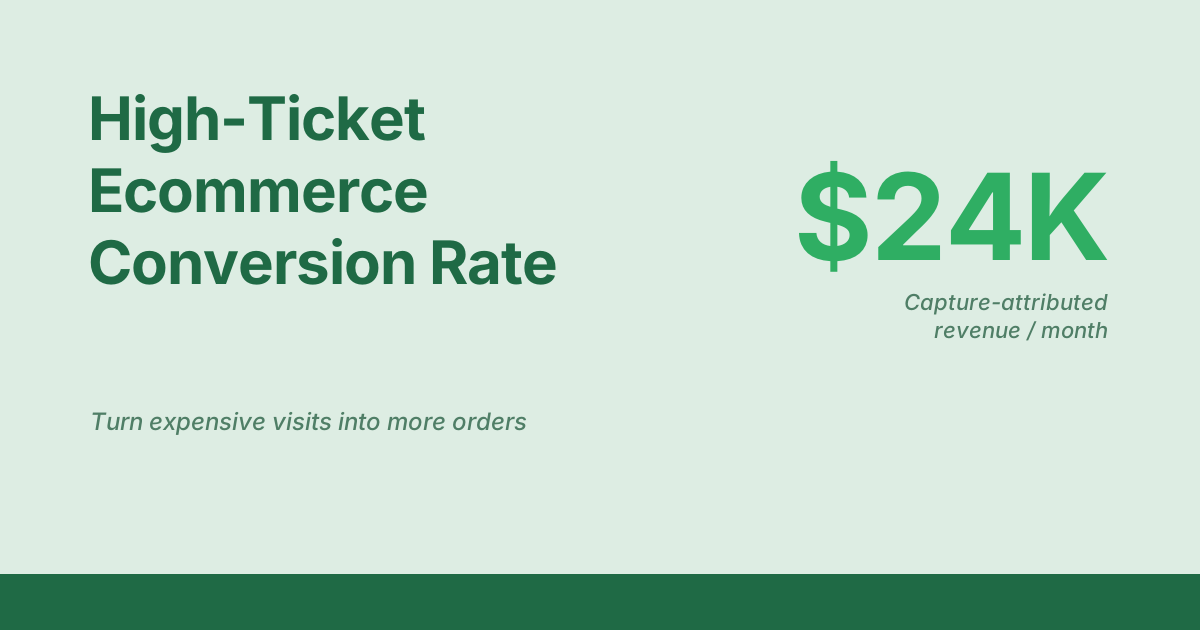
- In one measured month, Curtarra identified 1,000 additional visitors and generated $24,000 in Capture-attributed revenue, according to Attribuly customer case data.
Which industries count as high-ticket ecommerce?
There is no universal dollar threshold. “High ticket” means the purchase is expensive enough for the target buyer to slow down, compare options, and perceive meaningful risk.
| Industry | Examples | Why the decision takes longer |
|---|---|---|
| Furniture and window treatments | Sofas, mattresses, custom curtains, shades | Fit, fabric, color, measurements, delivery, installation |
| Home improvement | Saunas, HVAC, flooring, fixtures, outdoor structures | Technical requirements, installation, warranties |
| E-bikes and mobility | E-bikes, scooters, mobility equipment | Specifications, safety, service, local rules |
| Fitness equipment | Racks, treadmills, connected equipment | Space, delivery, assembly, subscription costs |
| Premium electronics | Computers, cameras, audio systems, projectors | Complex comparisons and rapid product changes |
| Jewelry and watches | Engagement rings, fine jewelry, luxury watches | Trust, authenticity, sizing, insurance and returns |
| Musical instruments | Pianos, guitars, studio equipment | Personal preference, expertise, shipping risk |
| Medical and wellness equipment | Hearing, recovery, monitoring and treatment devices | Claims, suitability, support, privacy, regulation |
| B2B and industrial products | Commercial equipment, tools, machinery | Multiple decision-makers, specifications, procurement |
Some products have a high price but a short decision cycle. Others have a modest price and still require research. Build the funnel around observed buyer behavior, not a fixed AOV label.
Why do interested high-ticket shoppers leave?
They are not ready yet
Baymard’s research finds that a large share of abandonment comes from people browsing or not ready to buy. For high-ticket products, consideration is part of the purchase—not necessarily a sign of weak intent.
The risk feels too high
The shopper may be uncertain about quality, fit, compatibility, authenticity, delivery damage, installation, warranty, service, or returns. One missing answer can stop a large purchase.
The final cost is unclear
Shipping, taxes, installation, accessories, subscriptions, or financing costs can change the decision. Show the realistic total early.
The comparison is difficult
Technical catalogs often make buyers open many tabs and build their own spreadsheet. If your site does not help them compare, another seller may.
The checkout creates new friction
Forced account creation, missing payment methods, slow delivery, or a long checkout can undo all the work that brought the shopper this far.
Why does a lost paid visit help your competitor?
A visitor who clicks an ad for a $2,000 product is not guaranteed to buy, but the click shows at least some category interest. If they leave because the decision is unresolved, the underlying need often remains.
They may return to Google, open a marketplace, ask a community, or click another brand’s ad. You paid to bring an active buyer into the category conversation. A competitor may close the sale.
This is why high-ticket teams should measure more than immediate session conversion. They need to understand return visits, assisted conversions, lead stages, recovered shoppers, and the full decision window.
What should a high-ticket product page include?
A clear decision summary
Explain who the product is for, the main outcome, the important tradeoffs, and what is included. Do not make buyers assemble the answer from marketing slogans.
Complete specifications and compatibility
Use dimensions, materials, performance ranges, compatibility, installation needs, care instructions, and downloadable documents. Explain technical terms in ordinary language.
Real proof
Use detailed reviews, customer photos, demonstrations, certifications, warranties, and service information. Proof should answer risk, not merely add social decoration.
Full delivery and return details
State realistic delivery timing, shipping cost, installation requirements, damage handling, return windows, restocking fees, and custom-order rules before checkout.
Ways to reduce commitment
Samples, swatches, consultations, virtual demos, measurement help, trial periods, and fit tools can move the shopper forward without demanding an immediate order.
Appropriate payment options
Installments or financing can help, but terms must be easy to understand. Surface interest, fees, payment schedule, and eligibility where the buyer makes the decision.
How should you re-engage high-ticket shoppers?
Use the shopper’s stage and behavior.
| Observed behavior | Likely question | Useful follow-up |
|---|---|---|
| Viewed one product once | “Is this relevant?” | Concise product education or no follow-up |
| Compared several models | “Which one fits me?” | Comparison guide or consultation |
| Revisited the same product | “Can I trust this decision?” | Proof, warranty, case example, expert help |
| Requested a sample | “Will it work in my space?” | Sample guidance and next step |
| Added to cart | “Is the total cost and timing acceptable?” | Shipping, delivery, returns, payment clarity |
| Began checkout | “Is anything blocking the transaction?” | Short recovery message tied to the exact product |
The aim is not to chase every visitor. It is to help qualified shoppers finish a decision they have already started.
Attribuly Capture can detect product views, add-to-cart, and extended browsing, then match eligible high-intent U.S. sessions through a consent-based identity network. Identified profiles can be synced to supported marketing destinations for appropriate activation and measured against resulting revenue.
Identity does not replace consent. Apply privacy notices, opt-out handling, suppression rules, frequency limits, and channel requirements before activation.
For the email-specific part of this workflow, use the high-AOV shopper recovery guide. Keep that flow downstream of the product-page and checkout fixes described here.
Customer example: Curtarra
Curtarra sells custom curtains and shades. Buyers need to consider fabric, color, measurements, style, light control, room fit, and final cost. A same-session impulse purchase is not the natural model.
In one measured month, Curtarra:
- identified 1,000 additional visitors; and
- generated $24,000 in revenue attributed to Capture.
These are Attribuly customer case figures for that measured month, not a universal conversion benchmark or guarantee. The result shows why a smaller number of qualified high-ticket visitors can matter: each completed purchase carries meaningful revenue.
A practical conversion plan
Step 1: Segment by product and source
Do not rely on one sitewide conversion rate. Compare product categories, device, new versus returning users, traffic source, geography, and purchase window.
Step 2: Diagnose uncertainty
Use onsite search, support questions, reviews, lost-sale surveys, heatmaps, and recordings. List the questions that appear before purchase.
Step 3: Fix the page and checkout
Prioritize cost transparency, proof, specifications, delivery, returns, payment options, guest checkout, and technical reliability.
Step 4: Add decision support
Create comparison tools, samples, consultations, quizzes, measurement help, or saved configurations according to the category.
Step 5: Recover qualified non-buyers
Set thresholds for product depth, repeat visits, cart, or checkout behavior. Send only the information relevant to that stage.
Step 6: Measure over the real buying window
Track first visit, return visits, assisted touchpoints, order value, gross margin, refund rate, and time to purchase. Use holdouts where feasible to test incrementality.
Common mistakes
- Expecting an expensive product to convert like an impulse purchase. Use a longer decision window.
- Hiding costs until checkout. Surprise costs create avoidable abandonment.
- Replacing useful detail with luxury language. Buyers need answers, not adjectives.
- Discounting before resolving uncertainty. A coupon does not fix fit, trust, or compatibility.
- Sending one generic recovery message. Match follow-up to the product and decision stage.
- Optimizing for identified visitors instead of profitable orders. Include margin, refunds, support cost, and incremental lift.
Conclusion
High-ticket shoppers do not need more pressure. They need less uncertainty.
Give them the information and support required to make a confident decision. When a qualified visitor still leaves, continue that decision across visits instead of assuming the opportunity is gone. That protects the advertising investment you already made and gives the shopper fewer reasons to finish the purchase with a competitor.
Recommended schema
ArticleFAQPageBreadcrumbList
FAQs
What is a good conversion rate for high-ticket ecommerce?
Why do high-ticket products have longer buying cycles?
Should high-ticket brands offer discounts?
Which industries benefit most from samples or consultations?
Should every product viewer enter a recovery flow?
Does visitor identification replace onsite email capture?
How long should a high-ticket attribution window be?
Sources
About Attribuly
Attribuly helps DTC brands recover abandoned cart revenue. We identify anonymous visitors and existing subscribers your ESP (like Klaviyo) missed, enrich their profiles, and feed the signals back — so your abandonment flows fire and your retargeting audiences grow, and you recover at least 15% more revenue. Shopify featured app, Klaviyo tech partner. Trusted by 20,000+ brands. Guaranteed 4× ROI.