
Attribuly vs Opensend (2026): Which Shopify Visitor Identification & Revenue Recovery Solution Fits Your Growth Stack?
Compare Attribuly vs Opensend for Shopify visitor identification. Discover key differences in server-side tracking, email recovery, ad attribution, and ROI.
Related articles
TL;DR
- Evaluation Dimension
- To understand how each platform fits into your Shopify store, it helps to examine how they handle user identification.
- Opensend operates a proprietary US consumer identity graph containing over 180 million email records collected across a network of digital publishers and e-commerce partners.
- Attribuly handles visitor identification through a dual first-party framework designed to preserve deliverability while capturing high-intent sessions:
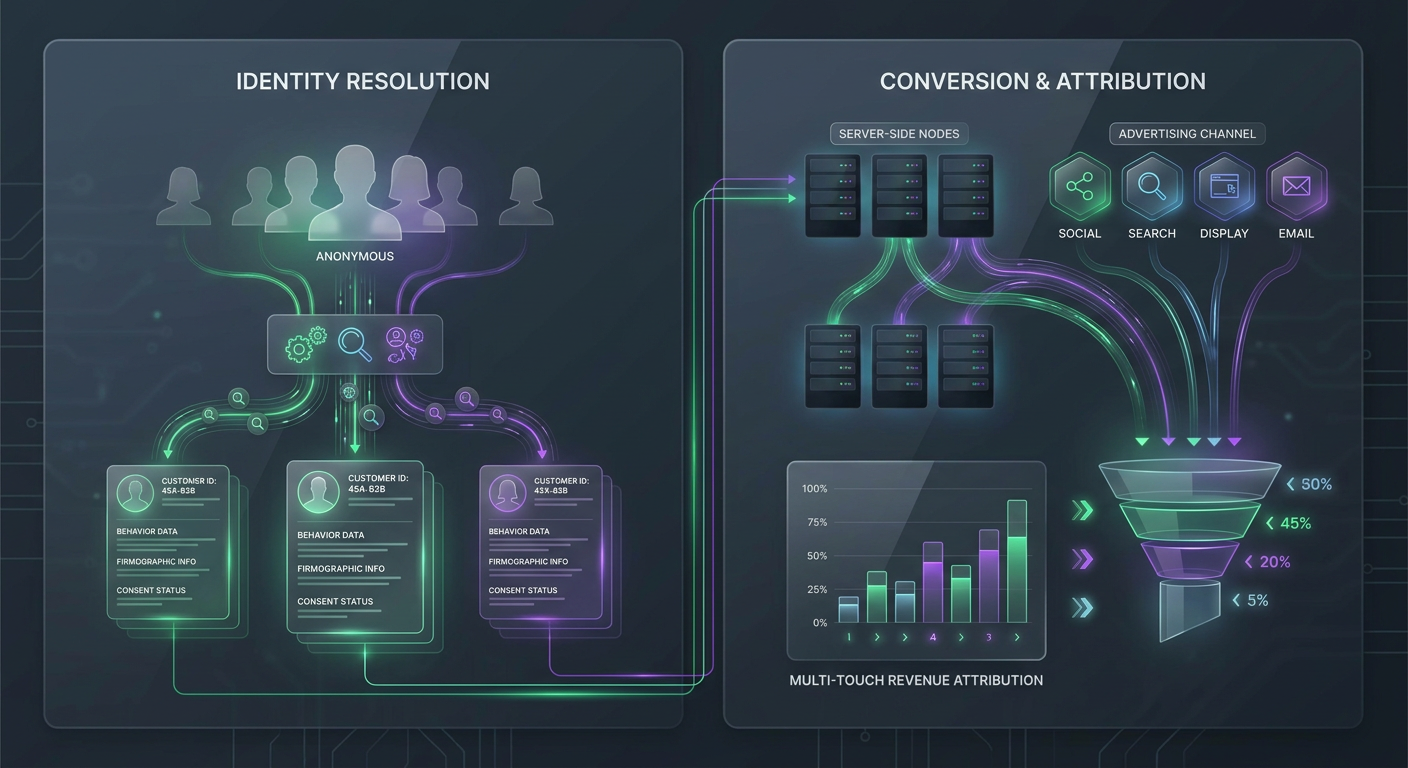
High-growth Shopify DTC brands operate in a challenging acquisition environment. With browser privacy updates, link tracking protection, and cookie decay causing site bounce rates to hover around 90%, brands spend heavily on Meta, Google, and TikTok ads only to lose track of high-intent shoppers the moment they leave the store.
To counter signal loss, two distinct categories of visitor identification software have emerged: pure top-of-funnel identity resolution feeds and comprehensive revenue recovery engines.
When evaluating Attribuly vs Opensend, merchants are comparing two different growth strategies:
Opensend focuses primarily on passive top-of-funnel identity resolution, tapping into a large proprietary US consumer identity graph to capture anonymous visitor emails and sync them to email marketing platforms, SMS channels, or direct mail networks.
Attribuly offers an end-to-end recovery, server-side tracking, and multi-touch attribution stack. It de-anonymizes traffic, re-identifies existing subscribers browsing anonymously, enriches ad platform learning via native Server-Side Conversion APIs (CAPI), automates recovery through AI email agents, and proves overall ROAS using multi-touch attribution.
This comparative guide analyzes how Attribuly and Opensend stack up across identification technology, deliverability safeguards, server-side tracking, multi-touch attribution, and total cost of ownership.
Attribuly vs Opensend: Quick Summary Matrix
Evaluation Dimension | Attribuly (Capture + ReCapture) | Opensend (Connect + Suite) |
|---|---|---|
Core Architecture | End-to-end recovery, server-side tracking, AI email, and multi-touch ROAS stack | Standalone passive US visitor identity resolution and list expansion feed |
Identification Engine | Dual Engine: Capture (net-new visitors) + ReCapture (existing subscribers) | Consumer Graph: Proprietary 180M+ US consumer identity graph |
Server-Side Tracking (CAPI) | Native Built-In: CAPI for Meta, Google, and TikTok with event deduplication | None: Relies on third-party tag managers or standard client-side browser pixels |
Multi-Touch Attribution (MTA) | Native Built-In: First-Touch, Last-Touch, Linear, and Position-Based models | None: Requires external attribution platforms or single-channel proxy reports |
AI Email Recovery | Native Built-In: Automated personalized email recovery execution | External Reliance: Syncs leads into external ESPs for manual flow creation |
Multichannel Outbound | Syncs to Klaviyo, Meta Ads, Google Ads, and TikTok Ads | Syncs to Klaviyo, Sendlane, Attentive, Meta, and Postal Direct Mail |
Deliverability Risk Level | Low: Prioritizes first-party subscriber re-engagement and intent filtering | Moderate-to-High: Syncs third-party matched contacts that require inbox warm-up |
Pricing Structure | ROI-Aligned: GMV-based pricing with performance guarantees (min 4:1 ROI) | Flat Subscription: Fixed monthly fee starting at $400–$500/mo (billed annually) |
Architectural Deep Dive: Dual-Engine Recovery vs. Consumer Identity Graph
To understand how each platform fits into your Shopify store, it helps to examine how they handle user identification.
                              [Shopify Store Anonymous Traffic]
                                              |
                     +------------------------+------------------------+
                     |                                                 |
         [Attribuly Dual Engine]                           [Opensend Identity Graph]
                     |                                                 |
         +-----------+-----------+                         +-----------+-----------+
         |                       |                         |                       |
  (Capture Engine)      (ReCapture Engine)           (Consumer Co-Op)      (3rd-Party Sync)
  Net-New Visitors     Existing Subscribers           180M+ US Emails         External ESPs /
  Intent Filtering     Behavioral Enrichment          Passive Matching         Direct Mail
Opensend: Third-Party Consumer Identity Resolution
Opensend operates a proprietary US consumer identity graph containing over 180 million email records collected across a network of digital publishers and e-commerce partners.
When an anonymous user visits your Shopify store, Opensend attempts to match the visitor's device fingerprint or IP network against its publisher database. If a match is identified, Opensend pushes the verified email contact into your ESP (such as Klaviyo or Sendlane) or direct mail distribution network.
Primary Strength: High raw match volume for US-based traffic (reporting match rates between 25% and 70% depending on traffic composition).
Primary Operational Focus: Maximizing top-of-funnel lead collection to scale direct marketing, direct mail postcards, and custom ad audiences.
Attribuly: First-Party Capture & Subscriber ReCapture
Attribuly handles visitor identification through a dual first-party framework designed to preserve deliverability while capturing high-intent sessions:
Capture: Identifies net-new anonymous visitors who demonstrate high purchasing intent (such as viewing multiple product pages or adding items to a cart) and syncs their profile data directly into core lifecycle flows.
ReCapture: Addresses a common issue in e-commerce lifecycle marketing—cookie decay among existing email subscribers. When a user who is already on your Klaviyo list visits your site from a new device, a private browser, or an ad click subject to iOS Link Tracking Protection, standard browser pixels treat them as a new, anonymous user. ReCapture recognizes their behavioral signals and reconnects the browsing session back to their existing profile.
By re-identifying known subscribers browsing anonymously, merchants can trigger high-converting cart abandonment and browse abandonment emails without adding unconsented third-party contacts to their database.
For a deeper look into implementing these mechanisms, review this Shopify visitor identification guide.
Server-Side Tracking & Multi-Touch Attribution: The Conversion Gap
Capturing visitor identities is only part of the equation. To build a scalable acquisition strategy, e-commerce brands need to understand how identified visitors interact with paid ad channels and contribute to bottom-line revenue.
  [Paid Ad Click] ──> [Site Session] ──> [Visitor Identified] ──> [Server-Side CAPI] ──> [Multi-Touch ROAS]
  (Meta/Google)       (Anonymous)        (Capture/ReCapture)      (Signal Recovery)     (Attribution Dashboard)
The Attribution Blind Spot in Standalone Identity Feeds
Standalone identity resolution tools like Opensend act as data feeds. They capture contacts and transfer them to an ESP or SMS platform. However, they do not collect server-side conversion signals or provide multi-touch attribution dashboards.
When measuring revenue from identified visitors using single-channel ESP reporting, attribution metrics can easily become inflated. If a user clicks a Meta ad, gets identified by a tracking script, and purchases 10 minutes later, single-channel reporting might attribute 100% of that sale to an automated abandonment email—masking the true return on ad spend (ROAS) of the originating Meta campaign.
Attribuly: Native Server-Side Conversion API (CAPI) & Multi-Touch Attribution
Attribuly combines visitor identification with server-side event tracking and multi-touch attribution in a single platform.
1. Server-Side Conversion API (CAPI) Integration
Browser-based tracking pixels regularly miss purchase events due to ad blockers, network dropouts, and strict browser privacy settings. Attribuly provides direct, native server-side CAPI integrations for Meta, Google, and TikTok.
When a visitor is de-anonymized, Attribuly enriches event payloads with hashed customer parameters and passes them directly to ad network APIs with automated event_id deduplication. This restores lost signal quality, improves Event Match Quality (EMQ) scores, and helps ad network algorithms optimize targeting.
2. Built-in Multi-Touch Attribution (MTA)
Attribuly includes native multi-touch attribution models (including First-Click, Last-Click, Linear, and Position-Based attribution). Growth managers can track customer journeys across paid social, paid search, organic channels, and email recovery flows to confirm which ad campaigns actually drive incremental sales.
Deliverability, Data Quality, and 2026 Sender Requirements
Major mailbox providers (including Google, Yahoo, and major ESPs like Klaviyo) enforce strict sender compliance rules. High bounce rates, elevated spam complaints, or sudden spikes in unengaged contacts can harm domain sender reputation and cause core marketing emails to land in spam folders.
Opensend Deliverability Considerations
Because Opensend feeds passive third-party identity graph contacts into your ESP, brands must manage these contacts carefully:
Verification Requirements: Third-party matched emails should pass through strict verification filters to remove invalid addresses, disposable inboxes, or potential spam traps.
Dedicated Flow Warm-Up: Sending aggressive cart abandonment sequences to third-party matched contacts who did not explicitly opt into your brand's form can lead to unsubscribe rates that are up to 2.7x higher than native opt-ins.
Operational Risk: Brands using Opensend need an established lifecycle marketing workflow to segment third-party matched leads into low-velocity warm-up flows before adding them to primary campaigns.
Attribuly Deliverability Safeguards
Attribuly structures identification around intent and consent signals:
1st-Party ReCapture Protection: ReCapture focuses heavily on re-engaging users who have already opted into your email communications. Re-engaging an existing subscriber browsing anonymously carries minimal deliverability risk because the user has a prior relationship with your domain.
Intent-Based Filtering: Capture filters out low-intent single-page bounces, ensuring that only engaged traffic triggers automated email recovery sequences.
For merchants exploring structural options to protect inbox placement, evaluating Opensend alternatives for e-commerce can provide additional technical context on deliverability frameworks.
Feature Comparison: AI Email Recovery vs. Multichannel Activation
  Attribuly Workflow:  [Identify Visitor] ──> [AI Email Recovery Agent] ──> [Native CAPI Feed] ──> [MTA Proof]

  Opensend Workflow:   [Identify Visitor] ──> [Export to External ESP]  ──> [External SMS / Direct Mail]
AI Automated Email Recovery (Attribuly)
Attribuly includes a built-in AI Email Agent that builds and executes automated, personalized recovery emails directly within the platform. Rather than building complex logic branches inside an external ESP, the AI agent uses real-time product browsing signals to generate contextual messaging, while syncing event triggers back to Klaviyo.
Multichannel Activation & Direct Mail (Opensend)
Opensend offers direct export capabilities for offline and multi-channel marketing campaigns. Through integrations with platforms like Postal, Opensend enables merchants to match anonymous site visitors to physical postal addresses, allowing brands to send automated direct mail postcards to high-value anonymous site traffic.
Pricing Models & Total Cost of Ownership (TCO)
Evaluating the financial commitment required for visitor identification involves comparing fixed operational software fees against revenue-aligned pricing structures.
Opensend Pricing Breakdown
Opensend uses a tiered subscription model based on captured contact volume, typically billed on an annual contract:
Starter Tier: ~$400/month (annual contract) or $500/month (month-to-month) for up to 2,000 captured identities ($0.25 per additional identity).
Growth Tier: ~$1,000/month for up to 4,300 captured identities ($0.23 per additional identity).
Scale Tier: ~$2,000/month for up to 9,500 captured identities ($0.21 per additional identity).
Note: Baseline subscription fees do not include secondary ESP pricing adjustments. Pushing thousands of cold contacts into Klaviyo can trigger higher monthly ESP subscription tiers.
Attribuly Pricing Breakdown
Attribuly uses an ROI-aligned, GMV-based pricing structure designed to minimize financial risk for growing e-commerce brands:
Free Tier: Available for entry-level attribution tracking and basic integration.
Scalable Growth Tiers: Structured around generated revenue and store GMV rather than charging fixed per-contact fees.
Performance Guarantee: Backed by a minimum 4:1 ROI performance guarantee, ensuring that measured recovery revenue directly covers platform costs.
To review official tier parameters and ROI calculator models, visit the official comparison page.
Merchant Decision Framework: Best for Who?
                                  [Which Platform Fits Your Needs?]
                                                 |
                   +-----------------------------+-----------------------------+
                   |                                                           |
  [Need Full Recovery Stack + Ad ROAS Proof?]                [Need Raw US Email List Expansion?]
                   |                                                           |
          (Select: ATTRIBULY)                                         (Select: OPENSEND)
  • First-Party Capture + Subscriber ReCapture                • Proprietary 180M+ US Identity Graph
  • Server-Side CAPI (Meta, Google, TikTok)                   • Multi-channel export (Direct Mail, SMS)
  • Multi-Touch Attribution (MTA Dashboard)                   • Fixed $400-$500/mo entry point
  • ROI-Aligned GMV Pricing (Min 4:1 ROI)                     • Requires dedicated inbox warm-up
Choose Attribuly If:
You want an end-to-end stack combining visitor identification, server-side tracking (CAPI), AI email flows, and multi-touch ROAS attribution.
You want to re-engage existing email subscribers (via ReCapture) who browse anonymously without risking domain spam complaints.
You run paid ads across Meta, Google, or TikTok and need accurate server-side conversion feeds to restore lost signal data.
You prefer a risk-free, ROI-aligned pricing model with guaranteed performance offsets.
Choose Opensend If:
Your main priority is expanding raw top-of-funnel US email lists to feed external marketing systems.
You have an established lifecycle marketing team capable of managing third-party warm-up flows and deliverability protocols.
You want to send automated direct mail postcards (via Postal) to de-anonymized site visitors.
You prefer a fixed monthly baseline fee structure and have the budget for $400+/month software contracts.
Does Opensend support server-side tracking (CAPI) or multi-touch attribution?
No. Opensend operates primarily as an identity capture feed. It does not provide native server-side Conversion APIs (CAPI) for ad networks like Meta or Google, nor does it include multi-touch attribution dashboards to track multi-channel ad ROAS.
Final Thoughts
Choosing between Attribuly and Opensend comes down to whether your Shopify store needs a standalone identity resolution feed or a complete recovery and attribution stack.
If your goal is to maximize raw top-of-funnel US consumer email leads for offline activation and direct mail, Opensend offers a large third-party match network. However, if you want to de-anonymize high-intent traffic, protect your email deliverability, restore lost ad signals with server-side tracking, and prove true channel ROAS in one unified dashboard, Attribuly provides the ideal foundation for sustainable e-commerce growth.
Explore how Attribuly can help you capture lost revenue, optimize ad spend, and scale your Shopify store today.
| Evaluation Dimension | Attribuly (Capture + ReCapture) | Opensend (Connect + Suite) |
|---|---|---|
| Core Architecture | End-to-end recovery, server-side tracking, AI email, and multi-touch ROAS stack | Standalone passive US visitor identity resolution and list expansion feed |
| Identification Engine | Dual Engine : Capture (net-new visitors) + ReCapture (existing subscribers) | Consumer Graph : Proprietary 180M+ US consumer identity graph |
| Server-Side Tracking (CAPI) | Native Built-In : CAPI for Meta, Google, and TikTok with event deduplication | None : Relies on third-party tag managers or standard client-side browser pixels |
| Multi-Touch Attribution (MTA) | Native Built-In : First-Touch, Last-Touch, Linear, and Position-Based models | None : Requires external attribution platforms or single-channel proxy reports |
| AI Email Recovery | Native Built-In : Automated personalized email recovery execution | External Reliance : Syncs leads into external ESPs for manual flow creation |
| Multichannel Outbound | Syncs to Klaviyo, Meta Ads, Google Ads, and TikTok Ads | Syncs to Klaviyo, Sendlane, Attentive, Meta, and Postal Direct Mail |
| Deliverability Risk Level | Low : Prioritizes first-party subscriber re-engagement and intent filtering | Moderate-to-High : Syncs third-party matched contacts that require inbox warm-up |
| Pricing Structure | ROI-Aligned : GMV-based pricing with performance guarantees (min 4:1 ROI) | Flat Subscription : Fixed monthly fee starting at $400–$500/mo (billed annually) |
About Attribuly
Attribuly helps DTC brands recover abandoned cart revenue. We identify anonymous visitors and existing subscribers your ESP (like Klaviyo) missed, enrich their profiles, and feed the signals back — so your abandonment flows fire and your retargeting audiences grow, and you recover at least 15% more revenue. Shopify featured app, Klaviyo tech partner. Trusted by 20,000+ brands. Guaranteed 4× ROI.