
First-party Data for Shopify: The Ultimate Guide to Modern E-Commerce Tracking and Activation
Master first-party data for Shopify. Learn how to implement hybrid server-side tracking, Web Pixels API, Meta CAPI, and multi-touch attribution to scale ROAS.
Related articles
TL;DR
- Capturing high-intent customer signals requires working within Shopify’s updated technical ecosystem.
- In previous years, app developers and internal marketing teams pasted tracking scripts directly into the theme.liquid header or the "Additional Scripts" box in the checkout settings.
- To execute custom tracking scripts safely, Shopify introduced the Web Pixels API .
- Relying exclusively on either client-side pixels or backend webhooks creates blind spots.
The landscape of digital acquisition for e-commerce brands has undergone a seismic shift. For years, direct-to-consumer (DTC) merchants on Shopify relied heavily on third-party cookies and client-side browser scripts to power ad targeting, measure conversion return on ad spend (ROAS), and trigger automated email sequences. Today, that legacy architecture is no longer viable.
Browser security enhancements such as Apple’s Safari Intelligent Tracking Prevention (ITP) now cap client-side cookie durations to 24 hours when tracking query parameters like fbclid or gclid are present. Simultaneously, privacy frameworks and ad-blockers routinely prevent standard JavaScript tags from firing altogether. As a result, e-commerce brands relying solely on browser-based client tracking lose between 30% and 40% of their conversion signals.
To rebuild data precision, scale ad performance, and reduce customer acquisition costs (CAC), online retailers must transition to a modern infrastructure centered on first-party data for Shopify. This comprehensive guide breaks down the architectural standards, privacy compliance frameworks, hybrid server-side setups, and downstream activation strategies required to master first-party data in 2026.
1. Modern Shopify Architecture: Checkout Extensibility & Web Pixels API
Capturing high-intent customer signals requires working within Shopify’s updated technical ecosystem. Shopify has sunset legacy theme script injections and checkout.liquid customizations in favor of modular, isolated environments designed for speed and security.
The Shift to Isolated Browser Sandboxes
In previous years, app developers and internal marketing teams pasted tracking scripts directly into the theme.liquid header or the "Additional Scripts" box in the checkout settings. While simple, this approach created significant security risks and degraded storefront loading speeds.
Under modern standards, all browser-based tracking runs through Shopify’s Checkout Extensibility and the Customer Events API. Rather than accessing the Document Object Model (DOM) directly, tracking tools subscribe to standardized storefront events (such as product_viewed, cart_updated, checkout_started, and payment_info_submitted).
How the Web Pixels API Operates
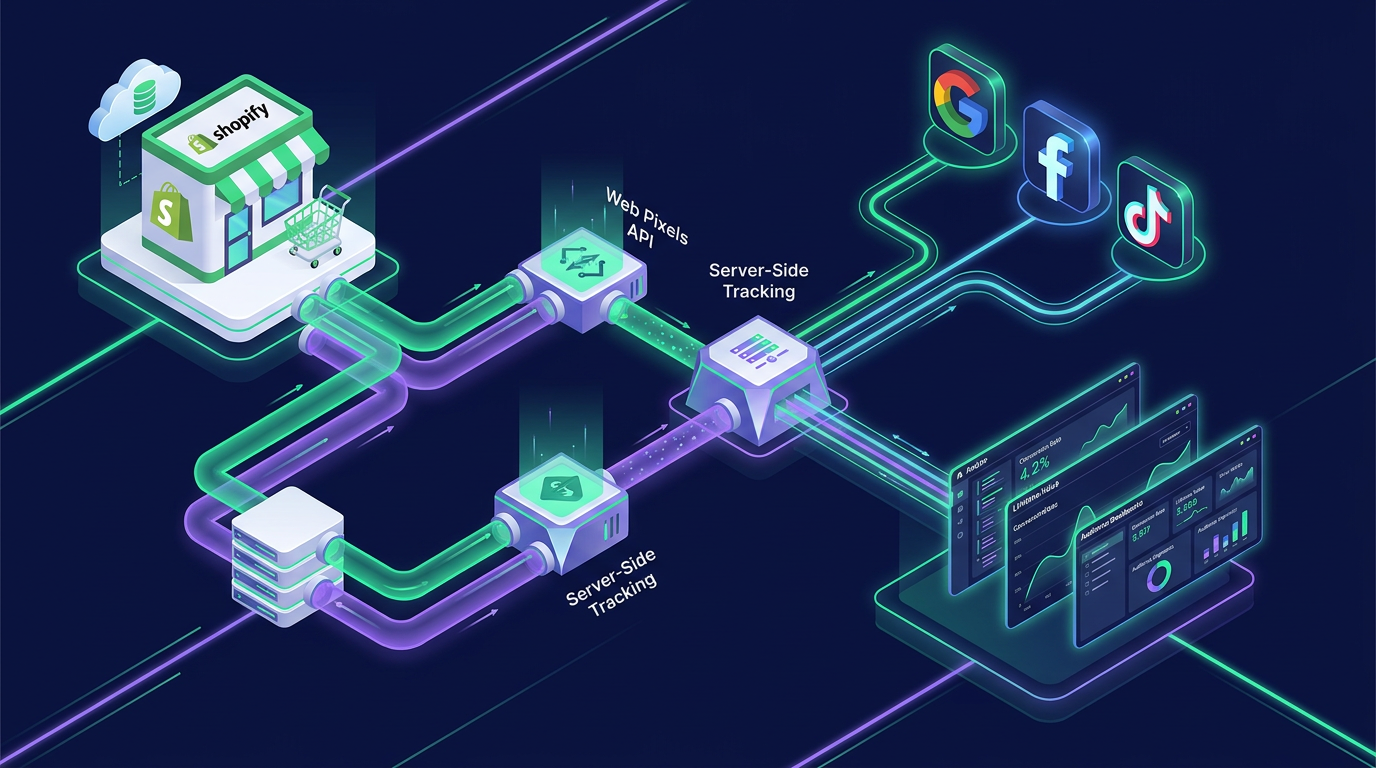
To execute custom tracking scripts safely, Shopify introduced the Web Pixels API. Web pixels run inside isolated web worker sandboxes. They listen to customer event subscriptions and forward event payloads to external collection endpoints without interfering with the user interface or slowing down page rendering.
While sandboxed pixels prevent script crashing and secure customer payment data, browser sandbox environments remain vulnerable to network dropouts, strict ad-blocking extensions, and browser privacy limits. Consequently, browser pixel data must be augmented with a server-side foundation.
2. Designing a High-Precision Hybrid Tracking Pipeline
Relying exclusively on either client-side pixels or backend webhooks creates blind spots. A browser pixel can capture rich client context (such as screen resolution, page location, and initial cookie states), but it can be blocked by ad-blockers. Conversely, server webhooks guarantee delivery for backend state changes (like order creation), but they lack immediate browser cookie context.
The industry benchmark for 2026 is a Hybrid Tracking Pipeline. This setup fires events simultaneously from the user's browser via the Web Pixels API and directly from Shopify's backend servers, routing both streams through a unified first-party server container before sending clean data to downstream channels.
[ Shopify Storefront / Sandboxed Checkout ]
       │                                 │
       ▼ (Browser Sandbox)               ▼ (Server Webhook)
[ Web Pixels API ]             [ orders/create Event ]
       │                                 │
       └──────────────► ┌────────────────┤
                        │ First-Party    │
                        │ Server Routing │
                        └────────┬───────┘
                                 │
     ┌───────────────────────────┼───────────────────────────┐
     ▼                           ▼                           ▼
[ Meta CAPI / Google EC ]   [ GA4 Protocol ]          [ Klaviyo Activation ]
Event Deduplication with Canonical Keys
When an ad network receives identical conversion signals from both a browser pixel and a server API call, it will double-count sales unless explicit deduplication mechanics are in place.
To prevent double-counting, every paired event must carry an identical event_id. For purchase events, the canonical key should always be the primary Shopify order_id or checkout_token.
Browser Dispatch: When a customer reaches the thank-you page, the Web Pixel generates an
event_id(e.g.,ORD_98231) and fires the client-side conversion call to Meta and Google.Server Dispatch: Simultaneously, Shopify's backend triggers an
orders/createwebhook. The server routing engine formats the payload using the exact sameevent_id(ORD_98231) and transmits it via Meta Conversions API (CAPI) or Google Enhanced Conversions.Ad Network Deduplication: The advertising platform matches the incoming browser and server records using the shared
event_idalong with browser tokens (_fbpand_fbc). It merges them into a single deduplicated order while incorporating the reliability of the server stream.
For detailed steps on configuring backend pipelines, refer to our comprehensive guide on How to Set Up Shopify Server-Side Tracking.
Extending Cookie Lifespans via First-Party Subdomains
When tracking cookies are set by third-party scripts, Safari ITP restricts their duration to 7 days, or down to 24 hours for traffic containing URL ad-click parameters. To maintain persistent customer identity across longer consideration windows, merchants configure a First-Party DNS Subdomain (e.g., data.yourstore.com) pointing directly to their server container.
By routing server tracking through a custom DNS CNAME record, response headers set cookies directly at the parent domain level using Set-Cookie headers with SameSite=Lax and Secure attributes. Browsers treat these as true first-party contextual storage, preserving visitor attribution history across multi-week buying journeys.
3. Signal Matching, Hashing, and Privacy Compliance
Collecting first-party signals is only half the battle; ad platforms require accurate identifier matching to connect conversion events back to real platform user accounts.
Maximizing Event Match Quality (EMQ)
Ad networks assess incoming signal strength using an Event Match Quality (EMQ) score. Higher EMQ scores directly improve ad delivery algorithms, lower cost-per-acquisition (CPA), and enhance audience retargeting efficiency.
To maximize EMQ, server payloads must normalize and hash customer identifiers using the SHA-256 cryptographic standard before transmission.
Email (
em): Strip all leading and trailing whitespace, convert all characters to lowercase, and format as a SHA-256 hash string.Phone Number (
ph): Remove all non-numeric characters, prepend the country code according to the E.164 standard (e.g.,+1for North America), and apply SHA-256 hashing.First & Last Name (
fn/ln): Lowercase and hash.Location Context (
ct,st,zp,country): Normalize city names, state codes, and postal codes into standard ISO formats prior to hashing.Browser Indicators (
fbp,fbc,client_ip_address,user_agent): Transmit raw first-party cookie identifiers, user IP addresses, and user-agent strings captured at request time.
Dynamic Privacy Compliance Architecture
First-party data infrastructure must respect regional customer consent choices, such as those under the General Data Protection Regulation (GDPR) and the California Consumer Privacy Act (CCPA/CPRA).
Modern server setups handle dynamic consent through a two-step verification flow:
Consent Listening: The Web Pixel queries the
window.Shopify.customerPrivacyAPI state on every page view to capture user choices.State Forwarding & Server Enforcement: Consent states (e.g.,
analytics_approved: true,marketing_approved: false) are appended to the outgoing event payload. The server container evaluates these flags prior to dispatching data to advertising destinations, natively honoring compliance protocols such as Google Consent Mode v2.
To learn more about structuring first-party data capture across your store, see our Shopify First-Party Data Collection: Complete Guide.
4. Architectural Trade-Offs: Native SaaS vs. Self-Hosted sGTM vs. Custom Engines
When implementing a hybrid first-party data infrastructure, e-commerce engineering and growth teams typically evaluate three core deployment paths: Turnkey Native SaaS Applications, Self-Hosted Server-Side Google Tag Manager (sGTM), or Custom In-House Webhook Engines.
Evaluation Metric | Native SaaS Platform (e.g., Attribuly) | Self-Hosted sGTM (GCP / Stape) | Custom In-House Engine |
|---|---|---|---|
Setup & Engineering Effort | Very Low (No-code Shopify app installation) | High (Requires custom GTM containers & cloud routing) | Extremely High (Requires ongoing developer resources) |
Maintenance Burden | Automated and managed by platform engineers | High (Requires container updates & cloud monitoring) | High (Requires continuous maintenance as APIs update) |
Deduplication Precision | Built-in | Manual configuration via custom tags and headers | Requires custom backend programming |
EMQ Optimization | Automated SHA-256 normalization pipelines | Manual JavaScript transformation setup | Custom cryptographic pipeline design |
Cost Structure | Predictable, flat SaaS subscription | Variable cloud infrastructure & hosting fees | High initial and ongoing engineering costs |
While self-hosted sGTM offers maximum control for enterprise engineering teams, many scaling Shopify brands prefer purpose-built platforms. For example, Attribuly provides native server-side tracking, automated event_id deduplication, and pre-configured EMQ parameter hashing without requiring cloud server management or custom developer code.
5. Omnichannel Activation: Converting First-Party Data into Revenue
Building a clean first-party data infrastructure provides the foundation for advanced audience activation across retention channels and paid acquisition platforms.
De-Anonymizing Shoppers for Retention Expansion
A primary bottleneck in email and SMS marketing is shopper anonymity. Standard client-side integration tags often fail to identify returning visitors who haven't logged in, missing opportunities to trigger automated recovery sequences.
By capturing persistent first-party identifiers at early touchpoints (such as email signup forms, quiz completions, and cart steps) and syncing them via server-to-server endpoints:
Identity Resolution: Anonymous store visitors are de-anonymized as soon as they interact with forms or checkout fields, binding their session back to a persistent first-party customer profile.
Reliable Triggering: Automated retention flows in platforms like Klaviyo—such as Browse Abandonment, Added to Cart, and Abandoned Checkout—trigger reliably even when browsers restrict third-party tracking scripts.
Multi-Touch Attribution (MTA) & Channel Optimization
As customer buying journeys stretch across multiple devices, ads, and touchpoints, single-touch attribution models (such as First-Click or Last-Click) give an incomplete view of performance.
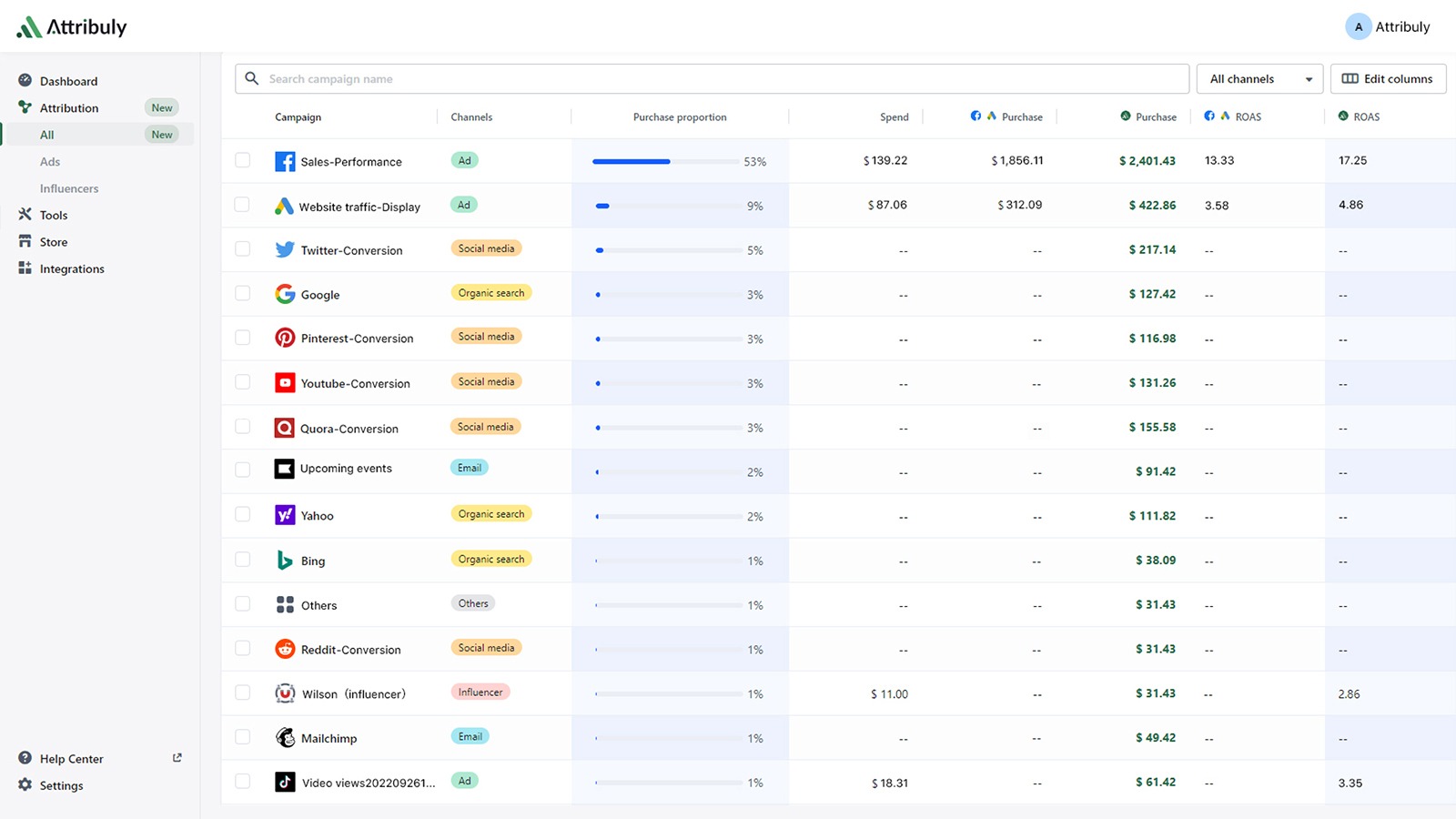
First-Click Models: Credit 100% of conversion value to the top-of-funnel discovery channel (e.g., a TikTok prospecting ad), ignoring downstream search and retention touchpoints.
Last-Click Models: Credit 100% of conversion value to the final touchpoint (e.g., a branded Google Search ad or retargeting email), undervaluing discovery channels.
Linear & Multi-Touch Models: Distribute credit across all verified touchpoints in the customer journey based on their actual contribution.
By consolidating client and server events into an advanced attribution engine, growth teams gain clear visibility into cross-channel performance, allowing them to eliminate wasted ad spend and scale winning campaigns with confidence.
To explore how dedicated attribution software models channel impact, refer to our comprehensive Shopify Attribution Software Guide and the Customer Journey Retargeting Guide for Shopify.
Conclusion: Building Your 2026 Data Strategy
Transitioning to a first-party data architecture is no longer an optional optimization; it is a fundamental requirement for e-commerce growth. By adopting Shopify’s modern Checkout Extensibility, implementing a deduplicated hybrid tracking pipeline, and ensuring full privacy compliance, merchants can build a durable data foundation.
Brands that own their data pipeline reduce acquisition costs, increase Event Match Quality across ad channels, and unlock higher lifetime value through personalized customer experiences. Audit your current tracking setup today to ensure your store is prepared for the future of digital commerce.
| Evaluation Metric | Native SaaS Platform (e.g., Attribuly) | Self-Hosted sGTM (GCP / Stape) | Custom In-House Engine |
|---|---|---|---|
| Setup & Engineering Effort | Very Low (No-code Shopify app installation) | High (Requires custom GTM containers & cloud routing) | Extremely High (Requires ongoing developer resources) |
| Maintenance Burden | Automated and managed by platform engineers | High (Requires container updates & cloud monitoring) | High (Requires continuous maintenance as APIs update) |
| Deduplication Precision | Built-in event_id and payload matching | Manual configuration via custom tags and headers | Requires custom backend programming |
| EMQ Optimization | Automated SHA-256 normalization pipelines | Manual JavaScript transformation setup | Custom cryptographic pipeline design |
| Cost Structure | Predictable, flat SaaS subscription | Variable cloud infrastructure & hosting fees | High initial and ongoing engineering costs |
Sources and Related Reading
About Attribuly
Attribuly helps DTC brands recover abandoned cart revenue. We identify anonymous visitors and existing subscribers your ESP (like Klaviyo) missed, enrich their profiles, and feed the signals back — so your abandonment flows fire and your retargeting audiences grow, and you recover at least 15% more revenue. Shopify featured app, Klaviyo tech partner. Trusted by 20,000+ brands. Guaranteed 4× ROI.