
Identity Graph Explained: How It Unifies Customer Data for E-commerce Attribution
Learn how identity graphs unify cross-device data, solve the guest checkout problem, and fuel e-commerce multi-touch attribution and ad network performance.
Related articles
TL;DR
- Nodes represent individual fragments of identity collected throughout a shopper's interaction history.
- Edges represent verified or statistical connections linking two or more nodes together.
- Identity resolution platforms connect data nodes using two distinct computational engines: Deterministic Matching and Probabilistic Matching .
- Purely deterministic matching is exceptionally accurate, but it only accounts for moments when users explicitly identify themselves (such as logging in or checking out).
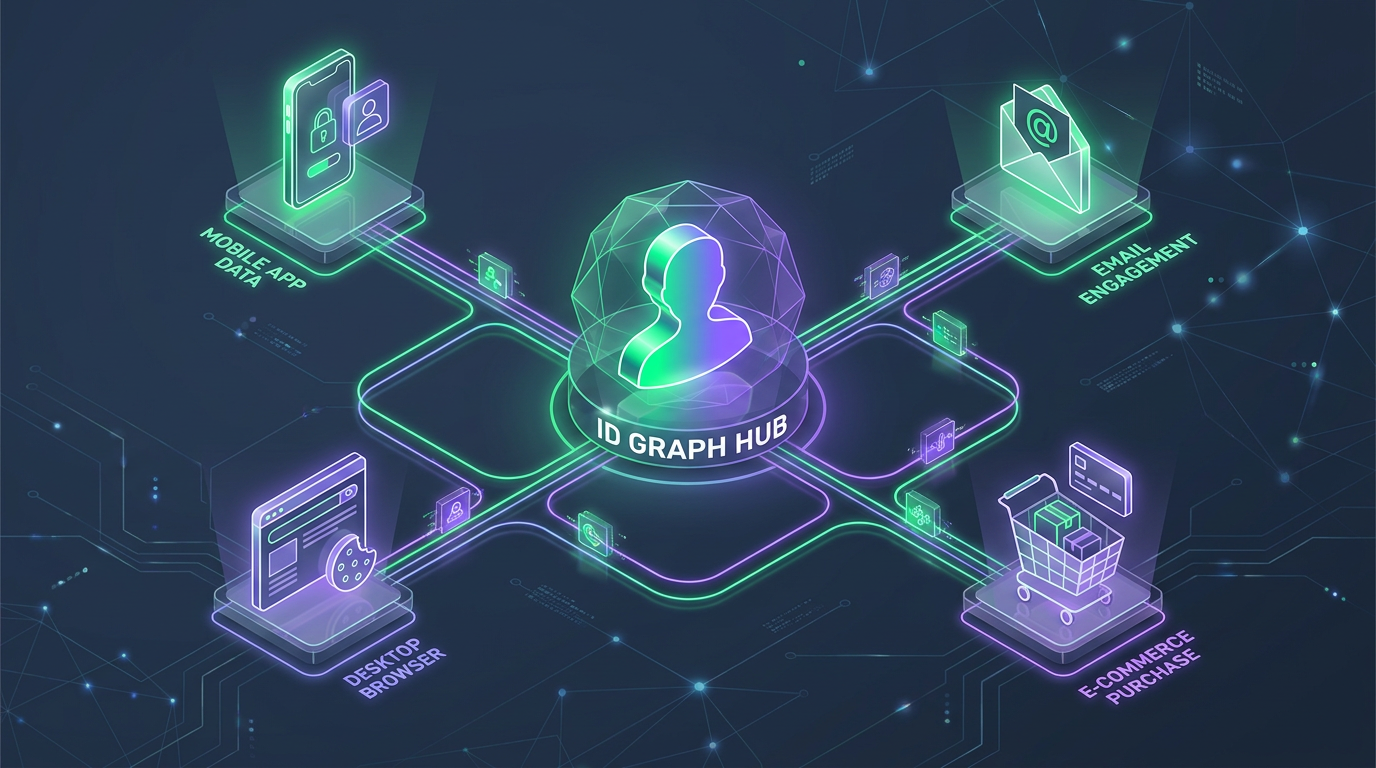
When a customer discovers your online store through a TikTok ad on their phone during lunch, browses product pages anonymously on a laptop later that evening, and finally completes a purchase three days later via a guest checkout flow, how does your analytics platform record that journey?
For most Direct-to-Consumer (DTC) brands, traditional tracking treats this single customer as three completely separate entities. The original ad click gets zero credit, the desktop visit appears as untracked direct traffic, and your marketing acquisition costs look higher than they actually are.
As browser privacy restrictions tighten, third-party cookies fade away, and multi-device shopping becomes standard, resolving identity across fragmented touchpoints has become a primary hurdle for performance marketing. This article provides a comprehensive Identity Graph explained guide, detailing how modern data structures unify customer touchpoints to power accurate multi-touch attribution (MTA) and maximize ad efficiency.
1. Nodes (The Identifiers)
Nodes represent individual fragments of identity collected throughout a shopper's interaction history. These fall into three primary categories:
Digital & Network Identifiers: First-party cookies (
_fbp,_fbc, persistent device tokens), Mobile Advertising IDs (IDFA, GAID), IP addresses, and User-Agent strings.Personally Identifiable Information (PII): SHA-256 cryptographic hashes of email addresses (
em), phone numbers (ph), first and last names, and shipping parameters.Account Keys: Internal CRM customer keys, e-commerce platform IDs (such as a Shopify Customer ID), and historical order numbers.
2. Edges (The Relationships)
Edges represent verified or statistical connections linking two or more nodes together. Edges carry essential metadata, including connection timestamps, confidence weight scores (ranging from 0.0 to 1.0), decay rules, and active privacy consent flags.
When an identity graph links multiple nodes through verified edges, it constructs a unified, persistent customer entity. According to data architecture standards detailed by CDP.com (2026), this persistent layer allows brands to stitch together historical touchpoints long after individual browser sessions expire.
Deterministic vs. Probabilistic Matching Engines
Identity resolution platforms connect data nodes using two distinct computational engines: Deterministic Matching and Probabilistic Matching. Most scalable enterprise architectures combine both into a hybrid identity spine.
Dimension | Deterministic Engine | Probabilistic Engine |
|---|---|---|
Matching Mechanism | Exact-match rules on verified unique keys | Machine learning algorithms & statistical confidence models |
Primary Inputs | User account logins, guest checkout PII, SHA-256 hashed emails, CRM IDs | IP address clusters, User-Agent strings, temporal behavior patterns |
Output Format | Binary match output (1.0 or 0.0) | Probability confidence score (e.g., 88% likelihood) |
Precision vs. Reach | High Precision (~99%+), limited to authenticated actions | High Reach, variable precision based on network overlap |
E-commerce Role | Post-checkout attribution, CRM sync, exact order matching | Top-of-funnel session stitching, cross-device ad click association |
The Hybrid Identity Spine
Purely deterministic matching is exceptionally accurate, but it only accounts for moments when users explicitly identify themselves (such as logging in or checking out). Conversely, purely probabilistic matching provides broad reach but risks false positives, such as merging profiles for two different family members sharing a home Wi-Fi network.
Modern identity resolution models deploy a deterministic spine backed by a probabilistic buffer. High-confidence deterministic links serve as permanent anchor points, while probabilistic heuristics link pre-authentication browsing behaviors to the unified profile.
Solving the E-commerce Guest Checkout Problem
A primary flaw in traditional analytics setups is their inability to handle guest checkouts. In DTC e-commerce, 60% to 70% of shoppers complete purchases without creating a store account.
Without an identity graph, a standard guest checkout breaks the attribution chain:
Session 1 (Paid Ad Click): A user clicks a Meta ad on mobile. The browser sets an anonymous cookie ID. The user adds an item to the cart but abandons the session.
Session 2 (Guest Checkout): Two days later, the same user opens a desktop browser directly, completes a guest purchase, and inputs their email address.
Standard web tools treat Session 1 as an abandoned visit and Session 2 as an unearned "Direct" conversion. This misallocation distorts performance metrics, artificially inflates customer acquisition costs (CAC), and hides channel effectiveness.
[ Anonymous Mobile Session ] ──► (Captured First-Party Cookie ID)
                                             │
                                  (Guest Checkout Event)
                                             │
[ Desktop Order + PII ] ──────► (Normalizes & Hashes SHA-256 Email)
                                             │
                                             ▼
                               (Identity Graph Retro-Stitch)
                                             │
                                             ▼
                      [ Full Multi-Touch Customer Journey Reconstructed ]
An identity resolution graph solves this issue through Session Retro-Stitching:
Pre-Purchase Signal Capture: As the shopper interacts with early touchpoints, server-side containers write persistent first-party identifiers and log click parameters like
fbclidorgclid.Real-Time PII Normalization: During guest checkout, as the customer fills out form fields, the system captures, normalizes (converting text to lowercase and stripping whitespace), and hashes the email address using SHA-256.
Graph Linking: The identity graph instantly creates an edge connecting the guest checkout SHA-256 email node with the first-party cookie token stored during the earlier anonymous mobile browsing session.
Journey Reconstruction: The attribution engine retroactively walks back through the linked nodes, reattributing the final purchase to the original paid ad touchpoint.
Supercharging Ad Signals: Meta CAPI and Google Enhanced Conversions
Identity graphs do more than just refine internal dashboard reports; they directly feed first-party signals back to ad platforms to improve bidding algorithms.
As privacy measures like Apple's App Tracking Transparency (ATT) restrict client-side pixel tracking, ad networks rely heavily on server-side event data.
Elevating Meta Event Match Quality (EMQ)
Meta's Conversions API (CAPI) assigns an Event Match Quality (EMQ) score from 1 to 10 based on the customer identifiers attached to server conversion events. Low EMQ scores (3–4) prevent Meta from matching web purchases back to active ad viewers.
By querying an identity graph at the moment of conversion, server containers can attach an enriched identity payload to the CAPI event:
SHA-256 Hashed Email (
em) and Phone Number (ph)Browser Cookie IDs (
_fbp,_fbc)Client IP Address and User-Agent parameters
External Customer & Session Identifiers
According to technical integration frameworks outlined by Upstack Data (2026), sending complete identity payloads can elevate EMQ scores to 8.5–9.5+, significantly improving ad attribution match rates and stabilizing ad delivery.
Optimizing Google Enhanced Conversions
Similarly, Google Enhanced Conversions uses hashed first-party customer data to match unobserved cross-device conversions. As detailed in Google Ads Help (2026), transmitting normalized, hashed customer data alongside conversion tags allows Google's Smart Bidding models to recover lost cross-device conversion signals and optimize ad delivery effectively.
Operationalizing Identity Resolution in Your E-commerce Stack
Implementing identity resolution requires connecting front-end data collection with backend customer data infrastructure.
In modern e-commerce technology stacks, first-party data solutions like Attribuly utilize server-side tracking to capture initial touchpoint signals (such as gclid, fbclid, or custom cookie keys) and store them in persistent session graphs.
When a guest checkout occurs, server-side attribution models link the purchase PII back to earlier anonymous browsing events. Building on robust Shopify first-party data strategies, this unified graph payload feeds clean data into multi-touch attribution reporting, allowing growth teams to track true return on ad spend (ROAS) across all sales channels.
Data Privacy, Consent, and Compliance Governance
Operating an identity graph requires strict adherence to global privacy laws, including the European General Data Protection Regulation (GDPR) and the California Consumer Privacy Act (CCPA). Because identity graphs centralize data across multiple points, compliance must be built directly into the graph logic.
1. Consent State Inheritance
Identifiers added to an identity graph must inherit explicit consent flags from integrated Consent Management Platforms (CMPs). If a visitor rejects advertising cookies, probabilistic edges designated for ad target syncs must be severed or restricted from downstream ad platform feeds.
2. Automated DSAR Executions
Under "Right to be Forgotten" provisions, when a user submits a Data Subject Access Request (DSAR), the identity graph engine must automatically cascade deletion requests across all linked nodes (such as cookie IDs, device tokens, and hashed emails) while preserving anonymized transactional records necessary for financial reporting.
3. Hashing Standards
Raw PII must never be stored in plaintext within analytics graphs or transmitted unencrypted. Email and phone identifiers should always be normalized and encrypted using standard SHA-256 hashing algorithms prior to database ingestion or external transmission.
Building an Attribution Foundation for Growth
Relying on fragmented cookie tracking and siloed ad-network reporting makes it difficult to scale ad spend efficiently.
An identity graph provides a durable foundation for e-commerce attribution by:
Unifying anonymous mobile and desktop sessions into single customer journeys.
Solving attribution gaps caused by guest checkouts.
Boosting ad platform match rates through server-side signals like Meta CAPI and Google Enhanced Conversions.
Maintaining full privacy and data governance compliance.
Understanding how identity graphs work allows e-commerce growth leaders to move past unreliable last-click metrics, eliminate wasted ad spend, and make confident data-driven scaling decisions.
| Dimension | Deterministic Engine | Probabilistic Engine |
|---|---|---|
| Matching Mechanism | Exact-match rules on verified unique keys | Machine learning algorithms & statistical confidence models |
| Primary Inputs | User account logins, guest checkout PII, SHA-256 hashed emails, CRM IDs | IP address clusters, User-Agent strings, temporal behavior patterns |
| Output Format | Binary match output (1.0 or 0.0) | Probability confidence score (e.g., 88% likelihood) |
| Precision vs. Reach | High Precision (~99%+) , limited to authenticated actions | High Reach , variable precision based on network overlap |
| E-commerce Role | Post-checkout attribution, CRM sync, exact order matching | Top-of-funnel session stitching, cross-device ad click association |
Sources and Related Reading
About Attribuly
Attribuly helps DTC brands recover abandoned cart revenue. We identify anonymous visitors and existing subscribers your ESP (like Klaviyo) missed, enrich their profiles, and feed the signals back — so your abandonment flows fire and your retargeting audiences grow, and you recover at least 15% more revenue. Shopify featured app, Klaviyo tech partner. Trusted by 20,000+ brands. Guaranteed 4× ROI.