
Abandoned Cart Recovery: The Complete Guide to Winning Back Lost Sales
Master abandoned cart recovery with this complete guide covering multi-channel workflows, 2026 data privacy rules, server-side tracking, and ROI measurement.
Related articles
TL;DR
- Cart Abandonment (Unauthenticated) occurs when a site visitor adds one or more items to their shopping cart drawer or page, but leaves the site before initiating the checkout process.
- In recent years, web browser privacy protections have fundamentally altered how user data is collected and processed.
- The launch of Apple’s Mail Privacy Protection (MPP) transformed how email marketing performance is evaluated.
- Traditional tracking scripts rely on the user's browser to execute JavaScript and send event data directly to ad networks and analytics platforms.
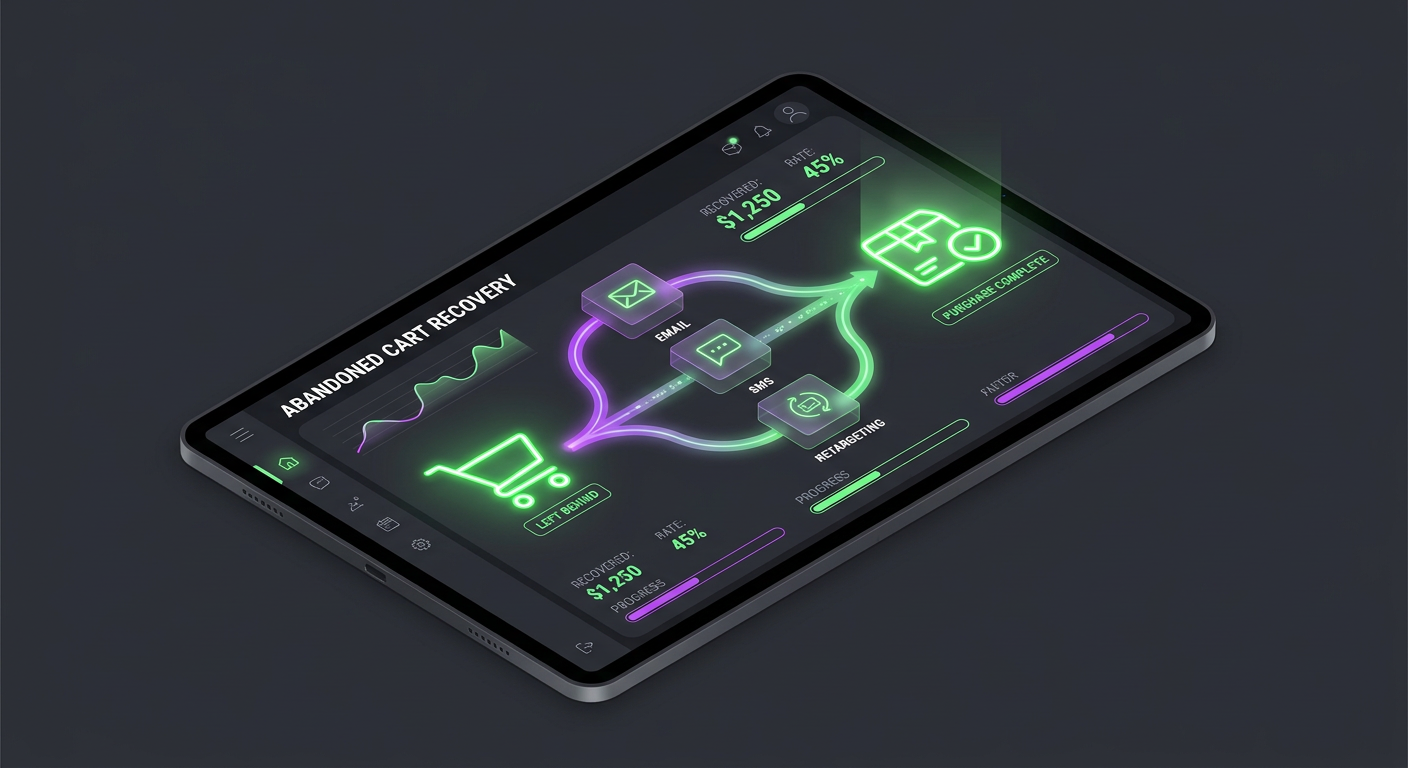
Over seven out of every ten online shopping carts are abandoned before a transaction is completed. For direct-to-consumer (DTC) brands and e-commerce merchants, this represents the single largest source of lost revenue in the digital customer journey. While user acquisition costs continue to climb across major ad networks, letting high-intent traffic slip away at the final hurdle severely undermines profit margins.
Recovering these lost opportunities requires moving past basic automated emails. Changes in digital privacy, client-side tracking limitations, and shifting consumer behavior have reshaped how shoppers interact with online stores. Today, an effective abandoned cart recovery strategy depends on a robust technical foundation, multi-channel orchestration across email, SMS, and retargeting, and precise incrementality measurement.
This guide details the technical infrastructure, compliance guidelines, multi-channel workflows, and analytical frameworks required to turn abandoned carts into predictable revenue.
Technical Distinction: Cart Abandonment vs. Checkout Abandonment
Cart Abandonment (Unauthenticated) occurs when a site visitor adds one or more items to their shopping cart drawer or page, but leaves the site before initiating the checkout process. At this stage, the shopper has not entered personal details such as an email address or phone number. Traditional marketing automation tools remain blind to unauthenticated visitors unless persistent cart drawer technologies or first-party identity resolution methods are active.
Checkout Abandonment (Authenticated) occurs after a customer clicks "Checkout" and completes Step 1 of the checkout funnel by entering their contact details, but halts the process before finalizing payment. The moment contact information is submitted, platform webhooks (such as
checkout_startedorcheckout_updated) instantly trigger down-funnel CRM flows in platforms like Klaviyo or Attentive.
Confronting checkout drop-off requires analyzing the friction points that cause shoppers to halt their purchase. Surprising extra costs—such as unanticipated shipping fees, taxes, or handling charges—account for nearly half of all abandoned checkouts. Complex account creation requirements, slow delivery options, and payment security concerns also drive shoppers away at the final hurdle.
Addressing these issues requires clear pricing transparencies on product pages, simplified express checkout options (like Apple Pay or Shop Pay), and optimized infrastructure that captures customer intent early in the session. For a complete audit of your store's setup, review this Shopify abandoned cart recovery checklist to identify potential friction points.
The Privacy Landscape: Signal Loss, Apple MPP, and Server-Side Tracking
In recent years, web browser privacy protections have fundamentally altered how user data is collected and processed. Client-side tracking scripts running entirely within web browsers are increasingly blocked, sanitized, or shortened by ad-blocking tools and browser engines.
Navigating Apple MPP and Link Tracking Protection
The launch of Apple’s Mail Privacy Protection (MPP) transformed how email marketing performance is evaluated. MPP automatically pre-downloads email content—including invisible tracking pixels—through remote proxy servers. This masks recipient IP addresses and generates artificial 100% open events for iOS users.
Relying on email opens to trigger follow-up steps in abandoned cart sequences leads to inaccurate messaging. Modern recovery flows must instead use click-through actions, site search events, or actual order confirmations as primary triggers.
Similarly, Link Tracking Protection (LTP) in iOS strips individual user identification parameters from links opened in Safari Private Browsing, Mail, and Messages. While standard campaign tracking tags (utm_source, utm_medium, utm_campaign) continue to function normally, granular user-level tracking parameter strings are removed. E-commerce platforms can no longer depend on simple URL parameters to reconcile user identity across sessions.
Client-Side Pixel Failures vs. Server-Side Tracking
Traditional tracking scripts rely on the user's browser to execute JavaScript and send event data directly to ad networks and analytics platforms. However, Intelligent Tracking Prevention (ITP) in Safari restricts the lifespan of client-side cookies to as little as 1 to 7 days. If a shopper abandons a cart on Monday and returns on the following Tuesday, browser cookies may have expired, rendering the visitor completely anonymous.
Server-side tracking bypasses browser restrictions by shifting event transmission from the browser directly to your store's backend server. Using tools like the Shopify Web Pixels API or Meta Conversions API (CAPI), customer actions are sent directly from server to server.
[ Client-Side (Browser) ] (Blocked by ITP / Ad-Blockers) X [ Analytics / CRM ]
▲
Server-Side (Backend)
(Direct Server-to-Server Event Transmission)
Server-side architectures preserve data integrity, extend cookie lifespans legally under first-party contexts, and ensure that abandonment events are delivered reliably to marketing channels.
First-Party Identity Resolution
The primary limitation of cart recovery has historically been unauthenticated sessions—visitors who add products to their cart but leave before typing an email address into a checkout form.
To bridge this gap, advanced tracking setups combine server-side data collection with first-party identity resolution. Platforms like Attribuly capture first-party server-side events and reconcile anonymous site sessions with known customer records. By securely matching hashed user identifiers across historical site interactions, these systems de-anonymize visitors early in the shopping journey. This allows connected lifecycle marketing tools to trigger recovery flows for unauthenticated cart abandoners who would otherwise be lost.
Compliance Framework for Multi-Channel Recovery
Reaching out to cart abandoners across multiple channels requires strict adherence to privacy legislation and telecommunications regulations. Non-compliance can lead to severe financial penalties and damage brand reputation.
TCPA and CTIA Essentials for SMS Marketing
In the United States, text message marketing is governed by the Telephone Consumer Protection Act (TCPA) and monitored by the Cellular Telecommunications Industry Association (CTIA). Collecting a customer's phone number during checkout does not grant permission to send marketing SMS messages, even for abandoned cart notifications.
Explicit Prior Express Written Consent: SMS consent must be collected via an un-checked, dedicated opt-in checkbox during checkout or via pop-up forms. The legal language must explicitly state that agreement is not a condition of purchase.
Quiet Hours Enforcement: Automated SMS systems must be configured to honor local quiet hours. Messages should never be sent between 9:00 PM and 8:00 AM based on the recipient's local time zone.
Automated Opt-Out Processing: Immediate processing of standard opt-out keywords (
STOP,UNSUBSCRIBE,CANCEL) is mandatory. Once a user opts out, all transactional and marketing automation triggers must cease immediately.
GDPR and CCPA Regulations
Under the European Union’s General Data Protection Regulation (GDPR) and the California Consumer Privacy Act (CCPA), processing personal data requires a clear legal basis.
While sending transactional cart reminder emails to customers who initiated checkout can sometimes fall under "Legitimate Interest" in specific EU jurisdictions, offering promotional discounts via SMS or email strictly requires explicit consent. Every recovery communication must include a visible, one-click unsubscribe mechanism, and unauthenticated session data must respect data retention expiration limits.
Multi-Channel Recovery Flow Orchestration
Relying on a single communication channel limits recovery performance. Consumers interact across multiple touchpoints, making an integrated, multi-channel approach essential for maximizing recovery rates.
Event: Cart / Checkout Abandoned
t + 15 mins → On-Site Persistent Cart Drawer / Push Prompt t + 30 mins → SMS Consent Check YES → Conversational SMS (Customer Support Focus) NO → Trigger Email 1 (Helpful Reminder + Cart Items) t + 4 hours → Activate Meta & Google Dynamic Product Retargeting t + 24 hours → Trigger Email 2 (Social Proof & Verified Product Reviews) t + 48 hours → Trigger Email 3 / SMS 2 (Incentive / Free Shipping Threshold) Event: Purchase Completed → Execute Cross-Channel Suppression
The Multi-Channel Timing Cadence
15 Minutes Post-Abandonment (On-Site & Push): If the shopper remains on the site or has desktop push notifications enabled, display a persistent cart drawer or gentle exit-intent intervention highlighting saved items.
30 Minutes Post-Abandonment (SMS or Email 1): Reach out while purchase intent remains high. If explicit SMS consent is on file, send a short, non-intrusive text message. If SMS consent is absent, dispatch Email 1 containing a clear link back to the pre-filled cart.
4 Hours Post-Abandonment (Retargeting Ads): Sync abandonment segment data with ad channels like Meta and Google. Display Dynamic Product Ads (DPAs) featuring the exact items left in the cart.
24 Hours Post-Abandonment (Email 2): Send a second email focused on building trust. Include customer reviews, star ratings, or user-generated content (UGC) related to the abandoned products.
48 Hours Post-Abandonment (Final Outreach & Incentive): If the cart remains unpurchased, deliver a final SMS or email introducing an incentive, such as a temporary discount or a free shipping threshold offer.
Evaluating channel performance is critical when balancing delivery costs against conversion rates. Review this detailed abandoned cart SMS vs. email strategy comparison to optimize your channel budget allocation.
Segmented Flow Logic
Sending identical recovery sequences to every customer undermines profitability. Recovery flows should adapt dynamically based on shopping behavior and order value.
High AOV Carts ($150+): Protect product margins by avoiding upfront discount codes. Instead, dispatch plain-text communications from a founder or customer concierge offering assistance, size guidance, or personal consultations.
Low AOV Carts (<$50): Margin constraints make static discounts impractical for smaller orders. Use dynamic logic to present a free shipping threshold ("Add $12 to qualify for free shipping") to increase average order value while recovering the sale.
VIP and Repeat Buyers: Frequent customers rarely need financial incentives to complete a purchase. Instead, offer non-monetary perks such as bonus loyalty points, extended cart reservation windows, or priority fulfillment.
Cross-Channel Suppression
Continuing to target a customer with recovery ads or text messages after they have completed their purchase wastes ad spend and frustrates buyers.
The moment a purchase webhook (Placed Order or Order Completed) fires, real-time API integrations must instantly remove the customer from all active email, SMS, and ad retargeting audience segments. Proper audience suppression ensures marketing dollars are spent efficiently.
Technical Assets & Plug-and-Play Liquid Code
Implementing dynamic personalization inside email templates requires clean code structures. Modern CRM tools like Klaviyo use Liquid template code to rebuild abandoned carts dynamically for returning shoppers.
Dynamic Checkout Link Generation Snippet
This snippet dynamically generates a functional link that redirects the recipient directly back to their saved cart session with all items fully populated:
{% if event.extra.checkout_url %}
  <a href="{{ event.extra.checkout_url }}" style="background-color: #000000; color: #ffffff; padding: 14px 28px; text-decoration: none; border-radius: 4px; display: inline-block; font-weight: bold;">
    Reclaim Your Cart
  </a>
{% else %}
  <a href="{{ store_url }}/cart" style="background-color: #000000; color: #ffffff; padding: 14px 28px; text-decoration: none; border-radius: 4px; display: inline-block; font-weight: bold;">
    Return to Cart
  </a>
{% endif %}
Free Shipping Threshold Dynamic Calculator Snippet
This snippet calculates the dollar difference between a shopper's current cart total and your store's free shipping threshold, encouraging higher order values:
{% assign free_shipping_threshold = 100.00 %}
{% assign cart_subtotal = event.extra.line_subtotal_price | default: 0 %}
{% assign amount_needed = free_shipping_threshold | minus: cart_subtotal %}

{% if amount_needed > 0 %}
  <p style="font-size: 15px; color: #333333; line-height: 1.4;">
    You are only <strong>${{ amount_needed | round: 2 }}</strong> away from qualifying for <strong>FREE Express Shipping</strong>!
  </p>
{% else %}
  <p style="font-size: 15px; color: #1b5e20; line-height: 1.4; font-weight: bold;">
    🎉 Your order qualifies for FREE Express Shipping!
  </p>
{% endif %}
Copywriting Swipe Files and Frameworks
The copy used in recovery messages directly impacts conversion rates. Message structures should focus on clarity, addressing customer friction points, and guiding shoppers smoothly back to complete their purchase.
Framework 1: The Plain-Text Founder / Concierge Email
Subject Line: Quick question regarding your cart
Body Copy:
Hi [First Name],
I noticed you were looking at the [Product Name] on our site earlier today, but didn't end up finishing your order.
Did you experience any technical issues during checkout, or did you have any questions about sizing, delivery, or return policies?
Simply reply directly to this email—I read every message and am happy to help you find what you need.
Best, [Founder/Support Lead Name]
Framework 2: The Social Proof & Review Matrix
Subject Line: Don't just take our word for it...
Body Copy:
Hi [First Name],
It looks like you left something special behind. The [Product Name] is one of our most popular items, and for good reason.
Here is what verified buyers are saying about it:
★★★★★
"The quality exceeded my expectations. Shipping was fast, and the customer support team answered all my questions immediately." — Sarah M.We have saved your cart items so you can pick up right where you left off:
[ Reclaim Your Cart Now ]
Every order is backed by our 30-day hassle-free return guarantee.
Framework 3: Conversational, Non-Intrusive SMS Recovery
Text Message:
Hey [First Name]! We saved the items in your cart at [Brand Name]. Would you like us to hold them for another 2 hours? Reply YES to reserve your items or STOP to cancel.
Selecting the right balance of platforms and software extensions simplifies execution. For an analysis of top-performing marketing applications, consult this guide to the best Shopify apps for abandoned cart recovery.
Measuring True Incremental Revenue & Holdout Testing
Standard CRM attribution models often claim credit for sales that would have occurred naturally without automated reminders. If a loyal customer leaves a site to grab their credit card and receives an abandoned cart email 15 minutes later, CRM platforms will attribute that conversion entirely to the email workflow.
Relying solely on last-click CRM dashboard metrics overstates campaign effectiveness and obscures the true return on investment (ROI) of your recovery strategies.
All Eligible Abandoned Cart Sessions
90% Treatment Group → (Receives Recovery Flows) → Measure Conversion Rate A 10% Control Group → (Suppressed / No Messages) → Measure Conversion Rate B
Running an Incrementality Holdout Experiment
To measure true incremental revenue lift, set up a controlled holdout experiment:
Establish a Control Group (10% - 20%): Randomly suppress 10% to 20% of eligible abandoned cart sessions from receiving any email, SMS, or retargeting communications.
Deploy Treatment Workflows (80% - 90%): Send standard multi-channel recovery flows to the remaining group.
Calculate True Incremental Lift: Compare overall purchase conversion rates between both groups after a set testing period (e.g., 30 days).
The true incremental conversion rate is determined using the following formula:
Incremental Lift = Conversion Rate (Treatment Group) - Conversion Rate (Control Group)
Incremental Revenue = ( Orders (Treatment) - ( Visitors (Treatment) × Conversion Rate (Control) ) ) × Average Order Value
Calculating incremental lift isolates the revenue directly generated by your recovery workflows from sales that would have happened organically. For step-by-step instructions and mathematical models, consult this detailed framework on measuring abandoned cart incrementality step-by-step.
Next Steps to Build Your Recovery Engine
Building an abandoned cart recovery system requires connecting technical tracking, multi-channel messaging, and precise measurement into a unified flow.
Start by reviewing your tracking infrastructure to confirm that server-side tracking and identity resolution capture high-intent behavior cleanly despite browser privacy restrictions. Next, align your SMS and email consent mechanisms with current compliance frameworks. Finally, implement dynamic liquid code snippets and segmented flows to ensure every shopper receives relevant, non-intrusive communications.
By auditing friction points, testing messaging frameworks, and validating revenue impact through holdout experiments, e-commerce brands can systematically recover lost sales and build long-term customer relationships.
About Attribuly
Attribuly helps DTC brands recover abandoned cart revenue. We identify anonymous visitors and existing subscribers your ESP (like Klaviyo) missed, enrich their profiles, and feed the signals back — so your abandonment flows fire and your retargeting audiences grow, and you recover at least 15% more revenue. Shopify featured app, Klaviyo tech partner. Trusted by 20,000+ brands. Guaranteed 4× ROI.