
Klaviyo Recovery Rate Benchmark: Native vs +Identification
Compare Native Klaviyo vs. Klaviyo + Identification recovery benchmarks. Learn how shopper identity resolution doubles total store cart recovery revenue.
Related articles
TL;DR
- To evaluate how shopper identification impacts lifecycle performance, consider the baseline metrics across core operational dimensions.
- Understanding why native tracking misses the vast majority of abandoners requires a quick look at client-side data mechanics.
- The modern web environment makes keeping these tracking identifiers intact difficult.
- First-party shopper identification platforms bridge this gap by shifting identity resolution from the browser to the server side.
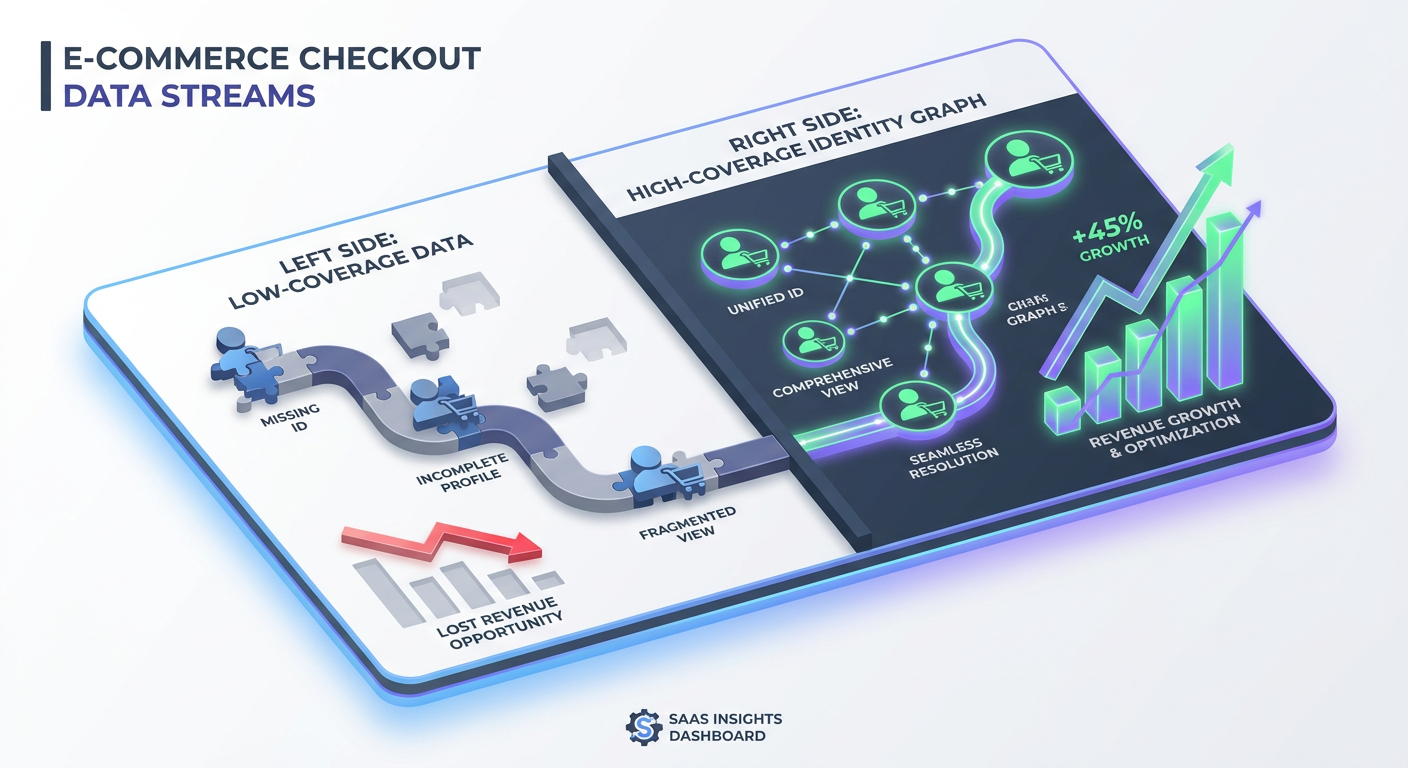
Every lifecycle marketer running an e-commerce store knows the feeling of inspecting Klaviyo flow reports and seeing stellar numbers. A 3.33% placed order rate, a $3.65 Revenue Per Recipient (RPR), and high open rates suggest an automated email recovery strategy is firing on all cylinders.
Yet, when comparing total recovered revenue against overall cart abandonment in store analytics, the numbers often tell a very different story.
This discrepancy stems from what data architects call the Metric Illusion. Email performance metrics only measure how well emails convert among sent recipients. They ignore how many high-intent shoppers left without ever triggering a recovery sequence.
Natively, web tracking mechanisms in platforms like Klaviyo rely heavily on client-side cookies and prior email link clicks (_kx parameters). Due to browser privacy restrictions like Apple's Safari Intelligent Tracking Prevention (ITP), native tracking de-anonymizes only 14% to 15% of total checkout abandoners.
By augmenting standard setups with first-party identity resolution—a process known as shopper identification—merchants can expand identification coverage to 25%–55%. This guide examines the benchmarks, mathematical frameworks, and operational trade-offs between Native Klaviyo and Klaviyo + Identification.
Benchmark Comparison Matrix: Native vs. +Identification
To evaluate how shopper identification impacts lifecycle performance, consider the baseline metrics across core operational dimensions.
Dimension | Native Klaviyo Web Tracking | Klaviyo + Shopper Identification | Measurement Basis & Primary Driver |
|---|---|---|---|
Identification Coverage Rate | 14% – 15% | 25% – 55% | Percentage of unauthenticated checkout abandoners successfully mapped to a valid email profile. |
Program-Level Recovery Rate | ~0.5% | 1.0% – 2.0%+ | Total orders recovered divided by TOTAL site checkout abandonments (authenticated + anonymous). |
Flow Placed Order Rate (POR) | 3.33% (Benchmark) | 2.8% – 3.33% | Percentage of emailed recipients who complete a purchase. Slight dilution occurs due to expanded reach. |
Revenue Per Recipient (RPR) | $3.65 (Benchmark) | $3.10 – $3.65 | Average dollar value generated per email delivered within the abandoned checkout sequence. |
Compliance & Regulatory Scope | Native opt-in / First-party session | First-party de-anonymization + TCPA/CAN-SPAM suppression | Requires automated suppression lists and compliant unsubscribe infrastructure. |
Technical Setup Overhead | 0 Minutes (Native app integration) | 15 – 30 Minutes (First-party script / CNAME DNS configuration) | Initial implementation effort required for tracking resolution scripts. |
Deliverability Risk & Safeguards | Minimal baseline risk | Low–Moderate (Requires API validation) | Managed via real-time API email verification and 30-day engagement filters. |
Net Financial ROI Multiplier | Baseline standard | 3x – 10x ROI on software fee | Net incremental margin generated relative to identity platform licensing costs. |
Why Native Klaviyo Misses 85% of Abandoned Checkouts
Understanding why native tracking misses the vast majority of abandoners requires a quick look at client-side data mechanics. Native web tracking relies on three primary factors to link a browsing session to a contact profile:
Prior Campaign/Flow Clicks: A user must have previously clicked a link containing a unique
_kxtracking parameter on that specific device and browser.Active Browser Cookies: The browser must hold an unexpired
__klaviyoclient-side cookie from a previous form submission or session.Form Submissions: The user manually inputs their email address into a popup or checkout field during the active session.
The Modern Browser Bottleneck
The modern web environment makes keeping these tracking identifiers intact difficult. Apple’s Safari Intelligent Tracking Prevention (ITP) caps client-side JavaScript cookie lifespans to 7 days—or as little as 24 hours under specific link-decorating conditions. When a high-intent customer returns to a store 8 days after clicking an email, native tracking views them as entirely anonymous.
Furthermore, cross-device browsing creates massive blind spots. A customer who opens a weekly newsletter on their mobile device but builds a cart on a desktop browser later that evening cannot be linked natively without a fresh login or email link click.
[ Anonymous Visitor ] ──> [ Starts Checkout ] ──> [ Abandons Session ]
                                  │
      ┌───────────────────────────┴───────────────────────────┐
      ▼                                                       ▼
[ Native Klaviyo ]                                [ Klaviyo + Identification ]
• Relies on local browser cookies                 • Server-side CNAME first-party tracking
• Requires prior _kx link clicks                  • Deterministic identity graph matching
• Captures: ~14% - 15% of abandoners              • Captures: ~25% - 55% of abandoners
• True Recovery Rate: ~0.5%                       • True Recovery Rate: 1.0% - 2.0%+
How First-Party Identity Resolution Closes the Gap
First-party shopper identification platforms bridge this gap by shifting identity resolution from the browser to the server side.
By routing web events through custom first-party subdomains (CNAME tracking), identity platforms bypass client-side ITP restrictions. When an unauthenticated visitor starts a checkout, server-side infrastructure matches privacy-compliant, cryptographic hashes (such as SHA-256 hashed emails) against deterministic identity networks.
Once matched, platforms sync an event—such as a custom Started Checkout or Added to Cart trigger—directly to Klaviyo via API. Solutions like Attribuly allow merchants to de-anonymize site visitors and automatically trigger existing Klaviyo recovery flows without altering message logic or email templates.
The ROI Mathematics: Incremental Revenue Calculation Model
To evaluate whether adding identity resolution makes sense for your tech stack, evaluate program revenue rather than recipient-level metrics alone.
The Incremental Revenue Formula
You can model the financial impact of expanding your identification match rate using the following formula:
$$\text{Net Incremental Monthly Revenue} = \left( \text{Total Monthly Abandoners} \times \Delta \text{Match Rate} \times \text{Flow POR} \times \text{AOV} \right) - \text{Platform Fee}$$
Where:
$\Delta$ Match Rate: The increase in visitor identification coverage (e.g., moving from 15% to 40% yields a $\Delta$ of 25%).
Flow POR: The expected Placed Order Rate among incremental recipients (typically estimated conservatively at 2.8% to 3.0%).
AOV: Average Order Value for cart recovery purchases.
Applied Benchmark Case Study: 10,000 Monthly Checkout Abandoners
Consider a mid-sized e-commerce brand handling 10,000 checkout abandonments per month with a $100 Average Order Value.
Scenario A: Native Klaviyo Baseline
Total Abandoners: 10,000
Identification Coverage (15%): 1,500 recipients trigger the sequence
Flow Placed Order Rate: 3.33%
Recovered Orders: 50 orders ($5,000 recovered revenue)
True Program Recovery Rate: 0.50% ($5,000 / $1,000,000 total abandoned value)
Scenario B: Klaviyo + Shopper Identification (e.g., Attribuly)
Total Abandoners: 10,000
Identification Coverage (40%): 4,000 recipients trigger the sequence (+2,500 incremental sends)
Incremental Flow Placed Order Rate: 3.00% (conservative estimate)
Incremental Recovered Orders: 75 additional orders ($7,500 incremental revenue)
Total Program Recovered Orders: 125 orders ($12,500 total recovered revenue)
True Program Recovery Rate: 1.25% (a 2.5x increase in aggregate store recovery)
Even after factoring in monthly software licensing costs, the net incremental margin provides a substantial financial return.
Compliance, Legal Scope, and Email Deliverability Protection
Expanding visitor identification requires strict adherence to global privacy laws and email deliverability best practices.
Regulatory Framework Overview
United States (CAN-SPAM & TCPA): Commercial cart recovery messages sent to de-anonymized visitors are compliant under US federal law provided the emails include clear seller identification, a valid physical mailing address, and a functional, one-click unsubscribe mechanism.
Canada (CASL): Requires implied or express consent. Abandoned checkout messages must be directly connected to an active cart session or an existing business relationship within specified timeframes.
European Union & UK (GDPR / ePrivacy): Strict pre-consent opt-in rules apply. De-anonymizing anonymous site visitors without prior, explicit cookie consent is prohibited for users located within the EU and UK.
Email Deliverability & Sender Reputation Protocols
Sending a higher volume of recovery emails to newly identified profiles requires strong deliverability safeguards:
Real-Time API Email Verification: Run incoming de-anonymized email addresses through real-time validation endpoints to strip out hard bounces, temporary addresses, and spam traps before triggering Klaviyo flows.
30-Day Engagement Window Suppression: Configure Klaviyo flow filters to suppress de-anonymized profiles that have not opened or clicked an email within the past 30 days.
Dedicated Sending Infrastructure: Ensure your domain health is protected by warming up dedicated sending subdomains when scaling overall email volume.
Strategic Decision Guide: When to Add Shopper Identification to Klaviyo
Shopper identification is not a one-size-fits-all solution for every store. The decision depends on store volume, geographical focus, and tech stack maturity.
                         [ Evaluate Store Profile ]
                                     │
            ┌────────────────────────┼────────────────────────┐
            ▼                        ▼                        ▼
  [ High Traffic / US ]    [ Strict EU / GDPR ]     [ Early Stage / Low Volume ]
   (>10k Abandoners/mo)    (EU Traffic Focused)       (<1k Monthly Visitors)
            │                        │                        │
            ▼                        ▼                        ▼
  [ Klaviyo + Identity ]     [ Native Klaviyo ]       [ Native Klaviyo ]
  • Maximize revenue capture • Prioritize explicit    • Focus on core traffic
  • High financial ROI         pre-consent opt-in       and baseline flows
1. High-Volume E-Commerce Stores (10,000+ Monthly Checkout Abandoners)
Recommendation: Klaviyo + Identification
Rationale: High traffic volume yields significant top-of-funnel recovery gains. Doubling identification coverage captures thousands of dollars in lost cart value each month. Utilizing tools like Attribuly also grants access to multi-touch attribution, preventing performance overlap between email sequences and paid retargeting channels.
2. EU-Centric & GDPR-Strict Merchants
Recommendation: Native Klaviyo
Rationale: Regulatory compliance mandates explicit pre-consent opt-in before tracking personal identifiers. Native consent management keeps stores compliant within strict legal frameworks.
3. Early-Stage Stores (< 1,000 Monthly Visitors)
Recommendation: Native Klaviyo
Rationale: When store volume is low, the absolute dollar lift may not cover recurring software fees. Early-stage brands should focus on driving organic traffic and establishing baseline conversion rates before adding paid identity layers.
| Dimension | Native Klaviyo Web Tracking | Klaviyo + Shopper Identification | Measurement Basis & Primary Driver |
|---|---|---|---|
| Identification Coverage Rate | 14% – 15% | 25% – 55% | Percentage of unauthenticated checkout abandoners successfully mapped to a valid email profile. |
| Program-Level Recovery Rate | ~0.5% | 1.0% – 2.0%+ | Total orders recovered divided by TOTAL site checkout abandonments (authenticated + anonymous). |
| Flow Placed Order Rate (POR) | 3.33% (Benchmark) | 2.8% – 3.33% | Percentage of emailed recipients who complete a purchase. Slight dilution occurs due to expanded reach. |
| Revenue Per Recipient (RPR) | $3.65 (Benchmark) | $3.10 – $3.65 | Average dollar value generated per email delivered within the abandoned checkout sequence. |
| Compliance & Regulatory Scope | Native opt-in / First-party session | First-party de-anonymization + TCPA/CAN-SPAM suppression | Requires automated suppression lists and compliant unsubscribe infrastructure. |
| Technical Setup Overhead | 0 Minutes (Native app integration) | 15 – 30 Minutes (First-party script / CNAME DNS configuration) | Initial implementation effort required for tracking resolution scripts. |
| Deliverability Risk & Safeguards | Minimal baseline risk | Low–Moderate (Requires API validation) | Managed via real-time API email verification and 30-day engagement filters. |
| Net Financial ROI Multiplier | Baseline standard | 3x – 10x ROI on software fee | Net incremental margin generated relative to identity platform licensing costs. |
About Attribuly
Attribuly helps DTC brands recover abandoned cart revenue. We identify anonymous visitors and existing subscribers your ESP (like Klaviyo) missed, enrich their profiles, and feed the signals back — so your abandonment flows fire and your retargeting audiences grow, and you recover at least 15% more revenue. Shopify featured app, Klaviyo tech partner. Trusted by 20,000+ brands. Guaranteed 4× ROI.