
How to Identify Website Visitors: A Step-by-Step Technical Guide
Learn how to identify anonymous website visitors using reverse IP lookup, server-side tracking, and identity graphs while maintaining GDPR compliance.
Related articles
TL;DR
- To choose the right identification stack, you must first distinguish between account-level identification (B2B) and individual shopper de-anonymization (B2C/E-commerce).
- B2B visitor identification focuses on identifying the company visiting your site rather than the specific individual.
- In e-commerce, identifying the corporate domain is useless; you need to know the individual shopper's identity to recover abandoned sessions.
- To build a reliable visitor identification framework, analytics engineers combine four distinct data capture mechanisms.
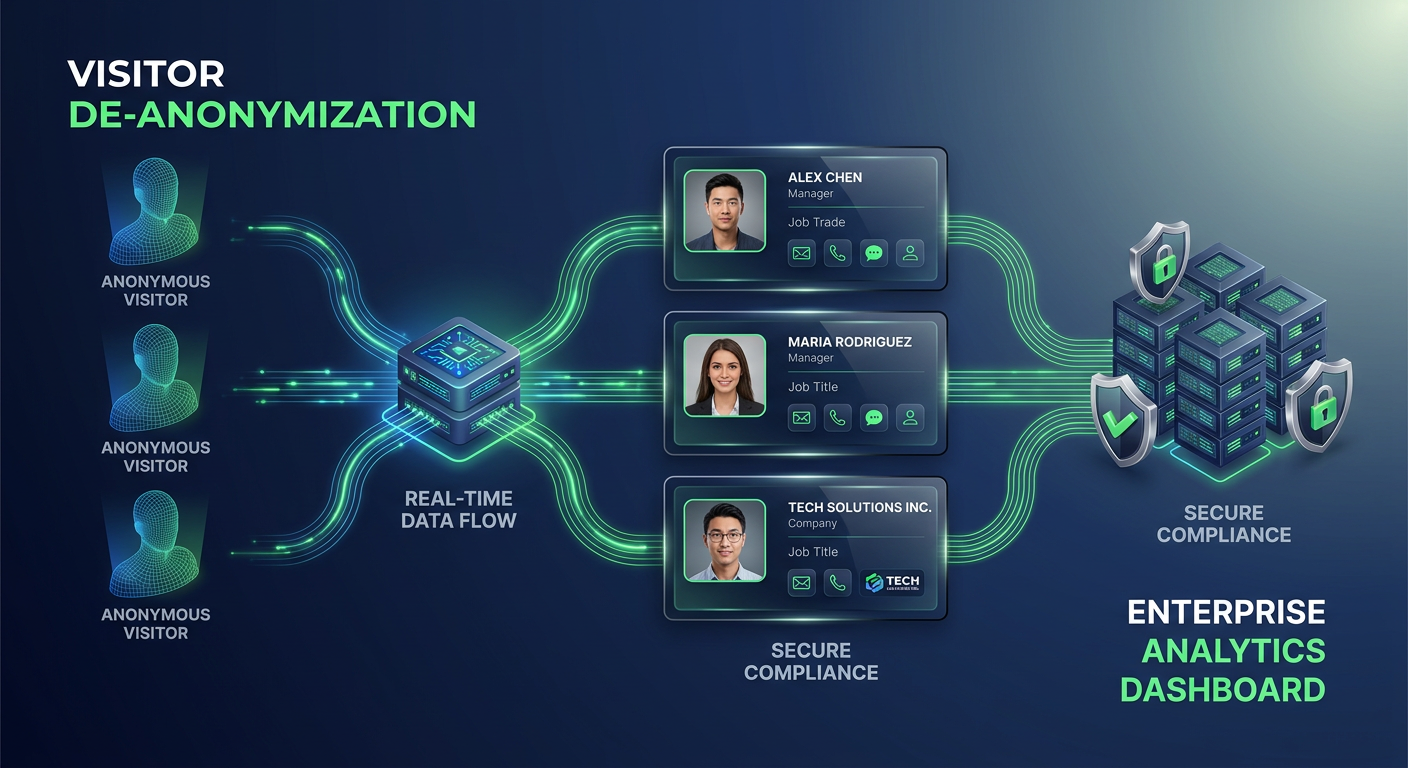
Over 95% of website visitors browse anonymously and leave without filling out a form or making a purchase. For growth marketers, revenue operations leads, and e-commerce founders, this uncaptured traffic represents wasted ad spend and lost pipeline.
Learning how to identify website visitors transforms raw, anonymous traffic into actionable data. Modern visitor identification technologies make it possible to de-anonymize inbound web sessions, reveal account-level or individual intent, and trigger targeted workflows in real time.
However, visitor de-anonymization is not a one-size-fits-all process. Identifying a corporate buyer on a B2B SaaS website requires completely different technology and compliance standards than identifying a consumer shopping on a direct-to-consumer (DTC) store. This guide breaks down the core identification architectures, browser privacy mitigations, regulatory compliance rules, and step-by-step setup workflows required to de-anonymize your website traffic legally and effectively.
Technical Architectures: B2B vs. E-Commerce Identification
To choose the right identification stack, you must first distinguish between account-level identification (B2B) and individual shopper de-anonymization (B2C/E-commerce).
                        Inbound Anonymous Traffic
                                    │
        ┌───────────────────────────┴───────────────────────────┐
        ▼                                                       ▼
B2B Account Identification                              E-Commerce Identification
(Reverse IP & ASN Matching)                            (First-Party Identity Graphs)
        │                                                       │
        ▼                                                       ▼
Resolves: Corporate Entity                              Resolves: Individual Shopper Profile
Key Data: Firmographics & Intent                        Key Data: Hashed Email (HEM) & Event History
Target: Sales Outreach & Account Ads                    Target: ESP Flows (Klaviyo) & Meta CAPI
B2B Account Identification: Reverse IP & ASN Matching
B2B visitor identification focuses on identifying the company visiting your site rather than the specific individual. When a user loads your page, their browser sends an HTTP request originating from an Internet Protocol (IP) address linked to an Autonomous System Number (ASN).
An identification engine captures this raw IP address and cross-references it against WHOIS registries, Regional Internet Registries (ARIN, RIPE), and firmographic databases mapping static IP blocks to enterprise networks. The engine strips away commercial Internet Service Providers (like Comcast or AT&T) and cloud infrastructure nodes (such as AWS or Cloudflare) to isolate corporate networks. The output is a firmographic profile containing company name, industry, employee count, annual revenue, and office headquarters.
Primary Use Case: B2B account-based marketing (ABM), real-time SDR alerts, and high-intent account routing.
Benchmark Match Rate: Expect 15% to 35% match rates for B2B traffic. The proliferation of remote work, home ISPs, and corporate VPNs accounts for the remaining unmapped traffic.
E-Commerce Identification: First-Party Identity Resolution Networks
In e-commerce, identifying the corporate domain is useless; you need to know the individual shopper's identity to recover abandoned sessions. E-commerce shopper de-anonymization relies on first-party identity resolution graphs.
When an anonymous user visits your store, JavaScript tags and server endpoints collect persistent first-party identifiers, device signals, and session parameters (gclid, fbclid). If that user has previously opted into an identity network—by making a purchase, subscribing to a newsletter, or logging into an affiliate partner site—their identity is stored as a cryptographically secure SHA-256 Hashed Email (HEM).
The resolution network matches the incoming anonymous session token against its decentralized identity graph. If a match occurs, the anonymous session is stitched to the persistent customer profile, revealing their email address, past browse history, and abandoned cart items.
Primary Use Case: Triggering browse/cart recovery emails, syncing custom audiences for ad retargeting, and measuring multi-touch attribution.
Benchmark Match Rate: US domestic e-commerce traffic yields match rates between 20% to 50%, depending on the breadth of the underlying identity network.
Core Methods to Identify Anonymous Website Visitors
To build a reliable visitor identification framework, analytics engineers combine four distinct data capture mechanisms.
1. Reverse IP Resolution
Reverse IP lookup remains the cornerstone of B2B lead discovery. By evaluating inbound IP packets against static business subnets, tools instantly notify revenue teams when strategic target accounts visit high-value pages (such as pricing or security documentation).
While remote work has reduced pure IP lookup accuracy, modern engines mitigate this by combining IP data with secondary browser signals and historical CRM activity.
2. First-Party Cookies & Server-Side Tracking
Client-side cookies created via browser JavaScript (document.cookie) are increasingly unreliable. Major web browsers restrict tracking duration to protect user privacy:
Safari Intelligent Tracking Prevention (ITP): Caps client-side JavaScript cookie lifespans to 7 days, or just 24 hours if the user arrives via ad links containing URL tracking parameters.
Firefox Enhanced Tracking Protection (ETP): Blocks third-party tracking scripts outright and isolates storage access across cross-site domains.
Ad-Blockers: Intercept and block client-side request signatures sent to known analytics domains.
To maintain persistent visitor identification, organizations deploy Server-Side Tracking. By routing event streams through a same-site first-party subdomain (e.g., ss.yourstore.com), tracking cookies are issued directly from HTTP Set-Cookie response headers. These HTTP cookies bypass client-side JavaScript restrictions and maintain their full intended duration.
3. First-Party Identity Resolution Graphs
Identity graphs combine deterministic and probabilistic matching methods:
Deterministic Matching: Occurs when a user performs a direct identification action—entering an email address during checkout, submitting a contact form, or clicking an authenticated link in an email campaign. The system links the raw PII to a persistent HEM and session ID with 100% precision.
Probabilistic Matching: Analyzes contextual signals (IP subnets, device hardware characteristics, timestamp proximity, and browser configurations) to infer identity using machine learning algorithms when deterministic keys are absent.
4. Form Submissions & Event Ingestion
The simplest method to resolve anonymous history is capturing conversion events. When an anonymous visitor who has visited your site five times finally submits a lead form or downloads an ebook, your marketing automation platform ties their historic anonymous session IDs to the newly created contact record. This reveals their full historical touchpoint path prior to conversion.
Navigating Privacy & Regulatory Compliance Rules
De-anonymizing web visitors requires strict compliance with global data privacy regulations. Failing to establish a clear legal basis can lead to substantial regulatory penalties.
Regulatory Framework | Target Data Type | Primary Lawful Requirement | Mandatory Compliance Actions |
|---|---|---|---|
GDPR (EU & UK) | B2B Corporate IP Data | Legitimate Interest (Art. 6(1)(f)) | Document a Legitimate Interest Assessment (LIA); minimize IP logs; provide clear opt-out mechanism in privacy policy. |
GDPR (EU & UK) | Individual PII / Shopper Data | Explicit Prior Consent (Art. 6(1)(a)) | Obtain opt-in consent via a compliant Consent Management Platform (CMP) before firing individual tracking pixels. |
CCPA / CPRA (California, US) | IP Addresses, Cookies, Identifiers | Notice & Opt-Out Right | Provide explicit "Notice at Collection"; display a "Do Not Sell or Share My Personal Information" link; honor Global Privacy Control (GPC) signals natively. |
GDPR Execution Rules
Under the EU General Data Protection Regulation, an IP address is considered personal data.
For B2B IP Lookup: You may rely on Legitimate Interest to process corporate IP addresses, provided your organization documents an LIA demonstrating that the processing does not override the fundamental rights of individual users. Raw IPs should be masked or truncated immediately after database resolution.
For E-Commerce Individual De-Anonymization: You must obtain Explicit Consent before storing non-essential cookies or collecting hashed personal data. You must also execute formal Data Processing Agreements (DPAs) with any third-party identity resolution vendors operating on your behalf under GDPR Article 28.
CCPA/CPRA Execution Rules
The California Consumer Privacy Act defines personal information broadly to include persistent unique identifiers, device fingerprints, and browsing history linked to a household.
Your website must disclose visitor identification technologies within your privacy policy.
You must respect browser-level Global Privacy Control (GPC) opt-out signals automatically. When a browser transmits a GPC flag, your server must suppress identity resolution and opt the user out of third-party data sharing.
Step 1: Deploy Base Tags & Server-Side Endpoints
Deploying identification tags requires configuring both client-side and server-side infrastructure.
Client-Side Deployment (Level 1): Add your visitor identification script to your website
<head>tag or trigger it through Google Tag Manager (GTM) on All Pages.Server-Side Proxy Setup (Level 2/3): Set up a server-side GTM (sGTM) container hosted on a custom subdomain (e.g.,
ss.yourdomain.com). Create a CNAME record in your DNS settings pointing this subdomain to your tracking server cluster.
Type: CNAME
Host: ss
Value: tracking-server.yourdomain.com
TTL: Automatic
This ensures tracking requests originate from your root domain namespace, preserving first-party cookie context against browser storage restrictions.
Step 2: Configure Traffic Ingestion & Bot Exclusion Filters
To protect database hygiene and ad budget efficiency, configure filter rules to strip out non-qualified session traffic:
Internal IP Filters: Exclude corporate headquarters IP ranges, employee subnets, and remote team VPN endpoints.
Cloud Infrastructure Filters: Suppress data center IP blocks belonging to AWS, Google Cloud, Azure, and Cloudflare to exclude web crawlers and automated bots.
Intent Threshold Filters: Require a minimum engagement threshold (e.g., at least 2 pageviews or >30 seconds dwell time) before flagging a session as a qualified lead.
Step 3: Implement Identity Resolution & Server-Side Event Sync
Establish persistent identifier resolution across user sessions.
For e-commerce brands looking to scale cart recovery, tools need to process server-side events and stitch anonymous returning traffic back to known profiles. For example, platforms like Attribuly combine server-side tracking endpoints with first-party identity networks to de-anonymize returning shoppers, capturing session event streams and stitching browser IDs to customer email hashes even when Safari ITP resets client-side cookies.
Once resolved, session data is enriched with past touchpoint metadata to construct an end-to-end customer journey map.
Step 4: Sync De-Anonymized Data to CRMs and Email Marketing Platforms
Send de-anonymized intent signals directly into your downstream conversion tools.
B2B CRM Sync (HubSpot / Salesforce)
Map resolved company fields (Company Name, Industry, Revenue, Target Page Visited) to Account objects in your CRM.
Configure automated workflow triggers: When a target account marked as "Target Tier 1" visits your pricing page twice within 24 hours, route an automated task and Slack notification directly to the assigned Account Executive.
E-Commerce ESP Sync (Klaviyo)
Connect server-side event streams to your Email Service Provider (ESP).
Configure dynamic event triggers for
Viewed ProductandAdded to Cartevents tied to de-anonymized shopper email hashes.According to technical documentation on Klaviyo abandoned cart setup and recovery, firing real-time server-side events directly to ESP automation flows enables store owners to trigger personalized recovery emails within minutes of session abandonment, capturing high-intent shoppers before they leave the buying window.
Trigger Event: "Viewed Product" (De-anonymized Shopper)
  │
  ├─ Filter: Has NOT placed an order in last 7 days
  ├─ Delay: 30 Minutes
  │
  └─ Action: Send Automated Browse Abandonment Email via ESP Flow
Step 5: Activate Multi-Channel Retargeting Audiences
Instead of relying on third-party tracking cookies, stream de-anonymized custom audience segments directly to ad platform Server-to-Server APIs (Meta Conversions API, TikTok Events API, LinkedIn Matched Audiences).
By pushing verified first-party user parameters (email_hash, phone_hash, external_id) directly to advertising networks, you can retarget high-intent website visitors with dynamic ad creatives without relying on client-side tracking pixels.
Troubleshooting Visitor Identification Performance
When monitoring your identification pipeline, you may encounter technical edge cases that affect data quality. Use this matrix to identify and resolve common performance bottlenecks.
                                Common Identification Bottlenecks
                                                │
       ┌────────────────────────────────────────┼────────────────────────────────────────┐
       ▼                                        ▼                                        ▼
Low Match Rates (<15%)                   Cloud Provider Noise                    Duplicate Sessions
  ├─ Cause: Client JS blocked              ├─ Cause: Bot/crawler traffic           ├─ Cause: Cross-device switches
  └─ Fix: Enable sGTM CNAME proxying       └─ Fix: Filter AWS/Cloudflare ASNs      └─ Fix: Enforce unified UID stitching
1. Low Match Rates (<15%)
Cause: Client-side tracking scripts are being intercepted by ad-blockers, or safari ITP is purging cookies before returning visits occur.
Solution: Transition your base pixel installation to a Server-Side GTM proxy using first-party CNAME DNS mapping. Ensure your cookies set the
SameSite=LaxandSecureattributes directly via HTTP headers.
2. Cloud Provider & Bot Traffic Noise
Cause: Web scrapers, uptime monitors, and cloud crawlers populate your CRM with fake corporate visits (e.g., visits originating from "Amazon.com" or "Google LLC").
Solution: Add an automated ASN filter rule blocking cloud infrastructure providers (e.g., AWS ASN 16509, Cloudflare ASN 13335, DigitalOcean ASN 14061). Set session engagement filters requiring visitors to execute at least one JavaScript event interaction before triggering identification enrichment.
3. Duplicate Session Counting
Cause: A user visits your website from their mobile browser on 5G and later returns on desktop Wi-Fi, creating two unlinked anonymous profiles.
Solution: Implement a unified primary user key (
user_idorSHA-256 HEM). Ensure your analytics provider stitches historical touchpoints deterministically as soon as the user logs in, completes a purchase, or clicks a personalized email link containing a hashed session parameter.
Next Steps for Implementing Visitor De-Anonymization
Unlocking the hidden value of your anonymous website traffic requires matching your technical execution strategy to your business model.
Audit your current traffic profile: Determine your balance of B2B vs. DTC/e-commerce visitors to choose between reverse IP resolution and first-party identity graph architectures.
Review your regulatory posture: Ensure your Consent Management Platform and privacy policy disclosures explicitly account for first-party data capture under GDPR and CCPA.
Upgrade to server-side tracking: Configure first-party DNS subdomains to bypass browser cookie caps and maximize identifier persistence.
Connect automated activation flows: Route de-anonymized intent signals directly into your CRM, ESP, and ad network endpoints to automate lead engagement and lower overall acquisition costs.
To learn more about optimizing your tracking stack, explore our foundational resource on how to identify website visitors and anonymous shoppers or review specialized tooling on the Attribuly Capture product page.
| Regulatory Framework | Target Data Type | Primary Lawful Requirement | Mandatory Compliance Actions |
|---|---|---|---|
| GDPR (EU & UK) | B2B Corporate IP Data | Legitimate Interest (Art. 6(1)(f)) | Document a Legitimate Interest Assessment (LIA); minimize IP logs; provide clear opt-out mechanism in privacy policy. |
| GDPR (EU & UK) | Individual PII / Shopper Data | Explicit Prior Consent (Art. 6(1)(a)) | Obtain opt-in consent via a compliant Consent Management Platform (CMP) before firing individual tracking pixels. |
| CCPA / CPRA (California, US) | IP Addresses, Cookies, Identifiers | Notice & Opt-Out Right | Provide explicit "Notice at Collection"; display a "Do Not Sell or Share My Personal Information" link; honor Global Privacy Control (GPC) signals natively. |
About Attribuly
Attribuly helps DTC brands recover abandoned cart revenue. We identify anonymous visitors and existing subscribers your ESP (like Klaviyo) missed, enrich their profiles, and feed the signals back — so your abandonment flows fire and your retargeting audiences grow, and you recover at least 15% more revenue. Shopify featured app, Klaviyo tech partner. Trusted by 20,000+ brands. Guaranteed 4× ROI.