
Why Klaviyo Misses Most Cart Abandoners and How to Fix It
Learn why Klaviyo can only send recovery emails to about 15% of cart abandoners, what causes the gap, and how Shopify stores can identify and recover more lost shoppers.
Related articles
TL;DR
- Klaviyo can only send recovery emails to shoppers it can match to an email address. Many cart abandoners are anonymous and never become a known Klaviyo profile.
- The gap usually comes from identity (no email), event delivery (missing add-to-cart/checkout events), and segmentation (treating all abandoners the same).
- Fixes include improving capture, using identity resolution for high-intent visitors, and making event delivery more reliable (often with server-side tracking).
- If you run paid ads, sending more consistent conversion signals can help ad platforms optimize for recovered outcomes, not just first-touch purchases.
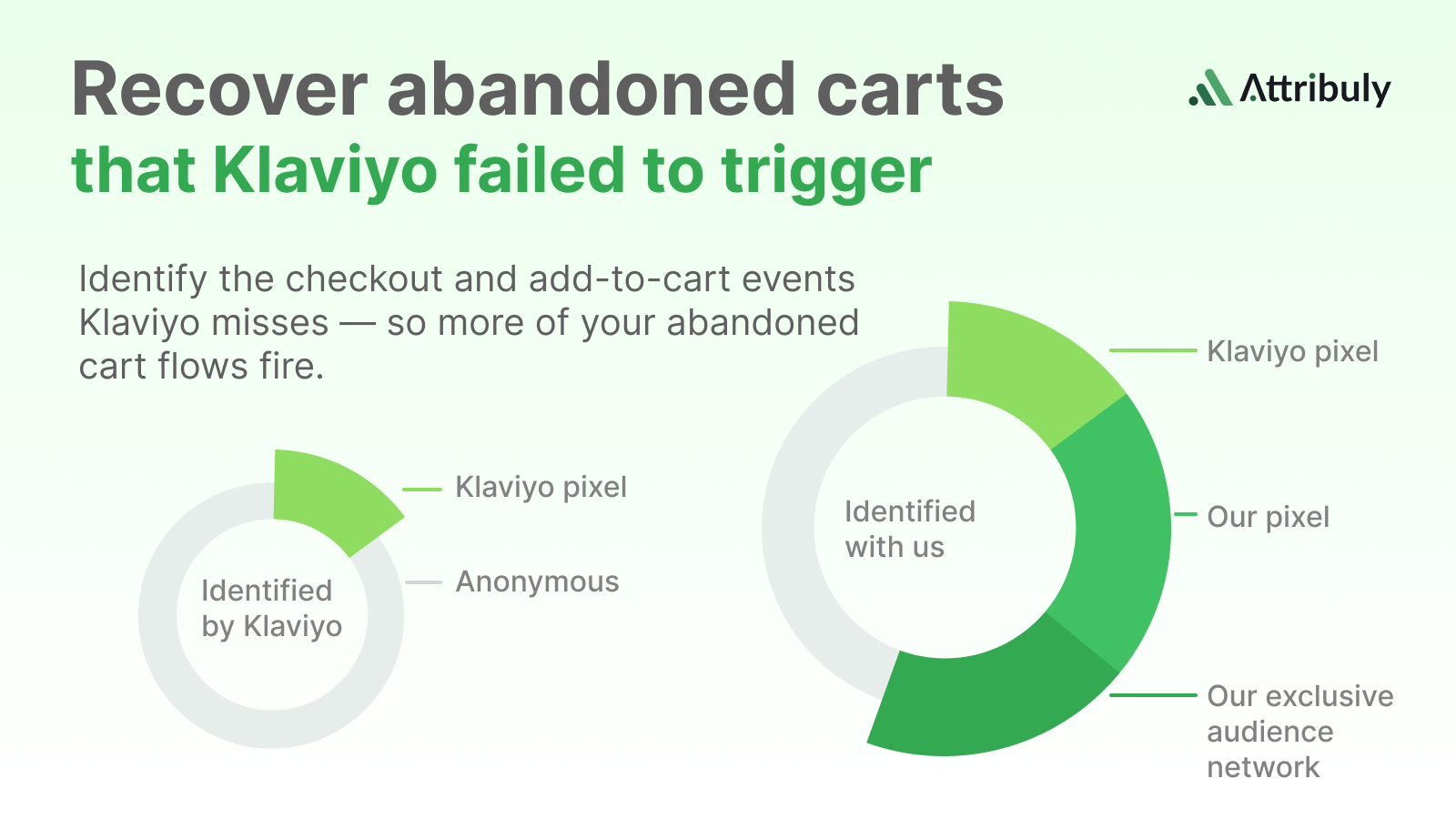
Many Shopify teams set up a Klaviyo abandoned cart flow and assume the problem is solved. Then they look at results and notice something uncomfortable: the flow only reaches a small slice of all cart abandoners.
This usually happens because Klaviyo is an ESP. It can only message profiles it can identify. If a shopper never becomes a known profile, Klaviyo cannot send email — even if that shopper viewed products, added to cart, and started checkout.
This article explains why the gap happens, what to measure, and the most practical ways Shopify stores can recover more revenue without guessing.
What “Klaviyo misses” actually means
“Klaviyo misses cart abandoners” usually means your store has more abandoners than Klaviyo can reach.
A shopper is reachable when Klaviyo can match the behavior (add to cart, checkout started, etc.) to a profile that has an email address. If there is no email, or the event can’t be reliably tied to a profile, the shopper never enters your flow.
In practice, that creates two populations: known abandoners (reachable) and anonymous abandoners (not reachable). The goal of “fixing” the gap is to shift more high-intent shoppers into the reachable population.
Why most cart abandoners are missed
Cause 1: The shopper never shared an email
Many shoppers browse on mobile, compare options, and abandon before they hit a step that collects email. If they never submit a form, create an account, or enter email at checkout, Klaviyo has nothing to message.
Cause 2: Key events don’t reach Klaviyo consistently
If add-to-cart or checkout events are missing or delayed, flows trigger late or not at all. This can happen with client-side scripts under blockers, privacy settings, or misconfigured integrations.
Cause 3: Identification without intent creates noise
Not every identified contact is a good recovery target. If your “identified” segment includes low-intent visitors (for example, blog readers), your recovery flows can hurt deliverability without improving revenue.
Cause 4: You treat all abandoners the same
A first-time visitor from a cold Meta campaign and a repeat customer from branded search should not get the same message. Without segmentation, you may underperform even when you reach more profiles.
How to fix it
Fix 1: Increase “known profiles” earlier in the journey
Add high-intent capture points (email/SMS) on product pages, cart, and checkout entry points. The goal is to collect identity before the shopper abandons.
Fix 2: Use identity resolution for high-intent behavior
Identity resolution can help you reach shoppers who did not opt in through a form but still showed purchase intent. A common best practice is to apply identification to events like product views, add to cart, and checkout started — not to all sessions.
For Shopify stores, Attribuly Capture is designed to identify more high-intent shoppers and sync them into Klaviyo flows.
Fix 3: Make event delivery more reliable
If your flow triggers are inconsistent, fix tracking before you rewrite copy. Server-side event delivery can help stabilize events when browser limits reduce client-side tracking.
Fix 4: Segment by intent and context
Treat identified visitors differently from subscribed customers. Use separate flows, conservative frequency, and a “high intent” definition (for example: product view + add to cart) to protect deliverability.
Comparison table: Klaviyo alone vs a recovery stack
| Factor | Klaviyo-only setup | With identification + better event delivery | Best for |
|---|---|---|---|
| Reach | Emails only known profiles | Identifies more high-intent visitors | Stores with many anonymous sessions |
| Flow triggers | Can be inconsistent if events drop | More reliable event delivery | Stores with tracking gaps |
| Segmentation | Often subscriber-centric | Separate identified vs subscribed flows | Brands protecting deliverability |
| Ad optimization | Recovered outcomes may not inform ads | More consistent signals for platforms | Brands spending on Meta/Google |
In most Shopify stores, Klaviyo is still the sending layer — but identification and tracking layers can expand reach and make flows more consistent.
Step-by-step: a practical way to recover more abandoners
- Measure how many abandoners are currently “reachable” in your ESP (known email) vs anonymous.
- Confirm Klaviyo is receiving key Shopify events (product viewed, add to cart, checkout started, purchase).
- Add high-intent capture points before checkout to increase known profiles.
- Introduce identity resolution for high-intent behavior to reach more anonymous abandoners.
- Create a separate recovery flow for identified (non-subscribed) profiles with conservative sending and strong intent gating.
- Monitor engagement and complaints, and iterate copy and timing only after tracking and segmentation are stable.
Common mistakes
Mistake 1: Optimizing copy before fixing reach and triggers
If most abandoners never enter the flow, copy changes won’t move the needle. Fix identity and event delivery first, then optimize messaging.
Mistake 2: Mixing subscribers and identified visitors in one flow
Subscribers and identified visitors behave differently. Separate them so you can protect deliverability while still testing recovery strategies.
Mistake 3: Using identification without an intent filter
Identify and message high-intent shoppers. If you capture low-intent visitors, you risk spam complaints and wasted sending volume.
FAQs
Why can Klaviyo only email a small percentage of cart abandoners?
Does Klaviyo track “add to cart” and “checkout started” automatically on Shopify?
What is identity resolution for ecommerce?
Will identifying more shoppers hurt deliverability?
Is server-side tracking useful for cart recovery?
Can I use Attribuly and Klaviyo together?
About Attribuly
Attribuly helps DTC brands recover abandoned cart revenue. We identify anonymous visitors and existing subscribers your ESP (like Klaviyo) missed, enrich their profiles, and feed the signals back — so your abandonment flows fire and your retargeting audiences grow, and you recover at least 15% more revenue. Shopify featured app, Klaviyo tech partner. Trusted by 20,000+ brands. Guaranteed 4× ROI.