
Klaviyo Abandoned Cart Flow: Complete Setup and Optimization Guide
Your Klaviyo abandoned cart flow is likely your highest-revenue email automation. This guide covers setup, timing, content, and how to expand its reach beyond the shoppers Klaviyo can natively identify.
Related articles
TL;DR
- Klaviyo's abandoned cart flow sends automated recovery emails to shoppers who add products to their cart but do not complete checkout.
- A well-optimized flow includes 3-4 emails with specific timing, content, and offers for each stage.
- The flow's biggest limitation is not email quality — it is coverage. Klaviyo can only send recovery emails to shoppers it identifies, which is approximately 15% of all cart abandoners.
- Expanding identification (through visitor identification tools like Capture) is the highest-leverage improvement for most stores.
- This guide covers both setup/optimization and audience expansion.
What is a Klaviyo abandoned cart flow?
A Klaviyo abandoned cart flow is an automated email sequence triggered when a Shopify shopper adds one or more products to their cart but does not complete the purchase within a defined time window.
When the trigger fires, Klaviyo sends a series of emails designed to remind the shopper about their cart and encourage them to complete the purchase.
Abandoned cart flows are consistently the highest-revenue automated email flow for ecommerce brands, with top performers generating an average of nearly $3 per recipient.
Flow setup: the recommended structure
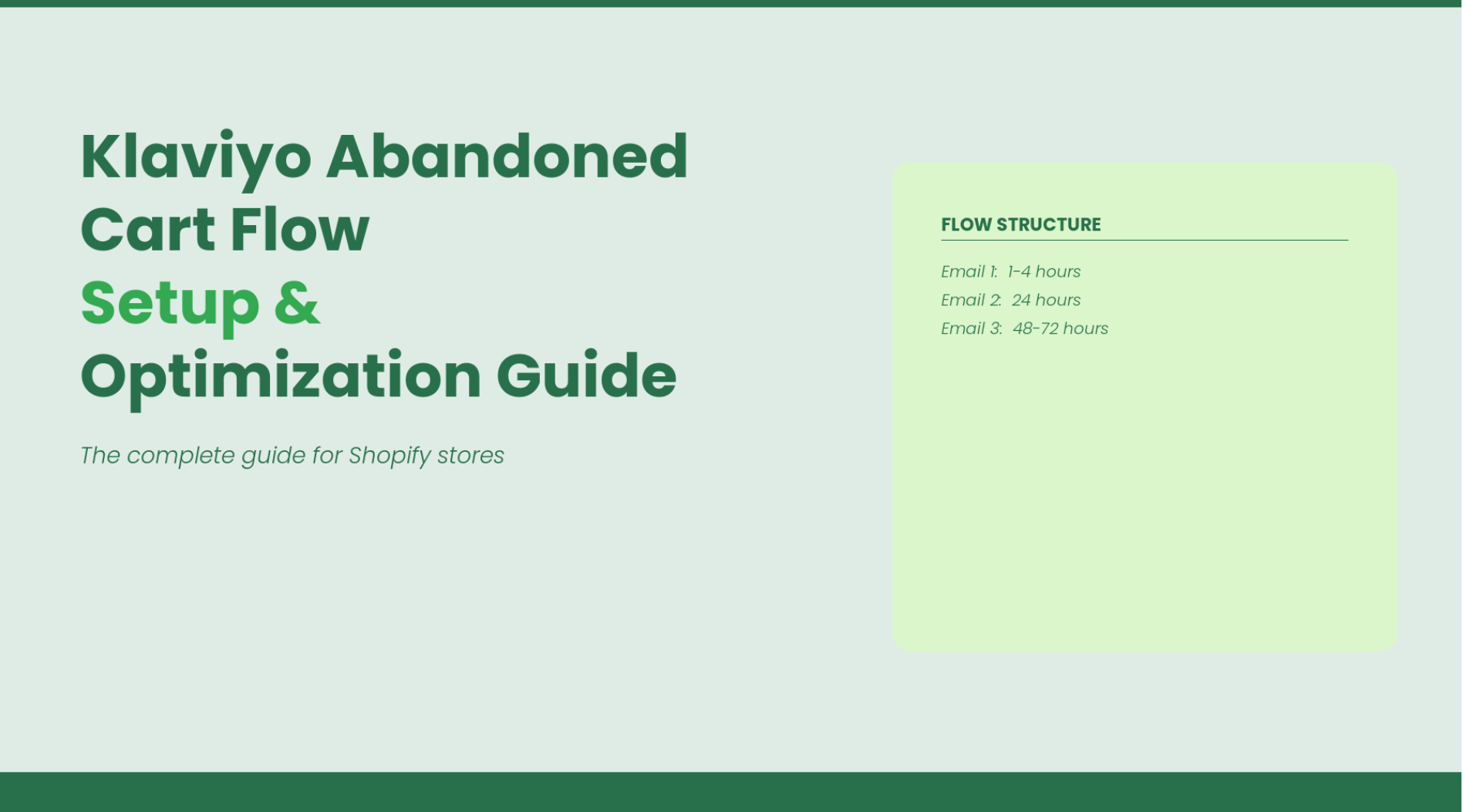
Recommended flow: 3 emails
| Timing | Purpose | Typical content | |
|---|---|---|---|
| Email 1 | 1-4 hours after abandonment | Catch shoppers while intent is fresh | Cart reminder with product image, name, price. Suggested CTA: "Complete your purchase" |
| Email 2 | 24 hours after abandonment | Re-engage shoppers who got distracted | Social proof (reviews, ratings), urgency signal. Suggested CTA: "Your cart is waiting" |
| Email 3 | 48-72 hours after abandonment | Last chance, may include incentive | Limited-time offer (free shipping or small discount). Suggested CTA: "Don't miss out" |
When to add a 4th email
Add a 4th email (5-7 days after abandonment) only for high-AOV products ($100+) where the decision cycle is longer. For lower-AOV products, 3 emails is sufficient — more than that risks annoying the shopper.
Trigger conditions
Set the flow to trigger when a shopper:
- Adds at least one item to cart
- Does not start checkout within the time window (or starts checkout but does not complete it)
- Has a known email address (Klaviyo's requirement)
Exclusion conditions
Exclude shoppers who:
- Complete the purchase (suppress immediately)
- Are already in the flow (prevent duplicate sends)
- Have unsubscribed from marketing emails
- Have placed an order within the last 24 hours
Email content best practices
Email 1: The reminder (1-4 hours)
Goal: Simple reminder while intent is still high.
Structure:
Subject: [Product Name] is still in your cart
Preview text: Complete your order before it sells out

Body:
- Hero image: the abandoned product(s)
- Product name + price
- One clear CTA button: "Complete your purchase"
- Optional: shipping info or return policy
What to avoid:
- Do not discount in Email 1 — shoppers may still buy at full price
- Do not include multiple CTAs or cross-sells
- Keep it short (under 150 words of body copy)
Email 2: Social proof (24 hours)
Goal: Address hesitation with evidence that others trust the product.
Structure:
Subject: [Product Name] — here's what customers say
Preview text: Rated 4.8/5 by 500+ customers

Body:
- Product image
- 2-3 customer reviews or star rating
- Optional: "X people bought this in the last 7 days" (urgency)
- CTA: "See why customers love it"
Email 3: Last chance + incentive (48-72 hours)
Goal: Final push with a small incentive for shoppers who have not responded.
Structure:
Subject: Last chance: free shipping on your cart
Preview text: Your cart expires soon

Body:
- Product image
- Incentive (free shipping, 5-10% off, gift with purchase)
- Urgency: "This offer expires in 24 hours"
- CTA: "Claim your offer"
Incentive guidance:
- Free shipping performs well without eroding margin
- 5-10% discount is reasonable for most DTC brands
- Do not go above 15% — it trains customers to always abandon for a discount
The coverage problem: why optimization alone is not enough
Even a perfectly optimized flow has a ceiling: Klaviyo can only email shoppers it identifies.
For most Shopify stores, Klaviyo identifies approximately 15% of cart abandoners through its native pixel, form submissions, and checkout email entry.
This means your 3-email flow — no matter how well-written — only reaches about 1 in 7 cart abandoners. The other 6 receive nothing.
How to expand flow coverage
Step 1: Maximize native Klaviyo identification
Before adding external tools, capture more emails through Klaviyo's own methods:
- Better popups (see our guide: How to Grow Your Shopify Email List Without Popups)
- Checkout email placement optimization
- Back-in-stock and waitlist forms
Step 2: Add visitor identification
Visitor identification tools match anonymous cart abandoners to email addresses and sync them to Klaviyo. These contacts enter your existing abandoned cart flow automatically.
Attribuly Capture identifies high-intent anonymous visitors and syncs them to Klaviyo. Your existing flow structure does not need to change — Capture simply increases the number of shoppers who enter it.
Step 3: Consider AI email for identified contacts
Newly identified contacts (from Capture) did not opt in through a form. They may not recognize your brand. For this segment, AI-generated recovery emails — focused on the specific products they viewed — can outperform generic templates.
Attribuly's AI Email Agent generates personalized recovery emails tailored to each shopper's behavior, either feeding into Klaviyo or sending directly.
Advanced optimization tactics
Segment by cart value
Create different flow versions based on cart value:
| Cart value | Flow variant | Why |
|---|---|---|
| Under $50 | Standard 3-email flow | Standard approach |
| $50-$150 | 3 emails + more detailed product info | Higher consideration, more information needed |
| $150+ | 4 emails + personal touch | High-value cart justifies more investment |
Segment by customer type
| Customer type | Flow variant |
|---|---|
| First-time visitor | Focus on product and trust signals (reviews, guarantees) |
| Returning visitor (no purchase history) | Focus on specific product interest, lighter brand intro |
| Previous customer | Focus on convenience, loyalty benefits |
| Capture-identified contact | Focus on product, softer brand voice, avoid assuming familiarity |
Test subject lines systematically
Run A/B tests on subject lines monthly. Test one variable at a time:
- Product name vs. no product name
- Urgency vs. curiosity
- Question vs. statement
- Emoji vs. no emoji
Metrics to track
| Metric | What it tells you | Benchmark |
|---|---|---|
| Flow entry rate | Are enough shoppers entering the flow? | Track month-over-month growth |
| Email 1 open rate | Are subject lines working? | 40-60% |
| Email 1 click rate | Is the content compelling? | 5-10% |
| Flow conversion rate | How many recipients buy? | 3-7% |
| Revenue per recipient | How much does each flow entry generate? | $2-$4 |
| Unsubscribe rate | Are you annoying people? | Below 0.5% per email |
| Spam complaint rate | Are identified contacts causing issues? | Below 0.1% |
Common mistakes
Mistake 1: Discounting in Email 1
Offering a discount immediately trains shoppers to abandon their cart to get a deal. Save incentives for Email 3.
Mistake 2: Too many emails
More than 4 emails in an abandoned cart sequence rarely improves conversion and can increase unsubscribes. Quality and timing matter more than quantity.
Mistake 3: Same flow for all shoppers
A first-time visitor and a loyal repeat customer should not receive the same email. Segment your flow by customer type and cart value.
Mistake 4: Ignoring the coverage problem
Spending weeks optimizing email copy while 85% of your abandoners never receive any email is misallocated effort. Fix coverage (identification) first, then optimize content.
Mistake 5: Not tracking identified contacts separately
If you add visitor identification (Capture), create a separate Klaviyo segment for these contacts. Monitor their engagement independently to catch any deliverability issues early.
Next step
Start by checking your current flow coverage: how many abandoned cart flow emails did Klaviyo send last month, compared to your total cart abandoners? If coverage is below 20%, identification is your highest-leverage improvement.
→ Start free trial → Learn more about Capture → Schedule a call → Complete guide: Shopify Abandoned Cart Recovery: Complete Guide
FAQs
How soon should the first email send after abandonment?
Should I include a discount in my abandoned cart emails?
How many emails should be in the flow?
What is a good abandoned cart flow conversion rate?
Can Capture contacts enter my existing Klaviyo flow without changes?
How does Capture affect my flow conversion rate?
About Attribuly
Attribuly helps DTC brands recover abandoned cart revenue. We identify anonymous visitors and existing subscribers your ESP (like Klaviyo) missed, enrich their profiles, and feed the signals back — so your abandonment flows fire and your retargeting audiences grow, and you recover at least 15% more revenue. Shopify featured app, Klaviyo tech partner. Trusted by 20,000+ brands. Guaranteed 4× ROI.