
Klaviyo 已弃购的购物车流程:完成架设/配置和优化指南
你的 Klaviyo 已弃购的购物车流程是可能的你的最高营收邮件自动化流程. 这个指南覆盖架设/配置,时机,内容,和如何扩展它的触达范围之上购物者 Klaviyo 能原生地识别.
相关文章
要点
- Klaviyo'已弃购的购物车流程发送自动化的恢复邮件到购物者用户添加产品到他们的购物车但做不完成结账.
- well-已优化流程包含 3-4 邮件用具体的时机,内容,和优惠用于每个阶段.
- 流程'最大的限制是不邮件质量 — 它是覆盖率. Klaviyo 能只有发送恢复邮件到购物者它识别,其中是大约 15% 的所有的购物车弃购用户.
- 扩展识别(通过访客识别工具比如捕获)是最高-leverage 改善用于最多店铺.
- 这个指南覆盖两者都架设/配置/优化和受众扩展.
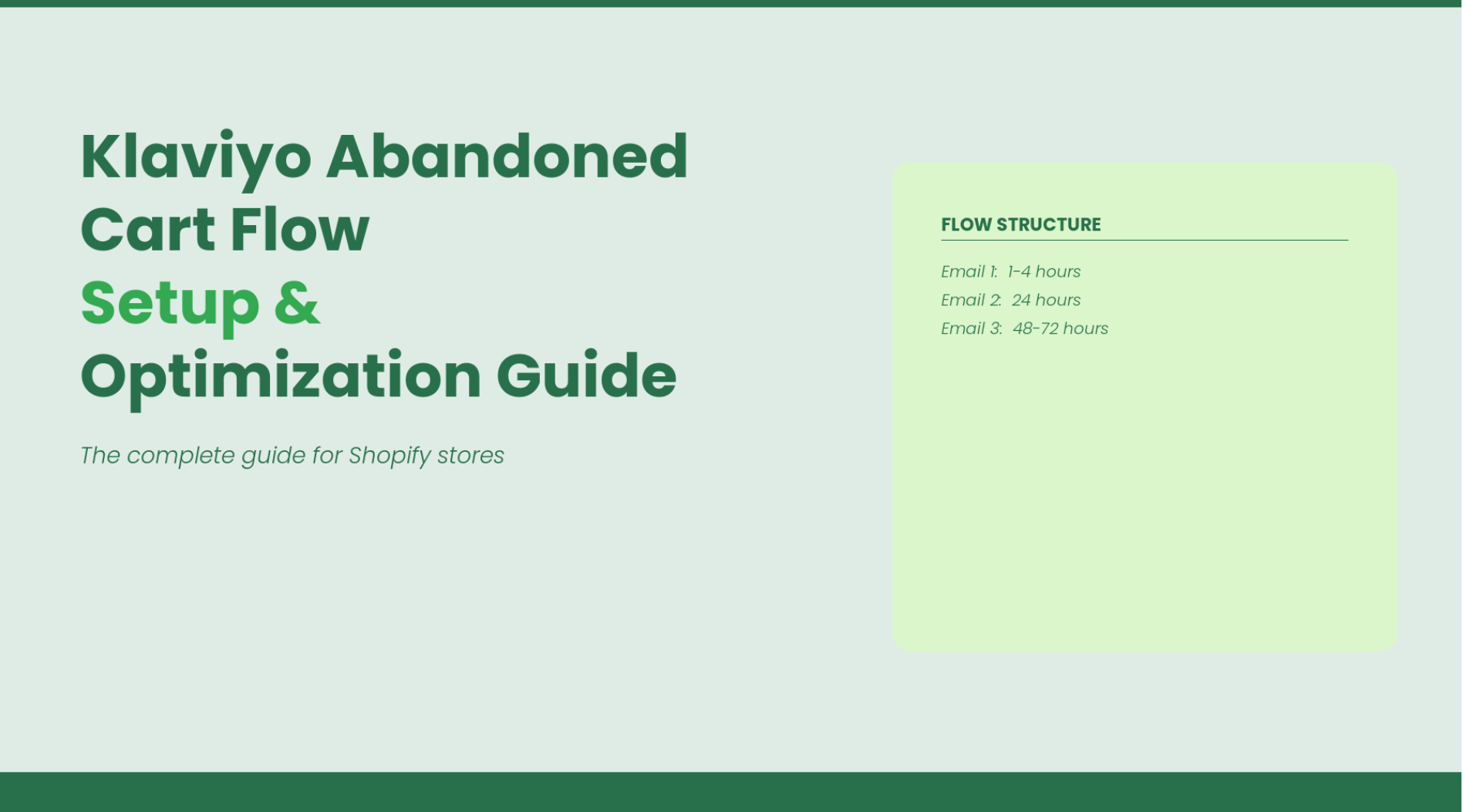
Quick setup: a high-performing Klaviyo abandoned cart flow
A strong Klaviyo abandoned cart flow usually includes a fast first reminder, a second message with product or trust reinforcement, a final reminder with clear urgency, and suppression rules that prevent over-emailing recent buyers or active subscribers.
The setup matters, but coverage matters too. Klaviyo can only send abandoned cart emails to shoppers it can identify.
If your native Klaviyo flow is missing anonymous cart abandoners, ReCapture helps identify more of them and sync them back to Klaviyo.
See how ReCapture expands Klaviyo recovery
What is a Klaviyo abandoned cart flow?
A Klaviyo abandoned cart flow is an automated email sequence triggered when a Shopify shopper adds one or more products to their cart but does not complete the purchase within a defined time window.
When the trigger fires, Klaviyo sends a series of emails designed to remind the shopper about their cart and encourage them to complete the purchase.
Abandoned cart flows are consistently the highest-revenue automated email flow for ecommerce brands, with top performers generating an average of nearly $3 per recipient.
Flow setup: the recommended structure
Recommended flow: 3 emails
| Timing | Purpose | Typical content | |
|---|---|---|---|
| Email 1 | 1-4 hours after abandonment | Catch shoppers while intent is fresh | Cart reminder with product image, name, price. Suggested CTA: "Complete your purchase" |
| Email 2 | 24 hours after abandonment | Re-engage shoppers who got distracted | Social proof (reviews, ratings), urgency signal. Suggested CTA: "Your cart is waiting" |
| Email 3 | 48-72 hours after abandonment | Last chance, may include incentive | Limited-time offer (free shipping or small discount). Suggested CTA: "Don't miss out" |
When to add a 4th email
Add a 4th email (5-7 days after abandonment) only for high-AOV products ($100+) where the decision cycle is longer. For lower-AOV products, 3 emails is sufficient — more than that risks annoying the shopper.
Trigger conditions
Set the flow to trigger when a shopper:
- Adds at least one item to cart
- Does not start checkout within the time window (or starts checkout but does not complete it)
- Has a known email address (Klaviyo's requirement)
Exclusion conditions
Exclude shoppers who:
- Complete the purchase (suppress immediately)
- Are already in the flow (prevent duplicate sends)
- Have unsubscribed from marketing emails
- Have placed an order within the last 24 hours
Email content best practices
Email 1: The reminder (1-4 hours)
Goal: Simple reminder while intent is still high.
Structure:
Subject: [Product Name] is still in your cart
Preview text: Complete your order before it sells out

Body:
- Hero image: the abandoned product(s)
- Product name + price
- One clear CTA button: "Complete your purchase"
- Optional: shipping info or return policy
What to avoid:
- Do not discount in Email 1 — shoppers may still buy at full price
- Do not include multiple CTAs or cross-sells
- Keep it short (under 150 words of body copy)
Email 2: Social proof (24 hours)
Goal: Address hesitation with evidence that others trust the product.
Structure:
Subject: [Product Name] — here's what customers say
Preview text: Rated 4.8/5 by 500+ customers

Body:
- Product image
- 2-3 customer reviews or star rating
- Optional: "X people bought this in the last 7 days" (urgency)
- CTA: "See why customers love it"
Email 3: Last chance + incentive (48-72 hours)
Goal: Final push with a small incentive for shoppers who have not responded.
Structure:
Subject: Last chance: free shipping on your cart
Preview text: Your cart expires soon

Body:
- Product image
- Incentive (free shipping, 5-10% off, gift with purchase)
- Urgency: "This offer expires in 24 hours"
- CTA: "Claim your offer"
Incentive guidance:
- Free shipping performs well without eroding margin
- 5-10% discount is reasonable for most DTC brands
- Do not go above 15% — it trains customers to always abandon for a discount
The coverage problem: why optimization alone is not enough
Even a perfectly optimized flow has a ceiling: Klaviyo can only email shoppers it identifies.
For most Shopify stores, Klaviyo identifies approximately 15% of cart abandoners through its native pixel, form submissions, and checkout email entry.
This means your 3-email flow — no matter how well-written — only reaches about 1 in 7 cart abandoners. The other 6 receive nothing.
How to expand flow coverage
Step 1: Maximize native Klaviyo identification
Before adding external tools, capture more emails through Klaviyo's own methods:
- Better popups (see our guide: How to Grow Your Shopify Email List Without Popups)
- Checkout email placement optimization
- Back-in-stock and waitlist forms
Step 2: Add visitor identification
Visitor identification tools match anonymous cart abandoners to email addresses and sync them to Klaviyo. These contacts enter your existing abandoned cart flow automatically.
Attribuly Capture identifies high-intent anonymous visitors and syncs them to Klaviyo. Your existing flow structure does not need to change — Capture simply increases the number of shoppers who enter it.
Step 3: Consider AI email for identified contacts
Newly identified contacts (from Capture) did not opt in through a form. They may not recognize your brand. For this segment, AI-generated recovery emails — focused on the specific products they viewed — can outperform generic templates.
Attribuly's AI Email Agent generates personalized recovery emails tailored to each shopper's behavior, either feeding into Klaviyo or sending directly.
You can improve timing, copy, and discounts, but those changes only affect shoppers who enter the flow. ReCapture helps expand the recoverable audience before the email is sent.
Find missed Klaviyo cart abandoners
Advanced optimization tactics
Segment by cart value
Create different flow versions based on cart value:
| Cart value | Flow variant | Why |
|---|---|---|
| Under $50 | Standard 3-email flow | Standard approach |
| $50-$150 | 3 emails + more detailed product info | Higher consideration, more information needed |
| $150+ | 4 emails + personal touch | High-value cart justifies more investment |
Segment by customer type
| Customer type | Flow variant |
|---|---|
| First-time visitor | Focus on product and trust signals (reviews, guarantees) |
| Returning visitor (no purchase history) | Focus on specific product interest, lighter brand intro |
| Previous customer | Focus on convenience, loyalty benefits |
| Capture-identified contact | Focus on product, softer brand voice, avoid assuming familiarity |
Test subject lines systematically
Run A/B tests on subject lines monthly. Test one variable at a time:
- Product name vs. no product name
- Urgency vs. curiosity
- Question vs. statement
- Emoji vs. no emoji
Ready to see how this works in your own store?
Metrics to track
| Metric | What it tells you | Benchmark |
|---|---|---|
| Flow entry rate | Are enough shoppers entering the flow? | Track month-over-month growth |
| Email 1 open rate | Are subject lines working? | 40-60% |
| Email 1 click rate | Is the content compelling? | 5-10% |
| Flow conversion rate | How many recipients buy? | 3-7% |
| Revenue per recipient | How much does each flow entry generate? | $2-$4 |
| Unsubscribe rate | Are you annoying people? | Below 0.5% per email |
| Spam complaint rate | Are identified contacts causing issues? | Below 0.1% |
Common mistakes
Mistake 1: Discounting in Email 1
Offering a discount immediately trains shoppers to abandon their cart to get a deal. Save incentives for Email 3.
Mistake 2: Too many emails
More than 4 emails in an abandoned cart sequence rarely improves conversion and can increase unsubscribes. Quality and timing matter more than quantity.
Mistake 3: Same flow for all shoppers
A first-time visitor and a loyal repeat customer should not receive the same email. Segment your flow by customer type and cart value.
Mistake 4: Ignoring the coverage problem
Spending weeks optimizing email copy while 85% of your abandoners never receive any email is misallocated effort. Fix coverage (identification) first, then optimize content.
Mistake 5: Not tracking identified contacts separately
If you add visitor identification (Capture), create a separate Klaviyo segment for these contacts. Monitor their engagement independently to catch any deliverability issues early.
Want the benchmark behind ESP identification rates and revenue lift?
Download the 400-brand shopper identification report
Next step
Start by checking your current flow coverage: how many abandoned cart flow emails did Klaviyo send last month, compared to your total cart abandoners? If coverage is below 20%, identification is your highest-leverage improvement.
→ Start free trial → Learn more about Capture → Schedule a call → Complete guide: Shopify Abandoned Cart Recovery: Complete Guide
常见问题
如何应该第一邮件发送之后放弃行为?
应该我包含折扣我的已弃购的购物车邮件?
如何很多邮件应该是流程?
什么是好的已弃购的购物车流程转化费率?
捕获能联系人进入我的现有的 Klaviyo 流程没有改变吗?
如何做捕获 affect 我的流程转化费率?
关于 Attribuly
Attribuly 帮助 DTC 品牌挽回弃购收入。我们识别被你的 ESP(如 Klaviyo)遗漏的匿名访客和已有订阅者,补全他们的画像,并将这些信号回传,让你的弃购流程正常触发、再营销受众持续增长,并帮助你至少多挽回 15% 的收入。 Shopify Featured App,Klaviyo 技术合作伙伴。已获 20,000+ 品牌信任。保证 4× ROI。