
How to Recover More Abandoned Carts on Shopify Beyond Klaviyo
Klaviyo's abandoned cart flow is one of the most effective email automations in ecommerce. But it only works for shoppers Klaviyo can identify. Here is how to recover more.
Related articles
TL;DR
- Klaviyo's abandoned cart flow is effective, but it can only message shoppers it can identify.
- Recovering more carts usually requires three layers: reliable event delivery, broader shopper identification, and more relevant recovery messaging.
- A practical rollout starts by measuring your current “reachable abandoner” coverage, then improving server-side event delivery before expanding identification.
- AI-assisted recovery emails can improve relevance for newly identified shoppers who may not recognize your brand yet.
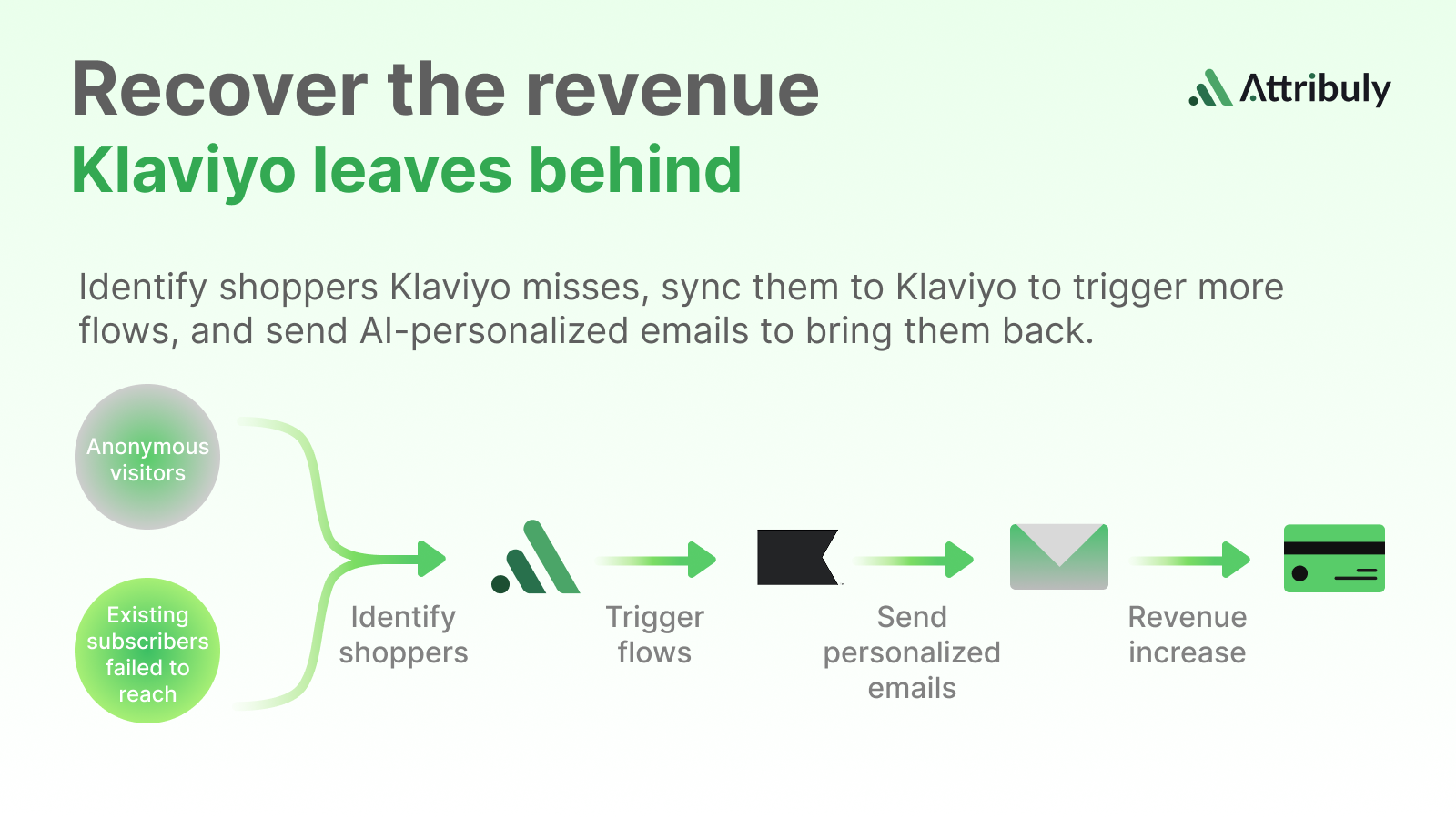
Klaviyo's abandoned cart flow is one of the most effective automations in ecommerce. The limitation is simple: it only works for shoppers Klaviyo can identify as an email profile.
This guide lays out a step-by-step approach to recover more abandoned carts without replacing Klaviyo, by expanding what your flow can reach and improving the data and messaging that power it.
Why most abandoned cart revenue goes unrecovered
Cart abandonment is high across ecommerce, and most stores only message a fraction of abandoners. The biggest leak is usually not the email template itself. It's that the majority of abandoners are never reachable.
A simplified way to think about it
- Many shoppers add to cart and abandon.
- Klaviyo can email the subset it can identify as known profiles.
- The remaining abandoners receive no recovery email because there is no identity to message.
The three layers of cart recovery
Expanding cart recovery typically means solving three separate problems. Each layer builds on the previous one.
| Layer | Problem it solves | What it does |
|---|---|---|
| Layer 1: Event delivery | Browser pixels miss events or arrive late. | Server-side tracking improves reliability for flow triggers. |
| Layer 2: Shopper identification | Most shoppers are anonymous to your ESP. | Visitor identification matches high-intent sessions to emails. |
| Layer 3: Email relevance | Generic recovery emails underperform for some segments. | Behavior-based messages improve relevance and engagement. |
Server-side tracking without identification still misses unknown shoppers. Identification without reliable event delivery can trigger the wrong flow or trigger late. And sending generic templates to newly identified contacts can reduce engagement.
Step-by-step guide
Step 1: Audit your current cart recovery coverage
Before adding tools, measure your baseline “reachable abandoner” coverage.
Check in Klaviyo
- How many abandoned cart flow emails were sent last month?
- How many total add-to-cart events did Shopify record last month?
- Coverage ratio: emails sent ÷ total abandoners.
Check in Shopify
- How many sessions had add-to-cart events?
- Compare to Klaviyo's “Started Checkout” and “Added to Cart” tracking.
- The gap often indicates events that are not reaching Klaviyo reliably.
Step 2: Fix event delivery with server-side tracking
Before identifying more shoppers, ensure events for already-known shoppers reach Klaviyo consistently. Server-side tracking supplements browser pixels when they are blocked, restricted, or misconfigured.
What to set up
- Send key Shopify events (page view, add to cart, checkout started, purchase) server-side to Klaviyo.
- Keep the pixel enabled; server-side improves coverage and stability.
- Optionally also send the same conversion events to Meta and Google to improve ad optimization feedback loops.
For Shopify stores that want tracking + recovery to work together, Attribuly provides server-side tracking that can connect to Klaviyo, Meta, Google, and GA4.
Step 3: Expand identification with Capture
Once event delivery is reliable, expand the pool of identifiable shoppers by matching anonymous high-intent sessions to email addresses.
What to set up
- Activate visitor identification (for example, Attribuly Capture) and connect it to Shopify.
- Sync identified contacts into Klaviyo so they can enter your existing abandoned cart flow.
- Start with high-intent segments (checkout starters, cart abandoners), then expand to product viewers.
What to expect
- Your recoverable abandoner pool may expand beyond what Klaviyo can identify natively.
- List growth shifts toward higher-intent contacts instead of only popup subscribers.
Step 4: Improve email relevance with AI
Generic “you left something in your cart” templates often work for existing subscribers. For newly identified shoppers, relevance matters more because they may not recognize your brand yet.
What to set up
- Generate recovery messages based on what the shopper viewed, added, and how far they progressed.
- Use product-first context (items, variants, price, shipping expectations) rather than generic brand-first copy.
- Segment identified contacts so messaging and cadence can differ from your organic list.
Attribuly's AI Email Agent is designed to generate recovery emails tailored to each shopper's behavior and can be used alongside Klaviyo flows.
Step 5: Send conversion signals back to ad platforms
If paid ads drive a meaningful share of your traffic, recovered purchases should flow back to Meta and Google so optimization learns from recovered outcomes, not just last-click purchases.
What to set up
- Send server-side purchase events to Meta Conversions API and Google Enhanced Conversions.
- Include enriched context so recovered conversions can improve audience learning.
Step 6: Monitor and optimize
After all layers are active, track performance weekly and compare to your baseline.
| Metric | What it tells you | Target |
|---|---|---|
| Identified contacts per week | Whether identification is producing enough volume. | Depends on traffic volume |
| Flow entry rate | Whether synced contacts are entering flows. | Close to 100% of synced contacts |
| Open rate (identified contacts) | Inbox placement and top-of-funnel interest. | 20%+ |
| Click rate | Whether recipients engage with the message. | 2%+ |
| Spam complaint rate | Whether messaging harms deliverability. | Below 0.1% |
| Recovered revenue | Incremental lift vs your baseline. | Track as lift over time |
What this looks like in practice (illustrative)
The exact numbers depend on your traffic mix, AOV, and flow design. The example below is meant to show the math behind expanding your reachable audience, not to guarantee results.
| Scenario | Reachable abandoners | Recovered orders | Recovered revenue |
|---|---|---|---|
| Before (Klaviyo only) | ~15% of abandoners | Lower reach | Baseline |
| After (Tracking + ID + Better email) | Higher reach | More opportunities | Incremental lift |
How to run this calculation for your store
- Start with monthly add-to-cart sessions.
- Estimate abandoners (or use your actual abandonment count).
- Measure reachable abandoners (how many entered flows).
- Multiply by flow conversion rate and AOV to estimate recovered revenue.
Common mistakes
Mistake 1: Skipping tracking and going straight to identification
If Klaviyo is missing events for already-identified shoppers, adding more identified contacts won't fix the underlying trigger gap. Improve event delivery first, then expand identification.
Mistake 2: Sending the same template to all contacts
Newly identified shoppers can behave differently than opted-in subscribers. Use product-relevant messaging and separate cadence to protect engagement and deliverability.
Mistake 3: Not segmenting identified contacts in Klaviyo
Create a segment for contacts identified through your identification tool and monitor their metrics separately. If performance diverges, adjust the flow for that segment.
Mistake 4: Expecting immediate lift from a small sample
Identification needs enough volume to show meaningful patterns. Give the system time to collect data and evaluate results over weeks, not days.
FAQs
Can I use this approach with an ESP other than Klaviyo?
Does this replace my existing Klaviyo setup?
What if my traffic is mostly international?
Is this worth it for small stores?
How long does setup take?
What does this cost total?
Sources
Notes: Any numbers in this article should be validated against your own store data and deliverability metrics.
About Attribuly
Attribuly helps DTC brands recover abandoned cart revenue. We identify anonymous visitors and existing subscribers your ESP (like Klaviyo) missed, enrich their profiles, and feed the signals back — so your abandonment flows fire and your retargeting audiences grow, and you recover at least 15% more revenue. Shopify featured app, Klaviyo tech partner. Trusted by 20,000+ brands. Guaranteed 4× ROI.