
Abandoned Cart Recovery for Fashion and Apparel Shopify Stores
Fashion has unique abandonment patterns — size uncertainty, color comparison, multi-item carts. Learn how fashion Shopify brands recover more abandoned carts with identification and tailored flows.
Related articles
TL;DR
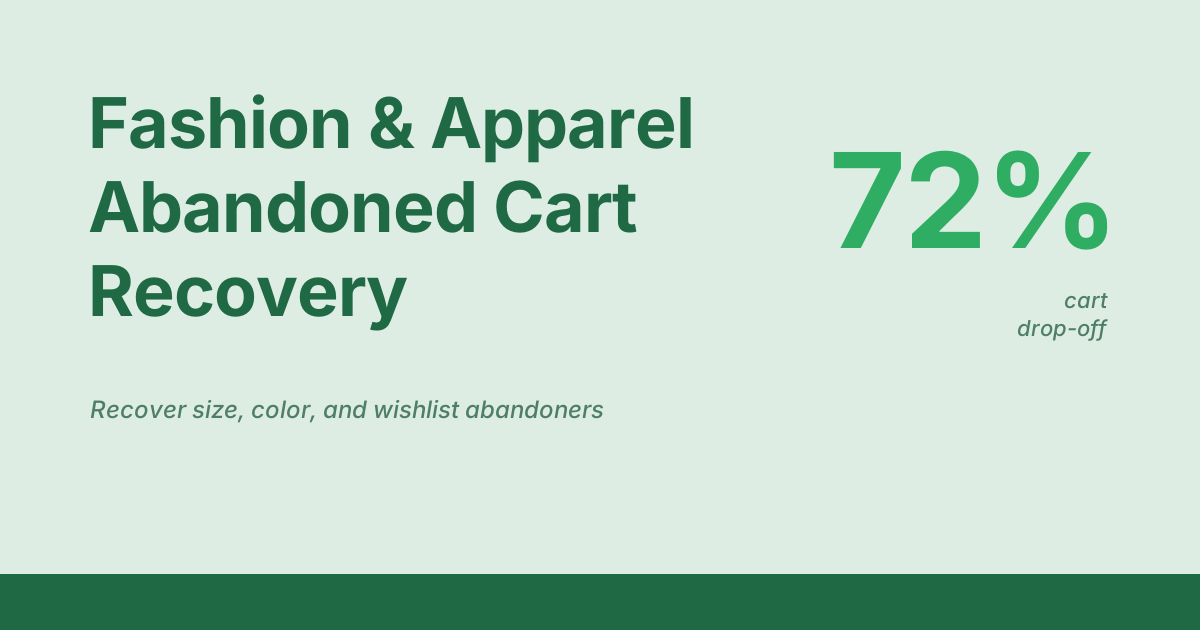
- Fashion and apparel stores have cart abandonment rates of 68-72%, with unique drivers like size uncertainty, color comparison, and "add to cart as wishlist" behavior.
- Standard abandoned cart emails ("You left something behind!") underperform for fashion because they do not address the actual reason the shopper left — which is often uncertainty, not forgetfulness.
- Effective fashion cart recovery addresses specific objections: size confidence, styling context, social proof from similar shoppers, and easy returns.
- Visitor identification (Capture) is especially valuable for fashion because shoppers often browse across multiple sessions and devices before purchasing — and most of those sessions are anonymous.
- Fashion stores using Capture with Klaviyo flows tailored to apparel-specific objections can recover significantly more than stores using generic recovery emails.
Why fashion cart abandonment is different
The top reasons fashion shoppers abandon carts
| Reason | % of fashion abandoners | How it differs from other categories |
|---|---|---|
| Not sure about size/fit | 35-40% | Unique to apparel — does not exist for electronics or home goods |
| Comparing across multiple stores | 30% | Higher in fashion due to many options at similar price points |
| Added to cart as "save for later" | 25-30% | Fashion shoppers use the cart as a wishlist more than other categories |
| Waiting for a sale or discount | 20-25% | Fashion has frequent sales cycles, training shoppers to wait |
| Shipping cost too high | 18-22% | Standard across categories, but fashion shoppers are especially sensitive |
| Just browsing / not ready | 15-20% | Standard across categories |
The key difference: For electronics or home goods, abandonment is usually about price or trust. For fashion, it is primarily about uncertainty — "Will this fit? Will it look good on me? Should I get the blue or the black?"
This means your recovery emails need to answer different questions than a standard "you forgot something" reminder.
Fashion-specific recovery email strategies
Strategy 1: Address size uncertainty head-on
The problem: The #1 reason fashion shoppers abandon is size uncertainty. A generic reminder email does not address this.
The solution: Include size-specific content in your recovery email:
- Link to your size guide or fit guide
- Include "true to size" customer feedback
- Mention easy returns/exchanges: "Not sure about the size? Free exchanges on all orders"
- If available, reference the shopper's previous purchase sizes: "You usually wear a Medium in our tops"
Email subject line examples:
- "Not sure about the fit? Here's our size guide for [Product]"
- "[Product Name] — see what customers your size are saying"
Strategy 2: Show the product in context
The problem: Fashion products in a cart look like flat images. Shoppers cannot visualize how the item looks on a real person, styled with other pieces.
The solution: Recovery emails that show the product being worn:
- Include user-generated content (UGC) or lifestyle images
- Show "style it with" suggestions — what other products pair well
- Include Instagram or social media images from real customers
Strategy 3: Leverage social proof from similar shoppers
The problem: Generic "4.8 stars from 500 reviews" does not help a shopper who wants to know if the product works for their body type or style.
The solution: Use targeted social proof:
- Filter reviews by size: "What customers who ordered a size M are saying"
- Show specific testimonials about fit, comfort, and quality
- Include "most popular size" data: "78% of customers order their regular size"
Strategy 4: Handle the "add to cart as wishlist" behavior
The problem: Many fashion shoppers add items to cart without purchase intent — they are saving items to compare later or to decide between options.
The solution: Treat these contacts differently:
- Email 1: "Your saved items" rather than "Your abandoned cart"
- Include all items viewed (not just those in cart) as recommendations
- Frame the email as helpful ("We saved these for you") rather than urgent ("Don't miss out!")
Strategy 5: Create urgency without discounting
The problem: Fashion shoppers are trained to wait for sales. Offering an immediate discount in recovery emails accelerates this behavior.
Better urgency signals:
- "Only 3 left in your size" (low stock, specific to their likely size)
- "This item is trending — 45 people viewed it today"
- "Your cart will expire in 48 hours" (scarcity of convenience, not price)
- "New arrivals dropping Friday — complete your look before they sell out"
The identification challenge for fashion
Fashion shopping journeys are especially fragmented:
- Discovery: Shopper sees an Instagram ad → visits store on mobile → browses 10 products → leaves
- Comparison: Shopper Googles the brand → visits on desktop → compares 3 items → adds 2 to cart → leaves
- Decision: Shopper returns via direct URL → reviews cart → removes 1 item → checks size guide → leaves again
- Purchase: Shopper returns 4 days later → completes checkout
Across these 4 visits, the shopper may use 2-3 different devices and be anonymous on most of them. Klaviyo might identify them on visit 3 (if they entered their email at checkout) — but by then, they have already visited the store three times with no recovery email.
Capture identifies shoppers at visit 1 or 2, when they first show interest. This means the recovery email can start working from the beginning of the shopping journey — not after the shopper has already made most of their decision.
Recommended Klaviyo flow for fashion
| Timing | Content | Fashion-specific element | |
|---|---|---|---|
| Email 1 | 2-4 hours | Product reminder with image | Size guide link + "free exchanges" |
| Email 2 | 24 hours | Social proof | Reviews filtered by the likely size, UGC photos |
| Email 3 | 48 hours | Style suggestion | "Complete the look" with complementary items |
| Email 4 | 5-7 days | Low stock alert | "Only [X] left in size [Y]" (if applicable) |
Why 4 emails instead of 3: Fashion decision cycles are slightly longer than average (shoppers compare more), and the "styling" email (Email 3) is unique to apparel and adds value rather than just urgency.
Common mistakes in fashion cart recovery
Mistake 1: Generic product images in recovery emails
Fashion is visual. A flat product shot on a white background does not inspire a purchase. Use lifestyle images, model photos, or UGC in your recovery emails.
Mistake 2: Ignoring size as an objection
If 35-40% of your abandoners left because of size uncertainty, and your recovery email does not mention sizing at all, you are not addressing the actual barrier to purchase.
Mistake 3: Discounting immediately
Fashion shoppers already expect sales. Offering a discount in Email 1 trains them to always abandon first. Use non-discount urgency (low stock, trending item) in Emails 1-3, and consider a small incentive only in Email 4 if needed.
Mistake 4: Only recovering cart abandoners
Fashion browse abandonment is massive — shoppers view dozens of products before adding anything to cart. Without a browse abandonment flow powered by Capture, you are missing the largest segment of potential recoveries.
Next step
If your fashion Shopify store is recovering abandoned carts with generic emails that do not address sizing, styling, or comparison shopping, start by tailoring your Klaviyo flows. If your flows only reach 15% of abandoners, activate Capture to expand your recoverable audience.
→ Start free trial → Learn more about Capture → Complete guide: Shopify Abandoned Cart Recovery: Complete Guide
FAQs
What is the average cart abandonment rate for fashion Shopify stores?
Should I include a discount in fashion recovery emails?
Does Capture work well for fashion stores?
Should I show all abandoned cart items or just the most-viewed one?
How does browse abandonment apply to fashion?
About Attribuly
Attribuly helps DTC brands recover abandoned cart revenue. We identify anonymous visitors and existing subscribers your ESP (like Klaviyo) missed, enrich their profiles, and feed the signals back — so your abandonment flows fire and your retargeting audiences grow, and you recover at least 15% more revenue. Shopify featured app, Klaviyo tech partner. Trusted by 20,000+ brands. Guaranteed 4× ROI.