
What Is Anonymous Visitor Identification for Shopify?
Anonymous visitor identification helps Shopify stores match unknown website visitors to email addresses — so more shoppers can enter recovery flows and retargeting audiences.
Related articles
TL;DR
- Anonymous visitor identification matches unknown Shopify visitors to contact information, typically an email address.
- Most stores can only recognize 2–15% of visitors with native capture methods, which leaves most abandoners unreachable by Klaviyo.
- Identification tools match first-party session signals to consent-based identity networks and then sync identified contacts to platforms like Klaviyo.
- Identified contacts can power abandoned cart and browse abandonment flows, retargeting audiences, and AI-generated recovery email.
- This is not the same as buying lists: reputable tools rely on permissioned, consent-based data sourcing.
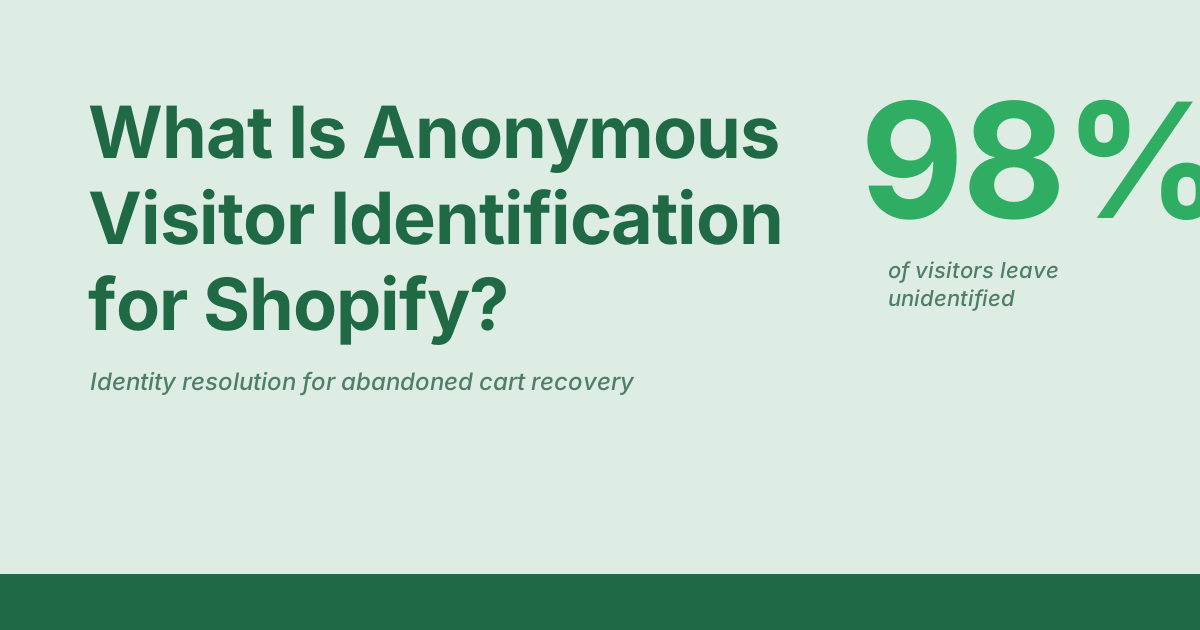
Most Shopify traffic is anonymous. Shoppers can view products, add to cart, and even start checkout without ever submitting an email. When they leave, your recovery tools can only follow up if the visitor is already known.
This guide explains what anonymous visitor identification is, how it works, what match rates to expect, and how Shopify teams use it to recover more abandoned carts through Klaviyo and retargeting.
Definition: What is anonymous visitor identification?
Anonymous visitor identification is a technology that matches unknown website visitors to known contact information, usually an email address, without requiring the visitor to fill out a form or log in.
It helps ecommerce teams reach shoppers who would otherwise leave the site with no way to follow up.
Anonymous visitor identification is not the same as
- Email popups, which require the shopper to submit their email.
- Login tracking, which requires an account and a logged-in session.
- Klaviyo’s pixel alone, which only recognizes previously cookied subscribers.
- Buying email lists, which typically lack consent and relationship context.
Why does this matter for Shopify stores?
Shopify stores have a visibility gap: most visitors never become identified. That means they never enter abandoned cart flows, they are excluded from email-based retargeting audiences, and they generate no recovery revenue after they leave.
| Visitor type | Typical % of traffic | Can Klaviyo reach them? |
|---|---|---|
| Logged-in customers | 1–3% | Yes |
| Email subscribers (cookied) | 5–12% | Yes (if cookie is active) |
| Anonymous visitors | 85–97% | No |
Anonymous visitor identification reduces this gap by matching some unknown sessions to emails, making more shoppers reachable for recovery and retargeting.
How does anonymous visitor identification work?
The process typically follows four steps.
- A visitor arrives at your Shopify store. They browse, add to cart, or start checkout, but do not submit an email or log in.
- Session signals are captured. Tools capture first-party signals from the browsing session that can be matched against an identity network.
- Identity matching occurs. Signals are compared to a consent-based identity graph. When a match is found, an email address is associated with the session.
- The identified contact is delivered. The email is synced to a destination like Klaviyo, or used by the platform’s own recovery email system.
The core idea is that you are not collecting email on your site in that moment. You are matching a session to a known identity that was collected elsewhere through consent-based data programs.
What is the typical identification rate?
Match rates vary based on traffic and device mix, but many tools report higher match rates on US desktop traffic.
| Factor | Impact on match rate |
|---|---|
| Geographic location | US traffic tends to match higher; international traffic is usually lower. |
| Traffic source | Returning and ad-driven traffic often matches higher than first-time organic. |
| Device type | Desktop typically matches higher than mobile Safari due to privacy limits. |
| Identity network size | Larger consent-based networks tend to improve match coverage. |
Many ecommerce identification tools report match rates in the range of 15–35% for US traffic. What matters more than match rate is whether the identified contacts have purchase intent and engage with recovery emails.
When should a Shopify store use visitor identification?
Most valuable when
- Klaviyo recovery flows only reach a small fraction of abandoners.
- You invest in paid ads and want to recover more paid traffic after it leaves.
- Your email capture rate is low despite popups and forms.
- You have US-heavy traffic, where match rates tend to be higher.
- Your AOV justifies the cost of identifying additional shoppers.
Less effective when
- Most traffic is outside the US.
- Your email capture rate is already very high (30%+).
- Traffic volume is too low to generate meaningful identified contacts.
- You do not have recovery flows built in Klaviyo or another system.
How does Attribuly's Capture feature work?
Attribuly Capture identifies anonymous shoppers who view products, add items to cart, or start checkout, and syncs identified emails to Klaviyo or routes them into Attribuly's AI Email Agent for recovery.
| Capability | Standalone ID tools | Attribuly Capture |
|---|---|---|
| Identify anonymous visitors | Yes | Yes |
| Send contacts to Klaviyo | Yes | Yes |
| Server-side event tracking | Usually no | Yes (built-in) |
| Conversion signal to Meta/Google | Usually no | Yes (Conversion Feed) |
| AI-generated recovery emails | Usually no | Yes (AI Email Agent) |
| Attribution context per shopper | No | Yes (built-in) |
Because identification, tracking, and recovery sit in one system, Capture can help teams avoid stitching together multiple tools just to reach more abandoners.
Common mistakes with visitor identification
Mistake 1: Expecting identification to replace email capture
Identification supplements popups, forms, and checkout email collection. The best outcomes usually come from combining native capture with identification.
Mistake 2: Focusing only on match rate
A higher match rate does not guarantee more revenue. Ask about downstream quality metrics like engagement, conversion rate, and recovered revenue per identified contact.
Mistake 3: Not monitoring deliverability
Identified contacts can behave differently than organic subscribers. Monitor spam complaints and inbox placement, especially during the first 30 days.
Mistake 4: Using identification without recovery infrastructure
Identification is step one. Without well-designed flows in Klaviyo (or another system), identified contacts may never turn into recovered revenue.
Before you test a tool
- Confirm consent-based sourcing and compliance posture (CAN-SPAM, CCPA, GDPR).
- Segment identified contacts so you can compare engagement vs organic subscribers.
- Track downstream metrics: flow conversion rate and recovered revenue, not just match rate.
FAQs
Is anonymous visitor identification the same as buying email lists?
Does visitor identification work on mobile?
How does identification affect Klaviyo deliverability?
Can I use identified contacts for Meta or Google retargeting?
How quickly do identified contacts appear in Klaviyo?
What does anonymous visitor identification cost?
About Attribuly
Attribuly helps DTC brands recover abandoned cart revenue. We identify anonymous visitors and existing subscribers your ESP (like Klaviyo) missed, enrich their profiles, and feed the signals back — so your abandonment flows fire and your retargeting audiences grow, and you recover at least 15% more revenue. Shopify featured app, Klaviyo tech partner. Trusted by 20,000+ brands. Guaranteed 4× ROI.