
How AI Email Recovery Works for Shopify Abandoned Carts
Standard abandoned cart emails send the same message to every shopper. AI email recovery generates a different email for each person based on what they did on your store.
Related articles
TL;DR
- AI email recovery uses shopper behavior (products viewed, cart items, checkout progress) to generate a personalized recovery email for each individual.
- It is most useful for newly identified contacts from visitor identification, who may not recognize your brand and can respond poorly to generic templates.
- AI-generated emails are not a replacement for well-designed Klaviyo flows. They work best as a complement for segments where templates underperform.
- AI recovery can often run alongside your existing Klaviyo setup without changing your core flows.
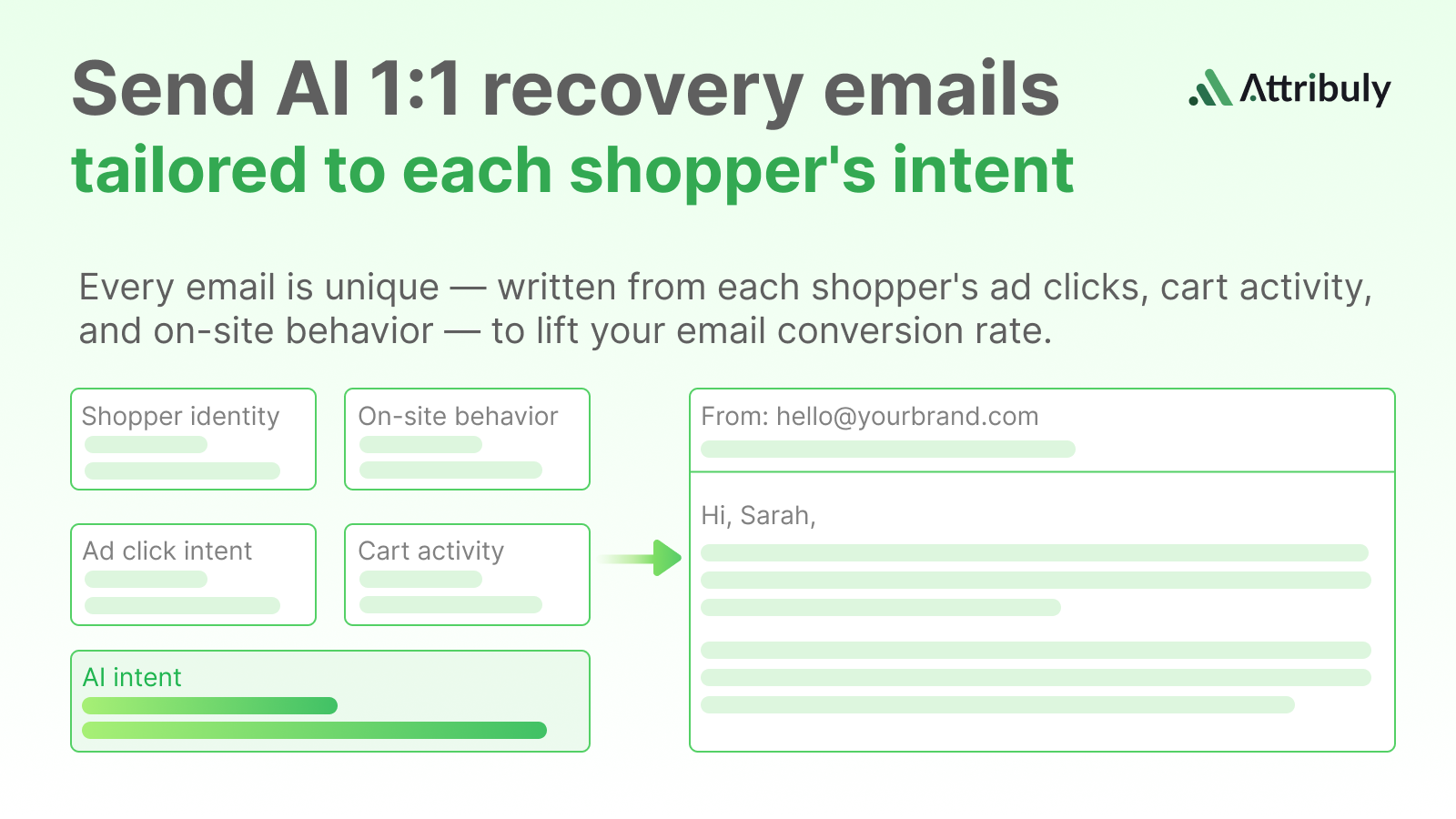
Standard abandoned cart emails send the same message to every shopper. AI email recovery generates a different email for each person based on what they did on your store.
This article explains how it works, when it matters, and what to expect if you already run Klaviyo.
What is AI email recovery?
AI email recovery is an automated process that generates personalized abandoned cart emails for individual shoppers using their behavioral data.
Signals commonly used for generation
- Which products they viewed
- What they added to cart
- How far they progressed through checkout
- How long they spent on site
- Whether they are new or returning
The goal is relevance: the email reflects the shopper's session, not a generic reminder.
How is this different from Klaviyo's personalization?
Klaviyo templates can include dynamic blocks (product images, names, prices). That is a powerful kind of personalization for known subscribers. AI email recovery goes further by generating the actual message structure and copy based on intent signals.
| Dimension | Klaviyo template personalization | AI email recovery |
|---|---|---|
| What is personalized | Product blocks inserted into a fixed template | Entire email message generated from behavior |
| Structure | Same structure for every recipient | Structure can adapt (browse vs checkout abandon) |
| Tone & framing | Fixed brand copy | Can shift based on signals and familiarity |
| Best for | Known subscribers | Newly identified contacts and edge segments |
| Setup effort | Manual template design | Automated generation with rules/guardrails |
The key distinction is scope: AI recovery is usually most valuable for specific segments where your best template is still not the right message.
Why do standard templates underperform for some segments?
Scenario 1: Newly identified contacts
When a visitor identification tool identifies an anonymous shopper and syncs them into Klaviyo, that person enters your flow but they never opted in. They may not recognize your brand name, so a generic “you left something in your cart” email can feel confusing or intrusive.
AI recovery can shift to product-first context and reduce assumptions about brand familiarity.
Scenario 2: Browse abandonment (no cart)
Some shoppers browse products but never add to cart. Cart templates assume there is a cart. A better message frames products as recommendations and uses the browsing context.
Scenario 3: High-consideration products
For higher-AOV products, the barrier is often uncertainty, not urgency. AI recovery can include relevant support content like comparison points, FAQs, fit guidance, or social proof based on the category.
How does AI email recovery work technically?
- Behavior is captured: product views, add-to-cart, checkout steps, time on site.
- Identity is resolved: behavior links to an email (via native ESP identity or a visitor identification tool).
- A personalized email is generated: copy, structure, and CTA adapt based on session signals.
- Email is sent: either through an ESP flow (content injection) or through the AI system's own sending pipeline.
- Performance is measured: open rate, click rate, conversion, complaints, and lift vs baseline templates.
When should you use AI email recovery?
AI recovery tends to add the most value when reach expands and templates become less effective for the new audience.
| Situation | Why AI email helps |
|---|---|
| You use visitor identification (Capture) | Newly identified contacts need more relevant, product-first messaging. |
| Your AOV is $50+ | Higher-value purchases benefit from tailored support content and framing. |
| Cart abandonment is high | More abandoners means more surface area for lift. |
| Template performance is declining | AI can refresh approach without constant manual redesign. |
| You lack a dedicated email marketer | AI reduces the manual workload of writing and iterating messaging. |
AI recovery may be less necessary if
- Your recovery flow conversion rates are already strong for all segments.
- Most recoverable shoppers are opted-in subscribers with high brand affinity.
- Your traffic volume is too low to evaluate incremental lift reliably.
- Your catalog is very small and messaging is naturally simple.
How Attribuly's AI Email Agent works
Attribuly's AI Email Agent is designed to work alongside your existing Klaviyo setup or as a standalone recovery tool.
What it does
- Receives shopper behavior data from Attribuly tracking.
- Generates recovery emails tailored to each shopper session.
- Can send emails directly or feed content into flows, depending on setup.
- Often targets Capture-identified contacts as the primary audience.
What it does not do
- It does not replace your entire Klaviyo program (newsletters, promos, loyalty).
- It does not guarantee a specific conversion rate.
- It does not fix product page or checkout UX issues that cause abandonment.
Product relevance: Capture solves “who to email.” AI Email Agent helps solve “what to email” for the newly reachable audience.
Learn more: AI Email Agent
Common mistakes with AI email recovery
Mistake 1: Using AI email for your entire list
AI recovery often performs best for segments where templates underperform, especially newly identified contacts. For engaged subscribers, your best Klaviyo templates may already be optimal.
Mistake 2: Not monitoring deliverability
Start with a segment and monitor spam complaints, bounces, and engagement. Expand only when metrics are stable.
Mistake 3: Expecting AI to fix a broken product page
If abandonment is driven by unclear pricing, weak product pages, or a confusing checkout, better emails won't solve the root problem.
Mistake 4: Ignoring the connection to identification
AI is only as valuable as the audience it can reach. Without identification expanding reach, AI is limited to the same small portion of shoppers you already email today.
Next step
If you're already using visitor identification (or planning to), AI email recovery can improve conversion by sending more relevant messages to newly reachable shoppers.
FAQs
Does AI email recovery replace Klaviyo?
How is AI email different from Klaviyo's dynamic content?
Do AI emails have higher open rates?
Can I review what the AI generates before it sends?
How quickly can I start using AI email recovery?
What does AI email recovery cost?
About Attribuly
Attribuly helps DTC brands recover abandoned cart revenue. We identify anonymous visitors and existing subscribers your ESP (like Klaviyo) missed, enrich their profiles, and feed the signals back — so your abandonment flows fire and your retargeting audiences grow, and you recover at least 15% more revenue. Shopify featured app, Klaviyo tech partner. Trusted by 20,000+ brands. Guaranteed 4× ROI.