
Abandoned Cart Email Timing: How Many Emails to Send and When
How many abandoned cart emails should you send, and when? Here's the timing data for standard cart abandonment, checkout abandonment, and high-AOV products.
Related articles
TL;DR
- The standard abandoned cart email sequence is 3 emails: 1-4 hours, 24 hours, 48-72 hours.
- Checkout abandonment (higher intent) needs faster timing: first email within 30-60 minutes.
- High-AOV products ($150+) benefit from 4-5 emails over 7-10 days — decision cycles are longer.
- More than 3-4 emails for standard products increases unsubscribes without proportional conversion improvement.
- Timing optimization is a secondary concern: if your flow is only reaching 14% of abandoners, timing changes produce marginal improvement compared to fixing reach.
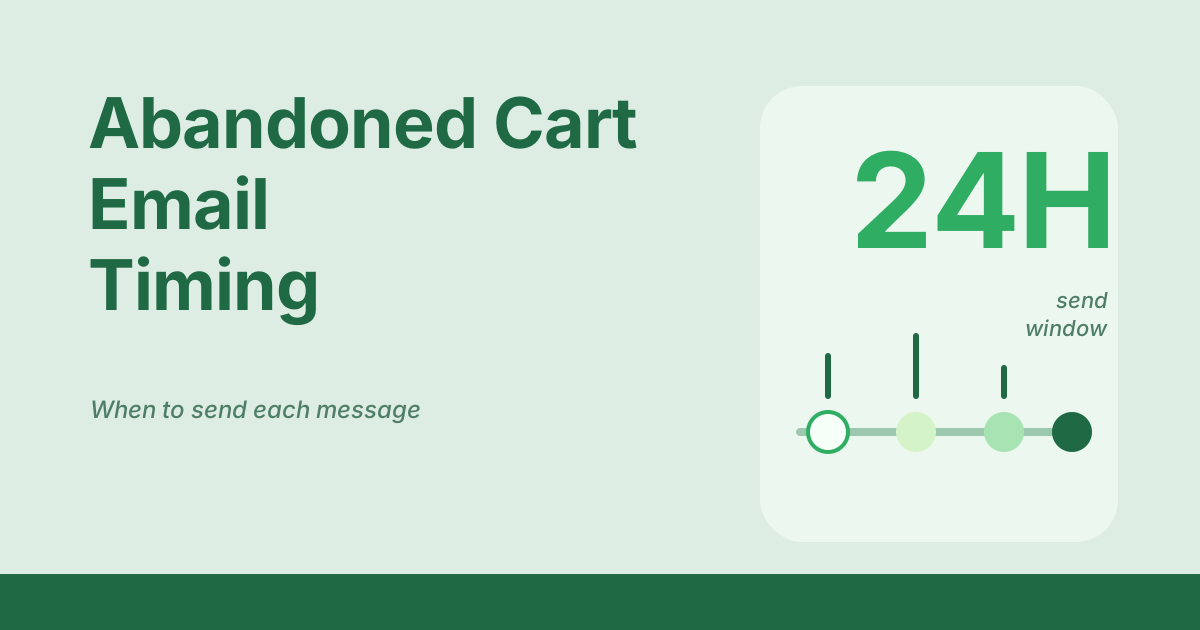
Standard abandoned cart email timing
The 3-email sequence
| Send time | Purpose | Subject line angle | |
|---|---|---|---|
| Email 1 | 1-4 hours after abandonment | Simple reminder while intent is high | "Your [Product Name] is waiting" |
| Email 2 | 24 hours after Email 1 | Address hesitation with social proof | "What customers say about [Product]" |
| Email 3 | 48-72 hours after Email 2 | Final push, optional incentive | "Last chance" or "Here's 10% off" |
Why 1-4 hours for Email 1: Purchase intent is highest immediately after abandonment. Klaviyo community data and multiple industry benchmarks consistently show that emails sent within the first few hours outperform those sent 12+ hours later. The 1-4 hour range allows for session completion (some shoppers return on their own within 60 minutes) while still catching high-intent abandoners.
Why 24 hours for Email 2: This catches shoppers who saw Email 1 but weren't ready to act, gives time for the purchase decision to advance or stall, and avoids sending two emails in rapid succession (which increases unsubscribes).
Why 48-72 hours for Email 3: By day 3-4, a shopper who hasn't converted has likely moved on or is in active comparison mode. This is the last realistic opportunity for a standard sequence. Email 3 with a modest incentive (free shipping, 10% off) can convert the remaining "I needed a push" segment.
Checkout abandonment timing (different, faster)
Checkout abandonment requires significantly faster timing than cart abandonment because the shopper's intent was actively demonstrated — they entered their email, possibly their shipping details, and may have started payment.
| Send time | Purpose | |
|---|---|---|
| Email 1 | 30-60 minutes | Direct, friction-removal focused |
| Email 2 | 4-6 hours | Address potential friction (shipping cost, trust) |
Why so much faster: A shopper who was seconds from purchasing and stopped may have been interrupted, experienced a payment failure, or had a question. Waiting 4 hours to send Email 1 means you're reaching them when they've already mentally moved on. 45 minutes catches them while the purchase is still top of mind.
High-AOV product timing (longer sequence)
For products over $150, the purchase decision cycle is longer. A $300 purchase requires more consideration than a $30 one. A 72-hour sequence ends before most high-AOV shoppers have finished their research.
| Send time | Purpose | |
|---|---|---|
| Email 1 | 2-4 hours | Product reminder with key specs |
| Email 2 | 24 hours | Social proof — detailed reviews |
| Email 3 | 48 hours | Comparison / "is this right for you?" |
| Email 4 | 5 days | Objection handling (returns, warranty, financing) |
| Email 5 (optional) | 7-10 days | Final incentive (BNPL option or modest discount) |
The timing rationale: High-AOV shoppers conduct research across multiple sessions and sources. Spacing emails over 7-10 days keeps your brand visible during the active consideration period without feeling aggressive.
How many abandoned cart emails should you send?
The answer depends on your product:
| Product AOV | Recommended sequence | Total emails |
|---|---|---|
| Under $50 | 3 emails, 3 days | 3 |
| $50-$150 | 3 emails, 3-5 days | 3 |
| $150-$500 | 4 emails, 7 days | 4 |
| $500+ | 5 emails, 10-14 days | 4-5 |
Why not more for all products: For low-AOV products, a shopper who hasn't converted after 3 emails and 72 hours typically won't convert from Email 4. The marginal recovery from additional emails is outweighed by unsubscribe risk and deliverability impact.
Why more for high-AOV: Decision cycles are genuinely longer. A shopper researching a $500 e-bike over 4 weeks needs touchpoints spread over that window — Email 3 on day 2 doesn't reach them at the right moment.
What happens when you send too many emails
Sending 5-7 emails for a $40 product does not increase recovery — it increases unsubscribes. Klaviyo's benchmark data shows that unsubscribe rates climb sharply after the 3rd email in a standard sequence, without proportional improvement in conversion rate.
The result: a smaller, less engaged list that becomes harder to market to over time. For most stores, 3 emails is the practical ceiling for standard products.
The bigger timing problem most stores overlook
Every timing optimization above assumes the emails are being sent at all.
Your abandoned cart flow can only trigger for shoppers Klaviyo has identified. Native tracking identifies approximately 14% of cart abandonment events. The remaining 86% of abandoners never receive an Email 1, let alone an Email 2 or Email 3 — regardless of your timing configuration.
For a store with 1,000 monthly cart abandoners:
- At 14% trigger rate: 140 abandoners enter your flow
- At 40% trigger rate (with ReCapture): 400 abandoners enter your flow
Optimizing Email 1 timing from 2 hours to 1 hour might improve conversion of those 140 by 5-10%. Improving trigger rate from 14% to 40% nearly triples the population your optimized timing applies to.
Fix reach before timing. Always.
Next step
Before adjusting timing, check your trigger rate. The right timing applied to 14% of abandoners produces a fraction of the results it should.
→ Start free trial → Learn how ReCapture improves your flow entry rate
About Attribuly
Attribuly helps DTC brands recover abandoned cart revenue. We identify anonymous visitors and existing subscribers your ESP (like Klaviyo) missed, enrich their profiles, and feed the signals back — so your abandonment flows fire and your retargeting audiences grow, and you recover at least 15% more revenue. Shopify featured app, Klaviyo tech partner. Trusted by 20,000+ brands. Guaranteed 4× ROI.