Ecommerce Marketing Attribution: 6 Best Practices to Improve ROAS
Learn 6 ecommerce marketing attribution best practices to improve ROAS — from reconciling backend orders to fixing tracking, identifying shoppers, and validating with incrementality.
相关文章
要点
- Here's the uncomfortable truth: attribution fails before any model ever runs.
- Your backend order data is the one ledger that can't lie.
- Once you know where the gaps are, close them.
- Most attribution conversations skip a fundamental question: how can you attribute anything when you don't know who's on your site?

Your ad platforms say one thing. Your backend says another. If you've ever stared at a Meta dashboard showing a 4x return while your accountant calmly asks where the profit went, you already know the problem: most ecommerce marketing attribution runs on incomplete data.
Every week, brands move budget based on ROAS numbers that silently exclude a large share of real shopping behavior. Ad blockers, iOS privacy prompts, consent banners, and cross-device gaps all chip away at what platforms can see. Fix the data, and everything else — model selection, budget allocation, creative decisions — gets easier.
This guide walks through six best practices, from reconciling backend orders to validating your models with incrementality. Along the way, I've included real examples of brands that closed the data gap and improved ROAS as a result. Let's dig in.
Why Ecommerce Marketing Attribution Data Breaks
Here's the uncomfortable truth: attribution fails before any model ever runs. The tracking layer itself is leaky.
Ad blockers hide an estimated 15–35% of client-side events on desktop, according to SignalBridge's 2026 server-side tracking benchmark.
iOS tracking prompts get opt-in from only about a quarter of users, per IAPP research, which pushes most iPhone sessions out of platform reporting.
Layer in consent refusals and cross-device gaps, and the same analysis estimates that 30–50% of conversions never reach your reports at all.
One more myth to retire: the cookieless apocalypse never happened. Google abandoned its third-party cookie phase-out and, in April 2025, dropped the standalone consent prompt entirely, as Reuters reported. Chrome still uses third-party cookies by default in 2026. But that's no reason to relax — partial cookie loss, consent refusals, and cross-device fragmentation still distort what platforms report as ROAS.
So before you debate models, fix the data. That's the whole game.
Step 1: Reconcile Every Channel Against Backend Orders
Your backend order data is the one ledger that can't lie. Shopify records what actually sold, for how much, and when. Platform-reported conversions aren't facts — they're claims about which touchpoint deserves credit. Treat them that way.
Build a weekly reconciliation ritual: export orders for the period, match them to platform-reported purchases by order ID, timestamp, and UTM, then calculate the gap. In practice, a 10–15% difference is normal variance from attribution windows and modeled conversions. Anything above 15% deserves investigation. A gap approaching 40% means something is broken — often duplicate events, misfiring pixels, or click IDs stripped by redirects.
This foundation underpins every ecommerce marketing attribution decision you'll make, which is why it belongs at the top of the stack. If you're unsure where to start, a Shopify attribution buyer's guide walks through the reconciliation setup in detail.
Step 2: Fix the Tracking Foundation
Once you know where the gaps are, close them. Three fixes do most of the heavy lifting.
Standardize your UTM taxonomy. Tag every external inbound link, never tag internal links (it overwrites your acquisition source), keep values lowercase and documented, and align utm_medium with GA4's channel groupings. Most "direct" traffic mysteries start here. Here's a UTM taxonomy checklist you can copy.
Capture and persist click IDs. gclid, fbclid, fbc, fbp, ttclid, msclkid — every platform has its own. Make sure they're captured on landing, survive redirects, and get mirrored into your backend so delayed conversions can be matched later.
Move to server-side tracking. Meta Conversions API and Google Enhanced Conversions send hashed first-party data from your server, recovering a meaningful share of lost conversions. The critical detail is deduplication: generate one event_id per conversion and send the same ID in both browser and server events. Think of it like a receipt number — both sides hand the platform the same receipt, so it knows they're describing one purchase, not two.
Step 3: Identify Anonymous Shoppers
Most attribution conversations skip a fundamental question: how can you attribute anything when you don't know who's on your site? Out-of-the-box ecommerce tracking typically identifies only around 14–15% of behavioral events — the vast majority of shoppers browse, add to cart, and leave without ever identifying themselves. Visitor identification closes that gap by matching anonymous sessions to real people through browsing signals and an identity graph. In practice, identity resolution for ecommerce lifts the identifiable share of traffic from that ~14% baseline to 25–55% of US visitors.
The revenue impact shows up fast. A leading consumer healthcare DTC brand, restricted from paid social categories, used anonymous-visitor identification to capture 20,000+ enriched emails from high-intent sessions — a 41x lift in email capture versus self-subscribed opt-ins (a first-party case study from Attribuly's published library). A consumer-electronics accessories brand took a similar route, rebuilding measurement on privacy-resilient, verified tracking and reaching 98% data reliability while doubling its retargeting audiences (published case study).
Would you make budget decisions knowing you could see only 14% of your shoppers? Because that's the data most platforms are working with.
Step 4: Choose an Attribution Model for the Right Question
No attribution model is "correct." Each one answers a different business question, and the fastest way to undermine trust in your numbers is to force one model to answer everything.
Model | What it credits | Use it when | Watch out |
|---|---|---|---|
First-click | 100% to the first touchpoint | You want to know which channels introduce new shoppers | Overvalues discovery, ignores the rest of the funnel |
Last-click | 100% to the final touchpoint | You need to know what closes sales right now | Overcredits retargeting and branded search |
Linear | Equal credit to every touchpoint | You want a simple multi-touch view of long journeys | Treats every touch as equally important |
Multi-touch | Credit split across touchpoints by rule or algorithm | You're allocating a full-funnel budget | Demands clean tracking and enough volume |
A couple of practical caveats. First, GA4's data-driven attribution silently falls back to last-click below roughly 400 conversions per key event, as Cometly's analysis notes — check your volume before trusting algorithmic output. Second, keep it simple: single-touch models are fine for channel reporting, while multi-touch models earn their complexity when you're making budget decisions on multi-session journeys.
Step 5: Turn Clean Attribution Data into Revenue
Clean data only matters if it changes what you do next. Here's what happens when it does.
FunnyFuzzy, a Shopify-based pet accessories brand, rebuilt its ecommerce marketing attribution on real-time multi-channel tracking and grew revenue 8x in about six months — while recovering 57% more abandoned carts through email and doubling its Meta audiences (published case study). Sylvox took a different route: after identifying anonymous visitors and syncing enriched events into its Klaviyo flows, email revenue rose 15% in four weeks, growing from 17% to 29% of total revenue (published case study). Both examples come from Attribuly's first-party case library, so treat them as instructive outcomes rather than independent benchmarks.
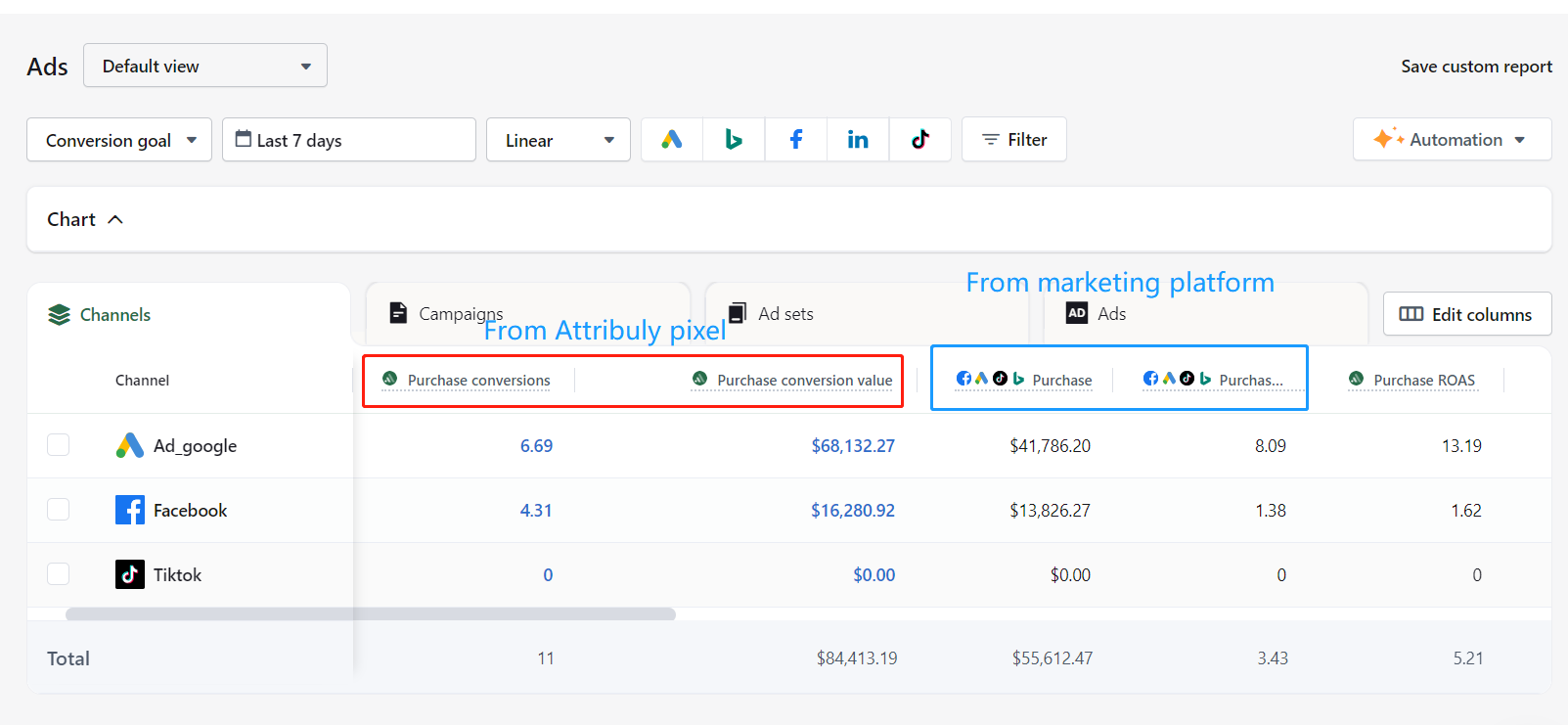
A channel-level view of that clean data looks something like this:

Different brands, same pattern. Better attribution data feeds better audiences, sharper flows, and smarter budget moves. That's the entire payoff of this exercise.
Step 6: Validate with Blended ROAS and Incrementality
Every attribution model has blind spots. The fix isn't to hunt for a perfect model — it's to check your conclusions against numbers that can't be double-counted.
Start with blended ROAS and marketing efficiency ratio (MER). Blended ROAS is total revenue divided by total ad spend; MER is total revenue divided by total marketing spend. Neither depends on attribution, which makes them a reliable sanity check: if a model says retargeting is wildly profitable but blended ROAS disagrees, trust the latter. Shopify's guide to MER explains the math simply.
Then add incrementality testing. It's gone mainstream: EMARKETER reports that 52% of US brand and agency marketers run incrementality tests, and brands acting on the results report 15–30% marketing-efficiency improvements by cutting non-incremental spend, per LayerFive's attribution research.
Make this a quarterly ritual, not a one-off. Compare attribution outputs against blended ROAS, run holdout tests on your biggest spend channels, and adjust. For a deeper playbook, see Retargeting Incrementality: Measuring ROAS & CLV.
Keep Your Attribution Honest
Attribution will never be a perfect mirror of your customer journey — and it doesn't need to be. It needs to be honest enough to guide decisions. That means committing to a simple cadence:
Weekly: reconcile backend orders against platform-reported purchases; investigate gaps above 15%.
Monthly: review model outputs against blended ROAS and MER; confirm audiences and flows are using clean data.
Quarterly: audit UTMs and click IDs, verify server-side deduplication, and run incrementality tests on your top channels.
Sound like a lot of upkeep? It's an hour a week, and it's the highest-leverage hour in your marketing calendar. Do it consistently, and the quality of every ecommerce marketing attribution decision you make — where to shift budget, which creatives to scale, which channels to cut — compounds. If you'd rather not assemble this stack yourself, platforms like Attribuly bundle server-side tracking, multi-touch attribution, and visitor identification into one system. The right model matters, but the data underneath it matters more.
| Model | What it credits | Use it when | Watch out |
|---|---|---|---|
| First-click | 100% to the first touchpoint | You want to know which channels introduce new shoppers | Overvalues discovery, ignores the rest of the funnel |
| Last-click | 100% to the final touchpoint | You need to know what closes sales right now | Overcredits retargeting and branded search |
| Linear | Equal credit to every touchpoint | You want a simple multi-touch view of long journeys | Treats every touch as equally important |
| Multi-touch | Credit split across touchpoints by rule or algorithm | You're allocating a full-funnel budget | Demands clean tracking and enough volume |
来源与扩展阅读
关于 Attribuly
Attribuly 帮助 DTC 品牌挽回弃购收入。我们识别被你的 ESP(如 Klaviyo)遗漏的匿名访客和已有订阅者,补全他们的画像,并将这些信号回传,让你的弃购流程正常触发、再营销受众持续增长,并帮助你至少多挽回 15% 的收入。 Shopify Featured App,Klaviyo 技术合作伙伴。已获 20,000+ 品牌信任。保证 4× ROI。