
Shopify Attribution Software Complete Buyer’s Guide 2026
Definitive 2026 buyer’s guide to Shopify attribution software — compare server-side solutions, dedup strategies, and vendor scorecards to choose the right tool. Read now.
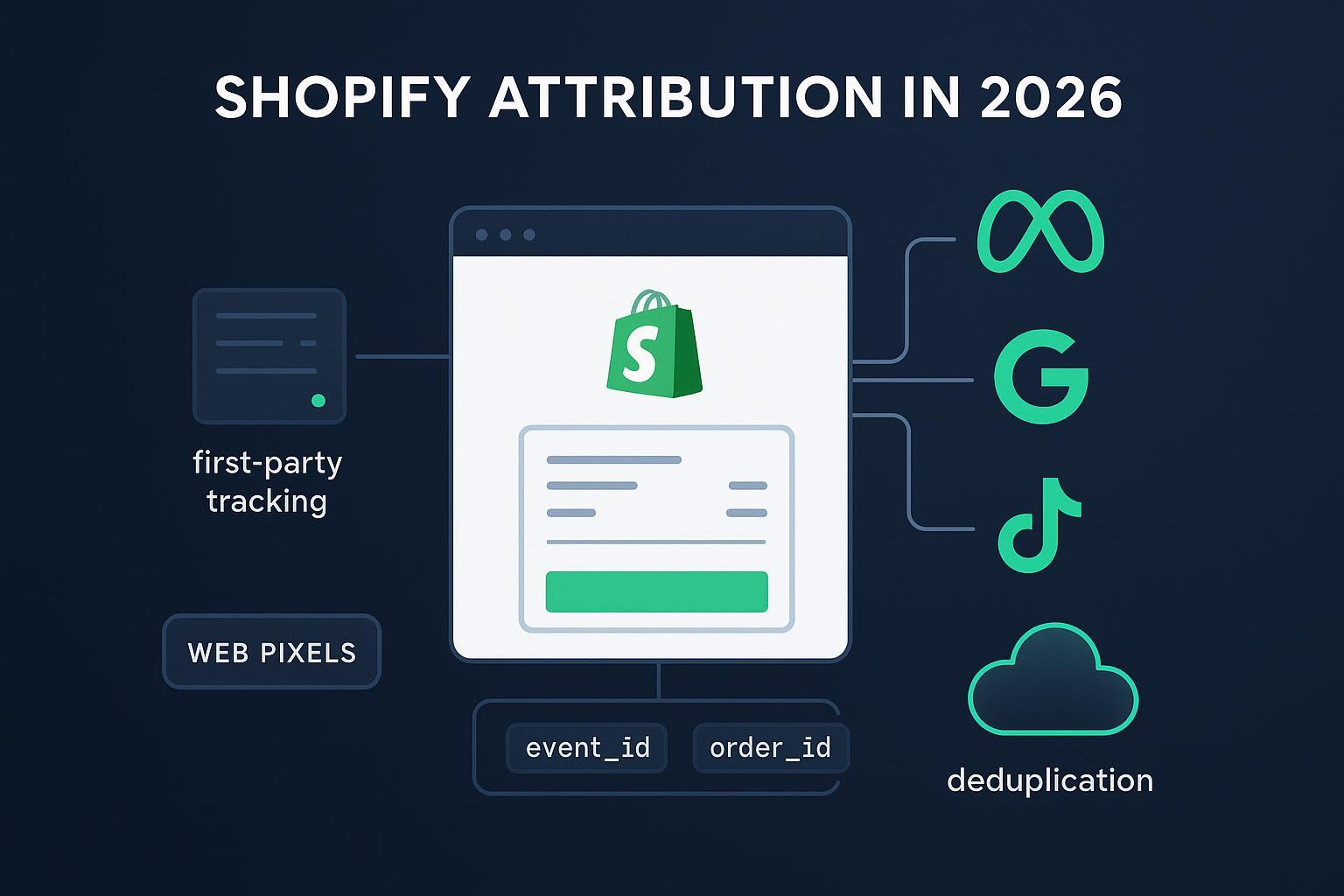
In 2026, accurate performance measurement on Shopify lives or dies by first‑party data and server‑side eventing. Shopify has shifted tracking away from legacy theme scripts toward Web Pixels and Customer Events, while Checkout Extensibility modernizes Thank you/Order status instrumentation. Ad platforms now expect deduplicated, high‑quality conversions that share consistent IDs across browser and server. This guide explains what “Shopify attribution software” actually solves in 2026, how to evaluate vendors, and how to implement a durable setup that stands up to privacy changes and consent rules.
Key takeaways
Treat Shopify Orders as your financial source of truth and use attribution software to reconcile what platforms claim versus what actually cleared in Shopify.
Favor first‑party and server‑side collection with deduplication keys (event_id and order/transaction_id) shared across browser and server for Meta CAPI, Google Enhanced Conversions, and TikTok Events API.
Build on Shopify’s native event architecture—Web Pixels, Customer Events, and Checkout Extensibility—to future‑proof purchase tracking and respect consent.
Standardize attribution windows/models across tools when testing; document assumptions so stakeholders compare like‑for‑like.
Run a controlled 2–4 week vendor trial with parallel reporting, then reconcile by order_id to decide which Shopify attribution software fits your scale, stack, and compliance needs.
What “Shopify attribution software” means in 2026
In 2026, Shopify attribution software is not just a reporting dashboard. It’s the connective tissue that captures commerce events reliably via Shopify’s first‑party mechanisms (Web Pixels, Customer Events, Checkout Extensibility) and server‑side pipes; deduplicates browser and server copies of the same conversion using shared identifiers; normalizes and compares attribution models (last‑click, first‑click, linear, position‑based, time‑decay, data‑driven) against standardized lookback windows; resolves identities across sessions and devices to stitch journeys compliantly; and feeds high‑quality conversions back to ad platforms to improve optimization.
Why numbers differ across systems
Shopify shows booked orders and revenue; GA4 applies a different attribution logic, and ad platforms optimize to their own rules. Aligning windows/models is essential before judging “which number is right.” Google notes that GA4 reporting commonly uses data‑driven attribution by default, so teams should align attribution models and lookback windows when comparing with Ads and other sources. See Google’s guidance in “Creating and managing conversions” (GA4, 2026) for details: Google — Creating and managing conversions (GA4).
Helpful implementation references
Shopify formalized modern event collection through the Web Pixels API and Customer Events, with consent/ privacy controls: Shopify — Build web pixels (developer guide) and Shopify — Pixel privacy (API reference).
Thank you/Order status tracking is migrating off Additional Scripts to Checkout Extensibility; migration guidance is documented for all plans: Shopify Help — Upgrade Thank you and Order status (Plus guide) and Shopify Help — Upgrade guide (non‑Plus).
Buyer criteria: a 7‑point checklist for evaluation
Use the following seven dimensions to compare Shopify attribution software during 2026 trials. Each criterion reflects requirements codified by Shopify and major ad platforms.
Data capture architecture and deduplication A durable setup must collect events via Shopify’s Web Pixels/Customer Events and ensure a persistent dedup key. Meta requires the same event_name + event_id across Pixel and CAPI with time proximity (see Meta — Conversions API docs and Meta Business Help — Best practices & deduplication). Google prioritizes transaction_id consistency across tag and API (see Google Ads API — Upload online conversions and Google Ads — Enhanced Conversions overview). TikTok also hinges dedup on event_id with strong match keys (see TikTok — Events API overview and TikTok — Event deduplication). Your vendor should expose the IDs they pass and the logic they use to avoid double credit.
Server‑side and first‑party support Expect rising signal loss from browser restrictions and consent gating. Your vendor should support server‑side sends (Meta CAPI, Google Enhanced Conversions upload/API, TikTok Events API) with hashing standards and consent awareness. Look for evidence of timely delivery, retry logic, and rate‑limit handling. Meta provides a managed option (CAPI Gateway) documented here: Meta — Conversions API Gateway.
Model options and validation tooling Insist on transparent model definitions and side‑by‑side comparisons against last‑click benchmarks. The tool should let you fix lookback windows and test data‑driven or position‑based models without locking you into a black box. For GA4 model defaults and comparison caveats, see Google — Creating and managing conversions (GA4).
Identity resolution quality Evaluate how emails/phones are normalized and hashed (e.g., SHA‑256), whether first‑party cookies persist across checkout/post‑purchase, and whether CRM/ESP data improves the stitch without violating consent. For match‑key coverage and diagnostics, Meta’s Dataset Quality guidance is useful context: Meta — Dataset Quality API overview.
Shopify ecosystem depth In 2026, Shopify‑native integrations are not optional. Your vendor should work natively with the Web Pixels API, Customer Events, and Checkout Extensibility, and support order‑anchored reconciliation and Shopify Audiences complementarity. Shopify’s enterprise content frames Audiences as a targeting/efficiency layer rather than a measurement replacement: Shopify Enterprise — Multi‑channel attribution and Shopify Enterprise — Audiences overview.
Operational usability and auditability Demand event inspectors, payload previews, and exports that reconcile orders against clicks/impressions. You should be able to trace a single order’s path, diagnose missing match keys, and see why something did or didn’t dedup.
Cost and scalability Match pricing to order volume and channel mix. Consider ongoing maintenance: server costs (if any), data warehousing, and investigation time during high‑volume periods like Q4.
Shopify‑first technical reference (quick, practical)
This section distills the minimum viable technical patterns that a robust Shopify attribution software solution should implement in 2026.
Web Pixels and Customer Events Subscribe to relevant events using Shopify’s Web Pixels API, which supports consent‑aware execution. Developers can register Custom Web Pixels and subscribe to events with analytics.subscribe(...). See Shopify — Build web pixels and Shopify — Pixel privacy.
Example: custom pixel subscription (minimal pattern)
// In a Custom Web Pixel script in Shopify Admin > Customer events
  analytics.subscribe('all_events', async (event) => {
    // Example: capture purchase confirmation and include a unique event_id
    if (event.type === 'checkout_completed') {
      const eventId = crypto.randomUUID();
      window.sessionStorage.setItem('event_id', eventId);
      // Dispatch to vendor endpoint; vendor should also send server-side copy with same event_id
      await fetch('https://your-endpoint.example/events', {
        method: 'POST',
        headers: { 'Content-Type': 'application/json' },
        body: JSON.stringify({
          event_name: 'Purchase',
          event_id: eventId,
          order_id: event.data?.order?.id,
          value: event.data?.order?.total_price,
          currency: event.data?.order?.currency,
          customer: event.client?.customer,
          timestamp: Math.floor(Date.now()/1000)
        })
      });
    }
  });
Checkout Extensibility and Thank you/Order status If you still rely on Additional Scripts, migrate to Checkout Extensibility and place tracking in Customer Events/pixels instead. Shopify’s step‑by‑step upgrade guidance is here for Plus and non‑Plus: Shopify Help — Plus upgrade guide and Shopify Help — Upgrade guide.
Deduplication patterns by platform
Meta CAPI: Share the same event_name and event_id between Pixel (browser) and server; keep event_time aligned. See Meta — Conversions API docs and Meta Business Help — Best practices & deduplication.
Google Ads Enhanced Conversions/Uploads: Use transaction_id for dedup across tag and server/API; enrich with gclid or hashed user data. See Google Ads API — Upload online conversions and Google Ads — Enhanced Conversions.
TikTok Events API: Use event_id for dedup and include strong match keys (e.g.,
_ttp, external_id, hashed email). See TikTok — Events API overview and TikTok — Event deduplication.
Example: Meta CAPI Purchase payload (server‑side)
{
    "event_name": "Purchase",
    "event_time": 1718409600,
    "event_id": "e6d2b9b1-1c0a-4cf8-9a4d-55b2a2d9a001",
    "action_source": "website",
    "user_data": {
      "em": ["0f0c1b...sha256"],
      "ph": ["3a1b2c...sha256"],
      "client_ip_address": "203.0.113.7",
      "client_user_agent": "Mozilla/5.0 ..."
    },
    "custom_data": {
      "currency": "USD",
      "value": 124.99,
      "order_id": "SHPFY-12345"
    }
  }
Example: Google Ads Enhanced Conversions (server/API upload fields)
{
    "conversion_action": "AW-XXXXX/conversions/purchase",
    "transaction_id": "SHPFY-12345",
    "conversion_date_time": "2026-06-14 16:45:00-07:00",
    "currency_code": "USD",
    "user_identifiers": [
      { "hashed_email": "0f0c1b...sha256" },
      { "hashed_phone_number": "3a1b2c...sha256" }
    ],
    "value": 124.99,
    "gclid": "EAIaIQobChMI..."
  }
Example: TikTok Events API Purchase (server‑side)
{
    "event": "CompletePayment",
    "event_id": "e6d2b9b1-1c0a-4cf8-9a4d-55b2a2d9a001",
    "event_time": 1718409600,
    "context": {
      "ad": { "callback": "__ttclid__" },
      "user": {
        "external_id": "cust_9876",
        "email": "0f0c1b...sha256",
        "phone": "3a1b2c...sha256"
      },
      "page": { "url": "https://store.example/thank-you" }
    },
    "properties": {
      "value": 124.99,
      "currency": "USD"
    }
  }
Troubleshooting red flags (convert to a short paragraph overview) If you see duplicate credit from browser and server for the same order, you likely missed event_id or transaction_id parity. Low match‑key coverage (few hashed emails/phones; missing gclid/ttclid) will depress platform attribution. If Additional Scripts still run on Thank you/Order status after migrating to Checkout Extensibility, you can trigger double sends. Finally, remember that consent states can block pixel execution; ensure server‑side flows and consent gating are aligned.
Model selection and validation in practice
Last‑click remains useful for sanity checks and budget defense in channels where click coverage is high. Multi‑touch and data‑driven models help surface assist value from prospecting and upper‑funnel content. The key is to validate models side‑by‑side under a controlled window.
A simple validation plan for 2026
Fix a 28‑day click, 1‑day view lookback (or your governance standard) across tools for the duration of a 2–4 week test.
Compare last‑click and your multi‑touch model against the same order cohort.
Document how refunds, partials, and split shipments are handled.
Where over‑credit risk is high (retargeting on heavy remarketing lists), run holdouts or audience‑level lift tests.
For background on GA4 and model defaults, consult Google’s 2026 help on conversion configuration and attribution models: Google — Creating and managing conversions (GA4).
Vendor comparison, scenarios, and a reusable scorecard
Rather than chasing “best tool” lists, map vendor fit to your use case.
Common buyer scenarios
Small team, fast setup: You need strong defaults, native Shopify pixel support, and basic server‑side sends without heavy engineering.
High‑volume DTC: You need robust dedup across Meta/Google/TikTok, granular identity resolution, audience syncing, and warehouse exports for BI.
Omnichannel with retail or subscriptions: You need advanced reconciliation, custom model support, and flexible connectors.
Reusable scorecard (fill in during trials)
Criterion | Weight (0–5) | Notes to verify during trial |
|---|---|---|
Data capture & dedup (IDs parity, event coverage) | Examine payloads; confirm order_id and event_id continuity | |
Server‑side & consent awareness | Check Meta CAPI, Google EC, TikTok EAPI delivery and consent gating | |
Model options & transparency | Validate side‑by‑side with last‑click; export definitions | |
Identity resolution quality | Inspect hashing normalization; stitch rate; ESP/CRM alignment | |
Shopify ecosystem depth | Web Pixels, Customer Events, Checkout Extensibility support | |
Usability & auditability | Event inspector, exports, order‑level traceability | |
Cost & scalability | Event volume pricing, rate limits, support SLAs |
For broader background, a neutral marketing attribution overview like the RulerAnalytics explainer can help frame trade‑offs: RulerAnalytics — Marketing attribution software guide.
For merchants comparing internal versus external measurement philosophies on Shopify, an internal perspective may help at decision time: Attribuly — Internal vs External Attribution: Shopify ROAS (2026).
Practical example: server‑side dedup to platforms (neutral)
Here’s a compact, replicable workflow you can use during a 2026 trial to validate that browser and server copies of a purchase event deduplicate correctly in Meta and Google Ads. A variety of vendors can facilitate this; one such option is Attribuly, which can be used to pass a shared event_id/order_id from Shopify to Meta CAPI and Google Enhanced Conversions.
Workflow outline At purchase confirmation, generate a UUID event_id in your Web Pixel and store it alongside the Shopify order_id. Send the browser Pixel (Meta) or tag (Google) with the same event_id (Meta) or transaction_id (Google) at Thank you/Order status via Shopify Customer Events. Within seconds, send the server‑side copy (Meta CAPI with the same event_name + event_id; Google EC upload/API with the same transaction_id). Keep timestamps aligned. In platform diagnostics, confirm “deduped from browser” (Meta) and “No duplicate” (Google); then verify value/currency consistency.
Minimal SQL to check order‑level reconciliation
-- Compute a simple orders_matched_rate for a 28-day window
  WITH shopify AS (
    SELECT order_id, total_price AS value, created_at::date AS order_date
    FROM shopify_orders
    WHERE created_at >= CURRENT_DATE - INTERVAL '28 days'
  ),
  meta AS (
    SELECT order_id, event_id, event_time::date AS conv_date
    FROM meta_capi_purchases
    WHERE event_time >= CURRENT_DATE - INTERVAL '28 days'
  ),
  gads AS (
    SELECT transaction_id AS order_id, conversion_date::date AS conv_date
    FROM google_ads_conversions
    WHERE conversion_date >= CURRENT_DATE - INTERVAL '28 days'
  )
  SELECT
    COUNT(DISTINCT s.order_id) AS orders_total,
    COUNT(DISTINCT m.order_id) AS orders_with_meta,
    COUNT(DISTINCT g.order_id) AS orders_with_google,
    ROUND(COUNT(DISTINCT m.order_id)::decimal / NULLIF(COUNT(DISTINCT s.order_id),0), 3) AS meta_match_rate,
    ROUND(COUNT(DISTINCT g.order_id)::decimal / NULLIF(COUNT(DISTINCT s.order_id),0), 3) AS google_match_rate
  FROM shopify s
  LEFT JOIN meta m ON m.order_id = s.order_id
  LEFT JOIN gads g ON g.order_id = s.order_id;
Interpretation If match rates are low, inspect whether event_id equals on Pixel and CAPI (Meta) or transaction_id equals between tag and API (Google). Also check consent states and hashing normalization.
Further authoritative reading
Meta’s parity and event quality guidance: Meta — Conversions API docs and Meta Business Help — Best practices & deduplication.
Google’s dedup and enhanced conversions standards: Google Ads API — Upload online conversions and Google Ads — Enhanced Conversions.
Implementation playbook: 0–8 weeks
Weeks 0–2: Quick‑start stability checks UTM governance comes first: standardize source/medium and naming; remove internal UTMs that pollute sessions. Confirm Customer Events are active on Thank you/Order status and that Additional Scripts have been retired per Checkout Extensibility. Test pixels in Shopify Admin > Customer events; Shopify’s testing guidance explains consent‑gated states: Shopify Help — Testing custom pixels.
Weeks 2–8: Server‑side rollout and validation Stand up server‑side sends for Meta CAPI, Google Enhanced Conversions, and TikTok Events API with dedup keys. Validate event parity—event_name + event_id (Meta) and transaction_id (Google) must be identical across browser and server—and keep timestamps close. Monitor quality using Meta’s Event Match Quality/Dataset Quality and Google’s match rates. Meta’s managed path is here: Meta — Conversions API Gateway.
Advanced (ongoing): Reconciliation and experimentation Export order‑level data and platform conversions; compute orders_matched_rate and ROAS deltas; investigate gaps. Where possible, use lift tests or holdouts to calibrate model expectations for remarketing‑heavy mixes. For a balanced explainer on GA4 trade‑offs versus external tools, see: Attribuly — Attribuly vs GA4: From Engagement to True ROAS.
Privacy, consent, and risk notes
Consent comes first in 2026. Shopify’s Customer Privacy settings and API govern when pixels run and what data you may collect. Ensure your consent management platform integrates with Shopify’s Customer Privacy API so browser tags and server sends reflect the same user choices. When sending user‑provided data to ad platforms, normalize and hash per platform standards (e.g., SHA‑256), declare purposes, and document flows for audits. Shopify documents privacy and cookie behavior here: Shopify Help — Customer privacy settings.
Next steps and resources
Run a 2–4 week controlled trial across two vendors. Keep the same UTMs, catalog, geos, and budgets. Lock windows/models and reconcile by order_id. Evaluate against the scorecard above; prioritize auditability and event parity over dashboard aesthetics. For a neutral look at how external tools compare to internal/platform reports on Shopify, see the internal perspective: Attribuly — Internal vs External Attribution: Shopify ROAS (2026). If you prefer a tool‑assisted approach to server‑side dedup and audience syncing, Attribuly supports Shopify Web Pixels, Meta CAPI, Google Enhanced Conversions, and TikTok Events API while keeping an order‑anchored trail.
Selected authoritative sources for deeper reading (2024–2026)
Shopify — Build web pixels; Shopify — Pixel privacy; Shopify Help — Plus upgrade guide; Shopify Help — Upgrade guide; Shopify Help — Testing custom pixels.
Meta — Conversions API docs; Meta Business Help — Best practices & deduplication; Meta — Conversions API Gateway.
Google Ads API — Upload online conversions; Google Ads — Enhanced Conversions.
Shopify Enterprise — Multi‑channel attribution; Shopify Enterprise — Audiences overview.
Glossary (2026 quick reference)
Web Pixels API: Shopify’s framework for first‑party, consent‑aware browser tracking.
Customer Events: Shopify Admin location for configuring Custom Web Pixels and testing pixel behavior.
Checkout Extensibility: Modernized checkout surfaces replacing legacy Additional Scripts on Thank you/Order status.
Deduplication: Preventing double credit by sharing IDs (event_id, transaction_id) between browser and server copies of the same event.
Enhanced Conversions (Google): Server/API augmentation using transaction_id and hashed user data to improve match quality.
Conversions API (Meta): Server‑side event ingestion; dedup with event_id parity.
FAQs (schema‑ready short set)
Why doesn’t Shopify revenue match GA4 or Meta in 2026? Different attribution models/windows, consent gating, ad blockers, and duplicate tags commonly cause gaps. Align windows/models and dedup IDs; then reconcile by order_id using exports. See Google’s GA4 conversion configuration notes for attribution defaults: Google — Creating and managing conversions (GA4).
Is Shopify Audiences a replacement for attribution software? No. Audiences improves targeting/efficiency but does not replace measurement; Shopify’s enterprise articles frame Audiences as complementary: Shopify Enterprise — Audiences overview.
Do I still need browser pixels if I use server‑side? Yes—most platforms recommend running both and deduplicating with shared IDs to maximize coverage and accuracy, e.g., Meta’s guidance in CAPI docs: Meta — Conversions API docs.