
How to Diagnose Ad Performance With Goal-Based Attribution Reporting
Ad platform metrics explain what happened on-platform. Goal-based attribution reporting helps you compare campaigns, ad sets, and ads by conversions and conversion value—under a consistent attribution model and primary goal.
Related articles
TL;DR
- In-platform metrics are great for delivery signals, but cross-platform decisions need consistent definitions.
- Goal-based attribution reporting starts with a primary conversion goal, a consistent attribution model, and a clear drill-down path.
- Overlap analysis helps you detect redundancy and hidden “introducer vs closer” dependencies across platforms.
- Compare spend share vs contribution share to spot budget mix issues before you scale or cut.
Most ad accounts are not “underperforming” as much as they are being evaluated with the wrong question.
Ads managers are excellent for delivery and in-platform signals. But when you need to decide what to scale, you usually need a report that ties campaigns to conversion value under a clearly defined attribution model and conversion goal.
This post lays out a workflow for ads attribution analysis that you can use with any tool. Then it explains how Attribuly supports the same workflow with Attribution Ads reporting.
Why ads reporting breaks when you only use in-platform metrics
In-platform reporting is built around each platform’s view of the world. That is useful, but it can create blind spots:
- Different platforms count conversions differently
- View-based and click-based touchpoints can be unevenly captured
- One platform can take credit for demand that was created elsewhere
- A campaign can look efficient while starving the top of the funnel
If your budget is spread across multiple platforms, you need a consistent measurement frame.
The three questions that make ads attribution usable
What is the primary conversion goal?
You cannot optimize everything at once. Decide the goal you care about, such as purchase, and treat every report view as a view of that goal first.
Many teams also track secondary goals such as lead or add to cart, but those should support the primary decision rather than replace it.
What attribution model are you using?
Even a perfect dataset can produce different answers under different attribution models.
Pick a model for ongoing monitoring. When you are about to shift spend, stress-test the conclusion under a second model to see whether the story holds.
What level are you diagnosing?
Ads analysis usually moves from broad to specific:
- Platform level to see allocation across ecosystems
- Campaign level to find the main drivers
- Ad set level to understand targeting and delivery differences
- Ad level to evaluate creative and messaging
The key is to drill down without losing the same attribution model and goal context.
Use overlap analysis to find wasted spend and hidden dependencies
When multiple platforms touch the same converting users, you can end up paying twice to reach the same outcome, or you can misread which platform is introducing vs closing.
Overlap analysis is a practical tool for:
- Understanding whether platforms reach distinct audiences
- Identifying where retargeting is cannibalizing prospecting
- Avoiding budget cuts that remove upstream demand creation
A simple way to spot budget mix problems
A common failure mode is spending heavily in places that do not contribute proportionally to conversions or conversion value.
A useful diagnostic is to compare:
- A segment’s share of conversions or conversion value
- The same segment’s share of spend
When contribution and spend move in different directions, you may have a budget mix issue that needs attention.
Where Attribuly fits in
Attribuly’s Attribution Ads reporting is designed to help teams diagnose ads performance under consistent definitions.
It supports:
- Selecting multiple conversion goals while keeping a primary goal as the anchor
- Choosing an attribution model and keeping it consistent across breakdowns
- Switching breakdown levels across platform, campaign, ad set, and ad views
- Drilling down with inherited conditions so deeper levels stay aligned to the parent selection
- Showing goal-based conversions and conversion value metrics as dedicated columns
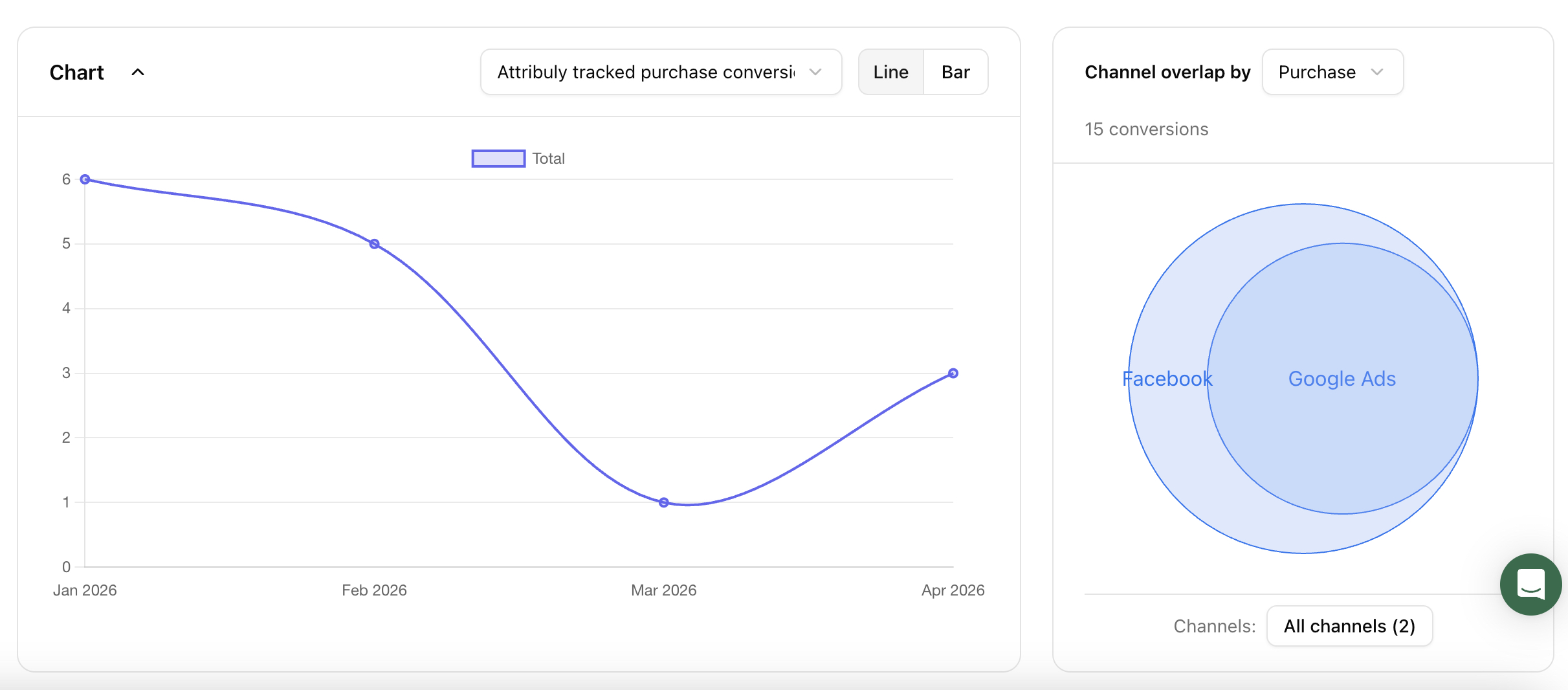
- Venn-style overlap analysis to understand cross-platform overlap by goal
- BMI as a quick diagnostic for spend share vs contribution share
- Exporting the current view when you need to share decisions with a team
If you want an ads attribution workflow that connects campaigns to conversion value with less guesswork, these building blocks make the analysis repeatable.
FAQs
Should I pick one goal or multiple goals?
What should I look at first, ROAS or conversion value?
What does overlap between platforms mean?
About Attribuly
Attribuly helps DTC brands recover abandoned cart revenue. We identify anonymous visitors and existing subscribers your ESP (like Klaviyo) missed, enrich their profiles, and feed the signals back — so your abandonment flows fire and your retargeting audiences grow, and you recover at least 15% more revenue. Shopify featured app, Klaviyo tech partner. Trusted by 20,000+ brands. Guaranteed 4× ROI.