8 Types of attribution every DTC brand should know
Hello there,
We recently came across an article by Curtis Howland, a DTC performance marketer who has managed over $30 million in annual ad spend. His article, 8 Types of Attribution Every DTC Brand Should Know (And the 3 I Actually Use), breaks down the different ways brands can measure marketing performance—and which methods are actually worth using.
As your brand grows, attribution becomes less of a nice-to-have and more of a necessity. You’re spending across Meta, Google, TikTok, and other channels, and every platform has its own version of what’s working. But good attribution isn’t just about reconciling platform-reported numbers with third-party attribution data. It’s about combining different measurement methods to get a clearer picture of what’s actually driving growth.
Here’s a familiar scenario: Meta reports 500 conversions, Google claims 400, and TikTok takes credit for another 150. That’s 1,050 attributed conversions, even though Shopify shows just 600 actual orders.
The problem? Every platform is grading its own homework, and they’re all giving themselves an A+. If you make budget decisions based solely on those numbers, you risk overinvesting in channels that are good at claiming conversions while undervaluing the ones creating demand.
The challenge isn’t a lack of data. It’s knowing what each number tells you, where it falls short, and how to put the pieces together.
The Christmas Tree Framework: How Attribution Fits Together
Think of your measurement stack as a Christmas tree. Each part serves a different purpose, and the biggest mistake is trying to solve a channel-level problem with an ad-level tool.
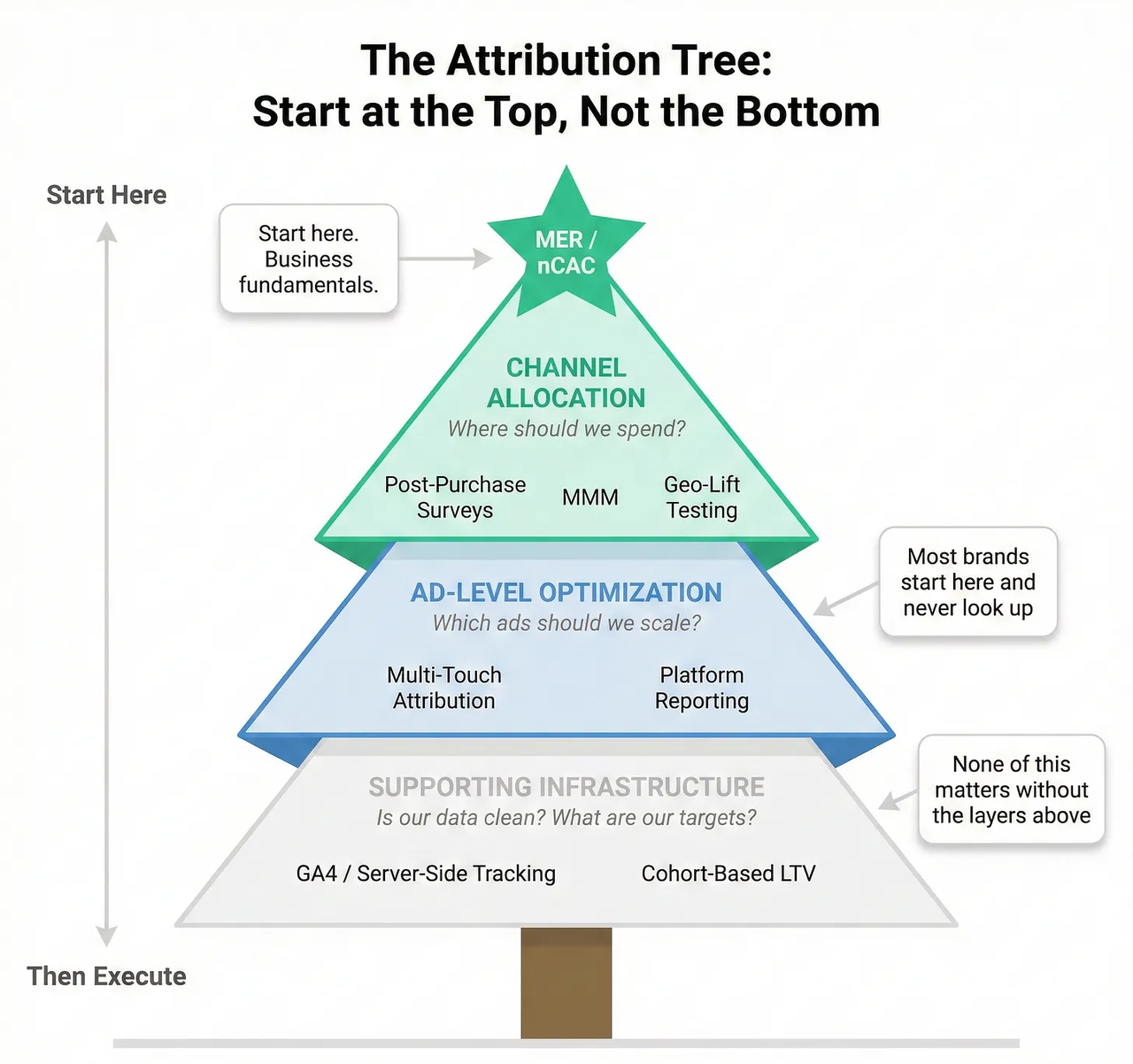
At the top are your blended business metrics. Marketing Efficiency Ratio (MER) and New Customer Acquisition Cost (nCAC) tell you whether your marketing is working for the business as a whole. They don’t tell you which channel deserves credit, but they do tell you whether your growth is financially sustainable.
The upper branches are for channel-level budget decisions. Post-purchase surveys, Marketing Mix Modeling (MMM), and incrementality testing help you understand which channels are contributing to growth and where your next dollar is likely to work hardest.
The lower branches are for campaign and creative optimization. Multi-Touch Attribution (MTA) and platform-reported attribution help you evaluate individual ads, identify what’s performing, and decide what to scale or cut.
The trunk is your tracking infrastructure. GA4, server-side tracking, and Conversions API integrations provide the data that supports the rest of your measurement stack. Better tracking won’t solve every attribution problem, but poor tracking can undermine everything built on top of it.
And the roots are your customer lifetime value data. Cohort-based LTV analysis helps you understand how much customers from different acquisition sources are worth over time, which should influence how much you’re willing to spend to acquire them.
Most brands approach attribution from the bottom up. They start by trying to assign precise credit to every click and touchpoint, then use those numbers to make broader budget decisions. But precision doesn’t necessarily mean accuracy, especially when the underlying data is incomplete.
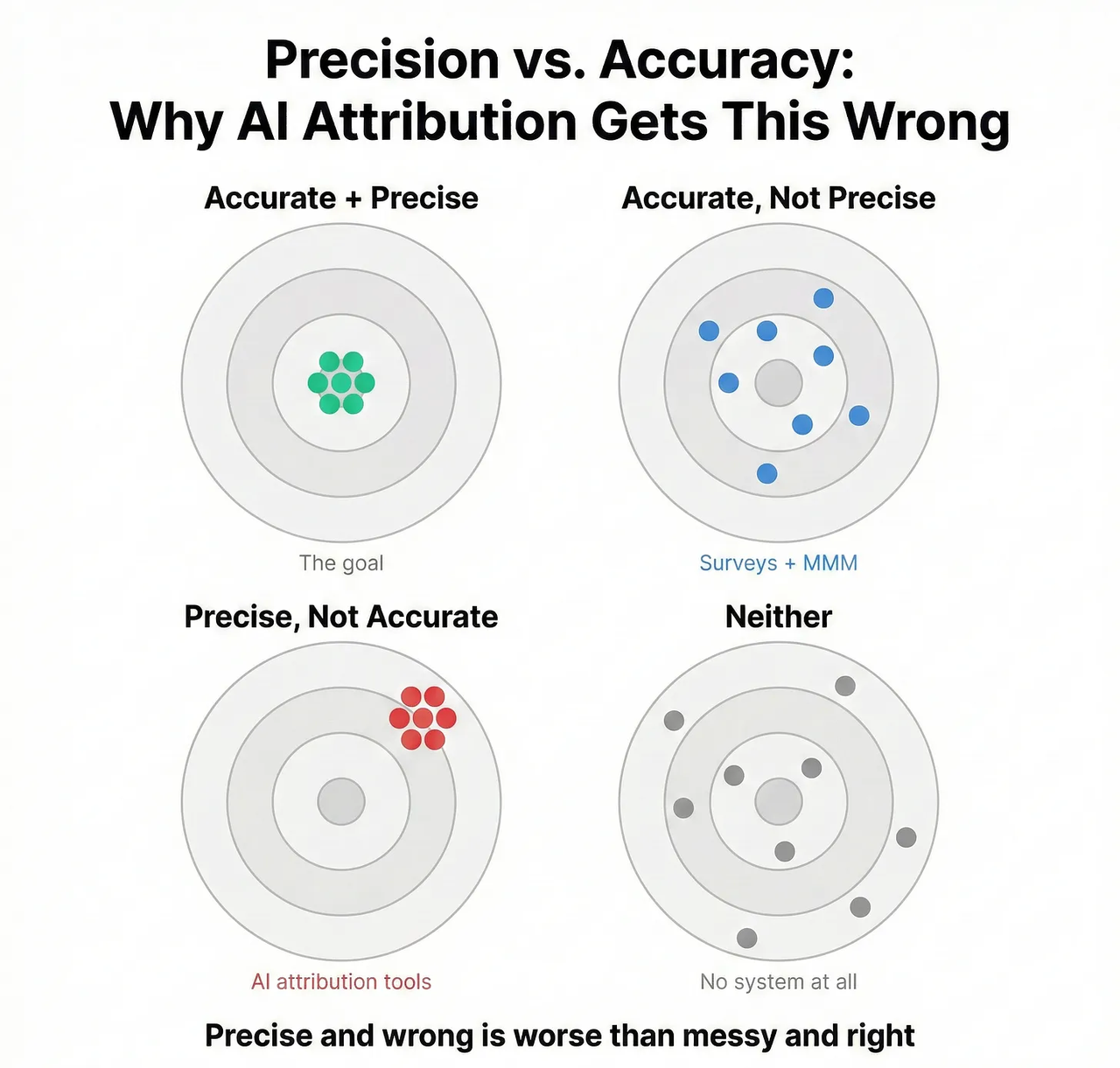
A better approach is to start with overall business performance, work down to channel allocation, and then use more granular attribution to optimize individual campaigns.
The 8 Types of Attribution Every DTC Brand Should Understand
MER & nCAC: Start With the Business, Not the Ad Platform
MER and nCAC are the starting point for understanding marketing efficiency. MER is typically calculated as total revenue divided by total marketing spend, while nCAC measures how much you’re spending to acquire each new customer. Neither metric attempts to assign credit to individual channels. Instead, they help answer a more fundamental question: is your marketing driving healthy growth?
For example, if your brand generates $200,000 in revenue on $50,000 in marketing spend, your MER is 4.0. If that spend brings in 1,000 new customers, your nCAC is $50. Those numbers provide a useful starting point, although profitability still depends on margins, operating costs, and the mix of new versus returning customers.
Imagine two brands with very different results. One is celebrating a 4.2x Meta ROAS, but after accounting for its customer mix, cost of goods, and other expenses, it actually loses $15,000 that month. Another has a much lower ROAS of 2.8x but a healthier customer mix and better cost structure, resulting in $45,000 in profit.
A higher ROAS doesn’t automatically mean a healthier business. MER and nCAC help you keep the bigger picture in view, even though you’ll need other methods to understand what’s driving the results.
Post-Purchase Surveys: Where Did Customers First Hear About You?
Post-purchase surveys are one of the simplest ways to understand what’s driving customer discovery. After someone completes a purchase, ask one question: “Where did you first hear about us?” Give them options such as Facebook/Instagram, TikTok, Google, YouTube, a friend, or another source.
Imagine someone discovers your product through a TikTok video, spends a few days thinking about it, then searches for your brand on Google and makes a purchase. Last-click attribution may give Google the credit, but the survey can reveal that TikTok was responsible for the initial discovery.
This makes post-purchase surveys especially useful for understanding awareness and demand creation. Some channels influence buying decisions long before the customer clicks through to purchase, and that influence isn’t always reflected in click-based attribution.
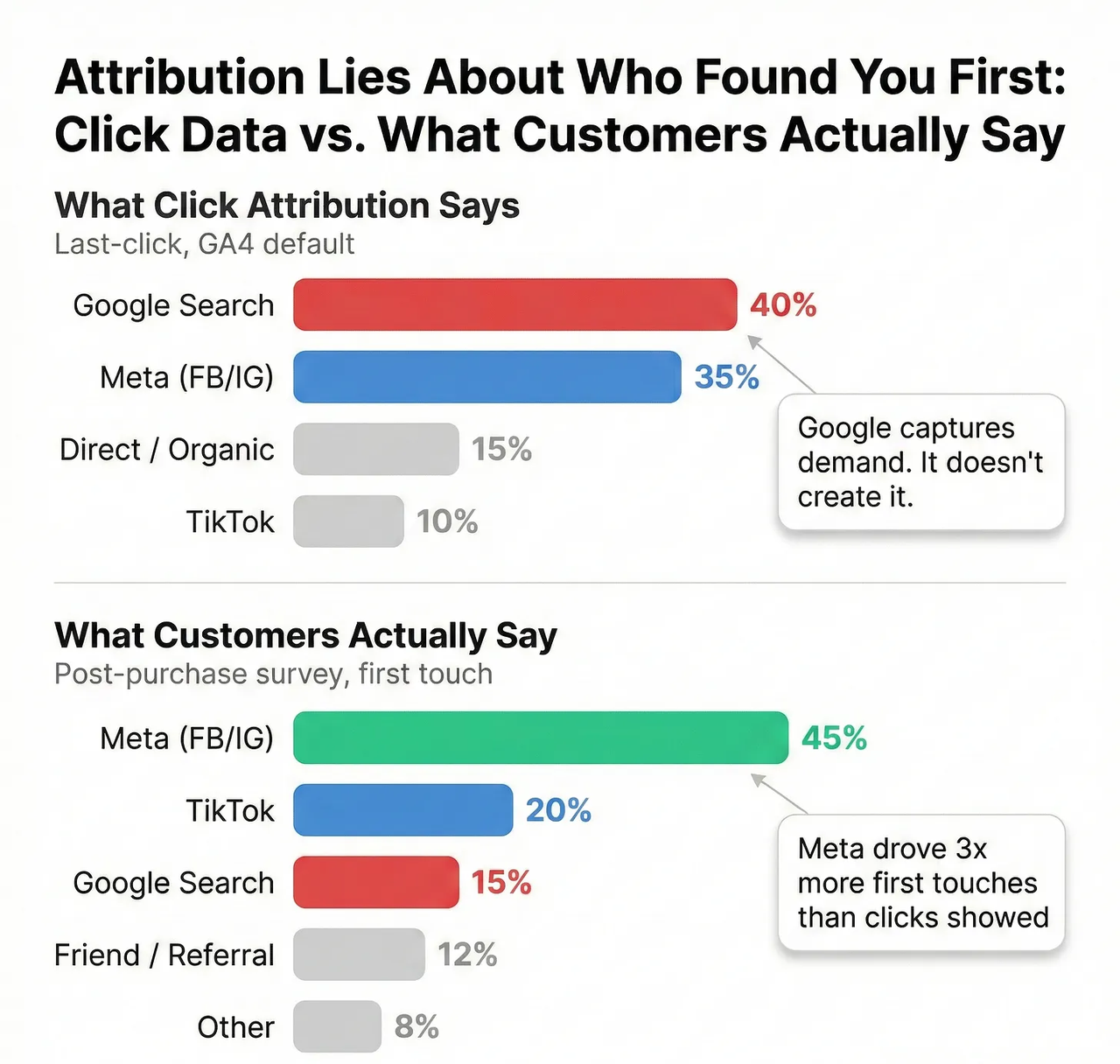
Of course, customer memory isn’t perfect. Someone may forget where they first heard about your brand or remember a more recent interaction instead. Surveys are best treated as another perspective on channel performance, not a perfect record of the customer journey.
Marketing Mix Modeling (MMM): Measure the Bigger Picture
Marketing Mix Modeling, or MMM, uses statistical analysis to estimate how different marketing investments contribute to sales. Instead of following individual users across touchpoints, it looks at historical data such as channel spend, revenue, seasonality, promotions, and other factors that may influence performance.
Let’s say you increase your TikTok budget and see revenue rise over the following weeks. MMM attempts to estimate how much of that growth can be attributed to TikTok versus other factors, such as a seasonal spike in demand or a promotion running at the same time.
One of MMM’s biggest advantages is its ability to inform marginal budget decisions. A channel might have a strong average ROAS, but that doesn’t mean the next $10,000 spent there will perform just as well. As spend increases, returns may begin to diminish. MMM can help you understand where additional investment is more likely to generate incremental value.
MMM is most useful for periodic, directional validation rather than day-to-day campaign management. It can be particularly valuable alongside post-purchase surveys: if both suggest a channel deserves more investment, that’s a stronger signal than either one alone.
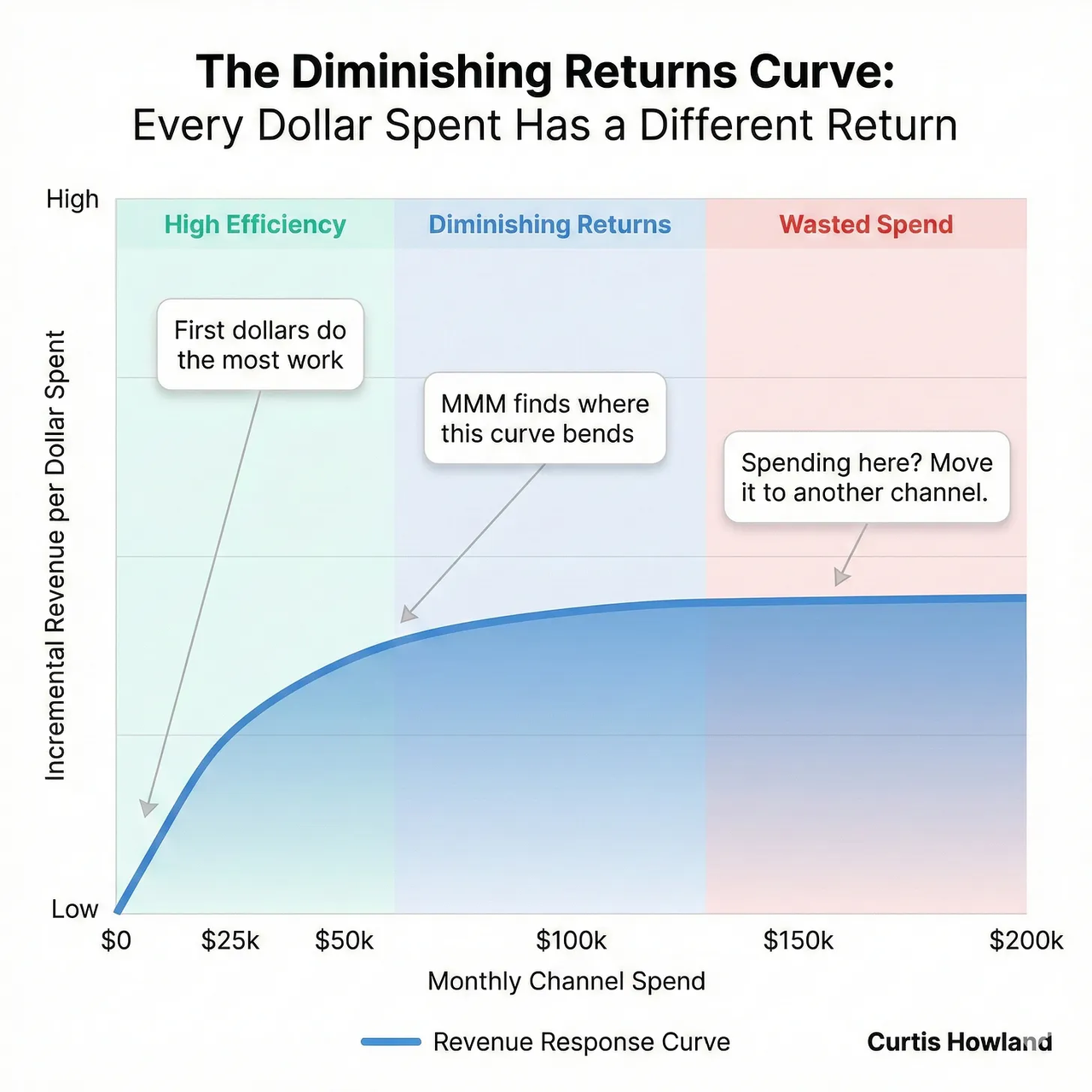
MMM does have limitations. It needs sufficient historical data, meaningful variation in spend, and careful model setup. Its outputs are estimates, not definitive answers, so they should be interpreted alongside other evidence.
Incrementality Testing: What Would Have Happened Without the Ads?
Incrementality testing asks a question that traditional attribution can’t fully answer: would those sales have happened anyway?
Imagine you want to understand whether your Meta retargeting campaigns are genuinely generating additional purchases. You could pause retargeting in one geographic area while continuing to run it in a comparable area, then measure the difference in sales performance over the test period.
If sales barely change in the area where ads were paused, some of the conversions previously credited to retargeting may have happened without those ads. If sales drop meaningfully, and the test is designed well enough to rule out other explanations, that’s evidence the campaigns are creating incremental demand.
This makes incrementality testing particularly valuable for big strategic questions: Is retargeting really worth the spend? How much additional revenue is YouTube generating? Would reducing branded search spend actually hurt sales?

The trade-off is that good experiments take time, budget, and enough data to produce reliable results. They aren’t something most brands can run every day, but they can be extremely valuable when validating major investment decisions.
Multi-Touch Attribution (MTA): Understand the Path to Purchase
Multi-Touch Attribution tracks the marketing touchpoints a customer encounters before purchasing and assigns conversion credit across those interactions. Rather than giving all the credit to a single click, it helps you understand how different channels and ads contribute throughout the customer journey.
Consider a shopper who first discovers your brand through TikTok, later sees a Meta retargeting ad, and finally searches for your brand on Google before purchasing. A last-click model may give Google all the credit. But with first-click, linear, position-based, and other attribution models, you can evaluate the roles TikTok, Meta, and Google played along the way.
This is where MTA becomes particularly useful for daily campaign optimization. You can compare individual ads, evaluate CPA against spend, and identify which campaigns deserve more budget. An ad that’s generating efficient conversions but receiving very little spend may be worth scaling, while a high-spend ad with poor results may need to be reconsidered.
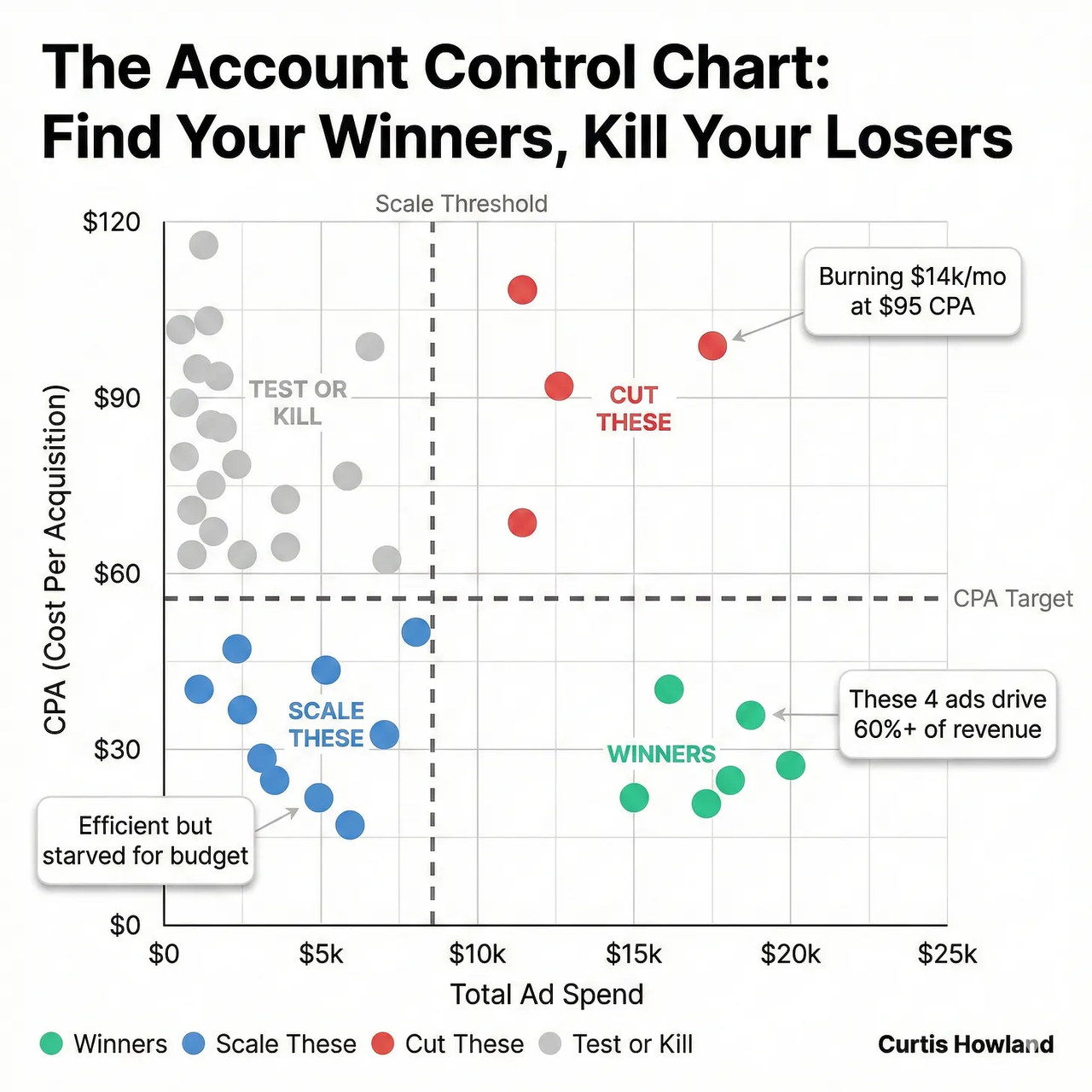
The limitation is that MTA can only work with the touchpoints it can observe or otherwise account for. Not every ad impression leads to a click, and not every interaction can be tied back to an individual shopper. That’s why MTA is useful for campaign-level decisions but shouldn’t be the only input for allocating budgets across channels.
Platform-Reported Attribution: Useful, but Don’t Add Everything Up
Meta, Google, TikTok, and other ad platforms all provide their own attribution reports. These reports are useful for understanding campaign performance within each platform, including conversion timing, attribution windows, and the differences between click-through and view-through conversions.
For example, looking at how quickly customers convert after interacting with an ad can help you understand your purchase cycle. A product where most conversions happen within 24 hours may require a different optimization approach from one where customers typically take two or three weeks to decide.
But platform-reported attribution has an obvious limitation: multiple platforms can claim the same order. That’s exactly what happens in the opening example, where platforms collectively report 1,050 conversions against just 600 actual orders.
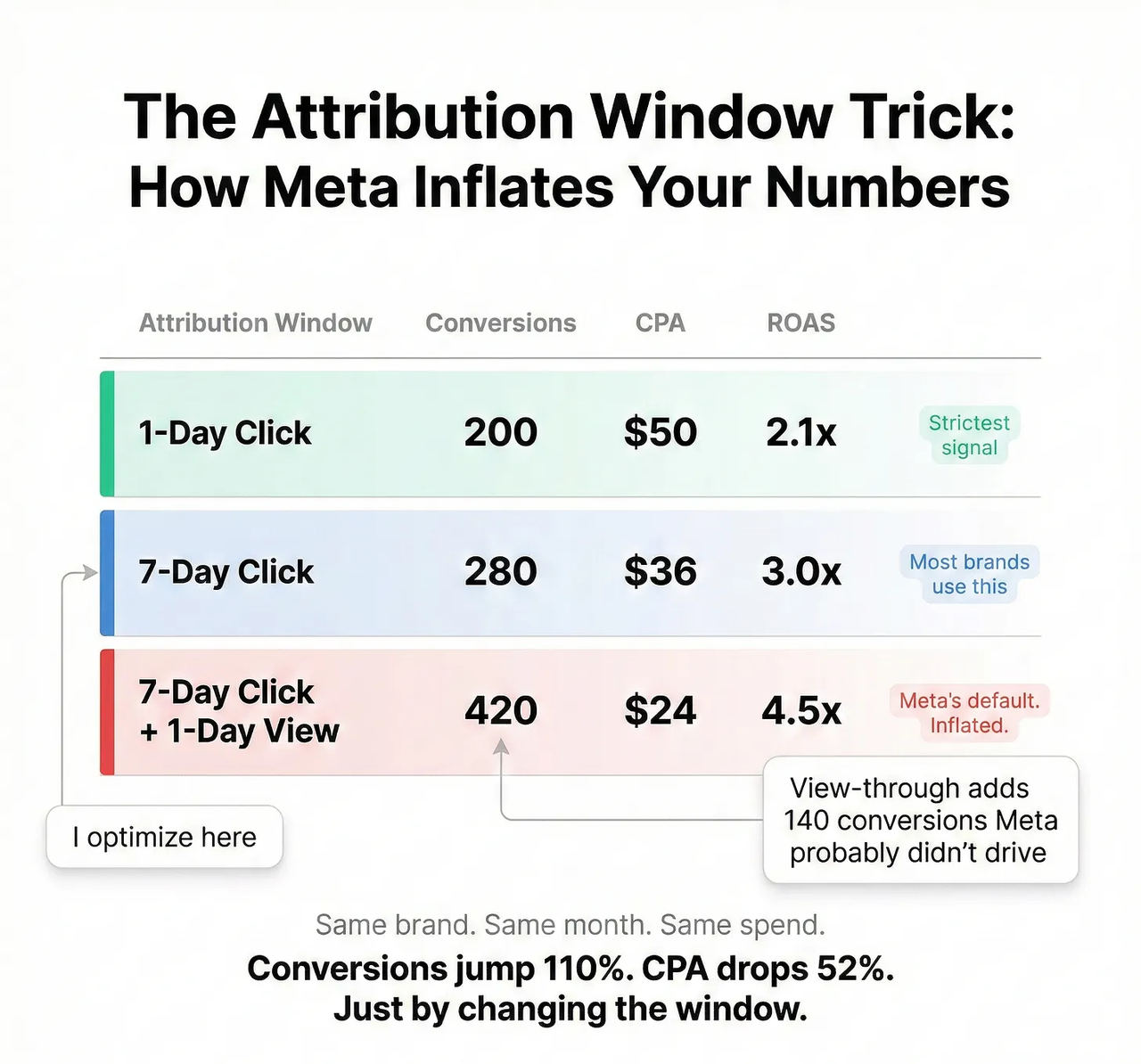
Platform data is still useful for optimizing campaigns within each advertising ecosystem. Just don’t treat the combined totals as your actual sales or use them as the sole basis for cross-channel budget decisions.
GA4 & Server-Side Tracking: Build a Better Data Foundation
GA4 and server-side tracking aren’t really attribution models in the same sense as MTA or MMM. They’re part of the infrastructure that makes measurement possible. GA4 helps you understand website traffic, user behavior, and conversions, while server-side tracking can send conversion events directly to advertising platforms through integrations such as Meta’s Conversions API.
With browser restrictions, cookie limitations, and ad blockers affecting how data is collected, some customer interactions may never be captured by traditional browser-based tracking. If your underlying event data is incomplete, the quality of your attribution analysis can suffer.
Server-side tracking can improve event delivery and data completeness where applicable, giving platforms and measurement tools better signals to work with. But it doesn’t automatically eliminate attribution bias or prove that a particular campaign generated incremental sales.
That’s why tracking infrastructure sits at the trunk of the Christmas tree. It supports the rest of your measurement stack, even though it doesn’t answer every attribution question on its own.
Cohort-Based LTV: Not All Customers Are Worth the Same
The final method looks beyond the first purchase. Cohort-based LTV analysis helps you understand how customer value changes over time based on where those customers came from, rather than judging acquisition performance solely by the initial CPA.
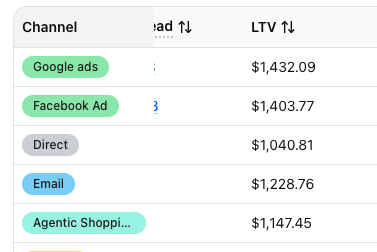
You can track this directly in Attribuly’s Attribution Dashboard. As shown above, you can compare the LTV of customers acquired through different marketing channels, helping you see which channels bring in the most valuable customers over time—not just the cheapest ones to acquire.
Imagine Meta acquires customers at $40 each, while TikTok acquires them at $30. On acquisition cost alone, TikTok looks like the better deal. But the picture changes when you look at repeat purchases and 12-month customer value.
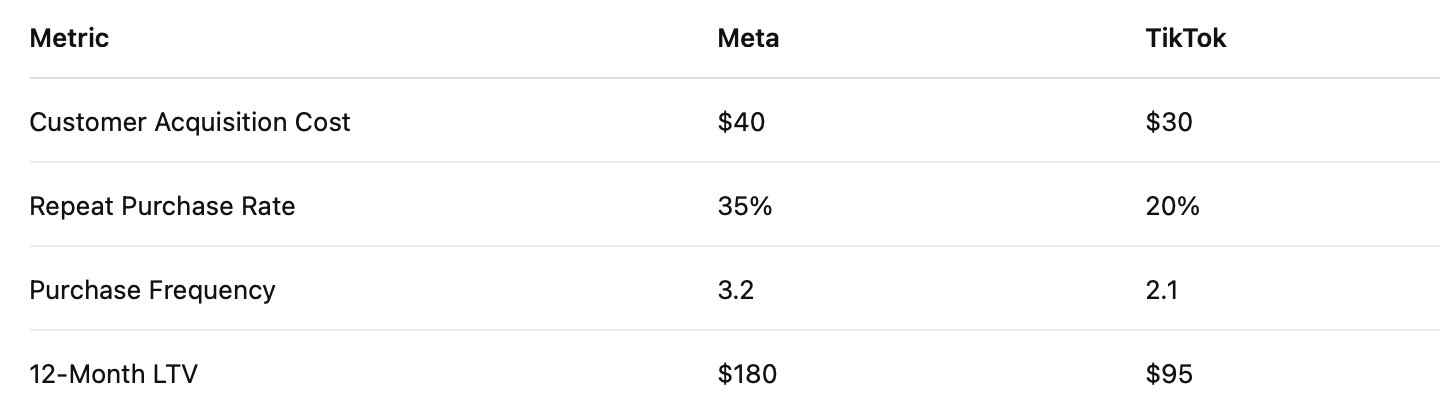
In this example, Meta customers cost more to acquire but generate nearly twice the value over 12 months. That could make Meta the more attractive investment, depending on margins and other costs.
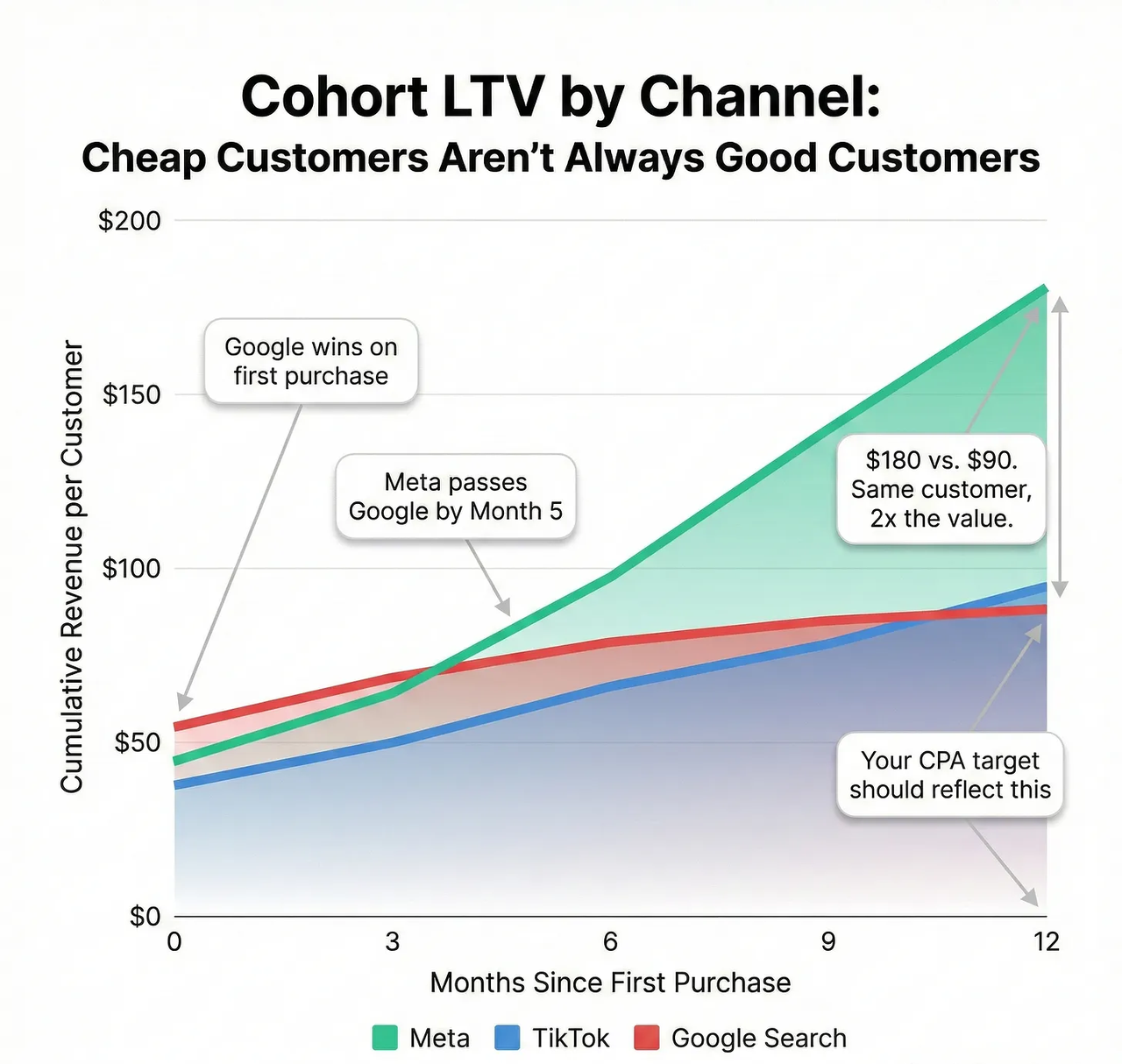
The lesson is that the cheapest customer isn’t always the most valuable customer. If different channels bring in customers with different retention and purchasing behavior, your acquisition targets should reflect those differences.
Why You Shouldn’t Rely on a Single Attribution Model
One of the biggest problems with attribution is how easy it is to mistake precision for accuracy. A tool might tell you that Meta drove 45% of your revenue, Google contributed 35%, and TikTok accounted for the remaining 20%. Those numbers look convincing, but they’re still shaped by the data the tool can see, the attribution windows it uses, and the assumptions behind its model.
This is especially important with black-box attribution models. Adding AI or machine learning doesn’t automatically make incomplete data more accurate. If your model misses certain ad impressions, offline interactions, or other upper-funnel touchpoints, those blind spots can still influence the results. The important thing isn’t whether a model uses AI. It’s whether you understand what it’s measuring, what it’s missing, and how to validate its conclusions.
That’s why you need more than one perspective. MTA helps you understand observable customer journeys, post-purchase surveys reveal what customers remember, and MMM looks at how marketing investment relates to overall sales. None is perfect on its own, but together they give you a stronger basis for making decisions.
The 3 Attribution Methods You’ll Actually Use
You don’t need eight separate tools to make better attribution decisions. For most growing DTC brands, three methods can form the foundation of a practical measurement stack: Multi-Touch Attribution, post-purchase surveys, and Marketing Mix Modeling. Each answers a different question, and the real value comes from using them together.
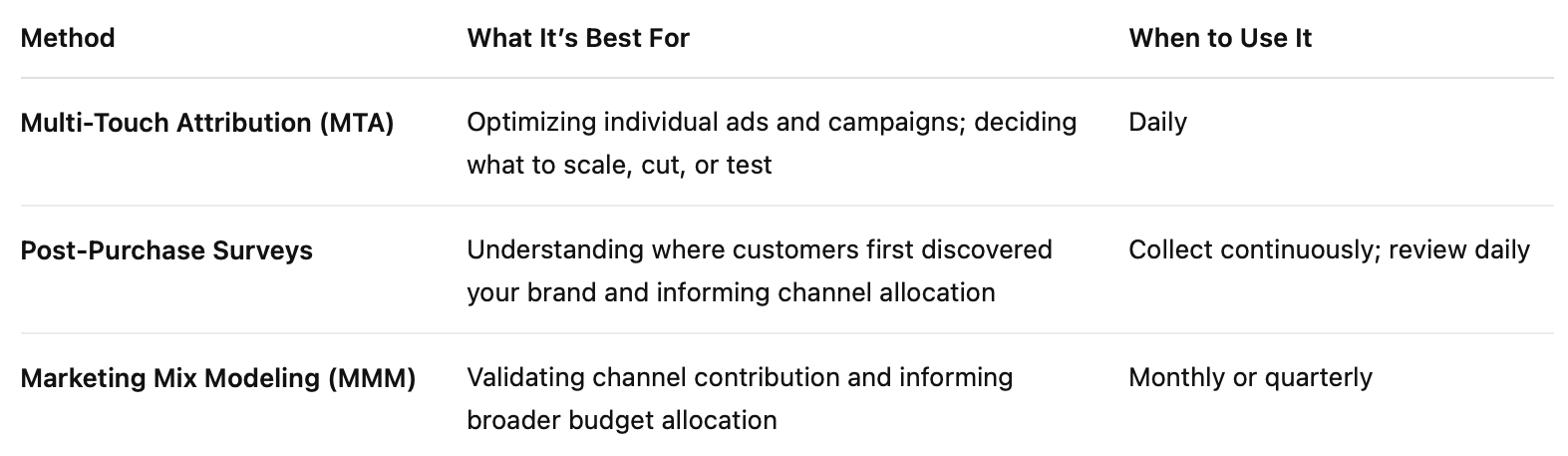
How the Three Work Together
Let’s say TikTok looks mediocre in your MTA reports. It isn’t generating many attributed conversions, and its ROAS is nothing special. But your post-purchase survey tells a different story: a significant share of new customers say they first discovered your brand on TikTok. Meanwhile, MMM suggests that TikTok spend is contributing positively to overall revenue.
That doesn’t automatically mean you should double your TikTok budget. But it does mean cutting the channel based on MTA alone could be a mistake. TikTok may be creating demand that converts later through Google, Meta, or another channel.
Now consider the opposite situation. Meta looks strong in both MTA and platform reporting, but the percentage of customers who say they first heard about your brand on Facebook or Instagram has been declining for months. That could be an early warning sign that your Meta campaigns are becoming increasingly dependent on retargeting rather than reaching new audiences.
When different methods point in the same direction, you can make budget decisions with greater confidence. When they disagree, you’ve found something worth investigating. That’s the whole point of combining them.
Where Should Your Brand Start?
This isn’t about buying eight attribution tools or building the most complicated measurement stack possible. It’s about understanding what each method is designed to measure and introducing the right tools as your business grows.
If you’re just getting started, focus on your overall marketing efficiency and make sure your tracking is working properly. As your spend grows, you can add MTA and post-purchase surveys to understand campaign performance and customer discovery. At a larger scale, MMM and incrementality testing can help you validate bigger channel investment decisions.
Here’s a practical starting point based on monthly ad spend:
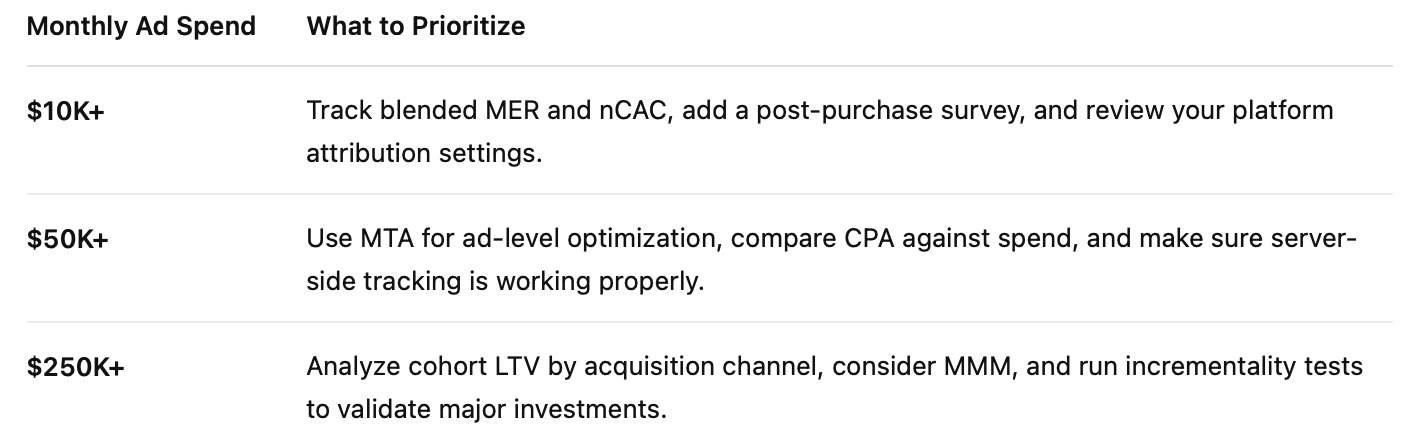
These are guidelines, not hard requirements. The right setup depends on your channel mix, data quality, budget, and the decisions you’re trying to make.
The goal isn’t to get every dashboard to report the same number. It’s to understand which investments are actually helping your business grow and where your next dollar should go.
Measure Your Ads With Attribuly
If you’re running ads across Meta, Google, TikTok, and other channels, Attribuly Attribution helps you evaluate performance from multiple angles instead of relying solely on what each platform reports.
Attribuly brings your cross-channel marketing data into one dashboard and offers multiple attribution models to help you understand the customer journey from first touch to purchase. With First Click, Last Click, Linear, and Position-Based models, you can compare how different channels and campaigns contribute to conversions, then use those insights alongside ad spend, orders, and new customer performance to optimize your campaigns and budgets.
Attribuly’s Full Impact Attribution also helps you measure the contribution of upper-funnel ad exposure. For example, someone might see your TikTok ad without clicking, then search for your brand on Google a few days later and make a purchase. Traditional click-based attribution may give Google all the credit, while Full Impact accounts for both ad views and clicks. This helps you better understand how prospecting and awareness campaigns contribute throughout the customer journey, rather than undervaluing them simply because they don’t generate immediate clicks.
Marketing Mix Modeling (MMM) is also coming soon to Attribuly. MMM will help you evaluate channel contribution by analyzing the relationship between overall marketing investment and sales performance, providing additional insights for cross-channel budget allocation.
MTA and MMM aren’t competing approaches. MTA is better suited to understanding individual ads and campaigns, while MMM helps you evaluate marketing contribution at the channel level. Together, they can help you optimize day-to-day campaign performance while making more informed decisions about your overall budget allocation.
Explore Attribuly Attribution →
Join the Attribuly WhatsApp Community
Want to stay on top of what’s happening in DTC marketing and connect with people working through the same challenges?
Join our Attribuly WhatsApp Group, where we regularly share product updates, industry insights, and practical growth ideas. You’ll also have a chance to exchange experiences with other DTC founders, marketers, and ecommerce operators—whether you’re working on attribution, paid media, or your next growth experiment.
Scan the QR code below to join the group.

The bottom line: there’s no perfect attribution model. Every method has its strengths and blind spots, and the most useful insights often come from comparing what different methods tell you.
Start with your overall business performance, use multiple sources to validate channel decisions, and get more granular when it’s time to optimize individual ads. The goal isn’t perfect attribution. It’s making better decisions with the information you have.
Adapted from an article by Curtis Howland, with additional information about Attribuly’s attribution capabilities.
Original Author: Curtis Howland
Original Article: 8 Types of Attribution Every DTC Brand Should Know (And the 3 I Actually Use)
Best,
Attribuly Team