
Internal vs External Attribution: What the Difference Means for Your Shopify ROAS (2026)
Compare internal vs external attribution for Shopify — ROAS truth vs platform signals. Learn about deduplication, refunds, attribution windows, and which approach to use.
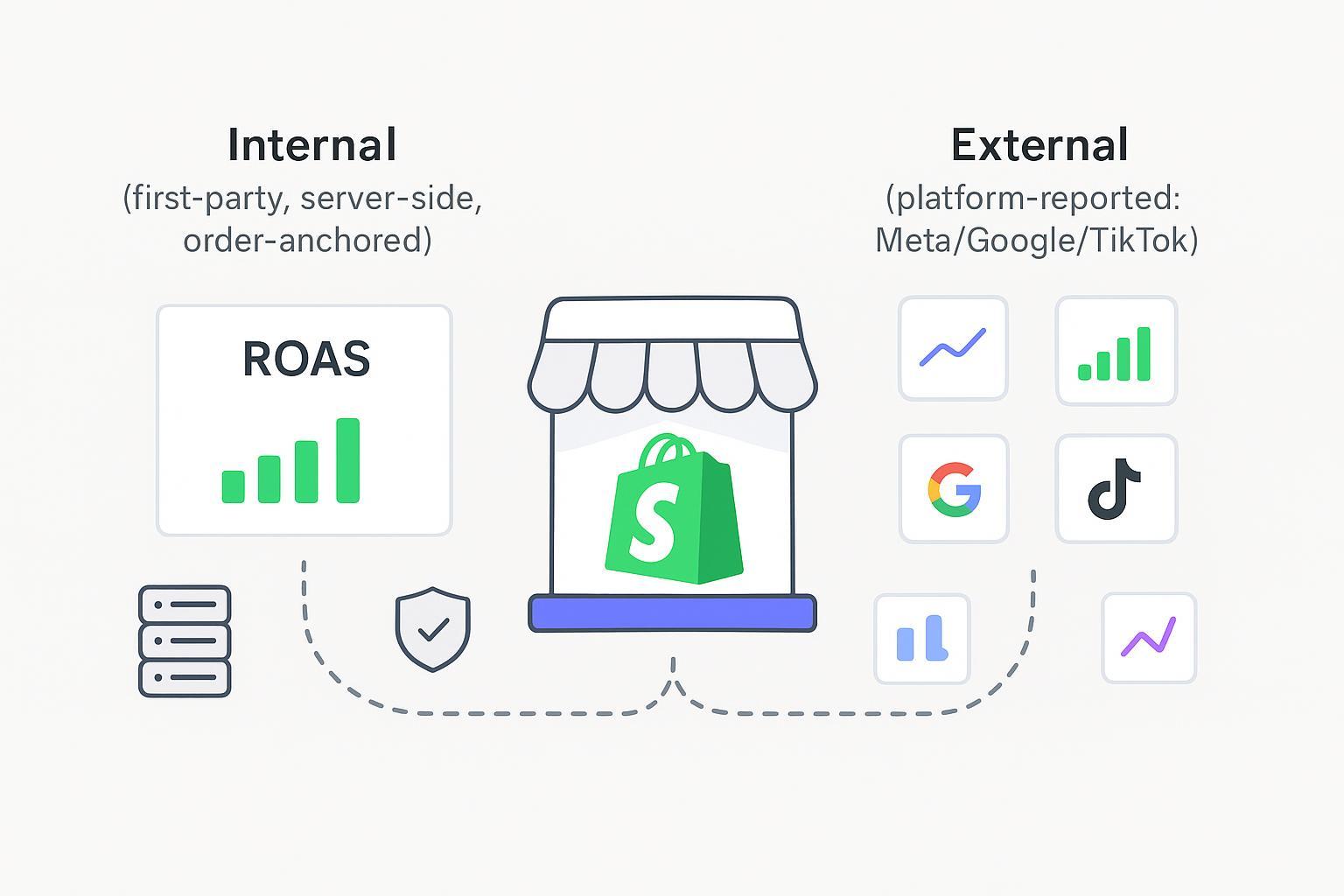
Your ads look great in-platform, yet your Shopify revenue tells another story. Here’s the deal: “internal vs external attribution” isn’t a jargon fight—it’s the difference between a budgeting truth baseline and an optimization signal. Internal attribution (first‑party, order‑anchored) reconciles Shopify orders, deduplicates overlaps, and nets out refunds for decision‑grade ROAS. External/platform attribution (Meta/Google/TikTok) is what their algorithms learn from inside short, configurable windows—excellent for optimization, not a single source of truth across channels.
Key takeaways
Use internal attribution as your budgeting baseline because it reconciles to Shopify orders, de‑duplicates overlaps, and can be refund‑aware.
Use external/platform attribution inside each ad platform to make optimization moves (bids, budgets, creatives) aligned to the platform’s learning window.
Expect ROAS gaps when attribution windows differ (e.g., 1–7 day click vs 30+ day multi‑touch) and when platforms double‑claim the same order.
For refund‑heavy categories, base ROAS on net revenue per Shopify finance definitions to avoid over‑stating payback.
Pair internal ROAS with periodic lift tests to validate causality; keep a dated note of your windows/models because platforms change frequently.
Internal vs external attribution at a glance
Dimension | Internal attribution (first‑party, order‑anchored) | External/platform attribution (Meta/Google/TikTok) |
|---|---|---|
Quick verdict | Best baseline for budgeting and profitability decisions | Best signal for in‑platform optimization and learning |
Source of truth | Shopify orders and revenue joined to touchpoints; cross‑channel comparable | Siloed, platform‑specific conversions; not inherently comparable across channels |
Attribution windows | Flexible and documented; align to buying cycle | Set per platform (e.g., Meta 1–7 day click; TikTok 1–28 day click options; Google configurable)—subject to change |
Cross‑channel coverage | Paid + owned + earned (email/SMS, organic, direct, POS) | Only that platform’s touches |
Deduplication & identity | Person/order‑level joins; event_id/transaction_id rules to prevent double‑counting | Limited to that platform’s dedup rules (pixel + server copies) |
Refunds & net revenue | Can credit net of refunds/discounts per Shopify definitions | Typically credits gross conversions within the window; refund handling varies by platform/report |
Privacy & signal resilience | Server‑side pipelines (CAPI/EC/EAPI), Consent Mode modeling | Platform‑specific resilience; still constrained by app/ID loss |
Optimization fit | Feeds clean server‑side conversions back, but used mainly for budget truth | Native optimization loop; what the algorithm actually learns from |
Model flexibility & transparency | Supports single‑ and multi‑touch models with clear documentation | Models/windows vary by platform; transparency differs |
Incrementality support | Easier to pair with holdouts/geo tests as a unified baseline | Each platform may offer its own lift tests, but cross‑channel view is limited |
Time‑to‑value & maintenance | Higher setup and QA burden; better payoff at scale | Fastest to start; little cross‑channel truth without reconciliation |
Footnote: Platform attribution settings, windows, and features are volatile. Always date‑stamp your setup and verify options in‑UI at the time of analysis (subject to change as of 2026‑06‑10).
A quick ROAS math example (why gaps happen)
Suppose Meta reports 100 purchases and TikTok reports 80 in the same week. Shopify shows 150 orders. After a simple internal reconciliation:
Orders uniquely matched to Meta: 60
Orders uniquely matched to TikTok: 40
Overlap (both platforms claimed): 25
The rest came via direct/organic: 25
If net Shopify revenue is $15,000, your cross‑channel truth might credit $6,000 to Meta, $4,000 to TikTok, and $5,000 to non‑ads. Platform‑only views double‑count the 25 overlapping orders, inflating perceived ROAS.
What “internal vs external attribution” means for Shopify ROAS
“Internal vs external attribution” is ultimately about the numerator and the rules for credit. Internal attribution assembles first‑party journeys, deduplicates events using identities like event_id and transaction_id, and ties credited revenue back to Shopify orders (ideally net of refunds). External/platform attribution is the number the platform records under its own windows and rules—it’s the number its algorithm optimizes against. Both are useful; they’re just built for different jobs.
Shopify net revenue definitions matter. Shopify’s finance reporting shows how gross sales, discounts, and refunds roll up to net sales; shipping and taxes are recognized on sale/refund dates. Using net revenue prevents refund‑heavy categories from over‑stating payback. See Shopify’s guidance in the Finance reports help (updated 2026‑06‑09) for the accounting logic and timing: Shopify Finance reports.
Attribution windows swing ROAS (and they change over time)
Meta Ads: Ads Manager supports multiple attribution windows (e.g., 7‑day click and 1‑day view are commonly referenced options). Meta also provides tools like Compare Attribution Settings to gauge impact. Deduplication between Pixel and Conversions API requires identical event_name and a shared dedupe key like event_id or External ID; dataset quality tooling reports coverage. See Meta documentation (date‑stamped examples: 2024‑10‑20 to 2026‑02‑24): Omni Optimal Technical Setup Guide and Dataset Quality API.
Google Ads/GA4: Google exposes attribution models and lookback controls; developer references list 7/30/40‑day lookbacks and the standard model catalog shared with GA4 (as of 2026‑05‑09). Enhanced Conversions hash first‑party identifiers to improve match when direct cookies/IDs are limited. Sources: Conversion sources (models/lookbacks) and Enhanced Conversions overview.
TikTok Ads: Windows are configured at the ad group level with options for click‑through (e.g., 1/7/14/28 days) and view‑through (off/1/7 days), subject to change (refs accessed 2026‑06‑10). See TikTok attribution overview.
Takeaway: Document your windows per channel and note the date. If your consideration cycle exceeds a platform window, expect under‑credit in platform reports and a higher share in internal multi‑touch models.
Deduplication and identity: how to stop double‑counting
Meta Pixel + Conversions API: Send the same event_name with a shared dedupe key (event_id or External ID) to merge browser and server copies; otherwise, duplicates can inflate conversions. See Meta’s setup guidance: Omni Optimal Technical Setup Guide.
TikTok Pixel + Events API: Use a consistent event_id and event_name; TikTok applies timing rules to deduplicate, generally using the first received event. Reference: Event deduplication.
Google Ads Enhanced Conversions: Align transaction_id/order_id and pass hashed identifiers to improve match while avoiding duplicates. Start with Google’s EC documentation: Enhanced Conversions.
Practical tip: In your internal model, prefer order‑anchored joins and enforce event_id/transaction_id hygiene. This alone can close large gaps between platform claims and Shopify revenue.
Refunds and net revenue: what your numerator should be
Shopify’s finance logic distinguishes gross vs net and applies returns on refund dates. For refund‑aware ROAS, base credit on net revenue after discounts and returns. Shopify documents the components and timing here (updated 2026‑06‑09): Finance reports. Align your attribution export to these fields to avoid overstating ROAS in high‑return categories.
Privacy and signal resilience
First‑party and server‑side pipelines keep measurement viable as cookies and device IDs degrade. Examples:
Meta Conversions API with strong dedupe keys (event_id/External ID) and dataset quality feedback.
Google Enhanced Conversions: hashed PII (SHA‑256) with Consent Mode v2 modeling gaps when consent is withheld; see Consent mode impact results (updated 2026‑01‑28).
TikTok Events API with server‑side tagging and event dedup rules.
Internal stacks that standardize these flows tend to maintain steadier signal quality and closer alignment to Shopify orders.
Optimization fit: when to read platform ROAS vs internal ROAS
Use external/platform ROAS to scale inside the platform. The algorithm learns from conversions defined under that platform’s window. Reading that number for bid/budget moves keeps the loop stable.
Use internal ROAS for cross‑channel comparisons and budget allocation. It reconciles orders across channels, nets refunds, and prevents double credit.
Best practice: Feed high‑quality server‑side conversions back to platforms while still judging profitability on the internal baseline. Pair with periodic lift tests (e.g., Meta Conversion Lift, 2026‑02‑24 guidance: Meta’s best practices).
Scenario picks: who should use what, and when
Short‑cycle purchases with heavy retargeting (1–7 days): Rely on platform ROAS to optimize quickly, but sanity‑check with internal attribution to catch double‑claims during promos.
Longer consideration cycles (7–30+ days): Favor internal multi‑touch models or extended lookbacks; platform windows will miss assists from email/SMS/content.
Mixed channels (Meta/TikTok prospecting + Google Shopping capture + email/SMS): Use internal as your budgeting baseline to compare channels apples‑to‑apples.
High repeat‑purchase brands: Preserve original acquisition source in your internal model; platforms tend to over‑credit later touches.
Seasonal surges and promos: Expect overlapping window inflation; read platform ROAS directionally and true‑up to internal after the surge.
Migration checklist: moving from platform‑only to an internal baseline
Define your truth fields: choose Shopify net revenue elements (discounts/returns applied) as your ROAS numerator.
Implement server‑side event pipelines (Meta CAPI, Google Enhanced Conversions, TikTok Events API) with consistent event_id/transaction_id conventions.
Set up deduplication: ensure browser + server events share dedupe keys (e.g., Meta event_id; TikTok event_id; Google transaction_id alignment).
Build order‑level joins: connect touchpoints to Shopify order_id and customer identifiers.
Document attribution windows and models: align to real buying cycles; time‑stamp choices.
Schedule weekly QA: check missing UTMs, duplicate events, refund syncs, and event matching quality.
Cost to maintain an internal baseline (heuristic)
Store scale | Typical weekly effort | Notes |
|---|---|---|
Starter (< $10K/mo revenue) | 2–4 hours | Basic server‑side setup, light QA, last‑click or simple multi‑touch |
Scale ($10K–$100K/mo) | 5–10 hours | Routine QA, window reviews, occasional lift tests |
Enterprise (>$100K/mo) | 10–20 hours | Ongoing schema upkeep, model evaluations, frequent experiments |
These are directional estimates, not guarantees. Complexity varies by channel mix, catalog, returns rate, and data quality.
FAQ
Why does Meta ROAS differ from Shopify ROAS? Because the platform applies its own attribution window and may count both pixel and server events unless properly deduped; Shopify ROAS based on net orders/returns will diverge. See Meta’s dedup guidance: Omni Optimal Technical Setup Guide and Shopify’s Finance reports.
Which attribution should Shopify merchants use for budgeting? Use internal attribution as your baseline because it reconciles orders across channels, nets refunds, and avoids double‑counting.
How do I reconcile platform‑reported ROAS with Shopify orders? Join orders to touchpoints, enforce dedupe keys (event_id/transaction_id), and switch the numerator to net revenue; then compare per‑channel ROAS after dedup.
Does internal attribution account for refunds? It can, if you base your numerator on Shopify net revenue and sync refund states; Shopify documents net/gross timing here: Finance reports.
Should I use 7‑day click? Use the window that matches your buying cycle. Meta, Google, and TikTok offer configurable options (subject to change). Start with the shortest window that still captures typical lag, then validate with internal multi‑touch and lift tests. See references: Google conversionsources lookbacks and TikTok attribution overview.
Also consider: server‑side dedup to narrow gaps
If you’re building an internal baseline, a server‑side pipeline that enforces consistent dedupe keys is essential. For a Shopify‑focused explainer on how server‑side tracking closes attribution gaps (Meta CAPI, Google EC, TikTok EAPI) with concrete steps, see How Shopify Server‑Side Tracking Fixes Attribution Errors. Tools such as Attribuly are particularly strong at narrowing platform‑to‑Shopify gaps with server‑side dedup and order‑anchored reporting; evaluate them alongside other options in your stack.
How to choose (decision rules you can save)
If you need a single ROAS number for budgets and profit: Internal baseline (order‑anchored, refund‑aware, deduped).
If you’re scaling inside a platform: Platform attribution for decisions; keep internal as the scoreboard.
If your cycle is > 7–14 days or multi‑touch heavy: Favor internal multi‑touch models or longer lookbacks and validate with lift tests.
If promos stack and retargeting overlaps: Read platform ROAS directionally; true‑up with internal after reconciling overlaps.
Subject to change: Platform windows and features evolve. Date‑stamp your settings (verified as of 2026‑06‑10) and re‑check quarterly.