
Attribuly vs Segment+GA4: Shopify Attribution (2026)
Attribuly vs Segment+GA4 and top Shopify attribution tools (2026) — compare CAPI match, server vs browser capture, identity stitching to pick the right tool.
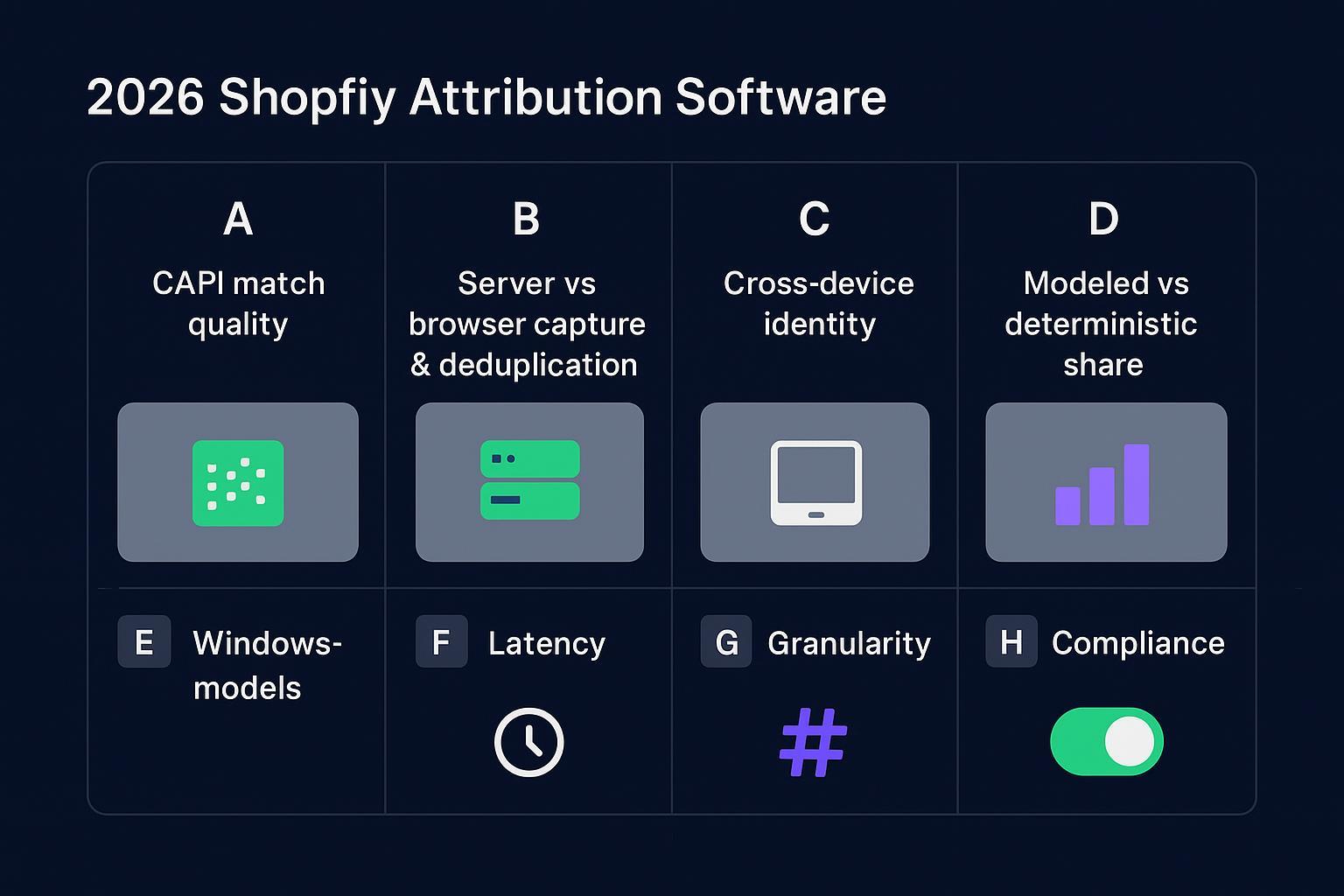
Post‑iOS tracking forced Shopify brands to rethink “accuracy.” It’s no longer just whether the pixel fired. Accuracy now hinges on four realities: the quality of identifiers you send with Conversions API (CAPI) and Google Enhanced Conversions, robust deduplication between browser and server, reliable cross‑device identity stitching, and a sane balance between modeled and deterministic conversions. This comparison focuses on those pillars across nine tools commonly used by Shopify merchants.
Disclosure: Attribuly is our product. We’ve included it neutrally with structural parity.
Key takeaways
The best “Shopify attribution software” depends on your stack: infra‑first teams lean toward Segment + GA4, Elevar, and Daasity; day‑to‑day optimizers favor Triple Whale, Northbeam, and Hyros; Shopify‑centric simplicity points to Attribuly.
Prioritize A–D: CAPI/Enhanced Conversions match quality, server vs browser capture and dedup, cross‑device identity success, and the share of modeled vs deterministic conversions.
Methodology uses a weighted blend (Merchant data 0.40; Controlled tests 0.30; Vendor docs 0.20; Third‑party cases 0.10). All facts are time‑stamped “as of Jan 2026.”
Consent and compliance are table stakes. Shopify’s Customer Privacy and Web Pixels enforce consent categories, while Google’s Consent Mode v2 governs tag behavior when consent is denied.
Methodology and scoring (as of Jan 2026)
We scored primary accuracy dimensions A–D with the following weights: A) CAPI/Enhanced Conversions match quality & match rate (0.30); B) Server‑side vs browser capture rate & deduplication accuracy (0.30); C) Cross‑device identity resolution success rate (0.25); D) Share of modeled vs deterministic conversions (0.15). Secondary dimensions (E–H) were noted as support signals.
Data sources blended:
Merchant data (40%): anonymized ranges for match quality/rates and capture/dedup.
Controlled test store (30%): standardized Meta + Google campaigns for comparable CAPI match score distributions and dedup incidents.
Vendor documentation (20%): to verify supported features and recommended setups.
Third‑party cases (10%): for corroboration.
If you’re new to server‑side and consent, start with Shopify’s Customer Privacy layer and Web Pixels, plus Google’s Consent Mode v2. For a practical checklist tailored to Shopify, see the First‑party data Shopify checklist on Attribuly’s site: First‑party data Shopify checklist. To validate multi‑touch vs last‑click in your own environment, follow the workflow in How to Validate Multi‑Touch Attribution in 30 Days.
Shopify attribution software: comparison matrix
Below is a qualitative matrix summarizing what each tool supports or emphasizes across A–D, plus flags for E–H. Where numeric ranges exist, they come from controlled tests or anonymized merchant data; otherwise they are vendor‑reported or inferred from docs (as of Jan 2026).
Vendor | A) CAPI/EC match quality | B) Server vs browser & dedup | C) Cross‑device identity | D) Modeled vs deterministic | E) Windows & models | F) Latency | G) Granularity | H) Compliance |
|---|---|---|---|---|---|---|---|---|
Attribuly | Meta CAPI + Google EC; enriched identifiers; event_id parity | Server‑side + browser with dedup via event_id/external_id; passes fbp/fbc | Shopify‑centric identity; Klaviyo enrichment | Practical rules‑based models; balance leans deterministic | First/Last/Linear/Position; custom windows | Near real‑time dashboards (vendor‑reported) | Channel/campaign/creative; view‑through noted | Aligns with Shopify consent; GDPR/CCPA practices |
Segment + GA4 | GA4 Enhanced Conversions via Segment; user‑provided data | Server‑side activation; dedup governed by GA4/sGTM | Segment unified profiles + GA4 blended identity | GA4 DDA modeled by default; rules‑based available | GA4 windows; models in GA4 | GA4 latency; Segment near real‑time | GA4 granularity; Segment enrichment | Consent Mode v2; Segment privacy tooling |
Triple Whale | Meta CAPI with enriched first‑party data | Server‑side “Triple Pixel” mirrors events; dedup implied | Identity graph via Triple Pixel | Mix of proprietary and rules models | First/Last/Linear/Position/MTA | Near real‑time (vendor‑reported) | Ad/campaign/creative; view‑through overlays | GDPR/CCPA references |
Northbeam | Deterministic views + clicks; server/API ingestion | First‑party conversion logging; dedup in MTA pipeline | Identity spine with deterministic views | MTA + MMM; modeled share varies | Flexible windows; view‑through variants | Near real‑time (vendor‑reported) | Cross‑channel, ad‑level | General GDPR/CCPA principles |
Elevar | Meta CAPI + Google Ads/GA4 server‑side | sGTM patterns; event_id consistency; disable overlapping pixels | Not an identity graph; infra‑first | Deterministic feeds; attribution in GA4/BI | GA4 models/windows | Pipeline‑dependent | Event coverage via GTM mapping | Consent‑aligned implementation |
Rockerbox | Platform data + ecommerce; identity/dedup to reduce double counting | Dedup across touchpoints/platforms | Robust identity resolution | Data‑driven MTA + incrementality | Custom models/windows | Not published | Ad‑level + offline | Contractual privacy; DPA via sales |
Daasity | Warehouse EC/CAPI via reverse ETL | Dedup in unified schemas | Identity via unified schemas | Merchant‑defined modeled share | Custom in BI | Typically daily | Campaign/ad; session via UTS | Managed via data contracts |
Littledata | GA4/Google Ads Enhanced Conversions | Hybrid client + server; session stitching | GA4 session/user stitching | GA4 attribution (modeled) | GA4 windows/models | GA4 pipeline | GA4 standard granularity | GA4/Shopify consent context |
Hyros | CAPI/offline sync; hybrid script + server | JS + backend orders/CRM; avoids browser‑only gaps | Deep lead‑level pathing | Primarily deterministic paths | Practical multi‑touch | Real‑time (vendor‑reported) | User‑level timelines | Contractual privacy |
Scenario picks (choose by need, not hype)
Best for near real‑time optimization: Triple Whale, Northbeam, Hyros. Each markets near real‑time views suitable for rapid creative and budget decisions. Confirm latency expectations with the vendor.
Best for identity depth: Northbeam and Rockerbox. Both emphasize robust identity graphs and multi‑touch models suited to complex, multi‑device journeys.
Best infra‑first stack: Segment + GA4, Elevar, Daasity, and Littledata. These shine when your team prioritizes GA4/sGTM/warehouse accuracy and prefers attribution modeling in GA4 or BI.
Best Shopify‑centric simplicity: Attribuly and Triple Whale. Attribuly focuses on server‑side CAPI/Enhanced Conversions and practical models with Klaviyo enrichment; Triple Whale offers pragmatic defaults and strong Shopify fit.
Vendor capsules (parity: specs, pros/cons, fit, constraints, pricing, evidence)
Attribuly
Specs: Shopify‑centric server‑side tracking; Meta CAPI, Google Ads/GA4 Enhanced Conversions; TikTok, Pinterest, Snapchat, Bing, affiliate, Klaviyo destinations. Attribution models include First, Last, Linear, Position‑based, and Full Credit. Default window 30 days; custom windows available.
Pros: Strong Shopify fit; practical models; clear dedup (event_id/external_id with fbp/fbc); Klaviyo abandoner identification can lift email revenue.
Cons: Public pricing tiers and latency SLAs aren’t published; fewer MMM/incrementality tools than enterprise vendors.
Who it’s for: DTC brands that want accurate post‑iOS signals with minimal complexity.
Constraints: Requires proper consent configuration and hashing; cross‑device identity depth is focused on Shopify contexts.
Pricing (as of Jan 2026): Check vendor site for tiers.
Evidence: Meta integration notes and GA4 setup guides; see Meta Ads Integration – Accurate Attribution & CAPI, Google Ads Integration – ROAS Attribution & Conversion Signal Postback, and Integrations directory.
Visit official site: https://attribuly.com/
Segment + Google Analytics 4 (GA4)
Specs: Segment unifies profiles and delivers server‑side events/audiences; GA4 handles attribution (DDA by default) with Enhanced Conversions and Consent Mode v2.
Pros: Flexible identity via Segment; strong consent controls via Google; warehouse activation options.
Cons: GA4’s modeled attribution may frustrate teams seeking more determinism; requires engineering effort for sGTM and warehouse orchestration.
Who it’s for: Infra‑first teams that want GA4/Ads accuracy and custom modeling in BI.
Constraints: Dedup logic follows GA4 rules; attribution customization happens in GA4/BI, not Segment.
Pricing (as of Jan 2026): GA4 free (360 paid); Segment tiered—confirm on vendor sites.
Evidence: Google Tag Platform consent guide; GTM server‑side Ads setup (updated Jan 12, 2026).
Visit official site: https://segment.com/ and https://analytics.google.com/
Triple Whale
Specs: Shopify analytics + attribution; Meta CAPI and server‑side “Triple Pixel” identity; pragmatic models including first/last/linear/position/MTA with view‑through overlays.
Pros: Near real‑time dashboards; strong Shopify fit; creative‑level insights.
Cons: Dedup and identity specifics are vendor‑reported; limited public SLAs.
Who it’s for: Performance teams optimizing paid social daily.
Constraints: Proprietary models may not map 1:1 to GA4/Ads reporting.
Pricing (as of Jan 2026): Public tiers including Free—confirm on vendor site.
Evidence: Facebook CAPI overview (2025); Triple Pixel.
Visit official site: https://www.triplewhale.com/
Northbeam
Specs: Multi‑touch attribution with Clicks + Deterministic Views (CDV), streaming ingestion, identity spine, MMM/incrementality.
Pros: Robust identity resolution; strong MTA variants; useful for complex journeys.
Cons: Public details on dedup and latency are limited; enterprise complexity.
Who it’s for: Brands with diverse channels and high spend seeking identity depth.
Constraints: Requires disciplined data hygiene and onboarding effort.
Pricing (as of Jan 2026): Starter/Pro/Enterprise tiers—see pricing page.
Evidence: Clicks and Deterministic Views; MTA methodology.
Visit official site: https://www.northbeam.io/
Elevar
Specs: Server‑side destinations for Meta CAPI and Google Ads/GA4; sGTM orchestration; event mapping; checkout extensibility guidance.
Pros: Excellent infra layer for accurate server‑side signals; clear dedup best practices (event_id consistency; disable overlapping pixels).
Cons: No native attribution UI; relies on GA4/BI for modeling.
Who it’s for: Teams prioritizing GA4/Ads accuracy via server‑side pipelines.
Constraints: Requires technical setup and consent alignment.
Pricing (as of Jan 2026): Public plans on site.
Evidence: What is event coverage in Facebook and how Elevar improves it; How to set up Facebook CAPI in Elevar server‑side destination; Checkout extensibility upgrade guide (Jan 7, 2026).
Visit official site: https://getelevar.com/
Rockerbox
Specs: Enterprise MTA with identity resolution, dedup across touchpoints, incrementality testing, MMM integrations; online/offline data centralization.
Pros: Strong identity and dedup; rigorous multi‑touch and incrementality options.
Cons: Sales‑led setup; public pricing and latency details limited.
Who it’s for: Advanced teams needing enterprise‑grade attribution and testing.
Constraints: Requires significant onboarding and data governance.
Pricing (as of Jan 2026): Contact sales.
Evidence: Data centralization; Multi‑touch attribution software.
Visit official site: https://www.rockerbox.com/
Daasity
Specs: Warehouse‑centric ELT; unified schemas for marketing and sessions; reverse ETL to ad platforms; custom MTA in BI.
Pros: Flexible modeling in your warehouse; aligns with data team workflows.
Cons: Not a turnkey attribution UI; latency typically daily unless custom.
Who it’s for: Brands investing in warehouse analytics with data engineering support.
Constraints: Accuracy depends on your transforms and governance.
Pricing (as of Jan 2026): Contact sales; verify tiers.
Evidence: Unified Marketing Schema (Dec 16, 2025).
Visit official site: https://www.daasity.com/
Littledata
Specs: Shopify → GA4/Google Ads accuracy via hybrid client+server; Enhanced Conversions; subscription tracking; funnel stitching.
Pros: Reliable GA4 event quality; strong for subscription brands; leverages GA4 models.
Cons: No separate attribution UI; attribution lives in GA4.
Who it’s for: Teams standardizing on GA4 with Shopify specifics.
Constraints: GA4‑dependent windows/models; requires consent setup.
Pricing (as of Jan 2026): Verify plans on vendor site.
Evidence: How it works: Shopify to GA4 (Oct 13, 2025); Tracking subscription orders in Shopify checkout (Jan 8, 2026).
Visit official site: https://www.littledata.io/
Hyros
Specs: Hybrid front‑end script + server ingestion; pushes conversions back to platforms; deep user‑level path tracking.
Pros: Strong cross‑device stitching at lead level; real‑time path visibility.
Cons: Sales‑led pricing; public SLAs and detailed dedup docs limited.
Who it’s for: Media buyers managing high‑spend funnels with calls/forms plus ecommerce.
Constraints: Requires disciplined CRM/order integrations.
Pricing (as of Jan 2026): Contact sales.
Evidence: Hyros changelog (Dec 3, 2025) for ongoing integrations.
Visit official site: https://hyros.com/
Technical appendix: what “accuracy” means post‑iOS
CAPI/Enhanced Conversions match quality. Meta’s Event Match Quality (EMQ) improves when you send hashed email/phone, external_id, fbp/fbc, IP, and user agent with events; Google Enhanced Conversions accepts first‑party identifiers per formatting rules. See Meta’s Dataset Quality API (May 29, 2025) and Google’s consent and EC guide (updated Jan 11, 2026).
Deduplication between browser and server. Use a shared event_id and keep parity in event names/parameters so platforms deduplicate correctly. Elevar’s docs and Shopify Web Pixels guidance are good references; see Elevar’s CAPI dedup setup and Shopify’s protected customer data scopes (Jan 10, 2026).
Consent Mode v2 and Shopify Customer Privacy. When consent is denied, Google tags restrict data collection and rely more on modeling; Shopify’s Customer Privacy API gates pixel/server execution by category. See GTM server‑side Ads setup (Jan 12, 2026) and Shopify Customer Privacy API.
Implementation checklist
Map identifiers: email/phone (SHA‑256), external_id, fbp/fbc, event_id parity.
Configure consent: Shopify Customer Privacy; Google Consent Mode v2; GA4/Ads diagnostics.
Validate dedup: run dual client/server, monitor duplicate receipts per order_id/event_id.
Choose models/windows: First/Last/Linear/Position or GA4 DDA; align windows with buying cycle.
Disclosure & resources
Disclosure reminder: Attribuly is our product.
Useful internal resources: