
Ultimate Guide: Shopify DPA Retargeting & Email/SMS
Comprehensive CDP-led guide to unify Email, SMS, and Shopify DPA retargeting—server-side tracking, de-duplication, playbooks, and launch templates to boost incremental ROAS.
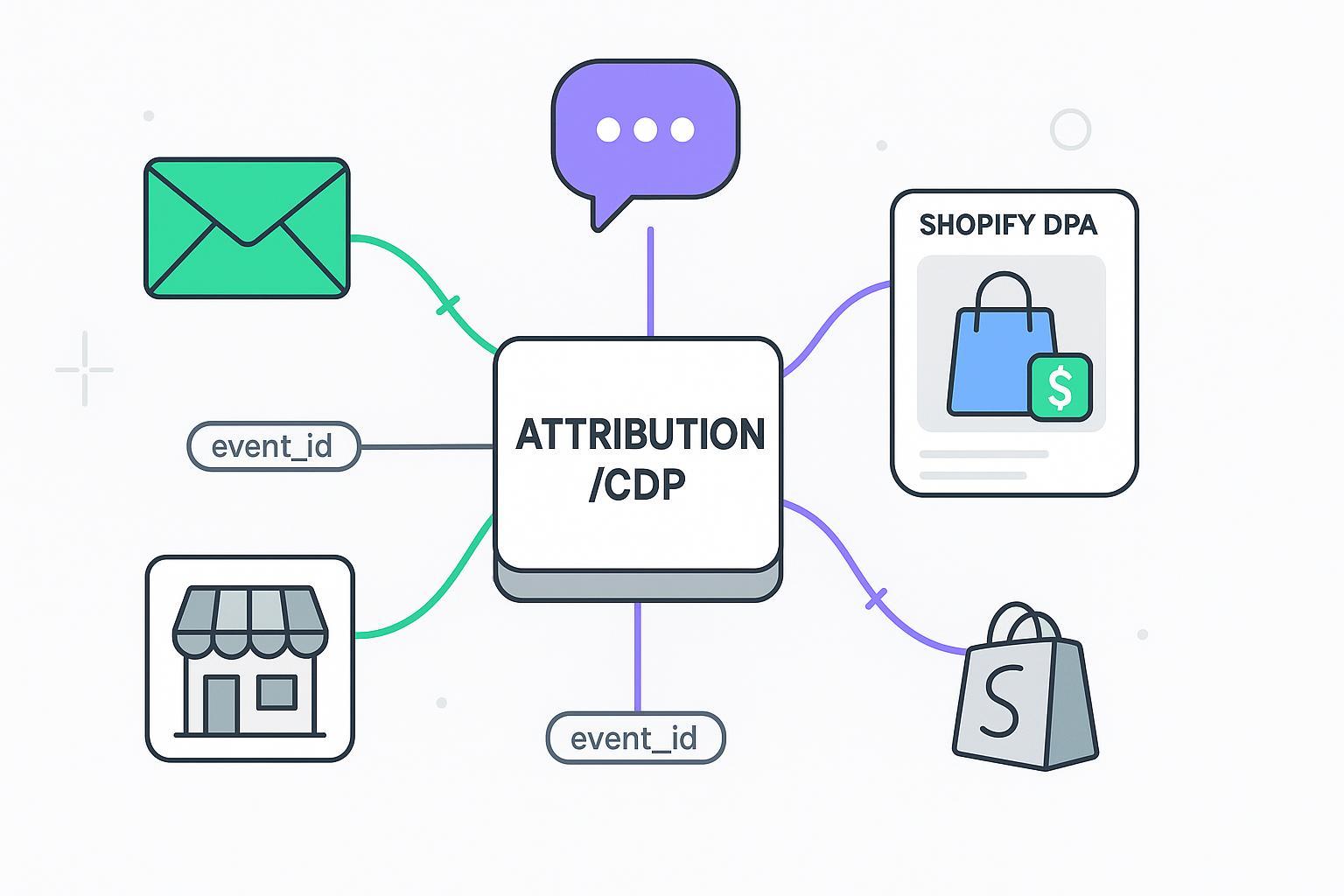
If you manage growth for a Shopify brand, you’ve probably felt the pain of fractured retargeting: pixels miss events, ESP segments don’t align with ad audiences, and SMS rules clash with email suppressions. This guide shows how to unify Email, SMS, and Shopify DPA retargeting with an Attribution/CDP‑led hub so you can maximize one north‑star KPI: Incremental ROAS from retargeting and owned‑channel assists.
We’ll keep it hands‑on: architecture first, then an interoperability checklist, launch templates, and a neutral comparison grid. The highest non‑negotiable criterion throughout is server‑side tracking completeness and cross‑channel de‑duplication.
Key takeaways
Adopt an Attribution/CDP‑led hub to coordinate identity, server‑side events, and consent across Email, SMS, and DPA.
Make de‑duplication non‑negotiable: share event_id between browser and server for Meta/TikTok and standardize event names/windows.
Build a deterministic identity graph (hashed email/phone/external_id) and enrich with consented click IDs (fbp/fbc, ttclid) for match quality.
Hit practical freshness targets: sub‑15‑minute audience updates for abandoners and instant purchase/opt‑out propagation.
Treat catalog/DPA hygiene as performance infrastructure: variant‑level content_id parity, clean feeds, low diagnostics errors.
Measure lift, not just last‑click: run audience/geo holdouts and bind reporting to contribution‑margin, not only revenue.
Architecture for Shopify DPA retargeting: one hub, many channels
An Attribution/CDP‑led pattern prevents channel silos and biased measurement while enabling tight sequencing and suppression across Email, SMS, and ads.
Data flow in practice:
Capture and normalize events
Shopify client events (pixel) fire on add_to_cart, initiate_checkout, purchase. Generate a UUIDv4 event_id in the browser and persist it.
Server‑side: Shopify webhooks and/or sGTM forward server events to Meta Conversions API and TikTok Events API using the same event_id and event_name to enable deduplication. Meta explains that browser and server events are deduplicated when both the event_name and event_id match; TikTok documents a similar deduplication pattern.
GA4 Enhanced Conversions carries hashed identifiers for modeled recovery and cross‑checks.
Useful references: Meta’s guidance on event_id deduplication in the Conversions API and fbp/fbc parameters; TikTok’s Events API and event deduplication docs; Google’s overview of GA4 Enhanced Conversions and Consent Mode v2.
Resolve identity with consent
Deterministic keys: lowercased/trimmed, SHA‑256 hashed email; E.164‑formatted, hashed phone; stable external_id (Shopify customer_id or custom UUID).
Enrich with platform identifiers when consented: fbp/fbc for Meta; ttclid for TikTok.
Consent gating: IAB TCF/Consent Mode v2 in EEA and Global Privacy Control (GPC) in US; SMS consent tracked separately per profile.
Read more in the official docs: Google’s Consent Mode (web) and GA4 Enhanced Conversions; Klaviyo’s SMS consent collection requirements.
Activate and orchestrate
The hub computes segments (e.g., “Cart Abandoners 7d”, “High AOV browsers”) and syncs to ESP/SMS and ad platforms.
Suppression rules and frequency caps are enforced centrally; purchase and opt‑out events propagate in real time to shut off messaging.
Why this matters for Incremental ROAS
Deduplication ensures you don’t count the same conversion twice across pixel and server, keeping lift estimates credible.
Identity accuracy raises match rates for DPA and improves email/SMS personalization, which reduces wasted impressions and overlap.
Consent‑aware activation protects addressability and reduces compliance risk that could force you to pause programs.
Authoritative sources with details:
Meta — Conversions API deduplication and parameters: see the sections on matching event_name + event_id and the fbp and fbc parameter specification.
TikTok — Event deduplication for Pixel and Events API and the Events API overview.
Google — GA4 Enhanced Conversions (user_provided_data) and Consent Mode (web).
Klaviyo — SMS consent collection and rules.
Interoperability checklist (pass/fail)
Use this as your build and QA backbone. Treat SLAs as targets, not industry standards.
Tracking and data integrity
Server events for Meta/TikTok mirror browser events with the same event_id and event_name.
Refunds/partial refunds are ingested and reflected in analytics; Meta can accept adjusted purchase via CAPI patterns; handle TikTok adjustments in analytics/CDP.
Profit fields (COGS, shipping, discounts) included where available to enable contribution‑margin reporting.
Identity and consent
Deterministic keys: hashed email/phone/external_id present for logged‑in or form‑captured users; cookie/click IDs passed when consented (fbp/fbc, ttclid).
CMP integrated: Consent Mode v2 purposes respected; GPC honored as a binding opt‑out; SMS consent stored separate from email and enforced.
Catalog/DPA hygiene
Catalog feed IDs match content_ids exactly (case‑sensitive) at the variant level.
Diagnostics <1% errors; titles/images/availability are fresh; item_group_id used correctly.
Audience sync SLAs
Abandoners and buyer suppressions update within 15 minutes; purchase and opt‑out events propagate instantly.
Alerting in place for API failures and schema mismatches.
ESP/SMS orchestration
Frequency caps enforced across channels; transactional vs marketing SMS separated with proper consent.
Cross‑channel suppressions: recent purchasers excluded from ad and owned‑channel retargeting windows.
Reporting and tests
Multi‑touch comparison and assisted conversions visible; lift experiments (audience/geo or auction‑level) planned with clear guardrails.
Dashboards flag identity match rates, audience freshness, and refund impact on ROAS.
For platform specifics, consult Meta’s Conversions API and Feed Management docs, TikTok’s Events API and Catalog parameters, GA4 Enhanced Conversions, and Klaviyo consent and audience sync documentation. For catalog references, Meta’s Feed Management guide and TikTok’s Catalog Product Parameters are good starting points.
DPA essentials: feed and event mapping that actually scale
Dynamic ads only work when feeds and events speak the same language.
Map content_ids in events to catalog id at the variant level. Mis‑casing or grouping mismatches break personalization.
Maintain clean feeds: required fields populated; item_group_id set for variants; media specs respected; diagnostics monitored.
Update cadence: at least daily; hourly for fast‑moving catalogs.
Refund and availability signals: ensure out‑of‑stock items aren’t promoted; send refund data to correct optimization where supported; reconcile in analytics where not.
Helpful official references include Meta’s Feed Management and Commerce Platform integration docs, and TikTok’s Catalog Product Parameters and catalog management pages.
Orchestration playbooks: from segments to sequencing
Audience definitions (examples)
Cart Abandoners (7d): viewed product + add_to_cart, no purchase; freshness <15 minutes.
High‑Intent Checkouts (3d): initiate_checkout, no purchase; prioritize SMS if explicit SMS consent and high AOV.
Recent Purchasers (30d): purchase in last 30 days; suppression audience across channels.
Sequencing and suppression rules
Start with email for most abandoners; escalate to SMS only for high intent + explicit SMS consent; avoid channel collision within 8–12 hours.
Suppress purchasers immediately across Email/SMS/DPA using the shared purchase event_id.
Use DPA to cover catalog depth while owned channels handle persuasion and value props; exclude owned‑channel engagers from the heaviest ad frequency tiers where budgets are tight.
Freshness targets and monitoring
Sub‑15‑minute audience updates for abandonment flows; real‑time purchase/opt‑out gating.
Alerts on drops in Event Match Quality or spikes in dedup conflicts in Meta/TikTok diagnostics. TikTok’s diagnostics guidance and Meta Events Manager can help pinpoint issues.
Sample payload sketch (Meta/TikTok aligned)
{
    "event_name": "Purchase",
    "event_id": "a1b2c3d4-e5f6-7890-1234-56789abcde01",
    "event_time": 1738627200,
    "user_data": {
      "em": "<sha256_lowercase_email>",
      "ph": "<sha256_e164_phone>",
      "external_id": "<stable_uuid_or_customer_id>",
      "fbp": "fb.1.1690000000.1234567890",
      "fbc": "fb.1.1690000000.AbCdEf...",
      "ttclid": "<tiktok_click_id_if_present>"
    },
    "custom_data": {
      "value": 129.99,
      "currency": "USD",
      "content_type": "product",
      "content_ids": ["sku-variant-123"],
      "order_id": "#100234",
      "discount": 20.00,
      "shipping": 5.99,
      "cogs": 45.50
    }
  }
Note: Parameter names vary slightly by platform; verify against the latest Meta and TikTok API docs.
Measurement for Incremental ROAS
Attribution alignment: Standardize windows and dedup rules across platforms; compare last‑click vs multi‑touch, and disclose whether view‑through is included.
Lift tests: Use audience holdouts (withheld from retargeting) or geo splits; for platform auction experiments, follow the platform’s documentation. Report confidence ranges, not just point estimates.
Profit‑aware metrics: Tie spend to contribution margin (post‑discount, shipping, COGS) rather than topline revenue alone; include refunds in the calculation.
Enhanced Conversions and modeling: Configure GA4 Enhanced Conversions with hashed user data; document how denied consent paths are modeled per Consent Mode v2.
Further reading: Google’s GA4 Enhanced Conversions and Consent Mode (web) explain required identifiers and consent mechanics.
Neutral comparison grid (includes disclosure)
Disclosure: Attribuly is our product. The grid below compares representative approaches and tools using objective criteria. Treat scores as qualitative guidance—validate in your stack.
Option | Server‑side tracking completeness & de‑dup | Audience sync freshness | Identity resolution | Shopify depth | Consent & privacy | TCO & complexity |
|---|---|---|---|---|---|---|
Attribuly (CDP/attribution hub) | Strong coverage for Meta/TikTok/GA4; shared event_id patterns | Minutes‑level targets; continuous segment sync | Deterministic keys + cookie/click IDs | Refunds, subscriptions, profit fields support | CMP/Consent Mode patterns; GPC honoring practices | Moderate license; low‑medium implementation |
Elevar/Littledata (tracking specialist) | Robust server‑side pipelines; GA4 strong | Varies by destination; often minutes‑level | Deterministic IDs; platform cookies where available | Solid Shopify depth | Consent integrations depend on setup | License + engineering effort required |
Hightouch/Segment (reverse ETL/CDP) | Depends on warehouse events; solid when modeled | Minutes to near‑real‑time targets (architecture‑dependent) | Strong identity stitching in CDP tier | Varies by connectors | Consent modeled via CDP + CMP | Higher TCO; strong flexibility |
Klaviyo (ESP‑led) | Client‑heavy; server‑side via integrations | Hourly to multi‑hour audience updates typical | Deterministic email/phone; ad IDs limited | Deep ESP profile; Shopify app depth | Strong for email/SMS consent | Lower TCO; limited ads orchestration |
Native CAPI/Event APIs | Max control; engineering heavy | Real‑time possible per endpoint | Identity as you build it | Custom depth by effort | Your CMP/consent to implement | Lowest license; highest engineering |
Shopify Audiences (Plus) | Not a tracking layer | Batch‑based audience exports | N/A (network modeling) | Limited to Plus and Payments | Shopify privacy guardrails | Included with Plus; scope‑limited |
Notes: Weights prioritize server‑side completeness and de‑duplication per our non‑negotiable criterion. Always verify latency claims and consent models in production.
Practical micro‑workflow (neutral example)
Goal: Sync “Cart Abandoners (7d)” to ads and trigger owned‑channel follow‑ups while enforcing consent and suppressions.
Segment definition in the hub: add_to_cart in last 7 days AND no purchase; consent.ad_personalization = true.
Activations:
Sync to Meta Custom Audience and TikTok audience; verify Event Match Quality and content_id ↔ catalog id parity in diagnostics. Refer to TikTok’s diagnostics overview and Meta’s Events Manager guidance.
Trigger Klaviyo email flow; where SMS consent exists and checkout value is high, send a single SMS after 8–12 hours if no email open/click; see Klaviyo’s Meta audience sync basics for expected sync behaviors.
Suppressions: Any purchase event with matching event_id immediately removes the profile from all audiences and halts flows.
As an example of this architecture, a CDP/attribution hub such as Attribuly can compute the segment, sync it to Meta/TikTok, and forward selected events to Klaviyo to trigger flows. This is one of multiple viable implementations; alternatives include Hightouch/Segment or custom sGTM + native APIs.
Launch templates
30/60/90 rollout (targets, not standards)
Day 0–30
Implement server‑side events with shared event_id; enable GA4 Enhanced Conversions.
Stand up consent gating (CMP, Consent Mode v2; honor GPC) and separate SMS consent.
Clean the catalog feed; enforce variant‑level content_id parity; reduce diagnostics errors below 1%.
Day 31–60
Define priority segments (abandoners, high‑intent checkouts, recent purchasers) and stand up suppression matrices.
Set freshness SLAs (≤15 minutes) and alerts for failures; verify match quality in platform diagnostics.
Launch DPA for abandoners with owned‑channel assists; add frequency caps across channels.
Day 61–90
Run your first holdout/geo test to estimate Incremental ROAS; report profit‑aware results.
Add refunds/returns adjustments into analytics; reconcile ROAS.
Expand to prospecting lookalikes seeded from high‑quality converters.
Interoperability checklist (quick paste)
Shared event_id across browser/server for add_to_cart, initiate_checkout, purchase
Deterministic identity (hashed email/phone/external_id); fbp/fbc and ttclid when consented
CMP integrated; Consent Mode v2 and GPC honored; SMS consent separated
Catalog: variant‑level id parity; <1% diagnostics errors; hourly/daily refresh
Audiences: abandoners and buyer suppressions update ≤15 minutes; real‑time purchase/opt‑out
Reporting: lift test plan; contribution‑margin ROAS; refund ingestion
Next steps and resources
Validate your current stack against the checklist, then implement the 30/60/90 plan.
Authoritative documentation for further implementation:
Meta: fbp and fbc parameters for Conversions API and Feed Management.
TikTok: Events API overview and Event deduplication.
Google: GA4 Enhanced Conversions and Consent Mode (web).
Klaviyo: SMS consent collection and Meta audience sync.
For a server‑side tracking walkthrough and audience design examples, see Attribuly’s public resources on Shopify server‑side tracking and audience segmentation by journey stage.
If you need a CDP/attribution hub to coordinate identity, deduplication, and audience sync, evaluate options that fit your engineering capacity and consent model. You can include a platform like Attribuly among your shortlist alongside Hightouch/Segment or a custom sGTM + native APIs approach.
Appendix: quick references
Meta — Conversions API and parameters (dedup with event_id, fbp/fbc best practices); Feed Management for catalog hygiene.
TikTok — Events API and deduplication, diagnostics, catalog product parameters.
Google — GA4 Enhanced Conversions and Consent Mode v2.
Klaviyo — Email/SMS consent collection and audience sync behaviors.
SEO note: this guide intentionally emphasizes “Shopify DPA retargeting” to align with search intent without stuffing the phrase. When in doubt, prioritize clarity and correctness over keyword density.