
Meta Purchase Event Match Quality benchmarks: good vs excellent
Learn what Purchase EMQ measures, what scores count as good vs excellent, how often it updates, and how to interpret ROAS impact.
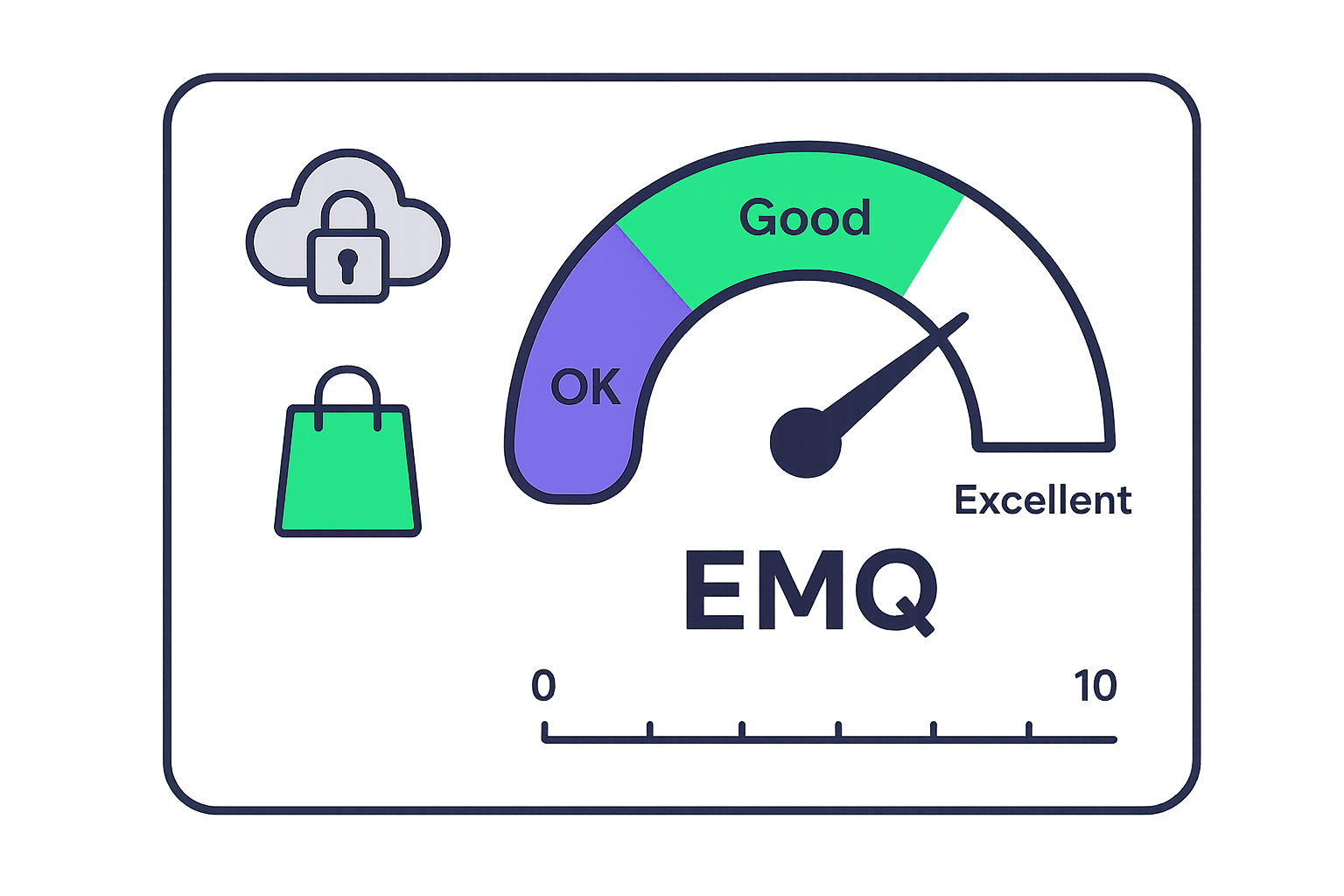
Meta’s tracking diagnostics can feel like a report card you didn’t ask for—especially when your Meta EMQ score for Purchase dips and ROAS is already under pressure.
This post makes EMQ plain:
what “Event Match Quality” actually measures
what score ranges usually count as good vs excellent for Purchase
how often EMQ recalculates (and why it fluctuates)
what EMQ can realistically change about attribution and ROAS—and what it can’t
Key Takeaway: Purchase EMQ is a signal-quality indicator, not a performance KPI. Get it into a healthy band, then prioritize conversion volume and measurement consistency.
Key takeaways
EMQ (0–10) estimates how well your Purchase events can be matched to real Meta accounts based on the customer info you send.
“Good” vs “excellent” is best treated as operational ranges (not a badge): you’re trying to be healthy and stable, not perfect.
Recalculation is continuous (Meta describes it as real-time), so day-to-day movement is normal—don’t panic on small swings.
Higher EMQ can improve attribution completeness and help Meta’s system learn faster, but returns diminish once you’re already healthy.
What is Meta Event Match Quality (EMQ)?
Event Match Quality (EMQ) is Meta’s score (out of 10) that indicates how effective the customer information sent from your server is at matching event instances (like Purchase) to a Meta account.
Meta’s own developer documentation describes EMQ as a composite score that looks at:
which customer information parameters you send,
the quality of that information, and
what percentage of events are successfully matched to Meta accounts.
Source: Meta for Developers, Dataset Quality API (Conversions API).
What EMQ is measuring in plain English
For Purchase events, EMQ is basically answering:
“When someone buys, how often can Meta confidently connect that purchase back to a real person in its system—using the identifiers you provided?”
More matchable events means cleaner:
attribution (what got credit)
optimization signals (what Meta learns from)
audience building (who can be retargeted)
What affects Purchase EMQ (the match keys)
EMQ is driven by the identifiers (match keys) you send with each event—think of these as the “clues” Meta uses to match an event to a user.
Meta’s docs mention match-key feedback for identifiers such as email, phone, IP address, user agent, external ID (among others). The more complete and consistently formatted these are, the better matching tends to be.
Source: Meta for Developers, Dataset Quality API (Conversions API).
Pro Tip: Don’t treat EMQ as a one-time setup item. A tracking stack can drift (theme changes, checkout updates, tag changes, consent changes). EMQ is useful precisely because it can catch that drift early.
Meta Purchase Event Match Quality benchmarks: “good” vs “excellent”
Meta’s UI often uses qualitative labels, but teams still need numeric thresholds to operate.
Here’s a pragmatic way to interpret Purchase EMQ for DTC performance marketing.
Purchase EMQ benchmark table
Purchase EMQ score | Practical label | What it usually means | What to do next |
|---|---|---|---|
0–5.9 | At-risk | Matching is weak or inconsistent; you’re likely missing key identifiers or sending low coverage. | Audit event payloads and coverage; validate deduping; fix missing/invalid identifiers; verify CAPI is firing reliably. |
6.0–7.9 | Good (healthy) | You’re in a workable range. Meta can match a meaningful share of Purchase events. | Stabilize: keep coverage consistent, improve the worst identifiers first (coverage gaps), and focus on conversion volume + clean measurement. |
8.0–8.9 | Great | Strong matching; typically enough for most scaling decisions. | Treat improvements as incremental. Don’t trade UX or conversion rate for +0.3 EMQ. |
9.0–10 | Excellent (diminishing returns) | Very strong matching. Gains above this often won’t move business outcomes much. | Only optimize further if there’s a clear technical reason and no user experience cost. |
Two commonly cited reference points:
Attribuly suggests you should expect Purchase EMQ > 8. Source: Attribuly’s guidance on Meta server-side tracking.
A practitioner view from Triple Whale suggests “healthy” often starts around ~6, and Purchase frequently lands in a higher band; they also argue returns diminish above ~8. Source: Triple Whale’s EMQ perspective.
How to use these benchmarks:
If you’re below 6, treat it as a diagnostic red flag.
If you’re 6–8, you’re usually “good enough” to shift attention to volume, creative, offer, and measurement consistency.
If you’re 8+, you’re in “good to excellent” territory—only chase further gains when it’s low-effort and low-risk.
How often does Purchase EMQ recalculate?
Meta describes EMQ as being calculated in real time in its developer documentation.
Source: Meta for Developers, Dataset Quality API (Conversions API).
What that means operationally
EMQ can move daily as traffic mix changes (new vs returning customers, geo mix, device mix), consent rates shift, or identifier coverage drifts.
Small changes (for example, ±0.5) are often noise.
Some practitioners describe EMQ as reflecting a recent rolling window (e.g., ~48 hours). If you use that mental model, it explains why EMQ can react quickly after a tracking change.
Source (practitioner guidance): Triple Whale’s EMQ perspective.
⚠️ Warning: Don’t “fix” EMQ based on a single bad day. If performance is stable, wait 2–3 days to see if EMQ normalizes before making big tracking changes.
What EMQ means for ROAS (and what it doesn’t)
DTC teams often ask: “If I raise Purchase EMQ, will ROAS go up?”
The clean answer is: not directly, and not reliably.
How higher EMQ can help (indirectly)
Better attribution completeness
When more Purchase events match to real users, Meta can connect more conversions back to ad interactions. That can make reporting less undercounted.
Cleaner optimization signals
Meta’s delivery system learns from conversion feedback. Cleaner, more matchable signals can help it learn more reliably—especially when combined with sufficient conversion volume.
More usable audiences for retargeting
If more purchasers (and non-purchasers) can be matched, you typically get more stable audience pools.
Where EMQ won’t save you
Creative/offer problems: EMQ can be perfect and ROAS can still be bad.
Low conversion volume: A “9 EMQ” Purchase event with very few conversions is usually less useful than a “6 EMQ” Purchase event with strong volume.
Broken measurement elsewhere: If deduplication is wrong, purchase value is incorrect, or funnel events are missing, EMQ alone won’t fix the story.
A practical ROAS interpretation rule
Use EMQ like a guardrail:
If ROAS drops and Purchase EMQ drops sharply, EMQ is a good place to investigate first.
If ROAS drops but Purchase EMQ is stable and healthy, look at creative, offer, landing page, auction pressure, budget structure, and attribution windows.
How to improve Purchase EMQ without tanking conversion rate
Focus on coverage and consistency first.
Send more (reliable) customer identifiers
Aim to improve the identifiers with the lowest coverage (email/phone/external_id, plus IP + user agent).
Prefer server-side where possible (CAPI / server-side tracking)
Browser-side signals are increasingly fragile. Server-side helps reduce signal loss from browser restrictions.
Enable advanced matching where it fits your stack
Advanced matching can improve identifier capture (when implemented correctly and compliantly), which can support better event matching.
Make sure deduplication is correct
If you send the same event both browser-side and server-side, ensure Meta can dedupe correctly (event IDs and consistent event metadata).
Watch for format and hashing issues
Small formatting mistakes (phone normalization, email casing/whitespace, inconsistent external IDs) can quietly reduce match rate.
Optimize for stability, not max score
A stable EMQ at 7+ is often more valuable than a spiky EMQ that occasionally hits 9.
What EMQ is not
To avoid common confusion:
EMQ is not your conversion rate. It’s about matching quality, not persuasion.
EMQ is not a guarantee of better performance. It’s a diagnostic indicator, not a lever like creative or pricing.
EMQ is not just “CAPI on/off.” Implementation quality and identifier coverage matter.
FAQ
What’s a “good” EMQ for Purchase?
A practical “good” band for Purchase is usually 6–7.9 (healthy). Many teams aim for 8+ as a strong target, especially if the setup is mature.
Why is my Purchase EMQ high but ROAS still low?
Because ROAS depends heavily on creative, offer, audience, and auction conditions. EMQ improves signal matchability and attribution completeness, but it doesn’t fix demand or conversion-rate issues.
How quickly should EMQ improve after changes?
Meta describes EMQ as calculated in real time, so it can react quickly. In practice, give changes a few days before drawing conclusions, and validate that your event coverage and dedupe are stable.
Next steps (neutral)
If you want a simple way to sanity-check whether your Purchase EMQ is “good” vs “excellent” by event type—and what to prioritize at each band—start with Attribuly’s benchmark resources.
Explore Attribuly for EMQ benchmarks and tracking diagnostics resources.