
Klaviyo win-back flow: Best practices to re-engage lapsed customers
Practical Klaviyo win-back flow guide for e-commerce teams: timing, segmentation, templates, incentive math, A/B tests and KPIs to recover lapsed customers.
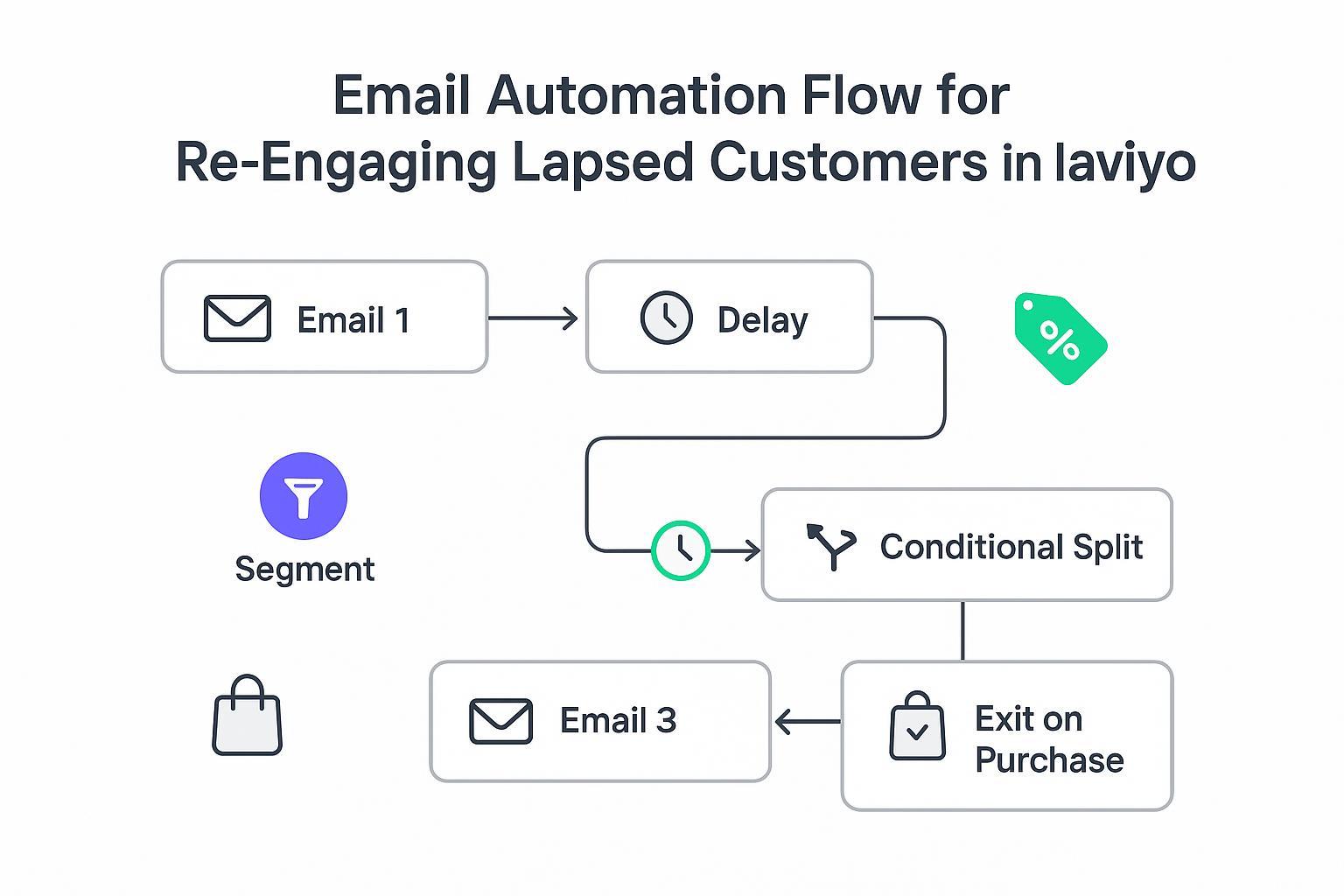
When repeat revenue slows, the fastest lift often comes from a disciplined Klaviyo win-back flow—not a bigger ad budget. This guide distills current benchmarks, proven timing rules, segmentation recipes, and reproducible Klaviyo flow logic so you can bring lapsed customers back without damaging deliverability or margin.
The term “lapsed” looks different across categories. That’s why we’ll anchor everything to your repurchase cycle, then layer in value bands and engagement signals. Along the way, you’ll get subject lines to test, a lightweight email template, incentive guardrails with quick ROI math, and a short example showing how richer event data can expand your eligible audience.
Key takeaways
Start your Klaviyo win-back flow slightly beyond the median time between orders, then add two more touches 10–15 days apart. Use exit filters so any purchase skips remaining sends.
Expect lower conversion than cart flows but meaningful revenue per recipient; use win-back benchmarks as directional ranges and measure incremental lift with a holdout.
Segment by purchase recency, value, and engagement recency to control cadence and incentives. Keep sequences short and sunset non-responders.
Introduce incentives only after a value-led first touch; size discounts with a simple margin-based formula and cap by customer value band.
Prioritize tests that change timing, incentive presence, and creative format. Read success with RPR and reactivation rate, not opens alone.
Benchmarks that set expectations
Klaviyo’s 2026 industry benchmarks show automations punch far above their weight: flows generate about 41% of email revenue from roughly 5.3% of sends, with click rates around 5.58% versus 1.69% for campaigns, and materially higher revenue per recipient (RPR) overall. See the details in Klaviyo’s 2026 benchmarks overview in the report titled the Klaviyo 2026 Email Marketing Benchmarks published in January 2026.
Win-back–specific public tables are rare, but cross-vendor data provides useful guardrails. Omnisend reports its lapsed purchase automation averages around a 33.0% open rate, 1.96% click-to-send, 0.52% conversion rate, and roughly $0.49 revenue per email, with an AOV near $94. See the vendor’s 2026 update in the article titled the Omnisend win-back email guide with benchmarks.
How to use these numbers: treat them as directional, not targets. Your performance will vary by repurchase cycle, offer economics, audience quality, and data coverage. The best way to judge your program is by measuring incremental lift versus a holdout (covered below) and tracking reactivation rate alongside RPR.
When to trigger and how often
A win-back should begin just after customers pass their typical reorder point. If your median time between orders is 60 days, start around day 75–90. Klaviyo’s help materials commonly illustrate a first message near 75 days with 10–15 day gaps for follow-ups in a short sequence. For a platform-specific starting point, see Klaviyo’s help article on building a win-back in the documentation titled How to create a win-back flow.
Suggested starting delays by category
Category example | Median reorder pattern | First send delay | Gap to email 2 | Gap to email 3 |
|---|---|---|---|---|
Apparel and accessories | 45–60 days | 75–90 days | 10–12 days | 10–15 days |
Beauty and skincare | 30–45 days | 45–60 days | 7–10 days | 10–12 days |
Home and decor | 90–120 days | 110–140 days | 12–15 days | 12–15 days |
Supplements and consumables | 25–35 days | 35–45 days | 7 days | 7–10 days |
Notes: Shorten delays for high-frequency consumables and shorten the entire cadence for recently engaged subscribers. If you run hybrid channels, test a gentle SMS nudge at day 0 or day 1 and move the first email accordingly.
Segmentation recipes that actually work
Use purchase recency to define “lapsed,” engagement recency to protect your sender reputation, and value bands to control incentives. Build the following in Klaviyo’s segment builder.
Segment name | Core logic in Klaviyo terms | Use in flow |
|---|---|---|
Win-back Purchasers | Has Placed Order at least once over all time AND Has Placed Order zero times in the last X days (X ≈ median TBO + buffer) AND Subscribed to email is true | Primary trigger segment |
High-value Lapse | Predicted CLV above threshold OR Total Spent ≥ threshold AND Last order date older than X days | Branch to richer content and possibly stronger incentive |
Engagement Tiers | Opened or Clicked email in last 30/60/90 days (create three segments) AND Has Placed Order at least once | Use as conditional splits to modulate cadence and message |
Tip: Keep “flow filters” strict so anyone who orders or meaningfully engages exits automatically. That way, you can be bold on the first touch of your Klaviyo win-back flow without worrying about over-sending to recent purchasers.
A reproducible Klaviyo win-back flow blueprint
Copy this logic into your flow. It uses a segment-triggered setup with send-time re-evaluation.
Trigger: Segment-triggered → "Win-back Purchasers"

  Flow Filters (evaluate before each send):
  - Has Placed Order = 0 times since starting this flow
  - Has Opened Email = 0 times since starting this flow (optional)
  - Has Clicked Email = 0 times since starting this flow (optional)

  Pathing:
  1) Conditional Split → Engagement Recency
     Condition: Opened OR Clicked email ≥ 1 in last 60 days
     YES → Standard creative, value-led, no incentive
     NO  → Plain-text style, social proof, consider light incentive in Email 2

  2) Conditional Split → Value Band
     Condition: Predicted CLV or Total Spent ≥ threshold
     HIGH VALUE → Personalized picks; escalate incentive only if no engagement after Email 2
     STANDARD   → Education + what’s new; hold incentive until Email 2 or 3

  Cadence (example):
  - Email 1 → At (median TBO + buffer). Subject: "It’s been a while—see what’s new"
  - Delay → 10–15 days
  - Email 2 → Escalate message; consider free shipping or 10% for NO path only
  - Delay → 10–15 days
  - Email 3 → Final reminder; include opt-down/unsubscribe clarity

  Exit: Any purchase or unsubscribe removes the person via flow filters.
Subject lines and a lightweight template
Short, clear, human. Test a mix of urgency, curiosity, and value.
Subject ideas “Still up for 10% off your next pick?” “We miss you—here’s what changed” “Last nudge from us for a while” “Fresh arrivals we handpicked for you” “Your favorites are back in stock” “Quick question—did we get something wrong?”
Preview text ideas “We saved your spot. See what’s new.” “Your taste, updated. Two-minute browse.” “Prefer fewer emails? Manage your settings below.”
One-email body starter Hi [First name],
It’s been a while since your last order, so we thought we’d show you what’s new and what our customers are loving now. If you’re still on the fence, no rush—your account’s waiting whenever you are.
What’s new: [New collection or product]
Your past favorites: [1–2 dynamic recs]
Why customers came back: [1 short testimonial]
Take another look → [Primary CTA]
Prefer fewer emails? Update your preferences or unsubscribe below.
Should you discount Incentive guardrails and ROI math
Lead with value in Email 1. If there’s no engagement, consider a modest incentive in Email 2, and escalate selectively by value band. Non-discount options (loyalty points, bundles, free gifts) preserve margin and still feel like a win.
A quick way to sanity-check an offer is to compare incremental profit per recipient between a control and an incentive variant.
Incremental Profit per Recipient ≈ (RPR_variant − RPR_control) × Gross Margin − Discount Cost per Recipient
  Where: Discount Cost per Recipient = Offer Value × Redemption Rate
Typical ranges to test: free shipping; 5–10% off as a light nudge; 15–20% off for high-value lapsers if the math works. If the equation is negative, pull back the offer or tighten targeting.
A/B tests to run first and how to read them
Timing of the first send: median TBO + 15 days vs. +30 days. Hypothesis: closer to the repurchase window converts better without hurting complaints.
Incentive presence: value-only vs. value + 10% in Email 2. Hypothesis: light incentive lifts click-to-order among less-engaged profiles.
Sequence length: 2 vs. 3 emails with the same filters. Hypothesis: a third touch adds incremental RPR without increasing complaints.
Creative format: branded HTML vs. short plain-text. Hypothesis: plain-text improves inbox placement and reply-driven engagement for cold tiers.
Offer type: free shipping vs. percentage. Hypothesis: fixed shipping relief converts low-AOV items more efficiently.
Channel order in hybrid: Email→SMS vs. SMS→Email for recently engaged tiers. Hypothesis: SMS first nudges immediate clicks; email first preserves opt-in sentiment.
Read success using RPR, placed order rate, unsubscribe, and complaint rate. To isolate true uplift, consider a holdout. Klaviyo describes global exclusions for lift analysis in the article titled the Global Holdout Groups overview.
Deliverability and list hygiene
Pre-clean your list regularly: remove hard bounces, suppress unsubscribes, and fix invalid addresses. Keep complaint rates extremely low.
Start with your 30-day engaged tier and expand to 60/90-day only if engagement and complaints are healthy.
Keep sequences short. After the win-back completes without engagement, move customers to a sunset path with one re-permission note, then suppress.
For platform guidance on the mechanics of a Klaviyo win-back flow and safe cadence, see the help documentation referenced above, and remember that send-time filters are your friend.
Practical example using richer data and audiences
If you’re finding that too few profiles qualify for your Klaviyo win-back flow, the issue might be data coverage or identity stitching. For example, brands that add a server-side source for checkout and purchase events often see more reliable “Placed Order” data and a larger eligible audience for win-back and exit rules. One practical approach is connecting a data layer that captures server-side Shopify events, then syncing those into Klaviyo so the same signal powers both entry criteria and flow filters. As a reference, Attribuly × Klaviyo Integration outlines how server-side tracking and first-party IDs can support broader eligibility and stable suppression. For additional build recipes and screenshots, see the Attribuly guide titled Ultimate Guide: Klaviyo Flows for Shopify.
Next steps
Rebuild your segment, copy the blueprint, set conservative filters, and launch with a holdout enabled. Track RPR, reactivation rate, and complaints weekly for the first month. If you need a cross-channel nudge later, consider syncing a lapsed-purchaser audience to ads—tools like Attribuly have a retargeting component, but keep the focus on email first.
Want a simple way to price out the impact of a discount before you roll it out broadly Try a quick test, and if you’re exploring tooling costs, you can review the plan tiers on Attribuly Pricing.
References and further reading
Automation performance context: the Klaviyo 2026 Email Marketing Benchmarks report (2026) explains flows’ outsized RPR and click rates.
Win-back automation figures: the Omnisend win-back email guide with benchmarks (2026) shares open, click, conversion, and revenue per email for lapsed purchase flows.
Platform build guidance: Klaviyo’s help article titled How to create a win-back flow (most recently updated in the 2025–2026 window) covers trigger and cadence principles.
Measuring lift: Klaviyo’s blog post titled the Global Holdout Groups overview (2023) outlines control groups for incremental analysis.