
Ecommerce Cart Incentives That Work (And the Ones That Kill Profit Margins)
Practical guide to ecommerce cart incentives that increase AOV without eroding margins—threshold rules, targeted recovery offers, and a testing playbook for merchants.
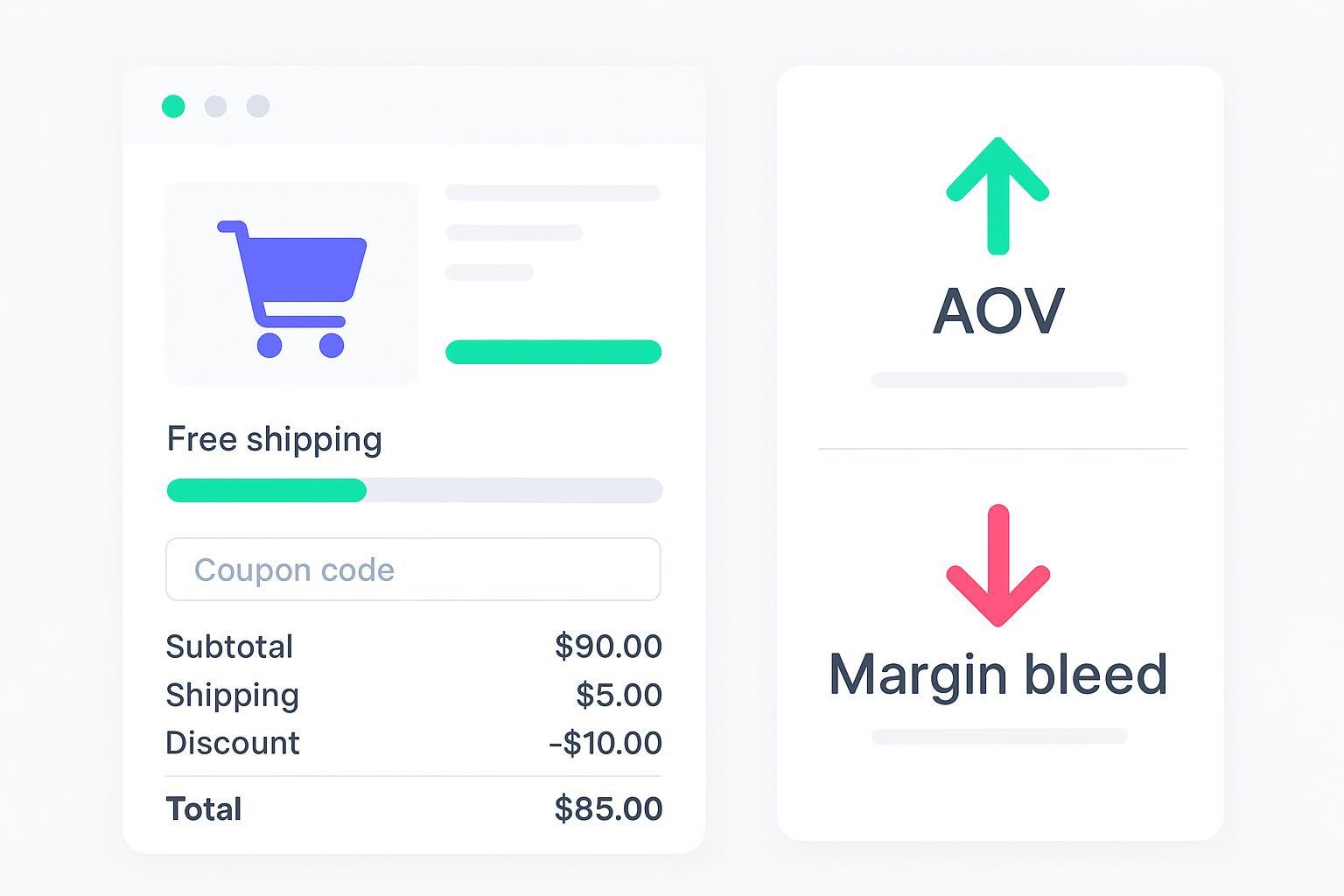
If 7 out of 10 carts never make it through checkout, every incentive you run either saves a sale—or silently taxes your margin. Cart incentives are any on‑site or triggered offers that nudge shoppers to finish checkout or add one more item: free‑shipping thresholds, dollar‑ or percent‑off coupons, loyalty points, time‑limited codes, and more. The trick is choosing levers that lift AOV and conversion without teaching customers to wait for discounts.
Key takeaways
Thresholded free shipping is often the highest‑leverage, profit‑safer incentive for AOV when the threshold sits just above current AOV and you validate it with a test.
Targeted, later‑touch abandoned‑cart offers outperform blanket sitewide discounts and protect margins.
Avoid unconditional free shipping on low‑AOV orders, frequent deep percent‑off sitewides, and stacked promos—these are the fastest routes to margin bleed and promo conditioning.
Measure success with incremental gross margin per visitor (GM/V), not just conversion or revenue.
Use holdouts and A/B tests to prove incrementality and check 3–12‑month cohort LTV so short‑term wins don’t become long‑term losses.
Why cart incentives matter (and why they backfire when sloppy)
Baymard’s 2025–2026 checkout research puts global cart abandonment around 70% and highlights leading reasons like extra costs (shipping, taxes, fees), slow delivery, forced account creation, and long checkouts. See Baymard’s current synthesis for details and year‑by‑year context in the Baymard Institute’s cart‑abandonment and checkout usability research (2025–2026): Baymard’s cart abandonment rate list and checkout usability research overview. Incentives can relieve price‑ and shipping‑related friction or trade a small, targeted cost for a bigger basket. Used carelessly, they erode contribution margin and reset reference prices.
The ecommerce cart incentives that actually work
Thresholded free shipping (primary lever for AOV)
Shopify’s guidance emphasizes that a minimum‑spend free‑shipping bar set slightly above typical orders can nudge larger baskets while keeping costs in check. See Shopify’s discussion of how free shipping and conversion interplay in 2024–2026: Shopify on free‑shipping strategy and conversion. A widely used practitioner starting point is to place the threshold about 10%–30% above your current AOV—then validate with an experiment. Pair the threshold with on‑page cues (progress bars, intelligent cross‑sells) to make the target feel attainable.
Guardrails:
Model shipping + pick/pack costs against expected basket lift.
Exclude bulky, low‑margin SKUs from threshold math if needed.
Don’t set a number so high it feels out of reach; that backfires into more abandonment.
Targeted abandoned‑cart offers (save incentives for later touches)
Abandoned‑cart email automations rank among the highest‑earning flows by revenue per recipient. Klaviyo’s 2024–2026 benchmarks point to robust revenue per recipient and placed‑order rates for abandoned‑cart emails relative to other automations. For current ranges and methodology, see Klaviyo’s abandoned‑cart benchmarks and its automation overviews. Keep monetary incentives for later touches (e.g., message two or three) and only for high‑intent segments: carts within a designated value band, first‑order only, one‑time use, and non‑stacking.
Practical pattern (to test, not assume): 2–3 touches over 48–72 hours across email first, then SMS for opted‑in users; layer paid retargeting as a complement. Reserve coupons for the final touch and keep the discount modest with a minimum order value.
Modest first‑order discounts (with exclusions and minimums)
Small welcome offers (for example, $5–$10 off or ~10% off) can help convert fence‑sitters. Protect margin with minimum order values, one‑time use, category exclusions, and strict non‑stacking. Don’t auto‑apply; require capture of first‑party contact so you can build owned reach.
Loyalty and member‑only rewards (build value beyond price)
Loyalty programs can lift CLTV and repeat purchase without constant markdowns. Vendor‑published case studies in the Klaviyo ecosystem report sizable gains; treat them as directional and validate internally. Examples include Shape Republic’s reported +34% CLTV and large gains in loyalty flow revenue (Klaviyo, 2025): Shape Republic case study. Use loyalty to replace blunt discounts with member perks, points multipliers, or shipping‑speed upgrades on higher tiers.
Tactics that quietly kill profit margins
Unconditional free shipping on low‑AOV orders
Shipping is a top abandonment reason, but footing the bill on every small order can compress contribution margin to near zero. Shopify’s enterprise guidance discusses trade‑offs between conversion and fulfillment costs—use it to calibrate your threshold: Shopify on fulfillment and free‑shipping tradeoffs (2024).
Broad, frequent sitewide percent‑off discounts and stacked promos
Heavy, repeated monetary promotions condition customers to wait for deals, lower reference prices, and harm perceived quality. A 2024 Journal of Retailing paper synthesizes how promotion overuse erodes brand equity through shifting price expectations: Journal of Retailing on promotion effects (2024). Complementary literature also finds frequent promotions degrade brand quality perceptions: SBIJ synthesis (2022). Avoid compounded giveaways (e.g., 25% off + clearance price + loyalty redemption + free shipping) that turn orders negative after costs.
BOGO overuse without cost modeling
BOGO and multi‑buy offers can clear inventory, but on low‑margin SKUs they quickly turn unprofitable—especially when combined with free shipping. Run the full margin math before launching and cap eligibility to SKUs that can bear the giveaway.
A quick decision matrix by AOV × margin
Use this as a starting point; always validate with tests and your own cost structure.
AOV × Margin scenario | Recommended incentive family | Safeguards and notes |
|---|---|---|
Low AOV (<$50) + Low margin (<30%) | Thresholded free shipping just above AOV; or small $‑off with exclusions | Model shipping/pick‑pack; no unconditional free shipping; non‑stacking; exclude low‑margin SKUs |
Mid AOV ($50–$150) + Mid margin (30%–50%) | Thresholded free shipping + segmented $10–$15 off for high‑intent abandoners | One‑time codes; first‑order only; minimum order value; coupon appears on later touches |
High AOV (>$150) + High margin (>50%) | Dollar‑off ($20–$40), gift‑with‑purchase, or expedited‑shipping upgrade | Prefer perks over deep %‑off; limit scope to protect perceived value; inventory‑aware targeting |
Any AOV + Healthy margin + Loyalty program | Member‑only perks and points multipliers | Tie perks to tiers; periodic boosters instead of sitewide discounts |
Free‑shipping thresholds: guardrails and quick math
Think of your threshold as a small, smart “nudge” that pays for itself. Here’s a fast way to sanity‑check it.
Inputs to collect:
Current AOV and conversion rate
Gross margin % by category and mix
Average shipping cost and pick/pack per order
Expected basket‑lift % at the proposed threshold (use a conservative estimate)
Example sketch:
Before: AOV $48, CVR 3.0%, gross margin 55%, shipping $7, pick/pack $2
After proposal: Threshold $60 (≈25% above AOV), expected AOV $58 (+21%), CVR flat
Margin before/order: $48 × 55% = $26.40; minus $7 + $2 = $17.40 contribution
Margin after/order: $58 × 55% = $31.90; minus $7 + $2 = $22.90 contribution
Visitors 1000 → Orders before 30; after still 30 (assume flat CVR)
GM/V before = $17.40 × 30 / 1000 = $0.522; GM/V after = $22.90 × 30 / 1000 = $0.687
Delta GM/V = +$0.165 (positive). Ship the change only if your experiment confirms this uplift and CVR doesn’t drop.
Success criteria:
Positive incremental GM/V vs control
Neutral or higher checkout completion rate
No spike in return rate or customer complaints about shipping fairness
Testing and measurement playbook (prove incrementality)
Primary metric: Incremental gross margin per visitor (GM/V). This bakes in discount cost, shipping subsidies, and pick/pack—so you avoid “fake wins.”
Secondary metrics: Conversion rate, AOV, revenue per visitor, coupon redemption, return rate, and 3/6/12‑month CLTV by exposed vs holdout cohorts.
Experiment designs to use:
A/B test threshold levels or on‑site coupon surfacing. Randomize by session/user, run 2–4 weeks, and pre‑compute sample size. For calculators and methodology, see Optimizely’s sample‑size guidance and its calculator; variance reduction techniques like CUPED can help stabilize results: Optimizely on CUPED. VWO’s experimentation hub provides additional context: VWO A/B testing resources.
Holdout/suppression cohorts for incentives: expose 80% to the incentive flow; suppress 20% entirely for 4–8 weeks. Compare incremental GM/V and CLTV over 3–12 months to spot promo conditioning and cannibalization.
A short, ready‑to‑run checklist
Hypothesis: “Raising the free‑shipping threshold from $45 to $65 will increase AOV enough to offset subsidy without reducing conversion.”
Design: Randomize 20% of traffic; run 4 weeks; power for a 5% CVR change (95% sig., 80% power).
Guardrails: One‑time codes; non‑stacking; minimum order values; low‑margin exclusions; frequency throttles.
Analysis: Report uplift with confidence intervals; segment by device and traffic source; run a 3‑month cohort LTV follow‑up.
Practical workflow example: expanding abandoned‑cart reach (Attribuly context)
Many teams underestimate how many abandoners they fail to identify due to client‑side event loss, identity gaps, and multi‑device behavior. Public resources from Attribuly outline how server‑side tracking and identity enrichment can expand reachable audiences and sync them into your messaging and ad platforms.
Why traditional setups miss people: identity gaps and client‑side loss. See Why Klaviyo misses many abandoners (Attribuly, explainer).
Implementation options: reviewed on the Attribuly integrations list (Shopify/WooCommerce plus Meta and Google ad platforms) for omnichannel follow‑up.
Neutral, sample workflow to test:
Capture more abandoners server‑side; sync to Klaviyo and ads.
Run a 3‑touch recovery over ~48–72 hours: email first; SMS for opted‑in users; light Meta retargeting. Keep the coupon for the final touch only, scoped to high‑intent carts (e.g., $60–$120) with one‑time use and a minimum order value.
Measure incremental GM/V with a 20% holdout; segment results by cart value band and device.
Quick answers to common questions
How often should I run sitewide discounts? As rarely as possible. Use them for true clearance or seasonal tentpoles, and always track cannibalization via holdouts and LTV checks.
What’s a reasonable starting point for a free‑shipping threshold? Practitioner rule of thumb: 10%–30% above current AOV, coupled with clear progress cues and a confirmatory A/B test using incremental GM/V as the primary decision metric.
Where should coupons appear in an abandoned‑cart flow? Later touches only, aimed at high‑intent segments, with one‑time codes, non‑stacking, and a minimum order value.
Next steps
If you need a neutral way to identify more abandoners and sync them to channels before you test incentives, tools like Attribuly’s integrations list can help you map what’s already possible in your stack. For additional implementation context, see our internal roundup of best abandoned‑cart recovery tools.