
Best Abandoned Cart Email Sequences Tools 2026 (Ranked by Recovery Rate)
12 abandoned cart tools ranked by actual recovery data — not vendor claims. Copy-ready email sequences, comparison table, Shopify & WooCommerce picks. 2026.
Every brand loses revenue to abandoned carts—but the smartest teams turn a chunk of those near-misses into orders. This 2026 guide brings two things you actually need: proven, copy-ready sequences and an evidence-led ranking of abandoned cart recovery tools.
If you’re here to choose software, you’ll get transparent recovery benchmarks where they exist, plus clear notes when vendors don’t publish data. If you’re here to ship a flow today, steal the templates below and test them this week.
Key takeaways
A practical 2–3 touch sequence within 72 hours recovers the lion’s share of reachable carts; start at 1 hour, follow at 24 hours, and optionally at 48–72 hours.
Expect overall recovery in the 5–15% range from email alone; adding push/SMS for opted-in users can lift results further. Benchmarks vary by list quality and offer.
Identity coverage matters in 2026: reaching previously anonymous abandoners and using server-side events improves both reach and measurement.
Choose tools using five lenses: audited recovery rate, abandoner identification coverage, tracking accuracy/privacy resilience, integrations/automation depth, and total cost of ownership.
Our primary keyword for this guide: abandoned cart recovery tools. You’ll find a comparison table and ranked picks below.
How we chose (criteria and weights)
We ranked tools using a transparent scorecard grounded in 2024–2026 evidence:
Audited recovery rate (sequence or flow) — 30%
Abandoner identification coverage (including anonymous) — 20%
Tracking accuracy & privacy resilience — 15%
Integrations & automation depth — 15%
Ease of implementation & time-to-value — 10%
Total cost of ownership & value — 10%
Sources included vendor docs, case studies, third‑party reviews, and industry benchmarks. For recovery-rate claims, we favored cohort-based or time‑windowed data. Where no public benchmark existed, we label it as such. For baseline abandonment context, Baymard’s cross‑study average is about 70.22% as of 2025–2026, per the research compiled in their cart-abandonment list (Baymard, updated 2025). For channel performance snapshots, Omnisend’s benchmark posts report abandoned cart email opens around 42% and push click‑to‑conversion near 13.94% across 2024–2026 datasets, while Klaviyo’s flow benchmarks commonly cite placed order rates around 3.33% and revenue per recipient around $3.65 for cart flows.
Soft CTA: Want a ready-to-edit Google Doc with these templates? Make a copy of the sequences below and test them this week.
Abandoned cart sequence: timing and templates
Recommended cadence for 2026: Email 1 at 1 hour, Email 2 at ~24 hours, Email 3 at 48–72 hours (extend to 96 hours for high‑AOV catalogs). Optional SMS or push near Email 2 for non‑openers.
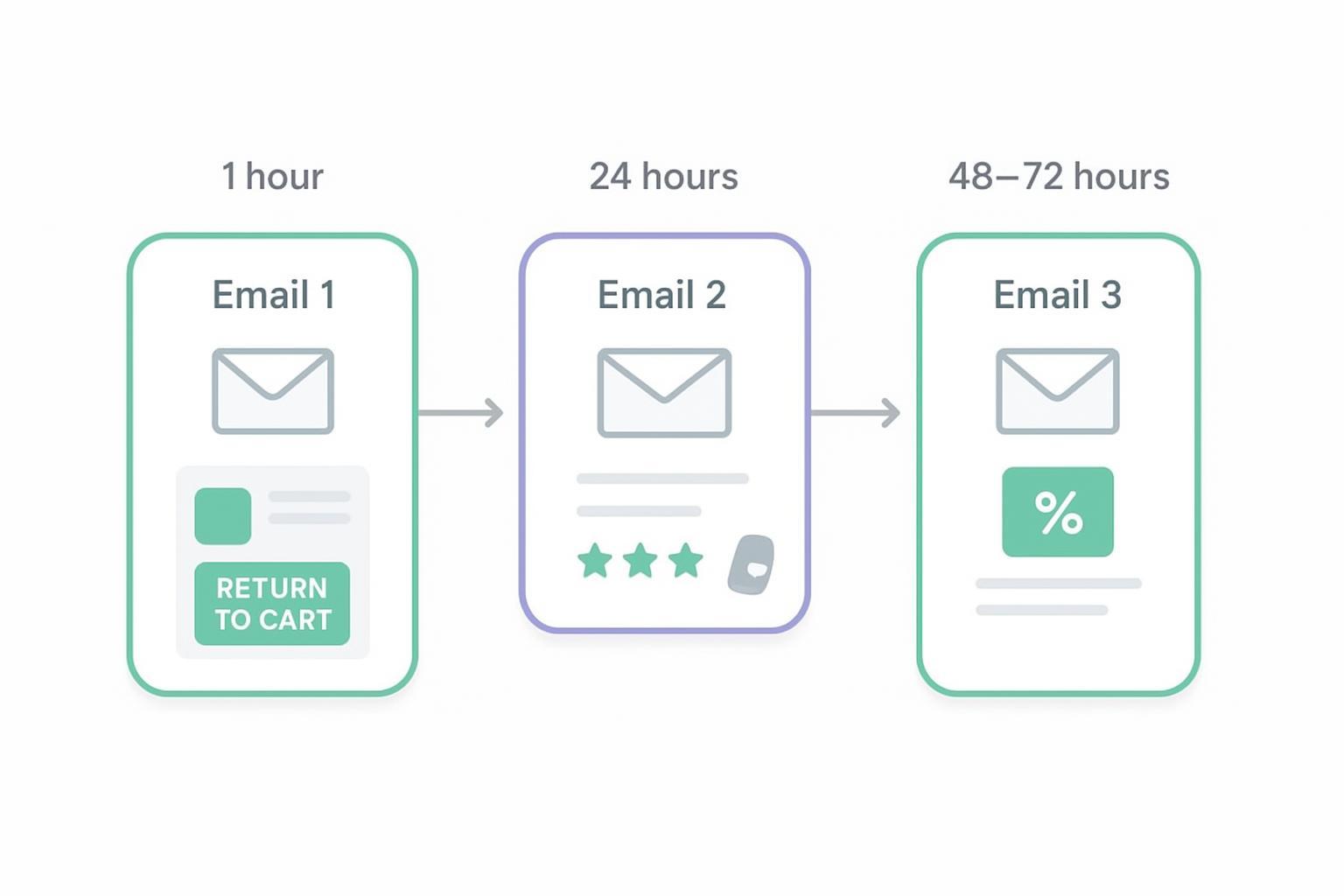
Why the timing works: Early reminders catch buyers while intent is warm; day‑two follow‑ups add trust and answers; day‑three incentives help borderline shoppers without over‑discounting. For a deeper timing breakdown with cohort notes, see this 2026 explainer on benchmarks and templates from Attribuly’s blog: abandoned cart timing cohort benchmarks and templates.
Sequence templates you can paste into your ESP today:
Email 1 — 1 hour: Reminder and reassurance
Subject: You left something behind — take another look
Body (short): Hey [First name], your picks are still in your cart. Checkout takes less than a minute — and we’ll save your progress. • What you saved: [Product image + name] • Quick facts: Free returns for 30 days · Secure checkout · Fast shipping Button: Return to your cart
Email 2 — 24 hours: Social proof and FAQs
Subject: Still thinking it over? Here’s what customers say
Body: Good news — your cart’s right where you left it. Here are a few reasons customers complete their order today: • “Love the quality and shipping was fast.” — 4.8★ average • Answers to common questions: shipping costs, returns, and warranties • Alternative: pick a different size/color directly from your cart Button: Resume checkout
Email 3 — 48–72 hours (optional): Incentive with a clear deadline
Subject: Last chance to save before your cart expires
Body: Final nudge — complete your order before midnight and get free shipping (today only). If you’re not ready, no worries: we’ll keep your picks saved for a bit longer. Button: Get free shipping and checkout
Optional SMS/Push (near Email 2 timing):
SMS: Your [Brand] cart’s waiting. Tap to finish: [short link]
Push: Your cart’s ready. Finish checkout now.
Benchmarks worth knowing:
According to Baymard’s rolling analysis, global cart abandonment remains near the 70% mark in 2025–2026.
Omnisend’s datasets show abandoned cart opens around 42% and push click‑to‑conversion near 13.94% in recent years.
Klaviyo’s flow benchmarks often cite ~3.33% placed order rates for cart flows, with top performers much higher. Use these as directional markers, not guarantees.
The best abandoned cart recovery tools in 2026 (ranked)
Below are our ranked picks. Each card summarizes positioning, key capabilities, evidence, pricing (as of Apr 22, 2026; subject to change), integrations, limits, and proof links. This section includes our target phrase abandoned cart recovery tools naturally.
Klaviyo — Best overall for ecommerce email/SMS automations
Key capabilities:
Prebuilt abandoned cart flows with robust analytics
Deep Shopify/WooCommerce data layer and segmentation
Scales from SMB to enterprise with powerful templates
Recovery-rate evidence: Abandoned cart flows average ~3.33% placed order rate and ~$3.65 revenue per recipient across 2024–2026 benchmarks (Klaviyo datasets and roundups). See Klaviyo’s public benchmark references on their site.
Best for / Not for: Best for Shopify/WooCommerce brands that want ESP-first automation. Not for teams seeking server‑side identity capture out of the box.
Pricing: From roughly $20/month for ~500 contacts; scales with list size; subject to change. Details on Klaviyo’s pricing page.
Integrations: Shopify, WooCommerce, broad martech ecosystem.
Limits / trade-offs: Costs scale quickly; advanced ID enrichment typically needs complementary tooling.
Proof links: Klaviyo pricing; Klaviyo benchmark posts on abandoned cart flows (publisher sources vary year to year).
Omnisend — Best for email + SMS + push in one place
Key capabilities:
Built‑in SMS and web push with cart/purchase triggers
Strong templates and Shopify App Store presence
Competitive pricing for SMBs
Recovery-rate evidence: Omnisend reports ~42% opens and ~5% clicks for abandoned cart emails; ~13.94% push click‑to‑conversion (2024–2026 datasets).
Best for / Not for: Best for SMBs wanting affordable omnichannel automation. Not for complex enterprise data models.
Pricing: Often cited from ~$16/month (up to ~500 contacts); subject to change.
Integrations: Shopify, WooCommerce, and popular apps.
Limits / trade-offs: Requires opt‑ins for SMS/push; analytics depth lighter than some enterprise suites.
Proof links: Omnisend abandoned cart benchmarks; Shopify App listing.
Attribuly — Best for identifying anonymous abandoners and server-side Klaviyo triggers
Key capabilities:
Particularly strong at expanding recoverable audiences by enriching identities for Klaviyo‑triggered flows
Supports more resilient tracking for abandonment flows through server‑side events and deduplication
Enables broader audience syncing across channels (email, Meta, TikTok, Google) to complement email-based recovery
Recovery-rate evidence: The FunnyFuzzy case study reports a +31% uplift in abandonment revenue recovered, +57% more abandoners recovered via email, and +100% larger Meta audiences over a multi‑month window (first‑party; methods/time window described in the case).
Best for / Not for: Best for teams missing a chunk of anonymous abandoners or needing server‑side Klaviyo triggers. Not for teams that only need basic ESP flows without added identity coverage.
Pricing: Free tier (ad tracking); Pro Retargeting from ~$19/month; Enterprise around ~$1,000/month depending on event limits; subject to change.
Integrations: Shopify, WooCommerce, Klaviyo, and ad platforms. Browse connectors here: Attribuly integrations list.
Limits / trade-offs: Much of the evidence is first‑party; effectiveness depends on consent and data quality.
Proof links: Attribuly Capture: identify anonymous visitors; FunnyFuzzy case study.
Drip — Best for visual workflows and ecommerce personalization
Key capabilities:
Visual builder with ecommerce triggers and branching
Segmentation and personalization for DTC
Recovery-rate evidence: No public recovery benchmark found.
Best for / Not for: Best for DTC brands that value workflow design flexibility. Not for teams demanding published recovery metrics.
Pricing: Commonly referenced from ~$39/month; verify current pricing; subject to change.
Integrations: Shopify, WooCommerce, and common ecommerce tools.
Limits / trade-offs: Sparse public case evidence; pricing can outpace SMB budgets.
Proof links: Directional third‑party overview: OptinMonster comparison.
Soft CTA (mid‑list): Want to sanity‑check your flow? Use a one‑page worksheet to compare your timings, ID coverage, and per‑step conversion targets.
Sendlane — Best for attentive support and behavior-based automations
Key capabilities:
Behavior tracking with robust triggers
24/7 support noted in reviews
Recovery-rate evidence: No public recovery benchmark found.
Best for / Not for: Best for teams that value hands‑on onboarding. Not for strict budget ceilings.
Pricing: Often cited entry around ~$100/month; subject to change.
Integrations: Shopify/WooCommerce + key apps.
Limits / trade-offs: Higher entry price; limited public recovery case studies.
Proof links: Pricing context via third‑party roundups such as Campaign Monitor’s alternative lists.
Mailchimp — Best for generalist ESP needs with cart automations
Key capabilities:
Easy start, broad template library
Massive integration ecosystem
Recovery-rate evidence: No public recovery benchmark found.
Best for / Not for: Best for small catalogs or teams already in Mailchimp. Not for brands needing deep ecommerce data models.
Pricing: Essentials often around ~$13/month; Standard near ~$20/month for ~500 contacts; subject to change.
Integrations: Wide martech ecosystem; ecommerce via native/partner apps.
Limits / trade-offs: Ecommerce depth behind specialists; advanced features on higher tiers.
Proof links: Mailchimp pricing explainer.
Attentive — Best for SMS-first recovery
Key capabilities:
High‑deliverability SMS with compliance tooling
Advanced list growth tools
Recovery-rate evidence: No public recovery benchmark found for cart sequences; channel‑level SMS data shows strong engagement in general.
Best for / Not for: Best for stores with healthy SMS opt‑ins. Not for teams avoiding usage‑based SMS fees.
Pricing: Custom; third‑party analyses place typical minimum spends in the mid‑hundreds per month; subject to change.
Integrations: Shopify and major ESP connections.
Limits / trade-offs: Requires explicit SMS opt‑in; costs scale with send volume.
Proof links: Third‑party pricing explainer from Omnisend’s blog; Attentive product overview.
Postscript — Best for Shopify‑native SMS
Key capabilities:
Shopify‑first triggers and automations
Transparent per‑SMS pricing structure
Recovery-rate evidence: No public recovery benchmark found.
Best for / Not for: Best for Shopify stores focused on SMS. Not for brands wanting all‑in‑one email + SMS in a single platform.
Pricing: Starter often around ~$49/month + usage; higher tiers available; subject to change.
Integrations: Shopify native; connects to ESPs.
Limits / trade-offs: SMS opt‑in dependency; separate ESP needed for email.
Proof links: Postscript on Shopify App Store.
CartStack — Best dedicated recovery suite for SMBs
Key capabilities:
Purpose-built cart/browse recovery toolkit
Multi‑channel options on higher plans
Recovery-rate evidence: No public recovery benchmark found.
Best for / Not for: Best for teams wanting a focused recovery add‑on. Not for those who prefer a single ESP for everything.
Pricing: Commonly referenced from ~$29/month for email; multi‑channel from ~$49/month; subject to change.
Integrations: Platform‑agnostic connectors.
Limits / trade-offs: Multi‑channel features on higher tiers; limited public proofs.
Proof links: Pricing context via OptinMonster roundup and ClickPost article.
Retainful — Best budget-friendly plugin for Shopify/WooCommerce
Key capabilities:
Lightweight, quick to implement
Accessible pricing for small stores
Recovery-rate evidence: No public recovery benchmark found (vendor claims vary).
Best for / Not for: Best for early‑stage stores testing basics. Not for advanced orchestration needs.
Pricing: Often cited ~$14–$19/month with free tier options; subject to change.
Integrations: Shopify and WooCommerce.
Limits / trade-offs: Feature depth vs. full ESPs; relies on good templates and opt‑ins.
Proof links: Vendor overview and third‑party listicles for context.
PushOwl (Brevo) — Best for web push add-on recovery
Key capabilities:
One‑click web push to reach beyond email/SMS
Documented case studies with high CTR/ROI
Recovery-rate evidence: Case studies show strong ROI and CTR; explicit time windows are sparse.
Best for / Not for: Best for teams adding push to email/SMS. Not for Safari/iOS‑sensitive audiences without fallback.
Pricing: Current public USD starting price unclear; verify live; subject to change.
Integrations: Shopify; part of the Brevo family.
Limits / trade-offs: Browser permission dependency; variable delivery across devices.
Proof links: Culture Kings case study.
Bloomreach Engagement (Exponea) — Best for enterprise data unification
Key capabilities:
CDP‑grade identity stitching and orchestration
Multi‑channel journeys at scale
Recovery-rate evidence: No public recovery benchmark found for cart flows.
Best for / Not for: Best for data‑mature enterprises. Not for SMB budgets or quick launches.
Pricing: Contact sales; subject to change.
Integrations: Enterprise connectors across channels.
Limits / trade-offs: Complexity and long time‑to‑value.
Proof links: Company overview and docs hubs.
Comparison table — abandoned cart recovery tools (2026)
Tool | Primary use-case | Recovery-rate evidence | ID coverage | Channels | Integrations | Starting price (USD) | Limitations |
|---|---|---|---|---|---|---|---|
Klaviyo | ESP for ecommerce automations | ~3.33% placed order rate; ~$3.65 RPR (benchmarks 2024–26) | Pixel-based; limited anonymous capture natively | Email/SMS; ads via sync | Shopify/Woo; many | ~20/mo | Costs scale; advanced server-side needs add-ons |
Omnisend | Omnichannel ESP | ~42% open, ~5% click (cart); ~13.94% push click-to-conversion | Standard pixel/ID; no server-side ID focus | Email/SMS/Push | Shopify/Woo | ~16/mo | Enterprise data depth limited |
Attribuly | ID enrichment + server-side triggers | Case study: +31% abandonment revenue; +57% email abandoners; +100% Meta audiences | Anonymous ID; server-side; dedup | Email/SMS/Push/Ads via sync | Shopify/Woo/Klaviyo/Ads | Free; Pro ~19/mo; Ent ~1,000/mo | First‑party evidence; consent limits |
Drip | Ecommerce ESP | No public cart recovery metric found | Standard ESP ID | Email/SMS | Shopify/Woo | ~39/mo (verify) | Sparse public benchmarks |
Sendlane | Ecommerce ESP | No public cart recovery metric found | Standard ESP ID | Email/SMS | Shopify/Woo | ~100/mo | Higher entry; limited public case data |
Mailchimp | Broad ESP | No cart-specific rate; cadence guidance only | Standard ESP ID | Email/SMS (add-on) | Broad ecosystem | ~13–20/mo | Ecommerce depth vs. specialists |
Attentive | SMS-first | No tool-specific cart rate; strong SMS engagement generally | Phone-centric; list growth tools | SMS (+email) | Shopify/ESP links | Custom | Opt-in dependency; usage costs |
Postscript | Shopify SMS | No tool-specific cart rate | Phone-centric | SMS | Shopify | ~49/mo + usage | Needs ESP for email |
CartStack | Recovery suite | No public rate/time window found | Email/SMS/Push (plan) | Email/SMS/Push | Platform agnostic | ~29–49/mo | Multi-channel on higher tiers |
Retainful | SMB plugin | Vendor claims only; no audited cohort | Email focus | Email (+optional) | Shopify/Woo | ~14–19/mo | Feature depth; limited cases |
PushOwl (Brevo) | Web push | Case studies show strong CTR/ROI | Device permission | Push | Shopify | Check current | Browser permission dependency |
Bloomreach | Enterprise CDP/orch. | No cart-specific public rate | Advanced stitching | Email/SMS/Push/Ads | Enterprise connectors | Contact sales | Complexity, cost |
Pricing as of Apr 22, 2026; subject to change.
Pricing notes and disclaimer
Prices listed above are directional snapshots to help you shortlist vendors. Final costs depend on contacts, sends, SMS fees, and add‑ons. Always check the official pricing pages before you commit.
FAQ: abandoned cart recovery in 2026
How many abandoned cart emails should you send in 2026?
Two to three within 72 hours covers most recoverable intent. Start at 1 hour, follow at 24 hours, and consider a 48–72‑hour nudge if AOV and margins allow.
What is a good recovery rate for abandoned cart emails?
Many brands see 5–15% recovery from email alone, with stronger programs exceeding that when they add SMS/push and better ID coverage. Baymard pegs overall abandonment near 70%, so incremental wins compound.
When should you send the first/second/third email?
1 hour, ~24 hours, and 48–72 hours (extend to 96 hours for high‑AOV). Early touchpoints grab warm intent; later ones add trust or a measured incentive. For a timing deep dive, see Attribuly’s guide on abandoned cart timing cohort benchmarks and templates.
Do you need discounts to recover carts?
Not always. Many flows recover well with reminders, social proof, and friction fixes. Reserve incentives for the third touch and test free shipping or modest % off with a clear deadline.
What are the best tools for Shopify vs WooCommerce?
Shopify: Klaviyo, Omnisend, Postscript (SMS), and PushOwl for push add‑ons are popular choices. WooCommerce: Klaviyo, Omnisend, Drip, and Retainful for budget starts. If you’re missing anonymous abandoners, consider adding an identity enrichment layer like Attribuly.
Next steps
Launch the 1h/24h/48–72h sequence this week and track placed orders and revenue per recipient by touch.
Audit your identification coverage: what percent of abandoners remain anonymous, and how will you reach them compliantly?
Shortlist 2–3 abandoned cart recovery tools from the table above and run a 30‑day test. If identity enrichment and server‑side triggers are a gap, review the docs and case studies linked in the Attribuly item card to evaluate fit.
Soft CTA: Download a one‑page worksheet to benchmark your current recovery flow and ID coverage before you switch or add tooling.
References (selected, for transparency and further reading):
Baymard cart abandonment rate list (updated 2025–2026): https://baymard.com/lists/cart-abandonment-rate
Omnisend abandoned cart benchmarks: https://www.omnisend.com/blog/shopping-cart-abandonment/
Klaviyo pricing (access latest tiers): https://www.klaviyo.com/au/pricing
Attribuly timing benchmarks and templates: https://attribuly.com/blogs/abandoned-cart-timing-cohort-benchmarks-templates/
Attribuly integrations list: https://attribuly.com/integrations-list/
FunnyFuzzy case study (Attribuly): https://attribuly.com/case-studies/funnyfuzzy/