
The ultimate guide to audience segmentation by journey stage
Complete guide to audience segmentation by journey stage — blueprint matrices, CRM tiers, exclusions, frequency caps, and server-side mapping to Meta & TikTok to grow CLV. Get the playbook.
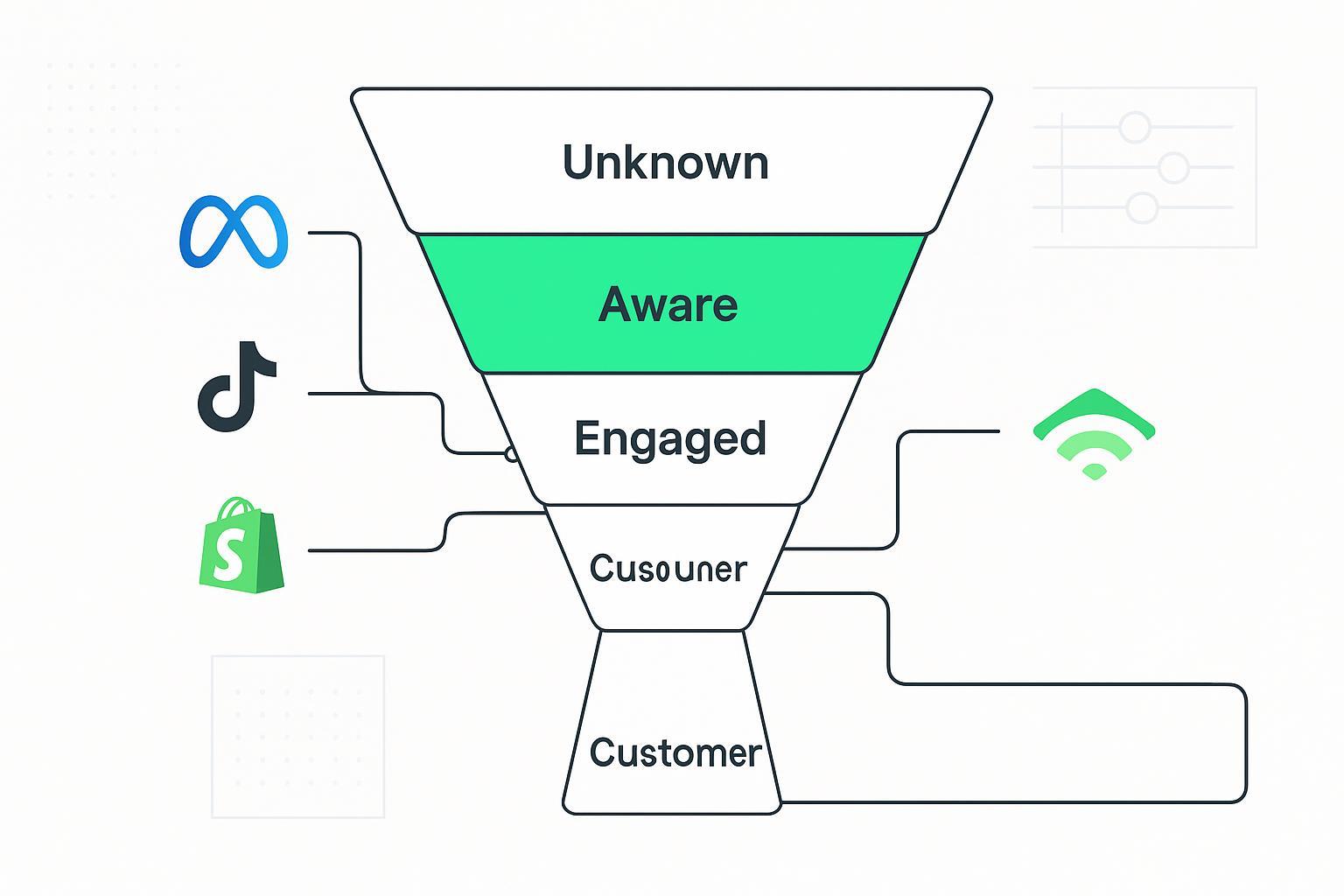
Your best customers rarely buy after a single touch. They move from first seeing your brand to comparing products to purchasing and returning. This guide shows how to design audience segmentation by journey stage to grow CLV through lifecycle, replenishment, and winbacks—while keeping your tracking accurate with server-side signals to Meta and TikTok.
Key takeaways
Use a five-stage framework—Unknown, Aware, Engaged, Consideration, Customer—to align segment logic, messaging, and budgets to CLV outcomes.
Build blueprint matrices that combine behavior signals, RFM-style CRM tiers, exclusion rules, and practical frequency caps. Keep caps conservative at the top of funnel and tighten as intent rises.
Send high-quality server-side events with deduplication and hashed identifiers to improve match quality on Meta and TikTok. Use shared event_id for Pixel and server events to avoid double counting, and measure effects on repeat purchase rate and time-to-second purchase.
Why audience segmentation by journey stage grows CLV
CLV increases when you create steady momentum from first view to second and third orders. Journey-stage segmentation ensures each cohort receives the right nudge: education for Unknown, proof for Aware, urgency for Engaged, reassurance for Consideration, and timely replenishment or cross-sell for Customers. Strong identity resolution and server-side delivery raise the likelihood your platforms recognize the same person across devices and sessions. Practitioner guides show that server-side delivery can improve match rates by enriching identifiers and stabilizing coverage despite browser limits, as outlined in the Twilio guide to retargeting with the Facebook Conversions API and Transcend’s comparison in Meta Pixel vs. Conversions API.
The five-stage framework
Journey stages define intent, creative strategy, and spending. Here’s how we’ll use them:
Unknown: Reach audiences with category education and thumb-stopping creative, measured on post-exposure site visits and product explorations.
Aware: Nurture those who viewed products with lightweight proof and social validation.
Engaged: Focus on cart and checkout starters with urgency, reassurance, and friction fixes.
Consideration: Re-engage sequences of high-intent actions without purchase; emphasize reviews, offers, and comparisons.
Customer: Split into New and Repeat. Optimize time-to-second purchase, replenishment windows, and category cross-sell.
Blueprint matrices for segments, tiers, exclusions, and caps
Use these matrices as a starting point; adapt thresholds to your brand’s velocity and margins.
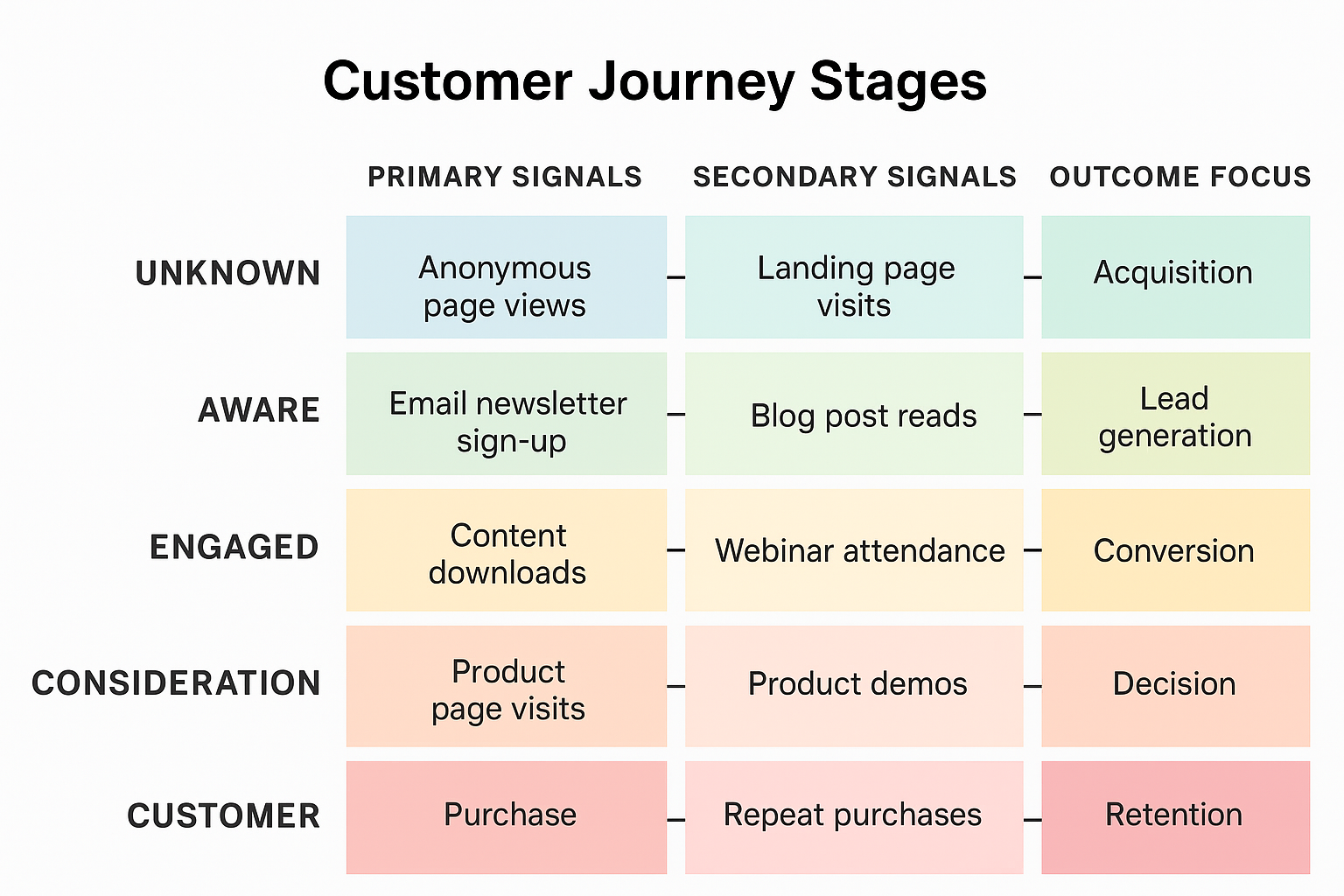
Behavior signals by stage
Stage | Primary signals | Secondary signals | Outcome focus |
|---|---|---|---|
Unknown | Anonymous page views, category views, site search | Engaged session depth, video views | Low-cost reach and discovery |
Aware | Viewed Product metrics, product detail page views | Multiple product views in one session | Educate and build trust |
Engaged | Add to Cart, Initiate Checkout events | High cart value, payment info add | Reduce friction and push to checkout |
Consideration | Started Checkout with no purchase, repeated product views | Coupon interactions, price checks | Overcome objections and close |
Customer (New) | Placed Order first time | AOV relative to median | Shorten time-to-second purchase |
Customer (Repeat) | Placed Order multiple times | RFM high-value patterns | Grow basket size and loyalty |
CRM tiers using RFM logic
Tier | Recency | Frequency | Monetary |
|---|---|---|---|
High-Active | Recent order within 30 days | 3+ orders | Top quartile spend |
Medium-Active | 31–90 days | 2–3 orders | Mid quartiles |
Low-Active | 31–90 days | 1 order | Bottom quartile |
At-Risk | 91–180 days | 1–2 orders | Any |
Lapsed | 181+ days | Any | Any |
Calibrate thresholds using RFM analysis methods in Shopify’s RFM analysis guide and estimate lifetime value with Shopify’s customer lifetime value primer.
Exclusions and frequency caps by stage
Stage | Typical exclusions | Indicative cap guidance | Rationale |
|---|---|---|---|
Unknown | Recent purchasers last 7–14 days; opt-outs; existing subscribers in nurture | 1–2 impressions per 7 days | Prevent waste and fatigue |
Aware | Current abandoned browse or welcome flow recipients | 2–3 per week | Reinforce without spam |
Engaged | People in active abandoned cart flows; recent high-frequency exposures | 3–5 per week | Urgency near intent peak |
Consideration | Recent purchasers; already redeemed offers | 3–5 per week | Close with proof and offers |
Customer | Respect replenishment windows; exclude in-flight post-purchase sequences | Based on cadence window | Align to lifecycle timing |
Use platform controls to enforce caps where available. On Meta, guaranteed caps are available with Reach and Frequency buying—see Meta’s overview of reach and frequency buying. On TikTok, awareness best practices cite 2–3 weekly impressions and explain frequency control features and reach and frequency buying.
Technical foundation for accurate activation
Clean segments perform best when your platforms actually recognize people. That means consistent events, shared identifiers, and deduplication between browser and server delivery.
Event schema and identifiers
Core commerce events: Viewed Product, Added to Cart, Started Checkout, Placed Order. Verify presence in Klaviyo’s Analytics Metrics (e.g., Shopify data reference for metrics).
Identifiers: Use hashed email and phone, plus platform cookies and click IDs where lawful. Meta’s fbp and fbc parameters help improve matching; see Meta’s fbp and fbc parameter guide.
Consent: Honor consent flags from Shopify’s Customer Privacy APIs and ensure lawful bases for data use; review Shopify’s customer privacy documentation and the legal overview at GDPR.eu.
Deduplication strategy
Use the same event_id for any event fired both via Pixel and server-side. Meta deduplicates overlapping events and scores dataset quality via Event Match Quality—see Meta’s Dataset Quality API. TikTok deduplicates server events against pixel events using event_id—see TikTok’s deduplication guide.
Meta Conversions API purchase payload example
{
    "data": [
      {
        "event_name": "Purchase",
        "event_time": 1705708800,
        "event_id": "order_987654321",
        "action_source": "website",
        "event_source_url": "https://yourstore.com/checkout",
        "user_data": {
          "em": ["<sha256_email>"],
          "ph": ["<sha256_phone>"],
          "fbp": "fb.1.1705600000.1111111111",
          "fbc": "fb.1.1705600000.ABCDEF1234"
        },
        "custom_data": {
          "value": 129.99,
          "currency": "USD",
          "content_ids": ["SKU-123"],
          "content_type": "product"
        }
      }
    ]
  }
Parameters, hashing, and dataset quality practices are in Meta’s Conversions API parameters reference and the Dataset Quality API guide.
TikTok Events API purchase payload example
{
    "data": [
      {
        "event": "Purchase",
        "event_id": "order_987654321",
        "event_time": 1705708800,
        "user_data": {
          "external_id": "<sha256_user_id>",
          "email": "<sha256_email>",
          "phone": "<sha256_phone>",
          "user_agent": "Mozilla/5.0..."
        },
        "custom_data": {
          "currency": "USD",
          "value": 129.99,
          "content_ids": ["SKU-123", "SKU-456"],
          "content_type": "product",
          "quantity": 2,
          "description": "Order description"
        }
      }
    ]
  }
Standard events and setup are outlined in TikTok’s standard events parameters and the Events API overview.
Activation recipes for Meta, TikTok, and Klaviyo
With clean signals, you can push segments into platforms as Custom Audiences and keep them fresh.
Unknown to Aware: Build broad interest or lookalikes; exclude recent purchasers and opt-outs.
Aware to Engaged: Create product viewers and page engagers with a 7–14 day membership window; suppress current nurture recipients.
Engaged to Consideration: Target cart and checkout starters with short windows and bid multipliers; integrate email/SMS flows to coordinate messaging.
Customer new to repeat: Time replenishment windows to SKU consumption; add cross-sell audiences based on Ordered Product.
Sync cadence and freshness
Keep high-intent audiences fresh at least daily. For larger catalogs, refresh cart and checkout segments multiple times per day.
Use shared external_id and event_id wherever platforms support it to strengthen identity stitching and deduplication.
For reconciling reporting across platforms for Shopify brands, see Shopify Attribution Mismatches: Meta vs TikTok (2026).
Measurement and CLV tracking
Your segmentation system is only as good as the way you measure its effect on lifetime value.
Core CLV formula: CLV ≈ Average Order Value × Purchase Frequency × Average Customer Lifespan. See Shopify’s customer lifetime value guide.
KPIs to monitor: Repeat purchase rate, time-to-second purchase, CLV to CAC, retention rate, and churn. Definitions and benchmarks are discussed in Stripe’s ecommerce KPIs resources.
Cohort dashboards: Track cohorts by first purchase month. Highlight shifts in time-to-second purchase and contribution from replenishment sequences.
Attribution reconciliation: Compare modeled conversions from server-side delivery to pixel-only baselines. Prioritize trends over exact parity; for cross-device patterns, review Shopify Cross-Device Tracking: Beginner’s Guide.
Case snippets
Replenishment acceleration: A skincare brand segments New Customers by SKU with typical usage windows. Using 30–45 day reminders plus TikTok and Meta reinforcement, it reduces time-to-second purchase by six days and grows repeat purchase rate among the cohort. The lift concentrates in RFM Medium-Active tiers.
Winback with proof: A beverage brand defines At-Risk at 90–150 days and Lapsed at 180+. Sequenced creative moves from community content to offer testing and a final reviews carousel. Results show a sustained increase in reactivation among High-At-Risk segments while controlling frequency to avoid fatigue.
Troubleshooting and privacy checklist
Low match quality: Verify hashing normalization, provide more identifiers when lawful, pass fbp and fbc on Meta, and ensure consented click IDs are captured. See Meta’s fbp and fbc parameter overview and the Dataset Quality API.
Double counting: Ensure shared event_id across Pixel and server events; audit dedup windows and confirm diagnostics. See TikTok’s deduplication guide and Meta’s parameters/dedup practices in the CAPI parameters reference.
Missing events: Confirm Shopify web pixels or storefront code fire product view and cart events; verify admin webhooks or server collectors confirm orders reliably. Shopify’s Web Pixels and Admin webhook docs are here: Web Pixels API and Admin webhooks.
Consent handling: Respect opt-in status from Shopify’s Customer Privacy APIs, honor CCPA opt-out of sale/sharing, and recognize Global Privacy Control where required. See Shopify customer privacy, GDPR.eu, and the California OAG’s CCPA guidance.
Practical next steps and a neutral workflow example
Disclosure: Attribuly is our product. In a neutral workflow, Attribuly can be used to sync Shopify checkout and order events server-side to Meta and TikTok with hashed identifiers, append fbp and fbc where available, and share a common event_id for deduplication with browser signals. It can also sync selected Klaviyo metrics to keep lifecycle flows and paid audiences aligned. For platform specifics, see Meta Ads Integration and the support hub Connection – Destinations. For consent and first-party identifiers, review First-party data Shopify checklist.
If you’re starting from scratch, begin with the five-stage matrices above, wire up server-side delivery with shared event_id, and set conservative frequency caps. Then track time-to-second purchase and repeat rate by cohort for four to six weeks before expanding budgets.
References and further reading
Server-side retargeting overview: Twilio – Retarget Customers with the Facebook Conversions API
Practitioner comparison: Transcend – Meta Pixel vs. Conversions API
Meta docs: Dataset Quality API, fbp and fbc parameters, CAPI parameters
TikTok docs: Standard events parameters, Events API, Event deduplication
Klaviyo docs: Shopify metrics reference
Shopify docs: Web Pixels API – standard events, Admin webhooks
Privacy: GDPR.eu, California OAG – CCPA
Internal resources for deeper implementation