
Attribuly vs Rockerbox 2026: Side-by-Side for Shopify Multi-Channel Attribution
Side-by-side comparison of Attribuly vs Rockerbox for Shopify multi-channel attribution — tracking, MMM/incrementality, integrations, setup complexity and pricing to guide your choice.
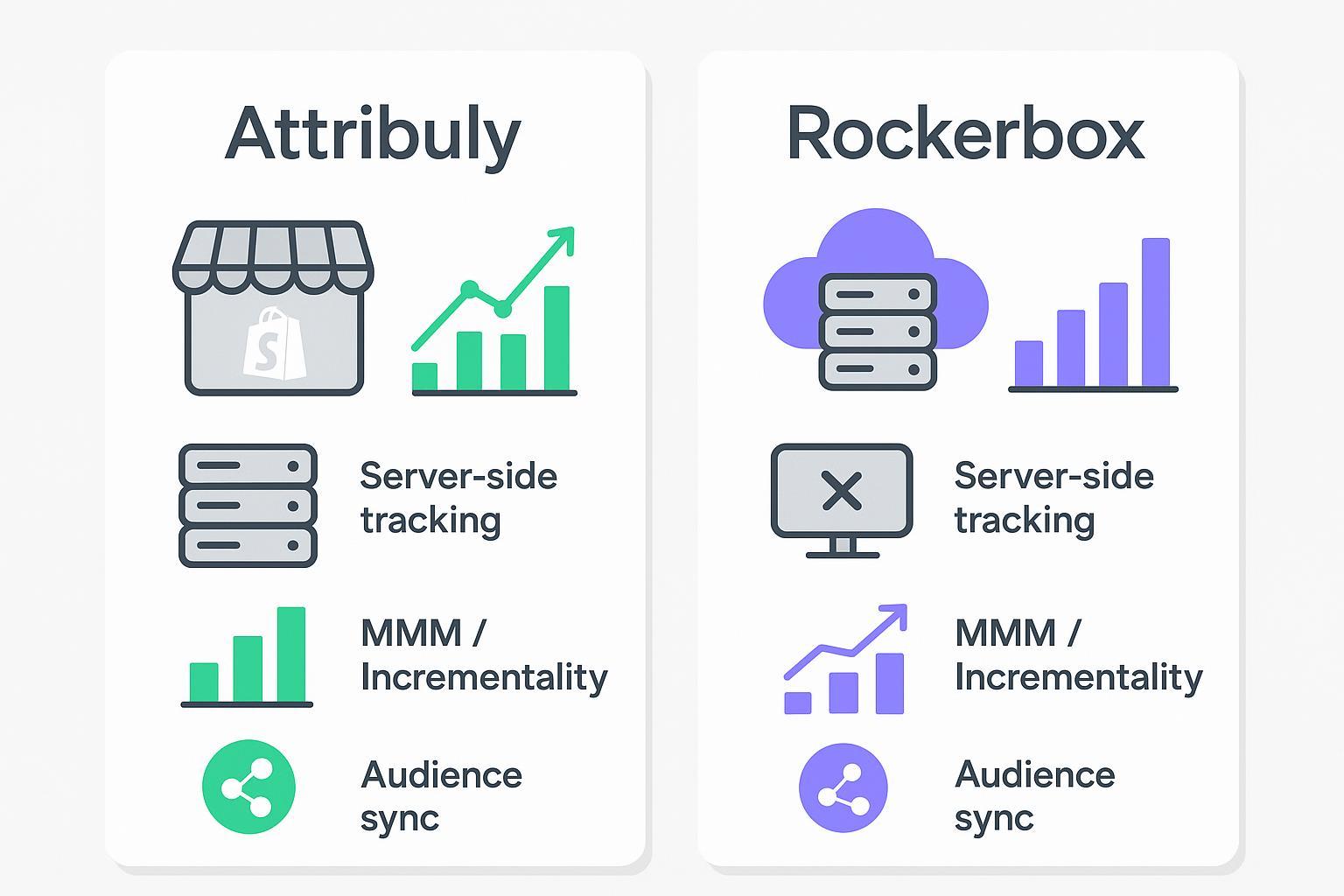
Shopify and DTC teams keep asking the same question: should we optimize fast with a Shopify‑native attribution stack that feeds cleaner server‑side signals back to ads and email, or step up to an enterprise measurement suite that adds MMM and incrementality across online and offline? This comparison gives you a side‑by‑side view of Attribuly and Rockerbox so you can choose the right fit for your team, channels, and timelines.
You’ll see scenario‑based picks, a single table that compares what matters, pricing caveats, and an FAQ. Throughout, we link to primary sources and keep the tone neutral so you can defend the decision internally.
Key takeaways
Attribuly is particularly strong for Shopify‑first teams that want rapid setup, server‑side conversion feeds to Meta and TikTok, and lifecycle activation through email and audience syncs.
Rockerbox stands out for unified measurement that combines multi‑touch attribution with MMM and documented incrementality tests across online and offline channels.
If you’re short on analyst support and want ready‑to‑use ROAS and LTV views, Attribuly tends to reach time‑to‑value faster on Shopify. If you run TV, podcast, or direct mail and need rigorous testing, Rockerbox is better aligned.
Pricing differs meaningfully. Attribuly publishes a free tier and paid plans on its site. Rockerbox uses a sales‑led quote model.
Both tools improve over pixel‑only setups, but they solve different jobs. Pick by scenario, not by a single “winner.”
Quick verdict by scenario
Here’s the short version. If you prioritize rapid Shopify install, consent‑aware server‑side signals to ad platforms, and lifecycle activation via Klaviyo and audience syncs, choose Attribuly. If you need enterprise‑grade cross‑channel measurement with MMM and documented incrementality testing, choose Rockerbox. Teams without dedicated analysts typically value Attribuly’s decision‑ready ecommerce dashboards; analytics‑heavy teams and omnichannel brands tend to benefit more from Rockerbox’s breadth and testing.
Attribuly vs Rockerbox comparison table
Dimension | Attribuly | Rockerbox |
|---|---|---|
Tracking architecture | Shopify‑centric, first‑party data collection with server‑side conversion feeds to supported ad platforms | User‑ and touchpoint‑level attribution with deduplication; supports conversion APIs and non‑click interactions where available |
Shopify integration depth | Native Shopify app workflow with fast install and web pixel hookup; Plus checkout events supported | Shopify among supported ecommerce connectors; onboarding typically guided by a CSM rather than one‑click install |
Attribution models | First‑click, last‑click, linear, position‑based; decision‑ready ecommerce ROAS framing | Multi‑touch attribution configurable by channel and combined with MMM for planning |
Incrementality and experiments | Incremental impact framing within the product; no public geo or holdout test documentation found | Documented incrementality tests including A/B, geo‑lift, and matched‑market; MMM alongside MTA |
Channel and data coverage | Focus on performance ecommerce channels and email; growing integrations | Broad coverage including TV, CTV, direct mail, and data warehouses |
Data activation and retargeting | Audience sync to social platforms and Klaviyo integration for lifecycle marketing | Measurement‑first orientation; conversion APIs supported, audience building less emphasized |
Reporting and usability | Ecommerce‑specific ROAS and LTV dashboards geared to lean teams | Robust measurement views and exports; deeper analysis expected with analyst involvement |
Setup complexity and time to value | Streamlined Shopify setup for fast signal improvement | Broader integration mapping; longer onboarding for unified measurement |
Pricing transparency and accessibility | Public pricing including a free tier and entry‑level paid plans | Sales‑led pricing with custom quotes and potential services |
Evidence transparency and explainability | Multiple product pages and explainers on models and server‑side signals | Extensive FAQs and methodology pages on incrementality and MMM |
Data governance and compliance | Consent‑aware server‑side signals and first‑party emphasis | Privacy policy and consent‑aligned API onboarding guidance |
Attribuly vs Rockerbox tracking architecture and Shopify integration
If Shopify is your operating center, the path to cleaner data usually starts with first‑party collection and server‑side conversion feeds. Attribuly’s native Shopify workflow highlights one‑click install and automatic web pixel hookup, with deeper checkout coverage on Shopify Plus. The product focuses on sending consent‑aware, server‑side events to ad platforms like Meta and TikTok to reduce loss from browser restrictions. You can see this orientation in the official Shopify integration overview and the retargeting product, which details conversion APIs and events syncing: see the Attribuly pages for the Shopify integration and the Retargeting product at these links: Shopify integration for Attribuly and Attribuly Retargeting with conversion APIs.
Rockerbox also centralizes a wide range of online and offline channels and supports conversion APIs, but its Shopify motion is typically part of a broader onboarding rather than plug‑and‑play setup. That breadth is the point: Rockerbox emphasizes data centralization across 200‑plus platforms and offline sources and then layers attribution, MMM, and incrementality testing over that foundation. For a sense of scope and onboarding posture, review Rockerbox’s materials on data centralization across channels and the plans overview that bundles MTA, MMM, and incrementality.
Attribution models compared to MMM and incrementality
Multi‑touch attribution helps you distribute credit across the journey so you can adjust budgets quickly. Attribuly offers multiple models—first‑click, last‑click, linear, and position‑based—combined with ecommerce‑ready ROAS and LTV views aimed at practitioners who need weekly decisions, not a statistics seminar. For product‑level detail and model definitions, see the Attribuly page on multi‑touch attribution models and its comparison article on Google Analytics, which explains why first‑party and server‑side signals produce more decision‑ready ecommerce reporting: Attribuly vs Google Analytics 4.
If your goal is to validate lift beyond correlation, Rockerbox documents several incrementality designs—A/B, geo‑lift, and matched‑market—alongside MMM for budget planning. These methods require more design work and data, but they answer different questions than MTA. Rockerbox’s public FAQs explain the mechanics and prerequisites, including guidance for geo‑lift and matched‑market tests and how MMM complements MTA. Start with these materials from Rockerbox: what is incremental attribution, what is a geo lift test, what is a matched market test, and the overview of MMM methodology.
Think of it this way: MTA tells you how to redistribute spend within the same week; incrementality tests and MMM tell you whether that spend creates new demand and how to plan across channels and offline media.
Data activation, reporting, and time to value
Beyond measurement, many Shopify teams want to close the loop by improving paid efficiency and email revenue. Attribuly leans in here with server‑side conversion feeds and audience syncs to ads, plus direct Klaviyo integration for lifecycle triggers and cart recovery. That combination often shortens the distance between better attribution and better outcomes. Explore the Attribuly pages on Klaviyo integration for lifecycle marketing and the broader orientation to server‑side conversions in the retargeting product.
Rockerbox, by contrast, is measurement‑first. It supports conversion APIs—including documented onboarding for Google Ads with hashing and consent prerequisites—but it focuses more on accurate attribution, incrementality, and MMM than on audience building. If your team has analysts and already runs lifecycle tooling, that separation can be an advantage. For setup specifics, see Rockerbox’s guidance on Google Ads Conversions API onboarding and consent.
On time to value, most Shopify users can deploy Attribuly quickly and start sending cleaner server‑side events the same day. Rockerbox’s broader scope typically means a longer onboarding, especially when offline channels and warehouses are in play.
When to pick each
Best for Shopify‑first growth and lifecycle activation
You run Shopify, optimize Meta and TikTok, and rely on Klaviyo for revenue. You want fast setup, cleaner server‑side signals, and decision‑ready ecommerce dashboards. Visit the official site: Attribuly.
Best for unified measurement with MMM and incrementality
You invest across many channels including TV or direct mail, need rigorous lift testing, and plan budgets with MMM. You have an analytics‑capable team and can support CSM‑guided onboarding. Visit the official site: Rockerbox.
Pricing and implementation caveats
As of 2026‑05‑16, Attribuly publishes plan information, including a free tier and paid plans that start at entry‑level price points on its public pricing page. Pricing changes frequently and may vary by usage and region.
Rockerbox uses a sales‑led quote model and may involve professional services and onboarding support. Expect pricing to reflect the broader scope—cross‑channel integrations, incrementality tests, and MMM. Always confirm current tiers, any minimums, and potential implementation fees directly with each vendor. Rockerbox outlines its packaging and services in its public materials, including the plans overview and professional services pages.
FAQ
Is Rockerbox suitable for Shopify merchants or only enterprises? Rockerbox is suitable for DTC and Shopify brands, but onboarding is sales‑led and part of a broader measurement program that can include offline channels. Review its stance on data centralization across channels to understand expected scope.
What’s the difference between server‑side tracking and pixel‑only tracking on Shopify? Server‑side tracking relies on first‑party data and consent‑aware event forwarding, which can improve conversion signal quality to ad platforms compared with client‑only pixels. Attribuly’s approach and model framing are described in its comparison page on Attribuly vs Google Analytics 4.
Which tool supports MMM and incrementality testing for DTC brands? Rockerbox documents MMM and several incrementality test types in its FAQs, including A/B, geo‑lift, and matched‑market designs. Start with Rockerbox’s overview of incremental attribution methods.
How long does it take to set up server‑side attribution on Shopify? Shopify‑native setups like Attribuly are designed for rapid install and immediate event capture, with deeper checkout coverage on Plus. Timeline depends on your current stack and consent configuration.
Is pricing public for both tools? Attribuly publishes pricing on its website, including a free tier. Rockerbox uses a sales‑led model; confirm current pricing and any onboarding costs directly with the vendor. Pricing and features are subject to change.
How to choose next
Start with your channels and team. If you’re Shopify‑centric and prioritize activation speed, Attribuly will likely deliver faster signal improvements and decision‑ready ecommerce reporting. If you run omnichannel and want MMM and incrementality, shortlist Rockerbox and budget time for onboarding.
Define the questions you must answer. For weekly budget shifts within paid social and search, MTA‑driven ROAS and LTV views are enough. For validating lift and informing TV or direct mail, prioritize incrementality and MMM.
Lock scope and timeline. Set a 30‑60‑90‑day plan for deployment, QA, and first decisions so you can show impact and move to the next test.
If you keep those guardrails, you’ll avoid tool sprawl and pick the platform that answers your real measurement job today—while leaving room to grow.