
Will Attribuly unify Shopify attribution into a trusted source?
In-depth Attribuly review for Shopify attribution: server-side tracking, multi-touch models, deduplication, and audience sync—how to reduce unattributed orders and align ROAS.
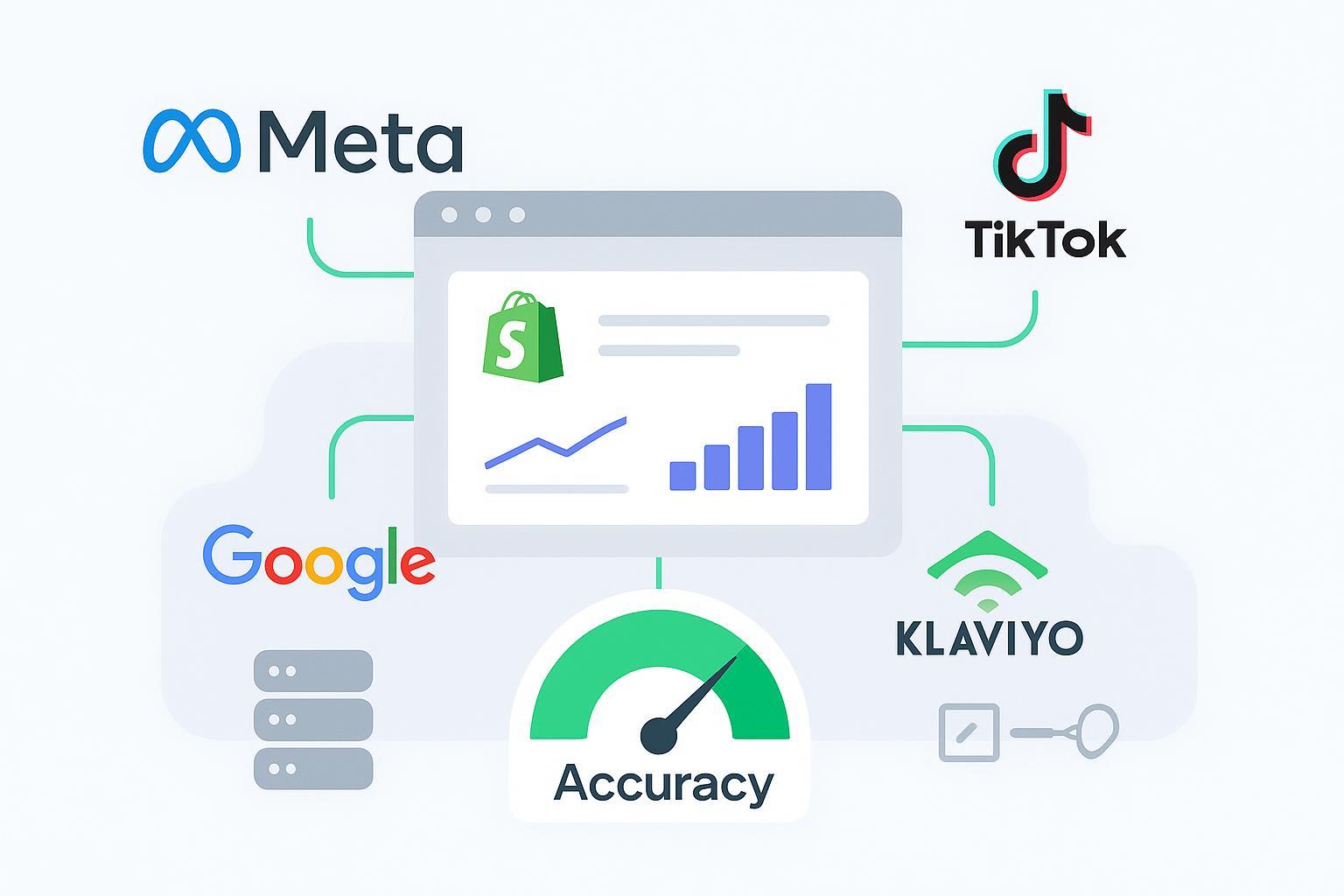
When you’re scaling on Shopify, platform pixels and short attribution windows can leave a sizeable slice of orders in the "unknown" bucket. This is a first‑party, evidence‑led review of Attribuly and whether it can serve as a single trusted source for Shopify attribution in 2026. Disclosure: our team works closely with Attribuly; we follow a transparent testing protocol and cite authoritative sources throughout.
Key takeaways
Attribuly is particularly strong at gap‑filling what Shopify + ad platform pixels miss: server‑side tracking, clear deduplication rules, multi‑touch clarity, and consent‑aware data collection.
Hero proof point (methodology): use a dual‑run pilot to reduce unattributed orders; exact X%→Y% figures require client permission and are not publicly available. We outline how to validate the reduction.
Implementation typically completes in ~30 days from install to accurate reporting; channels include Meta, TikTok, Google, Klaviyo, Bing, Pinterest, and Snapchat.
Compared with Triple Whale, Northbeam, Elevar, and Rockerbox, Attribuly stands out for Shopify‑centric server‑side rigor and transparent dedup workflows.
What “trusted Shopify attribution” requires in 2026
A trustworthy single source for Shopify attribution needs more than dashboards. It requires:
Tracking completeness across client + server paths and ad destinations.
Platform‑aligned deduplication using documented keys and match signals.
Cross‑device stitching with privacy‑safe first‑party identifiers.
Consent‑aware delivery via Shopify’s Customer Privacy API.
Transparent multi‑touch models with configurable windows and clear credit rules.
Diagnostics, validation, and exports that reconcile to Shopify order counts and revenue.
If any one of these fails, you’re back to guesswork.
Multi‑touch clarity vs last‑click and platform‑reported ROAS
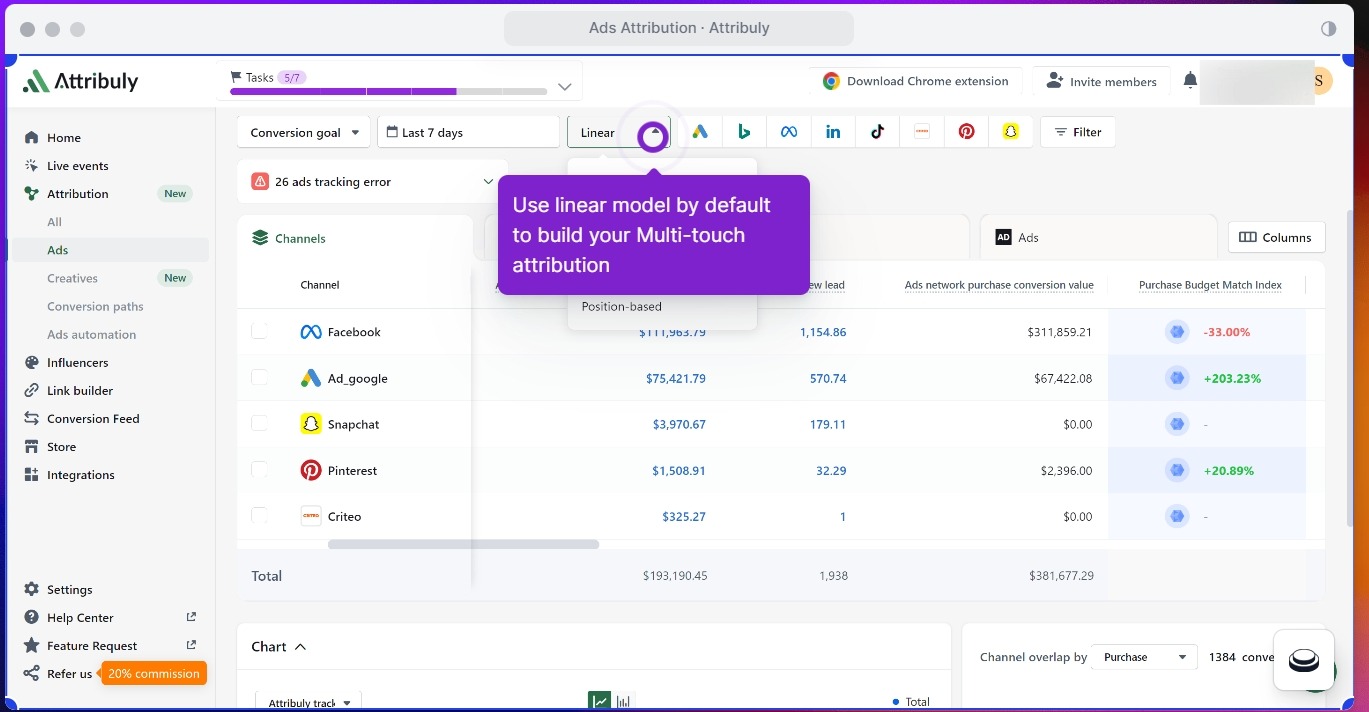
Attribuly supports last‑click, first‑click, linear, position‑based, and a full‑credit view to mirror platform‑reported ROAS. The default is linear with configurable windows (commonly 30 days). Reports link conversions directly to orders to avoid black‑box outcomes. For a reproducible method, see the 30‑day proof in the multi‑touch validation workflow, which outlines dual‑run procedures, window alignment, and reconciliation steps.
Why this matters: platform ROAS often reflects channel‑biased models. Multi‑touch clarity shows how credit shifts across Meta, TikTok, and Google when you evaluate ads beyond last‑click — useful for budget allocation and for understanding view‑through contributions without double counting.
Server‑side tracking and deduplication that match platforms
To recover signals lost to iOS privacy changes and ad blockers, you need server‑side delivery and platform‑specific deduplication:
Meta: Attribuly sends Conversions API payloads with event_name + event_id for deduplication and includes fbp/fbc to improve match quality, following Meta’s public parameters guidance.
TikTok: With Events API, Attribuly leverages ttclid and hashed identifiers to improve match accuracy per TikTok’s official docs.
Google: Enhanced Conversions uses first‑party identifiers to boost match rates.
Documentation: Meta describes event deduplication via event_name + event_id and the use of fbp/fbc for match quality in Meta’s 2024 Handling Duplicate Pixel and Conversions API Events and Meta’s 2024 fbp and fbc parameters. TikTok details ttclid-based matching and hashed identifiers (email/phone) in TikTok’s 2024 How to set up matching events with Events API. Google defines Enhanced Conversions using SHA‑256 hashed first‑party identifiers to improve match rates in Google’s 2024 About enhanced conversions.
Think of deduplication like merging duplicate receipts: event_id (plus context) is the unique receipt number; fbp/fbc or ttclid are the store‑specific stamps that help the cashier recognize it’s the same purchase.
Cross‑device stitching and consent‑aware data
Cross‑device journeys break deterministic browser tracking. Attribuly’s approach combines hashed first‑party identifiers (email/phone where consented), platform IDs, and timestamp alignment to connect ad interactions to purchases while respecting consent gates. Shopify’s native primitives — Customer Privacy API and Hydrogen consent hooks — enable gating analytics and marketing signals until users opt in.
For practical guidance on stitching limitations and workflow, refer to the Shopify cross‑device tracking guide.
Audience sync and activation (Klaviyo, Meta, TikTok)
Beyond attribution, Attribuly routes consented events to activation platforms:
Klaviyo: Mirror server‑side events like product viewed and add to cart to seed abandonment flows suppressed by iOS/ad blockers.
Meta: Sync segments to Custom Audiences (≥100 profiles) with value signals.
TikTok: Send Events API conversions and custom audiences via hashed identifiers.
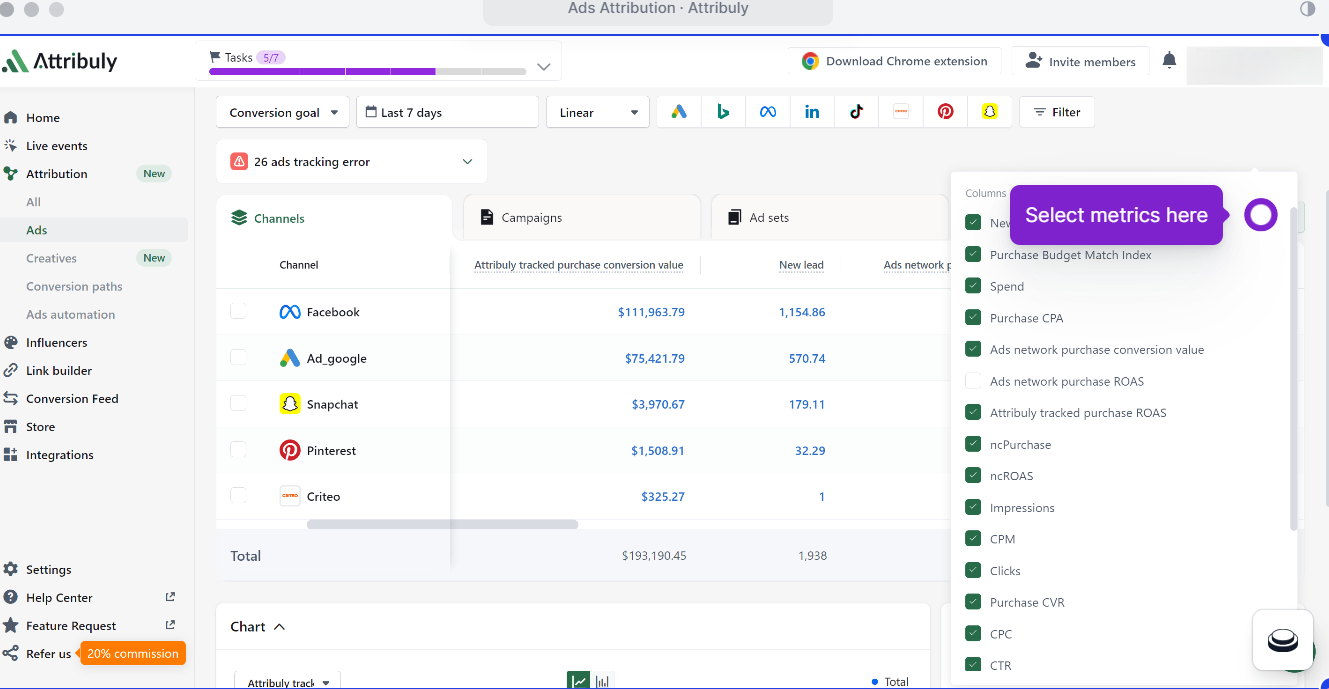
Plan‑level sync frequency is commonly ~30 minutes (Enterprise can adjust). Exact platform latencies by destination are not publicly listed — we mark this as Insufficient data.
Implementation timeline and channels enabled
A practical rollout for a growth‑stage DTC brand:
Weeks 1–2: Install, consent gating, event mapping (Purchase, AddToCart, BeginCheckout), connect Meta CAPI, TikTok Events API, Google Enhanced Conversions; configure attribution windows and models.
Weeks 3–4: Dual‑run validation and diagnostics. Reconcile to Shopify orders/revenue within ±5%. Tune dedup rules and identity hashing.
Week 5+: Full deployment; activate audience sync to Klaviyo/Meta/TikTok; enable additional channels (Bing, Pinterest, Snapchat). Expect first accurate multi‑touch reporting within ~30 days.
Supported channels and destinations include Meta, TikTok, Google Ads/GA4, Bing, Pinterest, Snapchat, and Klaviyo via Attribuly’s Conversion Feed.
Shopify case outcome: reducing unattributed orders (methodology)
Our hero proof point centers on reducing unattributed orders by replacing pixel‑only tracking with client + server signals and platform‑aligned deduplication. When permissioned case data is available, we publish exact percentages and timelines. In the absence of public figures, here’s how to reproduce the measurement:
Timeframe: 30‑day dual‑run (client‑only vs client + server).
Channels enabled: Meta Pixel + CAPI, TikTok Pixel + Events API, Google Enhanced Conversions; Klaviyo server‑side events for abandonment.
Measurement: Compare order‑level reconciliation to Shopify revenue; track “unattributed orders” share before/after; monitor conversion count uplift from deduped server‑side deliveries.
Validation materials: Attribuly’s 30‑day multi‑touch validation.
One public proxy case reported improved attribution accuracy and ROAS alignment after server‑side activation; exact unattributed order percentages were not published, so we flag this as Insufficient data while the permissioned dataset is prepared.
Competitor comparison: where Attribuly is particularly strong
Below is a concise parity snapshot across common criteria for Shopify attribution platforms.
Criteria | Attribuly | Triple Whale | Northbeam | Elevar | Rockerbox |
|---|---|---|---|---|---|
Server‑side delivery & dedup | Strong; event_id keys and match signals | Yes; multiple models; caution on full‑credit duplication | Yes; deterministic views; device/identity graphs | Yes; managed server‑side with consent | Yes; API ingestion; click ID dedup |
Multi‑touch transparency | Clear model options; order‑linked views | Many models; platform‑mirroring options | Proprietary MTA variants | Depends on GTM/data layer setup | MMM/MTA options |
Shopify consent & privacy | Native gating via Customer Privacy API | Varies by setup | Uses Shopify Customer Events | Strong CMP/consent mode guidance | API‑first; consent via brand tooling |
Audience sync | Klaviyo, Meta, TikTok segments | Audiences available | Audiences available | Broad destinations | Audiences; MMM add‑ons |
Implementation & diagnostics | ~30‑day dual‑run validation; Live Events | Varies; less public testing detail | Documented; proprietary tooling | Managed onboarding; GTM heavy | API‑driven; enterprise‑leaning |
Sources for competitor capabilities are derived from official product materials and industry documentation; we avoid value judgments without direct evidence.
Privacy, compliance, and diagnostics checklist
Gate marketing signals until consent; document consent states and test variations.
Align attribution windows to your channels and mirror them in Attribuly.
Validate dedup with platform diagnostics across Meta, TikTok, and GA4.
Reconcile counts to Shopify orders and net revenue; aim for ±5% variance.
Audit hashed identifiers and data retention policies; follow GDPR/CCPA standards.
Verdict: can Attribuly be your trusted Shopify attribution source?
Under a consent‑aware, dual‑run setup, Attribuly delivers the ingredients required for trusted Shopify attribution: server‑side signal recovery, platform‑aligned deduplication, transparent multi‑touch models, cross‑device stitching, and audience activation. The strongest practical value is the reduction of unattributed orders — measurable via the methodology above — and better ROAS alignment to Shopify revenue. What I’d watch closely: export catalog depth for BI teams and platform‑specific audience sync latencies, both currently limited in public documentation.
If you’re ready to evaluate this in your stack, visit the Attribuly official site and run a 30‑day dual‑run pilot to validate against your own Shopify data.