
Triple Whale Pricing 2026: Is It Worth It for Shopify Brands?
In-depth review of Triple Whale pricing (2026): plan breakdown, attribution features, ROI guidance for Shopify brands by ad-spend, and alternatives.
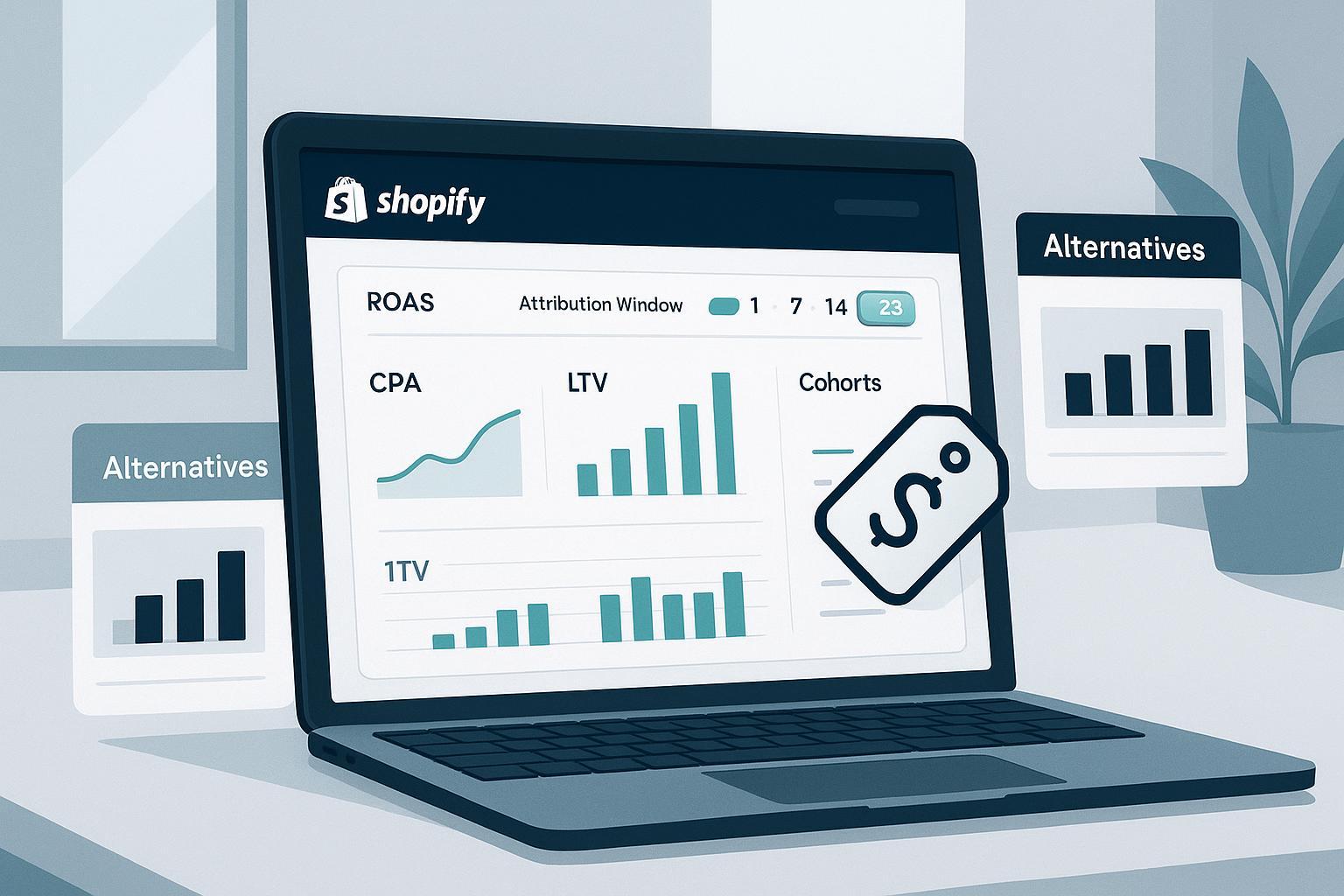
If you’re evaluating Triple Whale for a Shopify store in 2026, you’re likely asking two things: what does it really cost, and at what spend level does it pay for itself? Here’s the bottom line up front, followed by the details and evidence.
Key takeaways
Triple Whale pricing: the Free plan is publicly documented; paid-plan pricing is variably visible or gated. Always verify on the official page before you buy.
Free plan (as of May 17, 2026): up to 10 users and 12-month lookback, with first/last-click attribution and a blended analytics view. See the official Free overview on Triple Whale’s site.
“Worth it” depends on your ad spend and workflow needs: data quality, attribution controls, and cohort/creative depth can justify cost above ~$30k/month in paid media.
Strong alternatives exist. Northbeam publishes enterprise-oriented tiers; Elevar covers tracking infrastructure with public pricing; Polar Analytics signals GMV-based pricing; Lifetimely focuses on LTV/cohorts at lower cost.
Always confirm plan names, limits, and add-ons on each vendor’s official pricing page on your purchase date.
Snapshot verdict and who it’s for
For Shopify-first teams that need an AI-assisted attribution layer, creative analytics, and a unified view across Meta/Google/TikTok/email, Triple Whale can be worth it once you’re spending enough that small allocation errors move real dollars. Brands under ~$30k/month in paid media may start on the Free plan to validate fit. Above ~$30k–$150k/month, paid tiers begin to earn their keep if you use attribution windows/models consistently and act on creative/cohort insights.
Pros
Broad attribution model set with controllable windows and a first‑party pixel
Unified Shopify + channels view with creative, cohort/LTV, and profitability context
Agent/AI features (e.g., Moby) to surface insights faster
Cons
Paid-plan pricing details can be gated or change without notice; confirm on publish date
Shopify-first fit may be limiting for complex multi-platform stacks
Data quality depends on correct pixel/consent setup and ongoing maintenance
How we evaluated (methodology and evidence tiers)
As‑of date: May 17, 2026.
Evidence tiers used:
Tier 1 (official): vendor pricing/feature pages and KB articles.
Tier 2 (hands-on): workflows and reconciliation checks; where we lack live access, we mark items as “Insufficient data.”
Tier 3 (social proof): G2/Capterra sentiment; used sparingly.
Key standard we reference: under consistent models/windows, keep variance vs. Shopify net sales within ~5–10% over a 14–28 day window; document data refresh cadence and consent handling.
Triple Whale pricing in 2026: what’s public and what isn’t (as of May 17, 2026)
As of May 17, 2026, Triple Whale provides a clearly documented Free plan and references to advanced paid capabilities on its official site. A single public page with a complete paid-plan matrix may not always be available; treat any numbers found off-site as secondary until you verify them on the official pricing page the day you buy.
Official Free plan overview with inclusions: first/last-click attribution, real-time cross‑channel analytics, basic post‑purchase survey, up to 10 users, and 12‑month data lookback. See the Free plan overview on Triple Whale’s site via the official Free page and the Free plan blog article: Triple Whale Free plan overview and Free plan deep dive.
Paid plans: Triple Whale’s own pages highlight upgrades such as multi-touch attribution (Triple Pixel), advanced analytics, Marketing Mix Modeling, flexible BI, data enrichment, and custom dashboards/SQL on upper tiers. If you don’t see a current, official pricing table, contact sales and capture a quote. Start at the site root or pricing entry points: Triple Whale homepage and the Free plan page above.
Pricing visibility snapshot (as of May 17, 2026):
Plan | Indicative inclusions | Visibility status | Source |
|---|---|---|---|
Free | First/last‑click attribution; blended analytics; PPS; up to 10 users; 12‑month lookback | Public | |
Paid tiers (names/prices may change) | Triple Pixel multi‑touch; creative/product/customer analytics; Moby AI; MMM; BI/SQL on upper tiers; expanded integrations | Partially public/gated | Triple Whale site product/feature pages |
Important caveat: We deliberately avoid quoting unauthenticated paid-tier prices here. Always validate on Triple Whale’s official pricing or speak with sales for a fresh quote on the date you purchase.
Is Triple Whale worth it? Guidance by revenue/ad‑spend band
Below are pragmatic thresholds we use with Shopify brands. Think of these as starting points; your margins and channel mix will shift the math.
<$30k/month in paid media
Start with the Free plan to centralize Shopify + ad platforms and confirm basic attribution hygiene (UTMs, pixel placement, consent events). The goal is to establish whether model/window controls and creative analytics will materially change budget choices.
“Worth it” trigger: if a 5–10% lift in budget allocation accuracy would pay for a paid tier within 1–2 months, move up.
$30k–$150k/month in paid media
Paid plans start to make sense, particularly if you test multiple attribution windows (1/7/28 days) and rely on cohort/LTV and creative asset‑level insights weekly. Look for controls like Linear, First Click, and hybrid models (e.g., Clicks & Deterministic Views or Total Impact‑style) to examine touchpoint influence.
ROI lens: a 2–3% improvement in channel allocation at this spend level can recoup a mid‑tier analytics subscription quickly. Ensure you have the people/process to act on insights, or the value won’t materialize.
$150k+/month in paid media
You’ll benefit from advanced features (creative analytics, passback to ad platforms, BI/SQL, MMM, multi‑store rollups). At this level, accuracy and speed of decisioning can move six figures per quarter. Validate implementation effort and support SLAs.
Hands‑on considerations that swing ROI
Even the best pricing is a bad deal if data isn’t trustworthy or actionable. These levers matter more than list prices.
Attribution models and windows
Triple Whale documents a wide model set and window options typically spanning 1/7/14/28/Lifetime. Your “worth it” hinges on choosing a stable default and comparing channel performance under that same lens each week. Inconsistent windows produce noisy swings. See Triple Whale’s public product/KB materials for model/window references starting from the main attribution page on triplewhale.com.
Reconciliation vs. Shopify
Aim for <5–10% variance to Shopify net sales over 14–28 days under your chosen window/model. If variance drifts, audit event duplication, server‑side/browse‑side routing, and coupon/discount handling.
Consent and server‑side signals
First‑party cookies, Meta CAPI, and Google Enhanced Conversions are essential for post‑privacy completeness. If you route events server‑side, ensure consent is captured and propagated. For deeper primers:
Server‑side tracking and retargeting concepts: Attribuly Customer Retargeting Platform
GA4 vs attribution use cases: Attribuly vs GA4
Consent and Meta CAPI vs Google Enhanced Conversions: Attribution-friendly consent and CAPI vs EC explainer
Workflow/usability for media buyers
Time‑to‑value matters. Can a buyer pull nCPA, first‑order vs. new customer splits, and LTV by cohort in under three minutes? If yes, the tool will be used daily and justify cost faster.
Competitors to consider (and when they win)
When pricing is uncertain or value feels marginal, compare with these credible options under the same windows/models.
Northbeam
Public pricing indicates three tiers and a starting price point appropriate for scaling brands. Features include Multi‑Touch Attribution, Clicks + Deterministic Views, Creative Analytics, and correlation analysis, with MMM options on upper tiers. See Northbeam’s official page: Northbeam pricing and tiers.
Best for: brands already at significant spend levels that want enterprise‑grade incrementality/MMM and deeper data controls.
Polar Analytics
Signals GMV‑based pricing with public references; confirm live pricing directly on Polar’s site. Polar positions itself as a managed semantic layer/BI for ecommerce with many native connectors. Treat price points found in posts as indicative until verified. Start from Polar Analytics website for the latest pricing page.
Best for: teams that want broader BI plus ecommerce analytics and are comfortable with GMV‑based plans.
Lifetimely
Focuses on LTV/cohorts and retention analytics at lower cost tiers. Verify current plan names and pricing on Lifetimely’s official page before comparing. Start at Lifetimely pricing.
Best for: retention‑led roadmaps or early‑stage brands that primarily need solid cohort/LTV math.
Elevar (tracking infrastructure)
Public pricing is transparent, with tiered monthly plans and order‑based limits. Elevar provides server‑side tracking, a data layer for GTM/GA4, and identity graph features. See Elevar pricing plans.
Best for: brands that want to strengthen tracking signal quality and then push events reliably into analytics and ad platforms.
Attribuly (alternative with server‑side tracking + attribution + retargeting)
For Shopify brands prioritizing server‑side tracking depth, multi‑touch attribution, and automated retargeting/audience syncing (including Klaviyo), Attribuly is a credible alternative. A practical scenario: if your Meta‑reported conversions undercount due to browser restrictions, server‑side signals and first‑party data collection can recover attributed conversions and improve optimization feedback. Explore Attribuly attribution overview and Attribuly Customer Retargeting Platform for capabilities, and see Attribuly vs GA4 for context on when to supplement GA4.
FAQs
Do I still need an attribution tool if I have GA4?
GA4 is a strong web analytics suite but isn’t purpose‑built for ecommerce multi‑touch attribution and channel‑level ROAS across paid social/search. Many Shopify brands add an attribution platform to complement GA4 when budget allocation decisions require more granular models/windows and first‑party signal routing. For background, see Attribuly vs GA4.
Does Triple Whale support Amazon and TikTok integrations?
Triple Whale’s knowledge base lists connectors for Amazon and for major ad platforms including TikTok. Always confirm live connector availability and any plan restrictions before purchasing. Start from the Triple Whale site and knowledge base for the latest connectors.
Final verdict
Triple Whale’s Free plan is a low‑risk way to validate attribution hygiene and workflow fit. For stores spending ~$30k–$150k/month, paid tiers can be worthwhile when you consistently use model/window controls and act on creative/cohort insights. At higher spend, advanced features and potential passbacks/BI depth become more attractive. Because paid‑plan pricing details can change or be gated, confirm the latest plan names, limits, and rates on Triple Whale’s official site before committing. If your primary challenge is data signal quality, pair an analytics platform with robust server‑side tracking—or consider an all‑in‑one alternative that emphasizes first‑party collection and retargeting.
Inline sources (as cited):
Triple Whale Free plan and upgrade inclusions: Triple Whale Free plan and Triple Whale Free plan blog
Northbeam pricing and features: Northbeam pricing
Elevar pricing: Elevar pricing plans
Polar Analytics site (check latest pricing): Polar Analytics
Lifetimely pricing page: Lifetimely pricing
Note: Pricing and inclusions are time‑sensitive. Treat everything above as “as of May 17, 2026” and verify on the vendor sites before purchasing.