
Stage-Based Frequency Caps for Ecommerce Retargeting
Channel-specific daily/weekly caps, recency tiers, fatigue signals, and alert rules for ecommerce retargeting—practical benchmarks for DTC paid-media and growth teams.
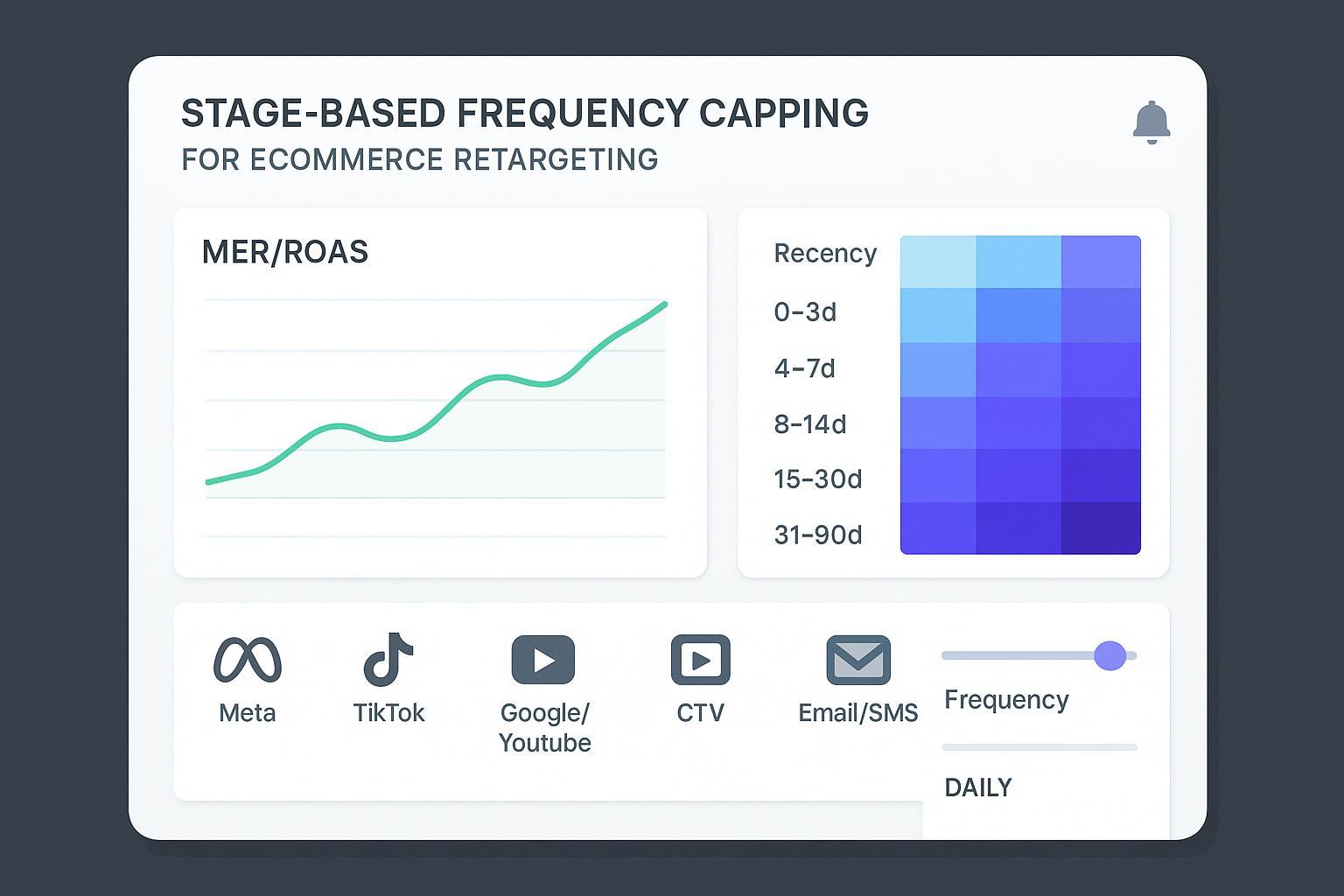
If you’re retargeting without stage-based caps, you’re either burning creative faster than you can produce it or leaving profit on the table. The smartest teams anchor caps and fatigue alerts to a business outcome, then adjust by recency tier and channel realities. Below is a practical, research-backed playbook with conservative-to-balanced defaults you can deploy today.
Key takeaways
Use blended MER and ROAS as the governing signal; treat channel metrics as diagnostics.
Cap by recency tiers to protect margins and creative longevity while preserving incremental reach.
Start with balanced weekly caps and rotate creative when CTR drops more than 20 to 30 percent or CPA rises more than 20 percent week over week.
Rely on platform guidance where it exists and label practitioner defaults where the public documentation is thin.
Automate alerts that combine MER drops with channel fatigue signals and escalate actions in 72 hour windows.
The anchor KPI that governs caps
Blended MER or brand-level ROAS should anchor your frequency policies. It keeps decisions tied to profit instead of silo metrics. Think of channel metrics like CTR, CPM, CPA, and in-platform ROAS as your instrument panel for diagnosing why MER moved, not as the pilot of your caps. When the governing KPI dips materially, your alert logic should check stage-level exposure and per-channel fatigue signals before pulling back budget or tightening caps.
Why not lead with channel metrics alone? Because retargeting often looks efficient inside a walled garden while cannibalizing other channels or organic demand. Anchoring to blended MER and ROAS ensures caps and rotations are aligned to business outcomes across the mix.
Recency tiers and stage mapping
Define clear tiers and keep your exclusions tight so you’re not paying to reach recent converters.
Hot 0–3 days: carts and deep product viewers
Warm 4–7 days: product viewers and active site browsers
Tepid 8–14 days: soft site engagers
Cold 15–30 days: broad site engagers and list match
Dormant 31–90 days: low intent or lapsed users
Hygiene basics: exclude purchasers for 7 to 30 days depending on replenishment cycles, exclude high LTV subscribers from aggressive caps, and mirror lookback windows to your typical decision cycle. Keep audiences deduped across channels where possible to avoid double counting frequency.
Channel benchmarks for frequency capping ecommerce retargeting
These benchmarks balance control and scale. Where platform guidance exists, we cite it. Where it doesn’t, we label as practitioner defaults and recommend validating with holdouts.
Channel or Inventory | 0–3d Hot | 4–7d Warm | 8–14d Tepid | 15–30d Cold | 31–90d Dormant | Notes |
|---|---|---|---|---|---|---|
Meta FB and IG | 1 per day or 3–5 per week | 1 per day or 2–4 per week | 1 every 2 days or 2–3 per week | 1–2 per week | 1 per week | Practitioner defaults pending newer public Meta docs |
TikTok | 2–3 per week | 2 per week | 1–2 per week | 1–2 per week | 1 per week | Weekly creative refresh and modest weekly exposure per TikTok guidance in the Creative Best Practices library: see the official guidance in the article titled Creative best practices at TikTok Ads Help at https://ads.tiktok.com/help/article/creative-best-practices and in seasonal playbooks |
YouTube or Demand Gen | Prefer campaign level caps sparingly at 3–5 per week for warm tiers | Same | Same | Same | Same | Google notes performance optimized Demand Gen already accounts for exposure; campaign caps apply across surfaces. See Google Ads and DV360 support articles for Demand Gen and frequency measurement |
Display via DV360 | 1–2 per day or 5–10 per week | 1–2 per day or 5–10 per week | 1 per day or 3–7 per week | 1–5 per week | 1–4 per week | Viewable impressions count toward line item caps per DV360 documentation |
CTV household level | 2–3 per day | 2–3 per day | 1–2 per day | 1 per day or 3–7 per week | 1–3 per week | Use identity to cap at household and individual levels; follow IAB ACIF and identity best practices |
Email Klaviyo | Not applicable | Not applicable | About 1 per week | 1 per week | 1 per week | Use Smart Sending and escalate during promotions with engaged cohorts |
SMS Klaviyo | Not applicable | Not applicable | 1–2 per week | 1–2 per week | 1 per week | Certain flows limited to one SMS per recipient and respect quiet hours |
Evidence and references you can verify now:
Google and DV360 frequency and cap behavior including viewable counting and 30 day cap window changes are described in the Display and Video 360 Help article titled Reporting updates in Q1 2025 at https://support.google.com/displayvideo/answer/15874746?hl=en and in Measuring reach and frequency at https://support.google.com/displayvideo/answer/15272050?hl=en as well as in Create a Demand Gen line item at https://support.google.com/displayvideo/answer/15598924?hl=en
TikTok’s modest weekly exposure norms and refresh cadence are summarized in Creative best practices at TikTok Ads Help at https://ads.tiktok.com/help/article/creative-best-practices and expanded in official seasonal playbooks like Back to School and Holiday
For CTV identity and dual level capping, see the IAB Ad Creative ID Framework announcement Improve Connected TV Advertising Experience at https://iabtechlab.com/iab-tech-lab-announces-ad-creative-id-framework-to-improve-connected-tv-advertising-experience-for-consumers-and-brands/ and The Trade Desk identity guides such as How to strengthen identity foundation for omnichannel campaigns at https://www.thetradedesk.com/resources/how-to-strengthen-identity-foundation-omnichannel-campaigns-guide
Email and SMS cadence plus deliverability thresholds including unsubscribe and complaint rates are outlined in the Klaviyo Help center article Getting started with deliverability monitoring at https://help.klaviyo.com/hc/en-us/articles/115000201131 and in the SMS Deliverability Guide at https://www.klaviyo.com/marketing-resources/sms-deliverability-guide
Fatigue signals and creative rotation cadence
How do you know caps are too high for a tier? Watch for fatigue patterns that tend to precede MER decay.
CTR down more than 20 to 30 percent versus the prior seven day baseline
CPA up more than 20 percent week over week on stable spend
ROAS down more than 20 percent on a 14 day basis adjusted for promo noise
Frequency hitting upper bounds without incremental reach growth
Rotation triggers: refresh creative when any of the above trip, or when average frequency over the last 14 days exceeds these soft ceilings: Meta 5 to 7, TikTok 3 to 4, YouTube or Display 5 to 7, CTV households 7 to 10. Keep at least three to five unique creative variants live in warm tiers to slow fatigue, and use value led messaging for dormant tiers to avoid unsubscribes and ad avoidance.
Alert rules and automation playbook
Your alerts should tie a business outcome drop to specific exposure signals by tier and channel. Here’s a simple and extensible pattern.
Global governing trigger: blended MER over the last 14 days is down more than 20 percent versus the prior 14 days
Channel confirmation windows: use seven day frequency and CTR or CPA for near real time detection
Stage guardrails: only trigger actions when the affected tier shows elevated frequency or decaying response
A compact rule you can adapt:
{
    "scope": "brand",
    "governing_kpi": {"metric": "blended_mer", "window": "14d", "delta": "-20%"},
    "confirmations": [
      {"channel": "meta", "frequency_7d_gt": 4, "ctr_drop_7d_gt": "20%"},
      {"channel": "tiktok", "frequency_7d_gt": 3, "cpa_increase_7d_gt": "20%"},
      {"channel": "dv360_display", "viewable_freq_7d_gt": 7, "roas_14d_drop_gt": "15%"},
      {"channel": "ctv", "hh_freq_7d_gt": 10, "completion_drop_7d_gt": "10%"}
    ],
    "stage_filters": ["0-3d", "4-7d", "8-14d"],
    "actions": [
      {"type": "notify", "targets": ["slack", "email"]},
      {"type": "tighten_caps", "adjustment": "-25%"},
      {"type": "rotate_creatives", "min_new_variants": 3}
    ]
  }
Practical workflow with Attribuly as a neutral example
Use blended MER and ROAS available in Attribuly reporting to watch the 14 day trend at the brand scope. See the page Attribuly Metrics for how ROAS variants are defined at https://support.attribuly.com/en/articles/9004248-metrics
Configure an alert that checks when blended MER falls more than 20 percent and the warm tier shows frequency above target in the last seven days for Meta or TikTok. Then route a Slack notification to the channel owner with a short action list tightening caps by 25 percent and rotating in three new creatives
If the alert persists for 72 hours, run a stage constrained budget reduction to hot tiers and schedule a creative audit. If it persists for seven days, schedule a geo holdout test to validate incrementality
For teams that prefer product documentation when setting up alerting workflows, review the Attribuly Product page for an overview of capabilities at https://www.attribuly.com/product and the Alerts feature page at https://www.attribuly.com/product/alerts
Implementation notes for measurement and privacy
Cross channel deduplication and clean measurement make these caps meaningful.
Server side tagging: use sGTM or CAPI to improve event stability under privacy constraints and to align impression and conversion timestamps across platforms
Viewable versus served counting: DV360 counts viewable impressions toward certain caps and reports reach and frequency accordingly, which you can confirm in Measuring reach and frequency at the DV360 Help Center at https://support.google.com/displayvideo/answer/15272050?hl=en
Creative identity: adopt the IAB Ad Creative ID Framework to reconcile creative performance and manage rotations consistently across CTV, display, and social. The IAB announcement Improve Connected TV Advertising Experience outlines how this helps cross platform control at https://iabtechlab.com/iab-tech-lab-announces-ad-creative-id-framework-to-improve-connected-tv-advertising-experience-for-consumers-and-brands/
Lookbacks and exclusions: align conversion lookbacks with typical decision cycles by product category. Keep conversion exclusions strict so hot tiers aren’t inflating frequency on recent buyers
Holdouts and PSA tests: when fatigue persists despite rotations and cap changes, use geo holdouts or PSA suppression to validate incrementality before large budget shifts
Next steps
Start with the balanced defaults above and wire the alert JSON to your analytics stack. If you need a simple way to monitor blended MER and route fatigue alerts across platforms, explore Attribuly Alerts at https://www.attribuly.com/product/alerts