
Shopify Attribution Mismatches: Meta vs TikTok (2026)
Why Meta and TikTok counts differ from Shopify — diagnose windows, UTMs, and server-side gaps and reconcile with a 7-day click / 1-day view Purchase baseline.
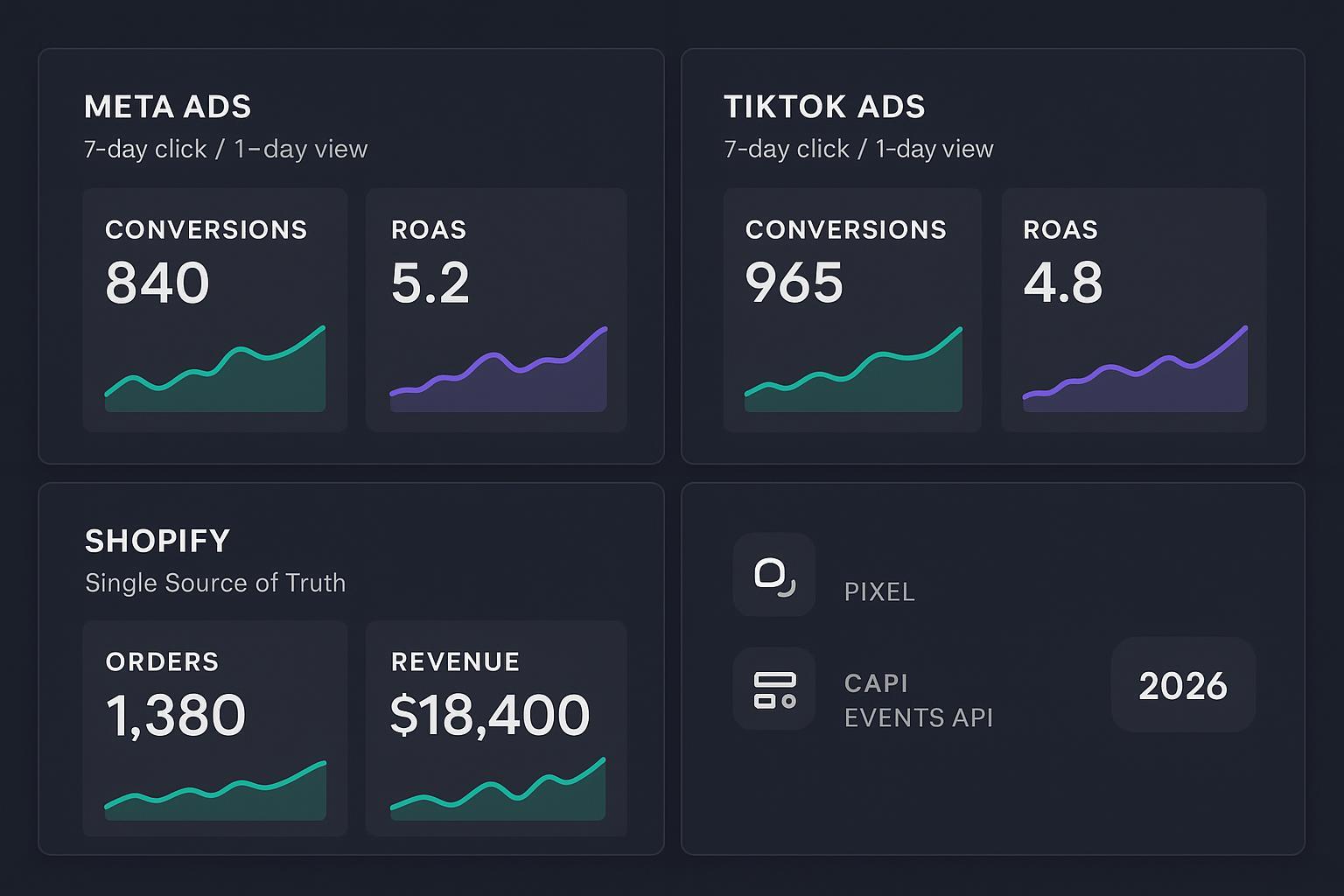
If Meta Ads and TikTok Ads swear they drove more purchases than Shopify shows, you’re not crazy—your stack is mixing different windows, scopes, and tracking paths. In this comparison, we’ll explain the specific reasons counts diverge, then give you a practical reconciliation workflow. Our adjudication baseline is Shopify orders and net revenue, and our head-to-head test uses the Purchase event with a 7-day click / 1-day view window on both platforms.
Key takeaways
Use Shopify orders and net revenue as the single source of truth when reconciling mismatches. See the Shopify integration overview for how to operationalize this on your store: Shopify integration for Attribuly.
Align your head-to-head baseline to Purchase with 7-day click / 1-day view on both platforms, and document the exact setting used per account and period.
Expect view-through to inflate platform counts relative to Shopify (UTMs are click-only). Sensitivity-test 0V vs 1V vs 7V where options exist.
Combine browser pixels with server-side (Meta Conversions API; TikTok Events API) and dedupe using a shared event_id. Monitor Meta’s Event Match Quality (EMQ).
Reconcile to net revenue (refunds/returns) and investigate cross-device paths (mobile discovery → desktop checkout) before judging channel performance.
Shopify attribution mismatches: quick comparison matrix
Dimension | Meta Ads | TikTok Ads | Shopify (Adjudication) |
|---|---|---|---|
Attribution windows | Commonly 1C, 7C and 1V. Meta announced reporting changes effective 2026-01-12 impacting view-through availability in the Ads Insights API; verify your UI per account. According to Meta’s update on metric availability (2025-10-16), some windows are deprecated in API reporting. | Click windows: 1/7/14/28; view windows: Off/1/7+. Configurable at ad group level in Ads Manager. TikTok help docs note many reports default to 7C/1V unless customized. | Treat Shopify orders and net revenue as system of record for reconciliation. Shopify analytics emphasize click/visit reality rather than view-through. |
View-through credit | Supported (view-through), but window availability may differ between Ads Manager and API; confirm exact settings used. Source: Meta’s API updates and unified attribution setting notes (2025–2026). | Supported (VTA and engaged view-through). TikTok’s SAN behavior self-attributes qualified exposures, which can raise counts vs last-click tools. | UTMs don’t capture impressions; Shopify won’t reflect view-only exposure without clicks. |
Server-side tracking | Conversions API (CAPI) with event_id dedup; track EMQ and send hashed identifiers (email/phone/external_id). Meta’s best-practice guide covers the setup. | Events API with event_id dedup; ttclid enriches attribution but isn’t required for dedup. TikTok’s Events API and dedup docs explain overlap rules. | Export orders via Admin GraphQL/Bulk Ops; adjust for refunds/returns; match platform events to orders. |
Reporting scope | Rule-based attribution in Ads Manager; incrementality needs experiments separately. Unified attribution setting reduces UI/API drift. | Self-Attributing Network (SAN) can change how conversions appear; multi-session and VTA can increase reported conversions. | Source of truth for orders and revenue; last-click oriented reality for sales. |
References in matrix:
Meta API deprecations and unified setting: Ads Insights API metric availability updates (2025-10-16); Out-of-cycle changes including unified attribution setting (2025)
TikTok windows/settings: Attribution settings at the ad group level; About the attribution window on TikTok Ads Manager; Seller Center metrics defaults
Shopify adjudication lens: Shopify Enterprise: Multi-channel marketing guidance
Head-to-head windows and reporting scopes (7C/1V Purchase)
For a fair comparison, lock both platforms to Purchase with 7-day click / 1-day view. Two caveats:
Meta window availability: Meta’s Ads Insights API deprecated certain view-through options effective January 12, 2026. Ads Manager UI may still show 1V for web conversions; either way, annotate the exact window you used. Meta introduced a unified attribution setting to reduce UI/API drift in 2025; align your reporting to that. See Meta’s API update on metric availability (2025-10-16) and out-of-cycle changes.
TikTok configuration: Set attribution at the ad group level (Bidding and Optimization → Attribution settings). Choose 7-day click and 1-day view to mirror Meta. TikTok’s help articles confirm adjustable CTA/VTA: Ad group attribution settings and Attribution window overview.
What this changes: When both are aligned to 7C/1V, you remove the biggest source of drift. Remaining differences typically come from view-through behavior (SAN vs rule-based), cross-device paths, and tracking completeness (pixel vs server-side). To diagnose persistent Shopify attribution mismatches, run short sensitivity checks (e.g., 0V vs 1V) and document.
UTMs governance (and why view-through doesn’t show up in Shopify)
UTMs are click-only. They set acquisition sources when a user clicks and lands; impressions without clicks never populate UTMs, so Shopify analytics won’t reflect view-through attribution.
Consolidated guidance:
Use a clear naming standard: utm_source = meta|tiktok; utm_medium = social_paid; utm_campaign/utm_content mapped to ad set/creative.
Capture fbclid and ttclid on landing (URL param → localStorage/sessionStorage), pass to pixels/server-side, and consider saving into Shopify order metafields via an app or webhook. Shopify checkout extensibility provides the hooks to move identifiers through checkout, but there’s no official one-click pattern. See Shopify’s checkout app building overview and Functions/API reference (2026-01).
GA4 limitation: Acquisition is UTM-driven; impression-only exposure isn’t represented. For protocol reference, see Google’s GA4 collection config.
Practical implication: If TikTok or Meta claim view-through purchases, expect Shopify to show fewer attributed orders unless those users clicked at some point.
Tracking stack and deduplication (pixel + server-side)
To reduce mismatches, run browser pixels alongside server-side and dedupe with a shared event_id. This typically narrows gaps toward Shopify’s order counts and net revenue.
Meta: Use Conversions API (CAPI). Keep event_id identical across pixel and server events, send normalized hashed identifiers (email, phone, external_id), and monitor Event Match Quality (EMQ). Meta’s guide covers best practices: Omni optimal setup guide.
TikTok: Use Events API. TikTok dedupes overlapping events via event_id (typically within 48 hours) and may merge events within five minutes to fill missing fields. ttclid helps attribution but isn’t required for deduplication. See Event deduplication and Events API.
Reconciliation workflow (step-by-step)
Define your baseline (Purchase, 7C/1V), export Shopify orders for your analysis period (order_id, created_at, customer email hashed, gross and net amounts, refunds), and export platform-side Purchase conversions (event_id, event_time, value, click IDs where available). Join primarily on event_id; use email hash + timestamp tolerance and click ID mapping to order metafields as fallbacks. Deduplicate where pixel and server events both fire. Adjust to net revenue (subtract refunds/returns) before calculating ROAS parity. Build sensitivity tables (1C/7C/14C/28C; 0V/1V/7V) to visualize how windows inflate platform numbers relative to Shopify. Investigate edge cases such as cross-device journeys, in-app browsers, and draft orders falsely tracked as purchases (filter these). For large ranges, Shopify Admin GraphQL Bulk Operations help: Bulk Ops: queries. Community notes on draft orders: Meta ads tracking draft orders discussion. For a dual-run validation plan, see Validate multi-touch attribution in 30 days.
Real-world anonymized examples
We use anonymized client datasets with vertical, spend bracket, and date range to illustrate mismatches and reconciliation.
Case A — Apparel, $20k/mo, 2025-10-01 to 2025-12-31: TikTok reported ~25% more purchases than Shopify attributed; Meta was ~8% above Shopify. With both set to 7C/1V and pixel + server-side enabled, TikTok’s view-through and SAN multi-session behavior lifted counts; Shopify captured only click-bound sessions. Sensitivity to 0V on TikTok dropped the gap to ~10%; cross-device paths explained the remainder.
Case B — Beauty, $60k/mo, 2025-10-01 to 2025-12-31: After adding server-side with event_id dedup, Meta EMQ improved from 0.62 to 0.86 for Purchase. Unattributed orders (vs platforms) fell from ~40% to ~15%. Counts moved closer to Shopify orders and net revenue.
Case C — Home goods, $120k/mo, 2025-10-01 to 2025-12-31: TikTok discovery (mobile) followed by desktop checkout; Shopify showed fewer TikTok-attributed orders. After persisting click IDs and strengthening email hashing server-side, TikTok-attributed purchases reconciled upward by ~12%.
Note: Percentages are illustrative to show patterns, not universal benchmarks. Always run your own sensitivity analysis for your store and timeframe.
Scenario-based decision guidance
TikTok often excels at upper-funnel discovery and creative-led reach, so expect more view-through influence. Meta tends to close sales at the bottom of the funnel, particularly when catalogs and signal density are strong. When purchase cycles are short, narrow windows (1C/0V or 7C/1V) keep noise down; test both platforms under the same baseline. For subscriptions/recurring flows, lean on server-side and identity stitching to credit returning purchases accurately; align windows to your billing cadence and exclude refunds.
If windows and scopes are aligned, choose based on observed funnel behavior: TikTok for discovery-heavy products, Meta for closure-heavy cycles. Use Shopify orders/net revenue as the ground truth for final adjudication of Shopify attribution mismatches.
Also consider (tooling for reconciliation)
Disclosure: Attribuly is our product. If you need a single workflow to stitch Shopify orders with Meta CAPI and TikTok Events API, identity match emails/IDs, and validate multi-touch over 30 days, see the Shopify integration overview. It’s a neutral reference point for server-side tracking and reconciliation.
FAQ
Which single source of truth should we use to adjudicate mismatches? Shopify orders and net revenue. Treat Shopify as the reconciliation layer and test platform counts against it.
Which event and window should be the default head-to-head baseline? Purchase, 7-day click / 1-day view on both Meta and TikTok. Annotate exact settings used per account and date range.
What dataset context should we use for examples? Anonymized client data with vertical, spend bracket, and date range (e.g., apparel, $20k–$200k/month, Q4 2025). Document tracking setup (pixel + server-side), identifiers, and any refunds considered.
Links to official docs within the article provide the authoritative references. Keep link density modest and run your own sensitivity tables before drawing conclusions for budgeting and ROAS decisions.