
Ultimate Guide: Shopify Attribution Accuracy iOS 17
Comprehensive guide on Shopify attribution accuracy iOS 17—diagnostics, pre/post ROAS benchmarks, deterministic vs modeled ratios, and privacy-safe fixes. Read now.
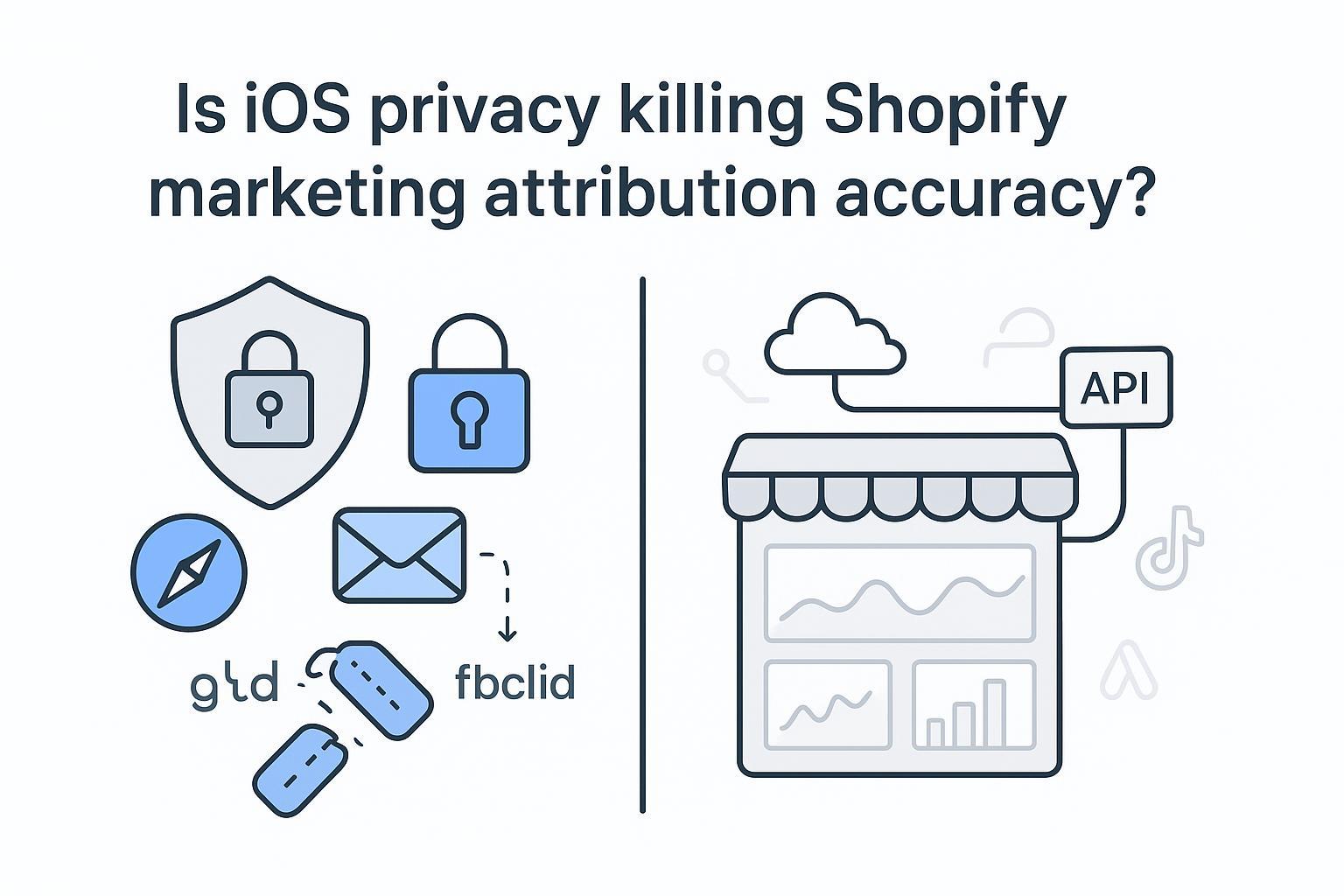
Apple’s ongoing privacy updates—ATT, SKAN for apps, and iOS 17+ Link Tracking Protection—have changed how signals flow from clicks to conversions. If your Shopify reporting feels “softer” on iOS traffic, you’re not imagining it. The net effect: deterministic web attribution breaks more often, modeled methods pick up the slack, and the old ROAS baselines drift. This guide explains what’s changing, what survives, and exactly how to measure and mitigate the damage. For readers searching for Shopify attribution accuracy iOS 17 guidance, you’ll find reproducible diagnostics and mitigation steps below.
Key takeaways
iOS 17 Link Tracking Protection selectively strips proprietary click IDs (e.g., gclid, fbclid) in Apple contexts, degrading deterministic web attribution; generic UTMs typically survive.
ATT opt‑in rates remain modest, limiting IDFA coverage for app campaigns; SKAN 4’s crowd anonymity constrains the granularity of postbacks.
Expect pre/post ROAS drift by channel and a rising share of modeled conversions—quantify both with reproducible diagnostics instead of guessing.
Shopify attribution accuracy iOS 17: what changed and why it matters
Apple’s privacy stack affects both app and web journeys, but Shopify merchants feel the pinch primarily on web.
ATT limits access to the IDFA unless users opt in. Reported opt‑ins vary by methodology and vertical—some analyses peg immediate first‑open opt‑ins near the mid‑teens in 2024, while others report ~35% in 2025—either way, deterministic coverage is constrained. See the overview by Singular (Q2 2024) and context from Aarki (2025).
SKAN 4 (via AdAttributionKit) replaces user‑level app attribution with privacy‑preserving postbacks. The richness of postback fields depends on crowd anonymity tiers; lower tiers mean fewer digits in sourceID and limited granularity. Apple’s docs cover data tiers and parameters in postbacks: Receiving postbacks across windows and Identifying postback parameters.
iOS 17+ Link Tracking Protection (LTP) removes “extra information from links” in Messages, Mail, and Safari Private Browsing—industry testing consistently shows identifiers like gclid, fbclid, and msclkid are target parameters, while UTMs usually remain intact. See Apple’s support note About iOS 17 updates and practitioner analyses from McGaw.io and Croud.
Bottom line for Shopify attribution accuracy iOS 17: when click IDs are stripped in Apple contexts, client‑side pixels lose deterministic joins; you’ll rely more on first‑party identifiers and server‑side matching.
What breaks vs. what survives under iOS privacy
Below is a compact view of parameters and storage behaviors relevant to Shopify marketers.
Signal / storage | Typical behavior under iOS 17+ privacy | Why it matters |
|---|---|---|
gclid / fbclid / msclkid | Often stripped in Messages/Mail/Safari Private via LTP | Breaks deterministic click‑ID joins for Google/Meta/Microsoft |
Standard UTMs (utm_source/medium/campaign) | Typically survive | Maintain basic channel/campaign classification |
Third‑party cookies | Constrained by Safari ITP | Shorter lifetimes and limited cross‑site tracking |
First‑party cookies/localStorage | Persist but subject to ITP nuances | Prefer first‑party IDs for continuity |
SKAN postbacks (app flows) | Aggregated, tiered detail | Limits granularity; requires modeled analysis |
Sources: Apple iOS 17 link tracking protection; industry confirmations via McGaw.io and Croud.
Benchmarks that matter (and how to measure them)
The right question isn’t “How much did iOS 17 hurt us?”—it’s “By how much, on which channels, on which devices, and what recovered after mitigations?” Use these reproducible frameworks.
Pre/post ROAS drift by channel
Compare two 90‑day windows: before vs after an iOS privacy shift (e.g., expanded LTP adoption or a consent‑mode change). Normalize for spend, discounts, and seasonality. Segment by channel (Meta, TikTok, Google), device (iOS vs Android), and browser (Safari vs Chrome). Export order‑level data with device/browser flags from Shopify and your analytics platform, align attribution windows across Ads Manager, GA4, or your attribution tool, and compute drift = (post ROAS − pre ROAS) ÷ pre ROAS. Document instrumentation changes (e.g., Enhanced Conversions go‑live date) to interpret recovery.
Expected pattern: deflation where click‑IDs are commonly stripped (Google/Meta inbound from Apple surfaces). Partial recovery after Enhanced Conversions or Conversions API rollout. Bind statements to your observed data; don’t generalize beyond your sample.
Deterministic vs. modeled conversion ratio
Deterministic conversions are credited via direct identifiers (click IDs, pixel ID joins, high‑confidence user matches). Modeled conversions rely on hashed first‑party data, server‑side matching, aggregated postbacks, or probabilistic rules consistent with platform policies. Classify each conversion by method using diagnostics (Meta EMQ for server events, Google EC match rates, GA4 join quality), segment by device/browser (iOS/Safari vs Android/Chrome), and track the ratio (modeled ÷ deterministic) over time. A rising modeled share on iOS/Safari indicates privacy impacts; successful mitigations should increase the matched pool while respecting consent.
Supporting diagnostics you should run
UTM capture rate under iOS contexts: test Mail/Messages/Safari Private clicks and verify whether
utm_source,utm_medium, andutm_campaignpersist; compare to standard Safari/Chrome. Practitioner threads have observed missing parameters on some setups—see Piwik PRO community—so validate on your stack.Meta Conversions API Event Match Quality (EMQ): quantify identifier coverage and deduplication health via Meta’s Dataset Quality API and fbp/fbc parameter guidance.
Google Ads Enhanced Conversions match rates: use the Diagnostics tab to validate hashing and data mapping; see Enhanced conversions overview and where to find diagnostics.
Attribution window sensitivity sweeps: run 1‑day vs 7‑day vs 28‑day click, plus 1‑day view where supported; watch how credit compresses under privacy constraints.
Measurement workflow for Shopify teams
Start with instrumentation, then validate, then benchmark.
Establish consent‑aware client signals. Implement Shopify Web Pixel API and respect customerPrivacy signals; avoid PII leakage and adhere to Shopify’s protected data enforcement, as described in Shopify’s pixel privacy docs. Add server‑side event forwarding. Dual‑run client pixel and server events for Meta (Conversions API) and Google Ads (Enhanced Conversions), with deduplication via shared event_id/external_id and consistent fbp/fbc where available; validate EMQ and EC diagnostics weekly until stable. Harden analytics with GA4. Use Measurement Protocol to ingest server events and unify journeys while honoring consent—see GA4 Measurement Protocol and server‑side send. Finally, run reproducible tests: execute the ROAS drift study, the deterministic vs modeled ratio audit, UTM capture tests, and window sweeps; store scripts and results in a versioned repository.
Disclosure: Attribuly is our product. As one implementation example, Shopify brands can forward consent‑safe server events to Meta, Google, and GA4, deduplicate via shared IDs, and monitor match quality centrally. Alternatives include native Shopify + Meta CAPI + Google Enhanced Conversions + GA4, or building a custom server‑side GTM stack. For a stack comparison, see our neutral Shopify attribution overview.
Mitigation by channel and tool
For Meta (Facebook/Instagram), deploy the browser pixel alongside Conversions API and deduplicate with event_id/external_id; pass fbp/fbc when available. This improves server‑side match quality and conversion completeness without relying on click‑IDs—see Dataset Quality API and fbc/fbp parameters. For Google Ads, enable Enhanced Conversions (hash customer data), review Diagnostics, and consider server‑side forwarding; this recovers attribution via hashed identifiers when click‑IDs are missing—see Enhanced conversions overview and Diagnostics locations. For TikTok, implement the Events API with consistent event_id deduplication across client/server to complete server‑side attribution in privacy‑constrained contexts (consult TikTok Business Help Center when you implement). On Shopify itself, use the Web Pixel API with consent signals, secure forwarding, and adhere to protected data enforcement noted in the Shopify changelog.
A concise note on SKAN and app scenarios
If your brand also sells via an iOS app, SKAN 4 governs attribution. Expect tiered postbacks tied to crowd size, limited parameter granularity, and conversion value timing considerations. Keep web vs app measurement pipelines separate, and avoid mixing SKAN aggregates with web pixels in a single deterministic score. Start with Apple’s guidance on postback windows and sourceID tiers.
30‑day action plan
In the first week, baseline consent and tagging: audit Shopify pixel consent, cookie lifetimes, and UTM hygiene, then stand up EMQ and EC diagnostics. In week two, roll out server‑side: deploy Meta CAPI and Google Enhanced Conversions, configure deduplication, and validate identifier coverage. In week three, run diagnostics and benchmarks: execute UTM capture tests, the pre/post ROAS drift study, the deterministic vs modeled ratio audit, and window sensitivity sweeps. In week four, stabilize and document: iterate on EMQ/EC, summarize findings, and decide on channel‑specific budget adjustments based on measured drift and recovery for Shopify attribution accuracy iOS 17 audiences.
References and further reading
Apple’s description of Link Tracking Protection in iOS 17.
Practitioner explanations of parameter stripping and UTM survival via McGaw.io’s analysis of Safari tracking protections and Croud’s 2025 overview of iOS 26 privacy changes.
ATT opt‑in context from Singular (2024) and Aarki (2025).
Meta Conversions API Dataset Quality API and fbp/fbc parameter guidance.
Google Ads Enhanced conversions overview and Diagnostics guidance.
Shopify Web Pixel privacy documentation and changelog.