
GA4 vs Attribuly: Best Multi-Touch Models for Shopify (2026)
GA4 vs Attribuly — compare multi-touch attribution models, lookback windows (7C vs 7C/1V), view-through handling and validation to pick the right Shopify DTC approach.
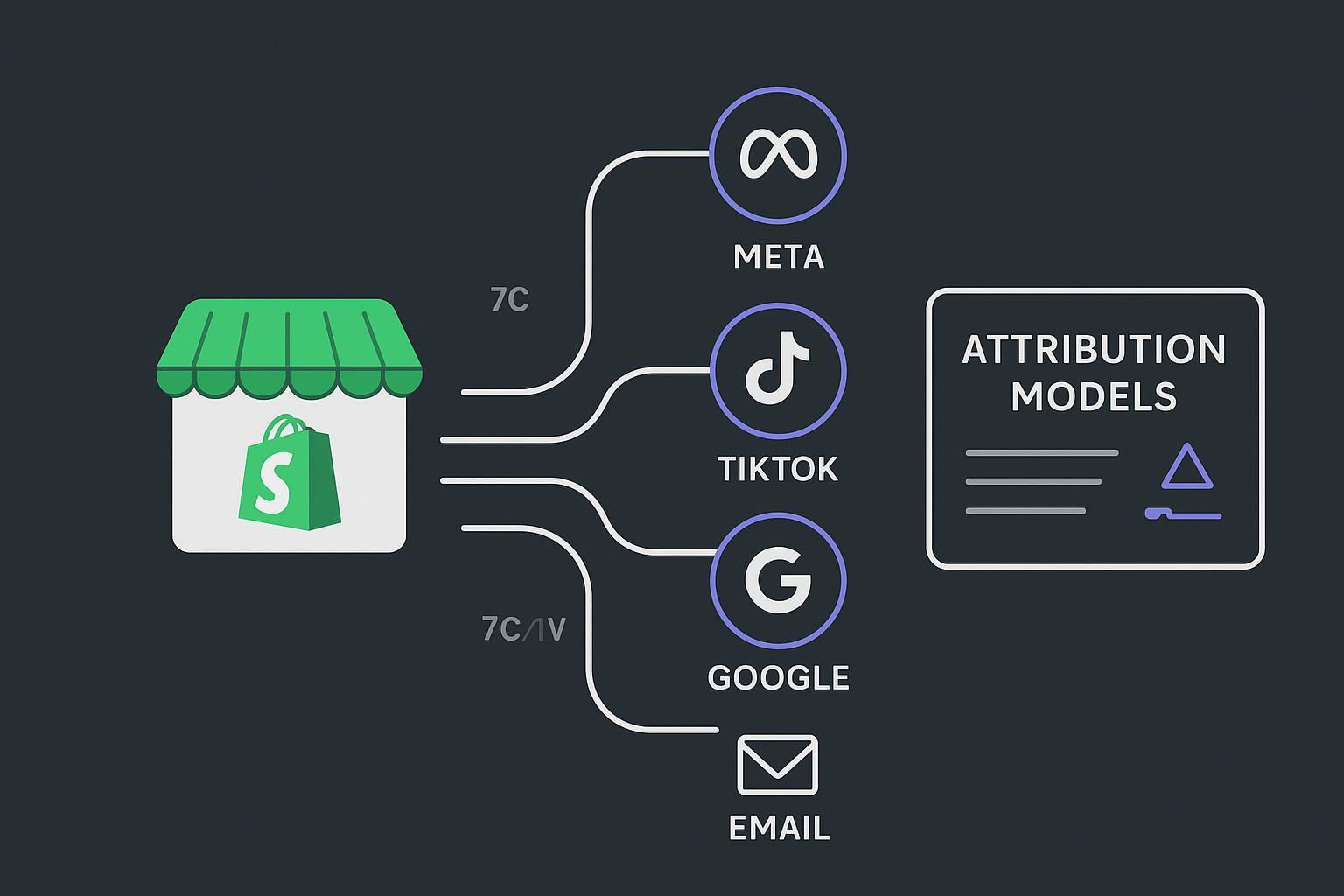
Brands on Shopify keep asking the same measurement questions: Which multi-touch attribution model should we use, what lookback window is fair, and when do we include view-through from short video ads? This comparison answers those questions for 2026—with GA4’s reality, Attribuly’s rule-based flexibility, and a validation plan you can actually run.
Key takeaways
There isn’t one “best” model. Choose based on funnel length, AOV, channel mix, and your data volume—then validate quarterly.
For Meta/TikTok-heavy mixes, compare both 7-day click (7C) and 7-day click + 1-day view (7C/1V) to bound ROAS; search-heavy mixes often stick to 7C.
GA4 now offers Data-Driven Attribution (default) plus two last-click variants; rule-based models like linear and time-decay are no longer selectable, as summarized by independent educators in 2024–2025.
Attribuly supports Shopify-native rule-based models (first, last, linear, position-based, time-decay), Full Credit, and Custom—with configurable windows (1/7/30/60/90/180) and server-side tracking.
Primary fairness check: triangulate with MMM every quarter; use operational checks like a 30-day dual-run (client vs server/API) and occasional geo holdouts to confirm incrementality.
What “multi-touch attribution” means for Shopify in 2026
For Shopify DTC, multi-touch attribution assigns conversion credit across the journey: discovery (short video/social), intent (search/retargeting), and close (brand/direct/email). Two families matter:
Rule-based models (first, last, last non-direct, linear, time-decay, position-based) offer transparency and low data requirements.
Data-driven models (like GA4 DDA) learn credit weights from historical paths and outcomes. They can adapt as your mix changes but need more stable conversion volume.
Reality check in GA4: By late 2023, Google removed selectable rule-based models from reporting. In 2025–2026, GA4 offers Data-Driven Attribution by default, plus Paid & Organic Last Click and Google Paid Channels Last Click for reporting. Educators and consultancies documented this change consistently across 2024–2025. According to the overview in the GA4 help ecosystem and practitioner explainers such as the summaries by Love’s Data and MeasureSchool, only these models are available in reporting.
On Shopify stacks, Attribuly remains useful for sensitivity analyses and day-to-day decisioning because it supports the rule-based set and custom models with configurable windows and server-side tracking. Disclosure: Attribuly is our product. See model availability on the Attribuly models page.
Comparison at a glance — multi-touch attribution models for Shopify
Model/Platform | Availability (2026) | Windows | View-through handling | Notes |
|---|---|---|---|---|
GA4 Data-Driven Attribution (DDA) | Available (default) | Up to 90-day default; configurable | Evaluates touchpoints; external platform view-through not directly credited | Machine learning; considers many path factors; educators cite up to ~50 touchpoints. |
GA4 Paid & Organic Last Click | Available | N/A | N/A | 100% credit to last non-direct; engaged views for YouTube can apply. |
GA4 Google Paid Channels Last Click | Available | N/A | N/A | Prioritizes last Google Ads click; otherwise Paid & Organic LC. |
Attribuly First/Last/Linear/Position/Time-decay | Available | 1/7/30/60/90/180 | Hybrid stance supported (click-only and click+view) | Rule-based flexibility; Shopify-native integrations; server-side tracking. |
Attribuly Full Credit | Available | Configurable | Not typical for view-through; credits all touches equally | Used as a comparison aid to see total touch presence. |
Attribuly Custom (Enterprise) | Available | Configurable | Hybrid and custom weights | Build your own windows/model; may take time to apply. |
Model capsules — GA4 vs Attribuly
GA4 Data-Driven Attribution (DDA)
Specs: Machine learning assigns credit to events across paths considering time to conversion, device, order of interactions, and engagement. Default in GA4 reporting.
Pros: Adapts as your channel mix changes; reduces arbitrary rule bias; widely accepted for standardized reporting.
Cons: Opaque; requires stable volume; limited control over rules; cannot directly incorporate external platform view-through.
Who it’s for: Teams standardizing on GA4 dashboards needing consistent cross-property reporting.
Constraints: Rule-based models are no longer selectable in GA4 reporting; some official help pages change over time.
Evidence: For model availability and DDA mechanics, see independent explainers such as the 2025 updates by Love’s Data on GA4 attribution models and MeasureSchool’s GA4 attribution overview.
GA4 Paid & Organic Last Click
Specs: Attributes 100% credit to the last non-direct channel (with special handling for YouTube engaged views).
Pros: Simple; useful as a baseline for search-heavy funnels and quick directional checks.
Cons: Overcredits closers; ignores mid-funnel; can distort budget decisions.
Who it’s for: Search-led funnels, brands needing a stable “last click” baseline.
Constraints: Does not fairly represent social/video discovery; no configurable rule weighting.
Evidence: Definitions are summarized in Google’s key event attribution documentation and practitioner explainers, e.g., Cardinal Path’s guide.
GA4 Google Paid Channels Last Click
Specs: Credits the last Google Ads click; falls back to Paid & Organic Last Click if no Google Ads click.
Pros: Helpful when analyzing Google Ads performance within GA4.
Cons: Biased toward Google Ads paths; can undercount non-Google discovery.
Who it’s for: Teams needing a Google Ads-focused baseline inside GA4.
Constraints: Same rule limitations; not suitable for holistic budget allocation.
Evidence: Defined in Google help and covered by consultants; see the Cardinal Path explainer above for context.
Attribuly First/Last/Linear/Time-decay/Position-based
Specs: Rule-based models selectable per report; configurable lookback windows (1/7/30/60/90/180); server-side tracking and Shopify-native integrations.
Pros: Transparent and easy to explain; position-based and time-decay fairly acknowledge mid-funnel; windows can match your sales cycle.
Cons: Rules are fixed; may misrepresent reality if your mix shifts rapidly; requires care to avoid window bias.
Who it’s for: Shopify DTC teams wanting flexible, model-on-demand comparisons and sensitivity analysis.
Constraints: Learning curve to set windows and channel groupings; ensure deduplication across sources.
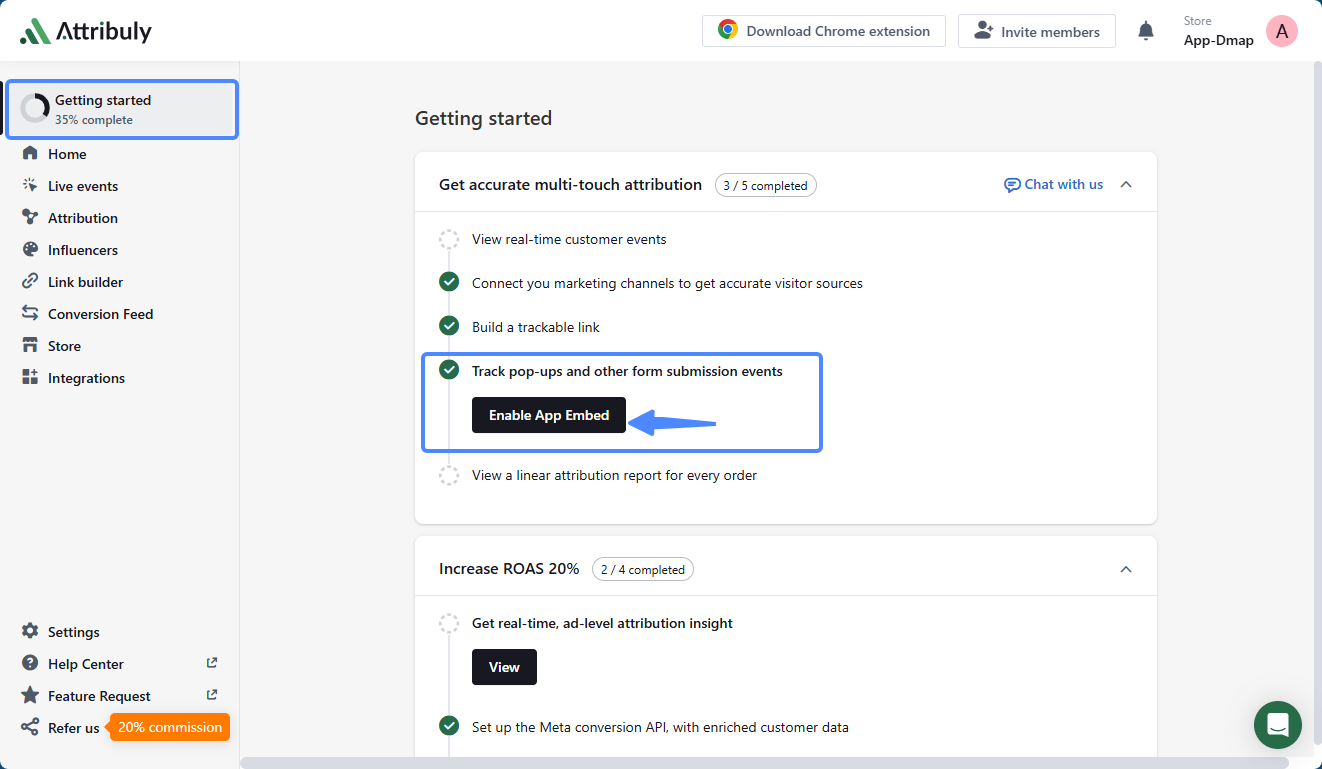
Evidence: See Attribuly models and configuration details in Attribuly Settings. Disclosure: Attribuly is our product.
Attribuly Full Credit
Specs: Assigns full credit across all touches; configurable window; useful to visualize presence rather than fairness.
Pros: Highlights multi-touch activity and assists sanity checks for channel presence.
Cons: Not suitable for budget allocation; inflates multi-touch credit.
Who it’s for: Teams running coverage diagnostics or looking for maximum path inclusion.
Constraints: Use alongside other models; don’t use as a KPI basis.
Evidence: Described in Attribuly support documentation; see the Attribuly models page for context. Disclosure: Attribuly is our product.
Attribuly Custom (Enterprise)
Specs: Custom weights and windows; includes hybrid handling for click + view-through; changes may require processing time.
Pros: Tailored to your funnel; aligns model rules to business realities like high AOV or subscription retention.
Cons: Requires clear governance; can be overfit without validation.
Who it’s for: Mature teams with strong data hygiene and need for bespoke rules.
Constraints: Enterprise access; ensure versioning and quarterly reviews.
Evidence: Configuration options are outlined in Attribuly Settings and Getting started. Disclosure: Attribuly is our product.
Windows and view-through: when 7C vs 7C/1V changes your ROAS
Here’s the deal: short video ads often drive impressions that nudge shoppers without an immediate click. If you only measure clicks, you’ll under-credit Meta/TikTok. If you always include view-through, you can inflate credit when impressions are cheap.
For social-first mixes, compare 7C vs 7C/1V for purchases. Meta and TikTok commonly align to 7-day click with 1-day view at the platform level; Meta made recent changes that standardize attribution reporting windows, which third-party analytics partners and developers documented in late 2025 and January 2026. For background on cross-platform window baselines and reporting mismatches, see our neutral explainer on Shopify attribution mismatches between Meta and TikTok. In search-heavy contexts, stick to 7C for clean comparability and reduced noise. If you sell high AOV products or have longer consideration, extend click windows (30–60 days) and prefer time-decay or position-based so you don’t starve mid-funnel touches.
Practical example: A Meta-heavy brand may see 7C/1V increase attributed conversions by double digits versus 7C, while a search-led brand may see minimal difference. Publish both reads side-by-side to bound ROAS and guide budget guardrails. If you’re comparing GA4 vs rule-based attribution Shopify workflows, document window choices and timestamps in every dashboard.
How to choose — scenarios and criteria weights
We don’t crown a single winner. Instead, score options with explicit weights and decide by scenario: accuracy (0.35), implementability (0.25), data requirements (0.15), Shopify fit/integrations (0.15), and validation support (0.10). Normalize the scores to your context and revisit quarterly.
For short-funnel, social-first brands, position-based or time-decay in Attribuly tends to provide a fair read of discovery plus retargeting. Publish both 7C and 7C/1V bounds to keep ROAS expectations realistic when impressions matter.
For long consideration or high AOV, extend click windows to 30–60 days and consider time-decay or position-based, while running GA4 DDA in parallel for directional learning and cross-team consistency.
For small catalogs or low volume, start with linear or position-based rules in Attribuly. Defer DDA until you have stable conversion counts so the model has enough signal to learn reliably.
For GA4-centric teams, use GA4 DDA for standardized reporting and supplement with Paid & Organic Last Click as a simple baseline. Run sensitivity analyses in Attribuly to understand how rule choices would re-shape credit without changing your GA4 governance.
Operationally, standardize channel groupings, document windows (7C vs 7C/1V) with timestamps, and aim for deduplication at or above 95% by aligning identifiers across Shopify, GA4, and ad platforms. Favor first-party and server-side tracking to recover signals post-iOS; Attribuly’s server-side integrations are documented on the Integrations list. Disclosure: Attribuly is our product.
Validation fairness: MMM triangulation (primary), plus dual-run and geo holdouts
Make MMM your primary fairness check and refresh it quarterly. MMM captures macro effects and seasonality, giving you a directional alignment point for your MTA reads. For a practical overview and cadence rationale, see the practitioner guidance in the 2025 explanation by PyMC Labs on marketing mix modeling.
Add operational checks. Over a 30-day dual-run (client-side vs server/API), track conversion capture uplift (industry ranges often show +10–30% when moving to server-side), cross-channel ROAS variance (target ≤10–15%), and deduplication (≥95%). Keep occasional geo-based holdouts on Meta/TikTok to confirm incrementality and calibrate view-through expectations. For step-by-step setup, see our 30-day validation playbook and a GA4-centric comparison for Shopify teams in Attribuly vs Segment+GA4. Disclosure: Attribuly is our product.
If your team needs flexible rule-based comparisons alongside GA4, Attribuly is particularly strong for Shopify-native setups with configurable windows and server-side tracking. Explore the models and adjust windows in Settings to fit your funnel. Disclosure: Attribuly is our product.