
Full Impact AI Attribution Model: How it Works and Use Cases
As a DTC brand, you’ve likely faced this frustrating scenario: You invest heavily in short video ads, display ads, or CTV ads on platforms like Meta, YouTube, or Amazon Prime Video. Your audience sees these ads, but few click through—yet later, they search for your brand on Google and make a purchase. When you check your attribution data, you only see the final Google search or direct visit, with no way to link that conversion back to the ads that first sparked their interest. This is the attribution black hole plaguing most DTC brands—and it’s exactly what Attribuly’s Full Impact AI Attribution Model is designed to solve.
In our recent live stream, we walked through how this revolutionary model transforms how DTCs measure ad impact, using insights from our official Shopify plugin and real-world data. Let’s break down the core of the Full Impact model, aligned with our presentation slides and live discussion.
The Pain Point: Why Short Video & Display Ads Are Hard to Measure
The rise of short-form video (TikTok, YouTube Shorts) and display/CTV ads has created a new challenge for attribution. According to our observations, 99% of users who see these ads do not click on them. Instead, they later visit your store directly, search for your brand on Google, or engage with your email campaigns—leaving you with no way to track the original ad’s influence.
Traditional attribution models (like Last Click, First Click, or Linear) only track click-based interactions, which means these high-impact, non-click ads are completely overlooked. This leads to two critical problems:
Overvalued touchpoints: Direct visits, Google brand keyword searches, organic searches, and email campaigns are often overcredited, as they are the “final step” in the conversion journey—even though they rely on earlier ad exposure.
Wasted ad budget: You can’t measure the ROI of your display, CTV, or short video ads, making it impossible to optimize your spending or identify high-performing content.
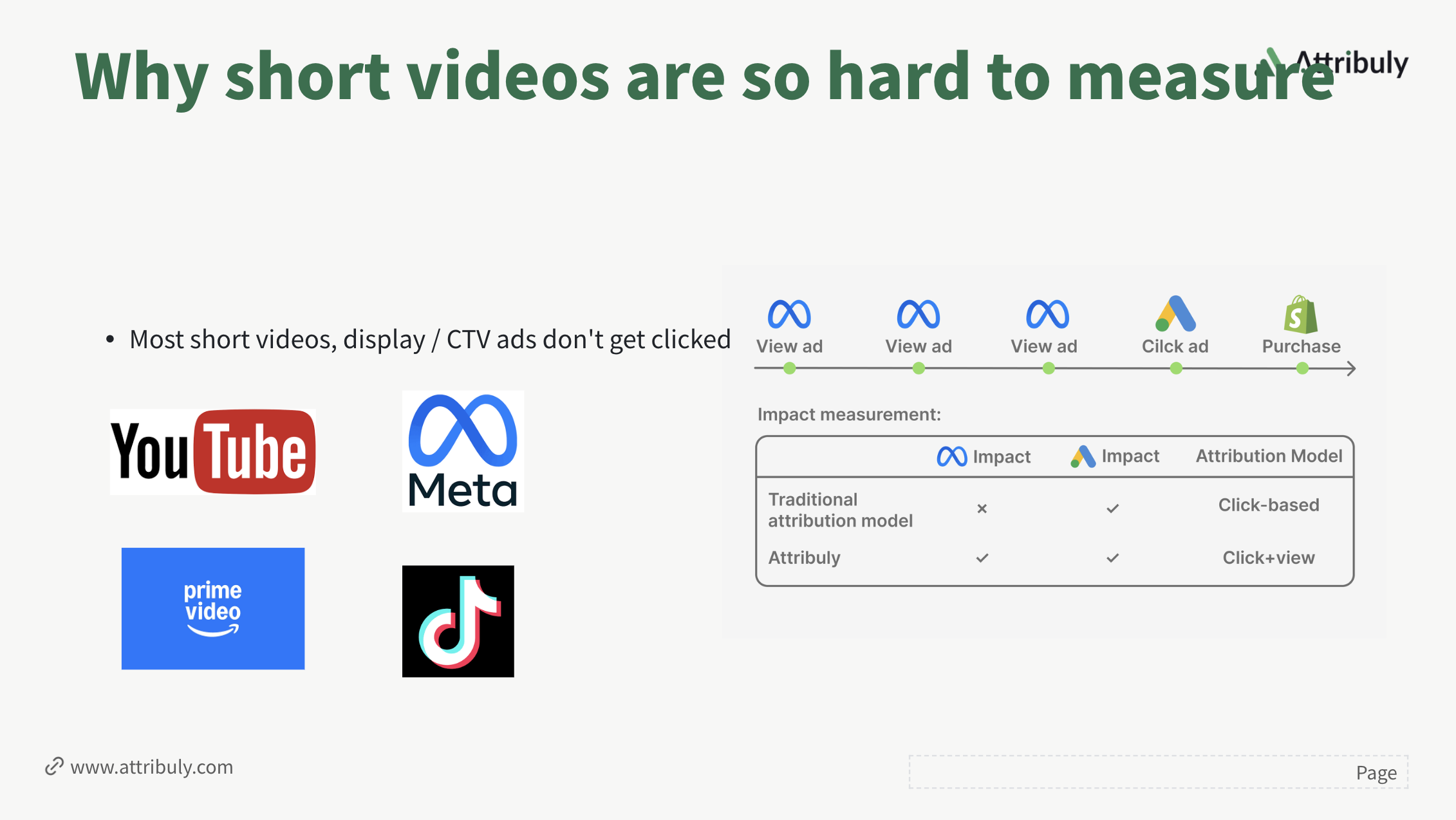
Why short videos are so hard to measure – showing the gap between ad views and click-based attribution]
As shown in the slide, most view-based ads (Meta display, YouTube, CTV) don’t generate clicks, but they do drive conversions. Traditional models ignore these views, creating a blind spot in your marketing data.
The Solution: Full Impact AI Attribution Model
Attribuly’s Full Impact AI Attribution Model is built to fix this gap by combining click-based attribution with view-through attribution, powered by machine learning. Unlike traditional rule-based models, it uses AI to predict and connect non-click ad exposures to final conversions—giving you a complete picture of your customer’s journey.
1. Core Feature: View-Through Attribution
The Full Impact model’s biggest innovation is its ability to attribute conversions to ad views (not just clicks). Here’s how it works, as we explained in the live stream:
Data Integration: The model pulls data directly from your ad platforms (Meta, Google, and soon Amazon DSP and TikTok) via API, including ad exposure, click, and engagement data. It also integrates with your Shopify store data (add-to-cart, purchase, email sign-up).
AI Prediction: We train a custom AI model for your store using your historical data. The model focuses on four types of orders that often have hidden prior touchpoints: Direct visits, Google brand keyword ads, organic brand searches, and email-driven conversions.
1-Day Attribution Window: The model looks at ad exposures from the 24 hours before the first touchpoint of the conversion. It predicts which ad (from your Meta, Google, or other campaigns) is most likely to have driven the user to search for your brand or visit your store.
Touchpoint prediction: The highest-probability ad is added to the customer’s journey, so you can see the full path from ad view to conversion.
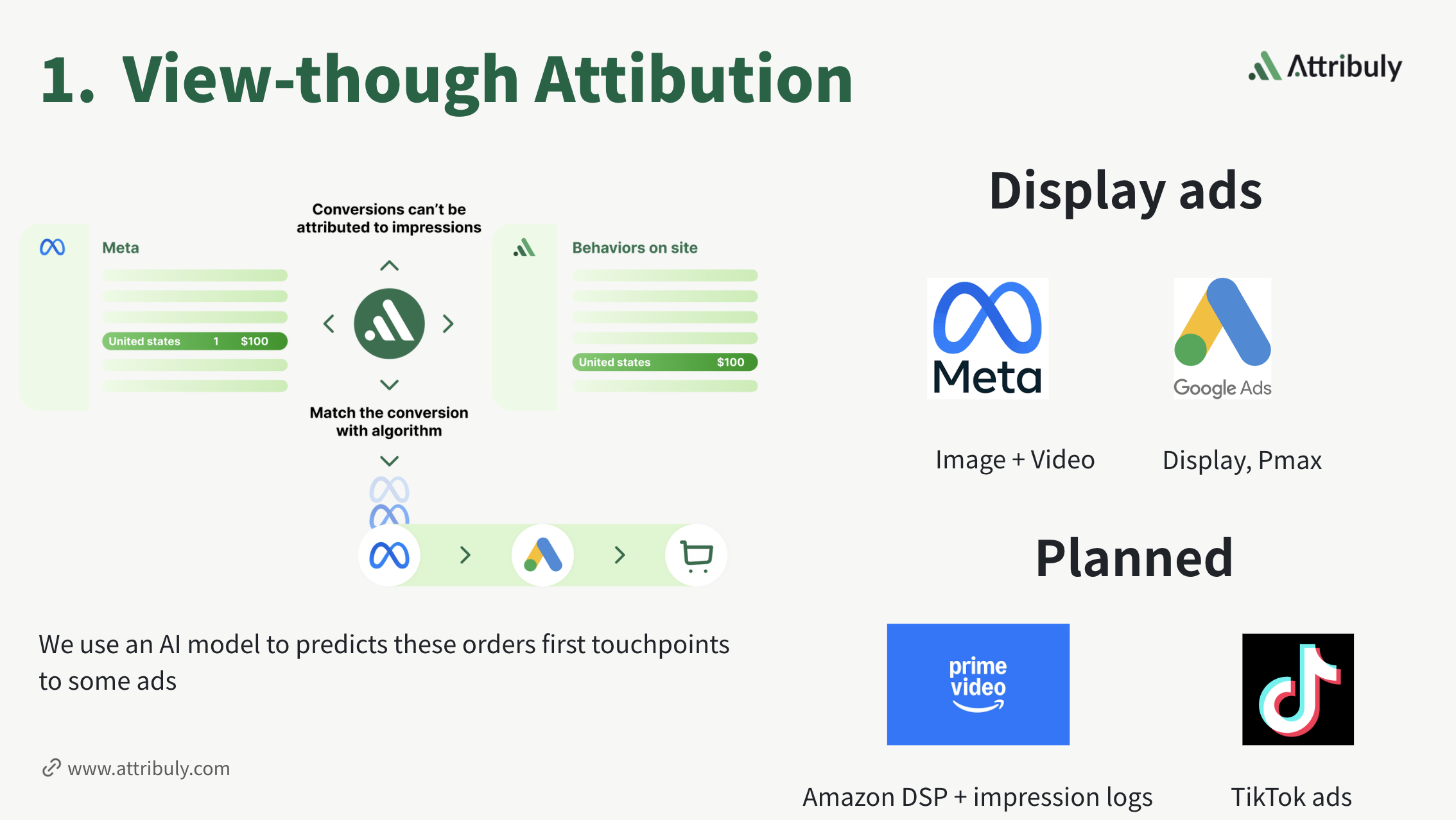
Figure: View-through attribution flow (ad view → AI prediction → conversion attribution).
This means you can finally credit Meta display ads, YouTube shorts, or CTV ads for driving conversions—even if users never clicked on them. For example, if a user sees your Meta display ad, then 12 hours later searches for your brand on Google and buys, the Full Impact model will link that conversion back to the Meta ad.
Method overview (high level) and limitations
At a high level, Full Impact combines platform and store signals to infer likely influence from view-based ads:
Data inputs: ad-platform events you connect (impressions, clicks, campaign/ad metadata) plus store events (sessions, add-to-cart, checkout, purchase) and first-party identifiers available under your setup.
Model training: we fit a store-specific model using historical paths. In practice, the model learns patterns where certain exposures tend to be followed by branded search, direct sessions, or assisted conversions.
Attribution output: the model assigns probabilistic credit (rather than deterministic rules) and surfaces an order-level journey view so you can inspect how credit was assigned.
Limitations to know (important for accurate expectations):
Correlation vs. causation: modeled view-through credit is an estimate; it is not the same as a controlled incrementality experiment.
Signal availability varies: privacy settings, consent rate, and platform APIs can reduce observable signals and affect accuracy.
Best practice: validate major budget decisions with holdouts, geo tests, or platform lift studies when feasible.
2. The Attribuly Algorithm: Beyond Rule-Based Models
Traditional attribution models (Last Click, Linear, Position) are rule-based—they split credit evenly or focus only on the first/last click. This is flawed because not all touchpoints are equal: a 3-second ad view has a different impact than a 5-minute site visit with an add-to-cart.
The Full Impact model uses incremental impact analysis to assign credit based on real influence. Here’s a simple example from our slide:
A customer journey of “Search → Email” has a 2% conversion rate.
When a Display ad is added to the journey (“Search → Display → Email”), the conversion rate jumps to 3%—a 50% increase.
The model credits the Display ad for this incremental lift, recognizing its critical role in driving the conversion.
Figure: Incremental impact example used to illustrate how additional touchpoints can change conversion probability.
This machine learning approach aims to credit each touchpoint based on its estimated contribution, rather than applying fixed rules. While other vendors may also offer incremental or model-based attribution approaches, Full Impact is purpose-built for DTC workflows and focuses on combining click and view-through signals in a single, order-level journey view.
Full Impact vs. GA4 DDA: What’s the Difference?
Many brands use GA4’s Data-Driven Attribution (DDA), but there are four key differences that make Attribuly’s Full Impact model more powerful for DTC brands:
Feature | GA4 DDA | Attribuly Full Impact |
|---|---|---|
Dataset | Limited to Google ecosystem data only | Integrates all your ad platforms (Meta, Google, soon Amazon/TikTok) + Shopify store data |
Transparency | Black box—no visibility into individual customer journeys | Full transparency: View the complete journey of every order (up to 365 days) |
Attribution Algrithm | Relevance | Incremental impact |
View-Through Attribution | Limited to Google ads only | Supports Meta, Google, and soon Amazon DSP/TikTok |
Notes | GA4 DDA typically relies on observed interaction data in GA4/Google ecosystem | Full Impact combines click-based + view-through signals using store + ad-platform data (per account connections) |
The biggest advantage? Full Impact gives you aholistic view of your entire marketing ecosystem, not just Google. This is critical for DTC brands that rely on multiple ad platforms to drive growth.
Real-World Results: What the Data Shows
How to validate results in your own store (recommended)
Because attribution outputs depend heavily on your data quality and channel mix, here’s a practical way to verify whether modeled view-through credit matches reality:
Pick a stable time range (e.g., last 14–28 days) and freeze budget changes if possible.
Compare two views side-by-side: last-click vs. Full Impact modeled attribution, at both channel and campaign level.
Inspect 20–50 individual orders where Full Impact adds a view-through touchpoint. Look for:
the ad platform and campaign that received modeled credit
the first observed on-site touchpoint (direct / branded search / email)
time gap between exposure and first touch
Run a lightweight test (when feasible): pause a single prospecting campaign for 3–7 days or apply a geo split, then watch whether branded search/direct demand shifts.
Document your definitions: view window, lookback window, and what counts as “direct,” so teams can interpret the same dashboard consistently.
In our live stream, we shared a real case study comparing Last Click attribution to Full Impact. Here’s what we found:
.
Meta Ads contribution increased significantly in our internal samples: In multiple audits, we often saw Meta’s modeled share rise once view-through signals were included (results vary by store, budget mix, and creative).
“Direct” contribution decreased after de-blackboxing journeys: A portion of traffic labeled as “direct” was reclassified to earlier ad exposure or assisted touchpoints when additional signals were available.
Email’s role often shifted from “primary driver” to “assist” in modeled paths: In some accounts, email still closes conversions, but earlier ad exposures can explain part of the demand that email captures.
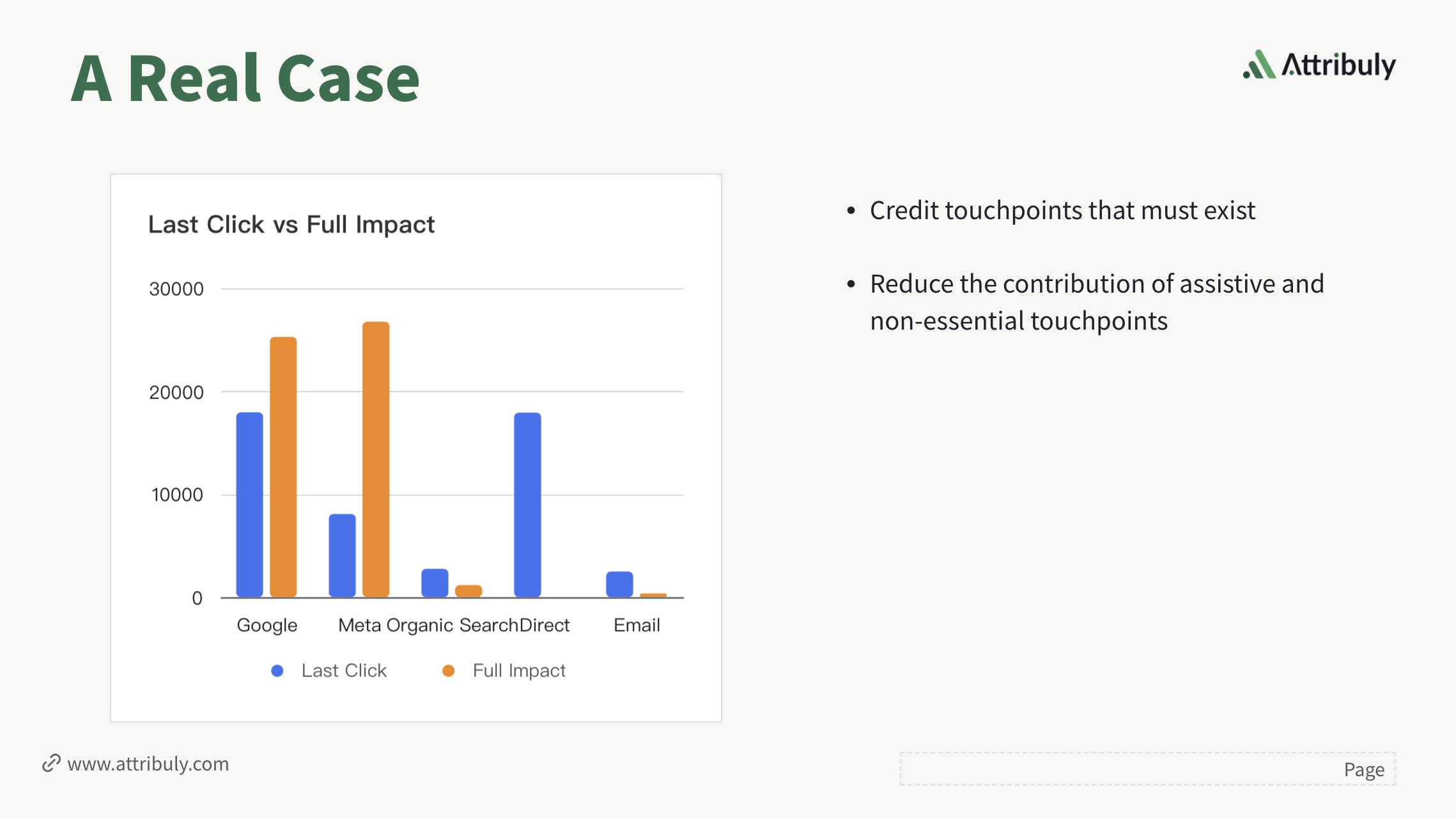
Figure: Example channel contribution shift (Last Click vs. Full Impact) — see “How to validate results in your own store” below.
This data proves that the Full Impact model gives you a more accurate picture of your ad performance—helping you optimize your budget for the channels and content that actually drive conversions.
Data Privacy & Security
Attribuly uses server-side tracking and connected ad-platform APIs to improve measurement resilience under browser privacy changes. For details on how we handle data, please review our Privacy Policy:
Privacy Policy: https://attribuly.com/policies/privacy-policy/
If your team requires additional documentation (e.g., DPA, security practices, data retention details), request it through your account manager or support.
How to Get Started with Full Impact
Getting up and running with the Full Impact AI Attribution Model is simple, and we’ve made it accessible for brands of all sizes:
Install Attribuly: Add our Shopify official plugin (we also support WooCommerce and custom stores).
Connect Your Ad Accounts: Link your Meta, Google, and other ad accounts to Attribuly via API (we handle data security and GDPR compliance).
Train Your Model: We use your historical data to train a custom AI model (takes ~5 days) and calibrate it over 1 month for maximum accuracy.
Start Measuring: Deploy the model in 1 week and start seeing complete attribution data in your Attribuly dashboard.
Eligibility: The Full Impact model is free for Attribuly Enterprise customers. Pro customers with a monthly GMV of over $100,000 can also get a 2-week free trial.
Final Thoughts: Why Full Impact Matters for Your DTC
In today’s competitive DTC landscape, accurate attribution is the key to growing your revenue and optimizing your ad spend. The Full Impact AI Attribution Model solves the biggest pain point of view-based ads—giving you visibility into the full customer journey and ensuring you credit every ad that drives conversions.
Paired with Attribuly’s Ally AI (our profit-first marketing advisor), you can turn this attribution data into actionable insights—from optimizing ad campaigns to improving LTV and profit.
Ready to stop missing out on hidden ad impact? Try the Full Impact model today and see how it transforms your marketing strategy.
— Alex, Founder of Attribuly
Live Stream FAQ: Common Questions About Full Impact Model
Q1: How is the Full Impact model different from other AI attribution tools on the market?
A: Most AI attribution tools either focus on click-based attribution or only support a single ad platform. The Full Impact model is the only one designed for DTC brands that combines view-through attribution (for non-click ads) with incremental impact analysis (to credit touchpoints based on real influence), and it integrates all your ad platforms + store data. Additionally, our model is transparent—you can view the complete journey of every order, unlike “black box” tools that don’t show how attributions are calculated.