
Customer Journey Retargeting for Ecommerce
Customer journey retargeting: stage-specific orchestration for ecommerce with incrementality testing, server-side tracking and LTV optimization.
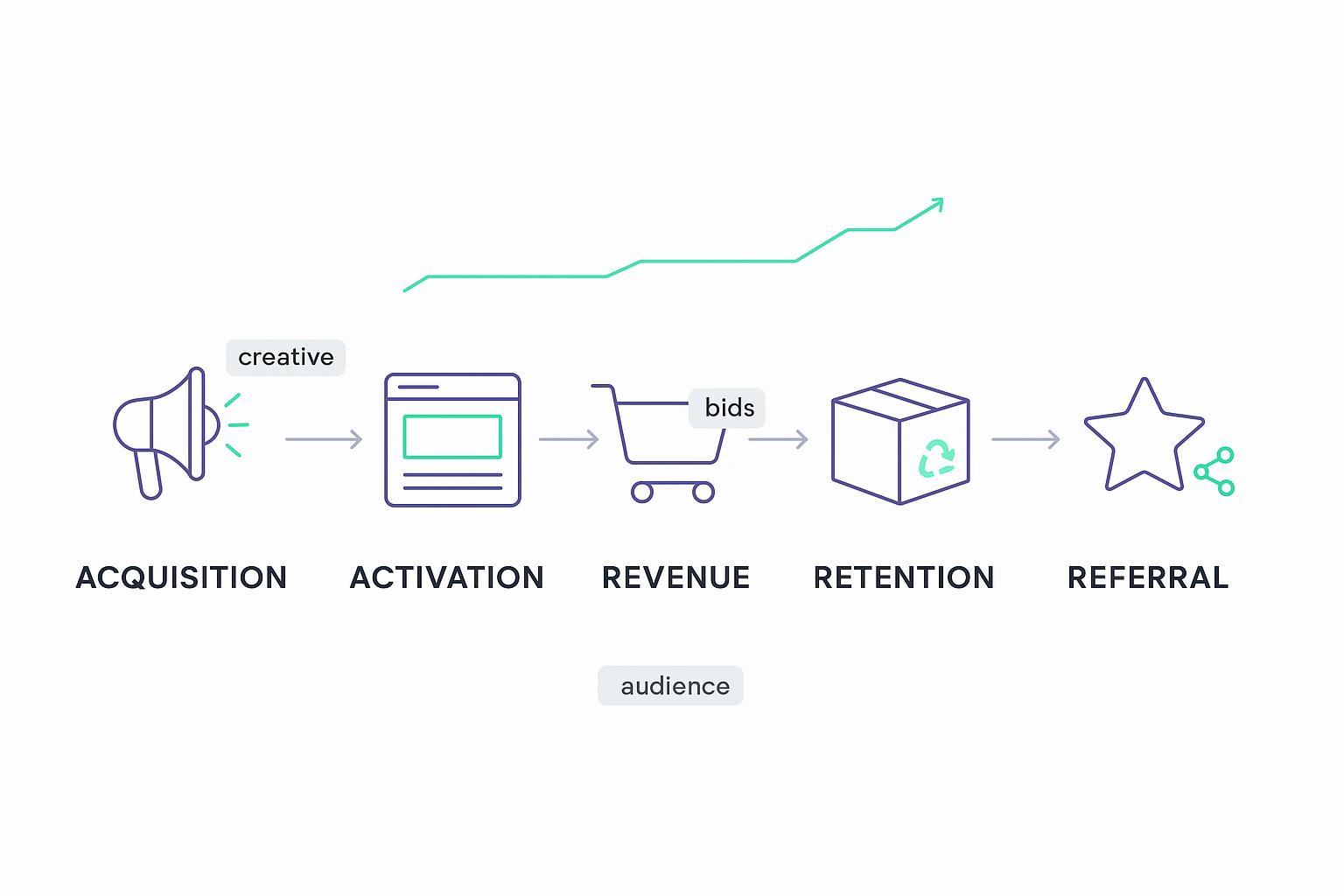
Customer journey retargeting is the lifecycle‑aware orchestration of creative, audiences, bidding, and suppression rules across clearly defined journey stages, measured by incremental lift and reinforced with privacy‑resilient first‑party and server‑side signals to maximize profit and LTV.
Put simply, it’s not one list and one ad set chasing everyone who ever visited your site. It’s a stage map that changes what you show, who you show it to, how hard you bid, and when you stop, validated by holdouts so you know what truly moved the needle.
Key takeaways
Customer journey retargeting aligns creative, audiences, bids, landing pages, and suppression to each lifecycle stage, not a one‑size‑fits‑all pool.
The gold standard metric is incremental lift, proven with holdouts or placebo ads and de‑duplicated across channels.
Privacy resilience matters; first‑party identifiers and server‑side tracking keep signals flowing as browser tracking fades.
Optimize to contribution margin and LTV, not just last‑click ROAS; value‑based bidding and AOV/margin rules belong in the plan.
What makes customer journey retargeting different
Generic retargeting re‑shows ads to past visitors and calls it a day. Customer journey retargeting maps the experience end to end and orchestrates distinct plays by stage. According to Shopify’s overview of ecommerce journey mapping, effective journey work spans awareness through loyalty with specific signals and actions at each step. See the stage‑based perspective in the Shopify explainer on ecommerce customer journey maps for grounding.
Orchestration by stage: Messaging, audiences, bids, landing pages, and suppression rules change from Activation to Revenue to Retention.
Incrementality first: You quantify causal lift with holdouts or PSA/ghost ads rather than relying on platform‑reported ROAS.
Cross‑channel governance: You align lookback windows and de‑duplicate conversions so budget follows real impact.
Reference: read the five‑stage view in the Shopify guide to ecommerce customer journey maps for context on mapping stages and signals: Shopify’s ecommerce customer journey maps.
AARRR journey map for ecommerce
A simple AARRR backbone keeps things practical while covering the full lifecycle. Think of an orchestra: each section plays a different part, but timing and dynamics create the result.
Acquisition: First‑touch discovery and anonymous engagement. Signals include ad or video views and first landings. Goal is qualified attention.
Activation: Product discovery and intent signals such as PDP dwell, size guide opens, add‑to‑cart starts. Goal is product‑specific interest.
Revenue: Checkout progress and purchase. Goal is conversion value and margin optimization, not just a ticked “Purchase.”
Retention: Post‑purchase engagement, replenishment windows, cross‑sell relevance. Goal is second order and frequency growth.
Referral: Reviews, UGC, loyalty advocacy. Goal is social proof and net new customers via customers.
Stage by stage playbook
Below is a one‑screen cheat sheet. Use it to brief creative, channel owners, and analytics in one go.
Stage | Objective | Creative | Audience logic | Bid posture | Suppression | Primary metric |
|---|---|---|---|---|---|---|
Acquisition | Earn qualified attention | Category pain points, UGC snippets, short video | Broad/contextual plus lookalikes of high‑LTV buyers | Scale with learning budget; value signals if available | Exclude recent purchasers; cap frequency | Qualified landings, engaged sessions |
Activation | Turn interest into evaluation | PDP‑level benefits, price, reviews, dynamic items | PDP dwellers, cart starters, video engagers, first‑party segments | Aggressive on high‑intent cohorts; test DCO | Suppress active checkout users for N hours | Product views to cart adds, view‑through aided evaluation |
Revenue | Convert with value and trust | Cart reminders, shipping, financing, bundles | Abandoned carts, checkout initiators | Target conversion value with ROAS guardrails | Suppress on purchase; rotate creative to avoid fatigue | Incremental purchases and revenue |
Retention | Drive second order and AOV | Replenishment timers, cross‑sell, loyalty | Purchasers in item‑specific windows, high‑RFM | Value‑based bidding using LTV or margin proxies | Suppress open service tickets | Repeat purchase rate, AOV, LTV growth |
Referral | Generate advocacy | Review prompts, refer‑a‑friend incentives | Satisfied repeat buyers, high NPS | Modest budgets; optimize for quality actions | Suppress recent negative feedback cohorts | New customers from referrals, review volume |
Measure incremental lift the right way
If you don’t measure causal lift, you’ll over‑credit retargeting for outcomes that would have happened anyway. Industry primers lay out the basics: define exposed vs. holdout, run long enough for stability, and read lift on conversions or revenue.
Why lift: A clear walkthrough of incrementality with examples shows how to compute the true impact of your media rather than counting correlations. See this perspective on proving marketing’s real impact from Search Engine Land: why incrementality proves marketing’s impact.
Test designs: Start with user‑level randomized holdouts or platform lift/PSA designs for social and display. Supermetrics’ guide offers practical steps and guardrails for running and interpreting lift tests: incrementality testing basics.
Deduplicate across channels: Align attribution windows and models across platforms and GA4 so you don’t double‑count. In GA4’s Admin you can configure lookback windows and channel credit to keep reads consistent. Overview here for reference to settings and their impact on cross‑channel credit: GA4 channel credit settings.
A 60–90 day template to get moving fast:
Weeks 1–2: Lock the stage taxonomy and suppression rules; define primary incremental metrics by stage.
Weeks 3–6: Launch retargeting sequences with at least one holdout per major channel; monitor contamination and keep budgets steady.
Weeks 7–10: Read lift, compute iCPA/iROAS, and re‑allocate budgets toward the most incremental stages and audiences.
Privacy resilient tracking and data flow
Signals power orchestration, but they must be privacy‑safe and durable. First‑party identifiers, server‑side event pipelines, and strict deduplication preserve measurement quality as client‑side tracking erodes.
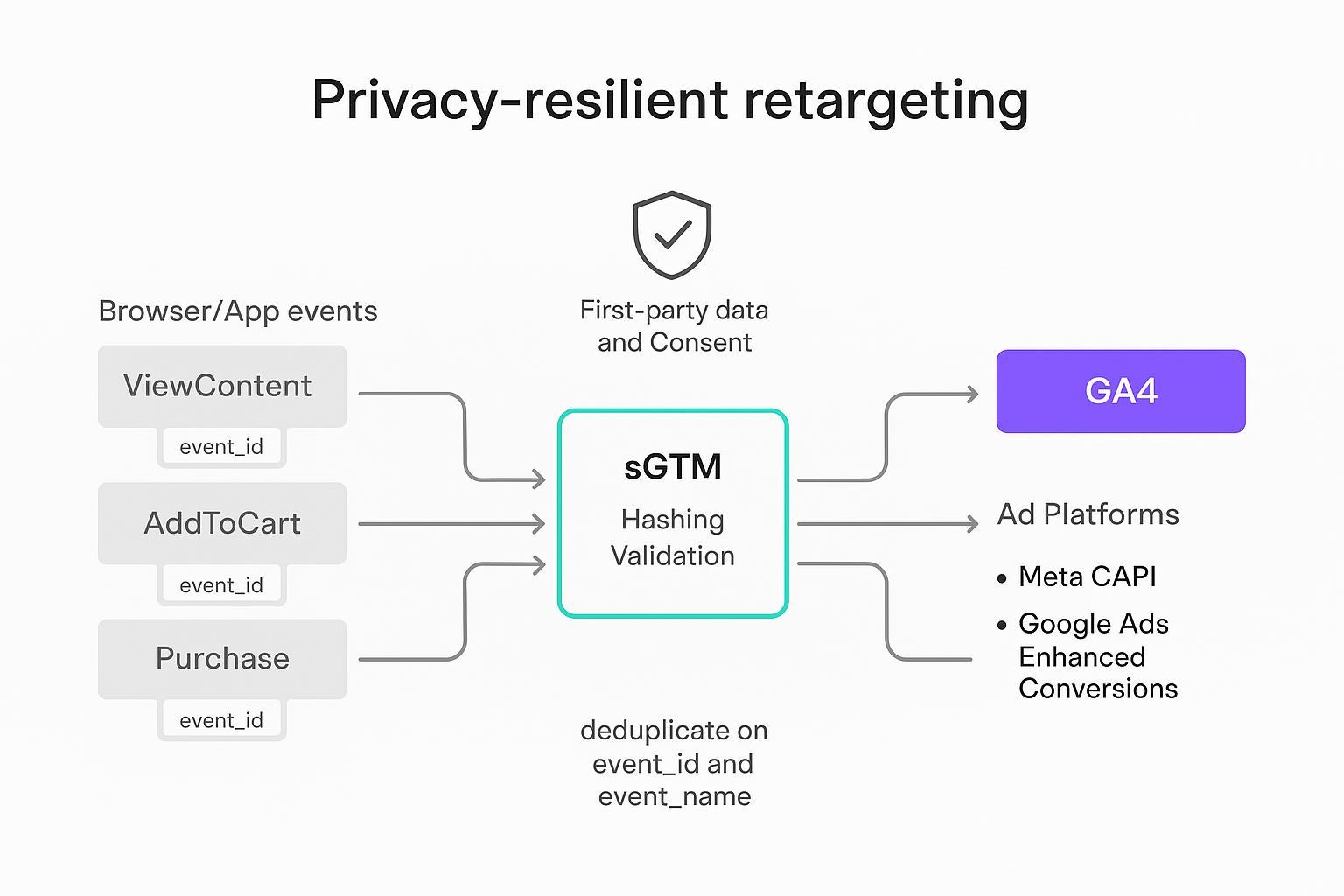
Server‑side to Meta: Use Conversions API with GTM server‑side to send web events alongside browser pixel events and deduplicate on event_name plus a unique event_id. See the Meta guide for the GTM server‑side path and dedup fields: Meta’s GTM server‑side Conversions API guide.
Server‑side routing: Google’s server‑side Tag Manager lets you validate, enrich, and route events to GA4 and other destinations while controlling data leakage. Learn the architectural role and setup approach here: Google’s server‑side Tag Manager overview.
Include hashed first‑party identifiers when consented, enforce consistent event names and event_id keys, and audit data quality weekly. Think of identity and dedup like a postal sorting center: everything needs a legible label to arrive once—and only once.
Optimize to profit and LTV
Retargeting efficiency looks different when you price outcomes by contribution margin or predicted LTV. Map conversion values to net margin where permissible, use audience value adjustments for new vs. existing customers, and let bidding optimize to actual business value. For search and shopping, Google describes how Target ROAS and related value‑based bidding strategies allocate spend toward higher‑value conversions; that same mindset applies to paid social and display once you have reliable values and deduplication in place. See the official overview for mechanics and guardrails: Google Ads Target ROAS explained.
Practical example and next steps
As you operationalize customer journey retargeting, it helps to have one source of truth for multi‑touch attribution and journey views. For a neutral example of how ecommerce teams visualize stages and measure channel ROAS with de‑duplicated windows, see the product overview here: Attribuly product attribution.
Next steps you can take this week:
Finalize your AARRR map, define suppression windows by stage, and brief creative with stage‑specific messages.
Ship server‑side events with event_id and consistent names; verify dedup against browser events and review GA4 attribution settings.
Stand up a holdout on one major retargeting channel; pre‑commit to 60–90 days for a stable lift read.
FAQ
What is the simplest definition of customer journey retargeting
It is stage‑specific retargeting that changes creative, audiences, bids, and suppression by lifecycle step, validated by incrementality and powered by first‑party, server‑side signals.
How is it different from dynamic product ads alone
Dynamic product ads are a powerful tactic inside the Activation and Revenue stages, but journey retargeting adds cross‑stage orchestration, suppression rules, holdouts, and profit‑weighted optimization.
Do I need server‑side tracking to begin
You can start with client‑side pixels, but expect signal loss and data drift. A server‑side pipeline with first‑party identifiers greatly improves event match quality and deduplication durability.
Which single metric should lead my reporting
Lead with incremental conversions or revenue lift by stage. Use iCPA or iROAS derived from those lift reads to compare channels and audiences on equal footing.
Further reading and standards mentioned above
Journey mapping fundamentals for ecommerce stages: Shopify’s ecommerce customer journey maps
Incrementality overview with examples: why incrementality proves marketing’s impact
Practical testing steps and guardrails: incrementality testing basics
Cross‑channel credit configuration reference: GA4 channel credit settings
Meta server‑side dedup path: Meta’s GTM server‑side Conversions API guide
Value‑based bidding mechanics: Google Ads Target ROAS explained