
Customer journey retargeting for e-commerce: definition
Customer journey retargeting: a cross-channel primer using first-party signals and server-side tracking to fix cross-device breaks and improve attribution.
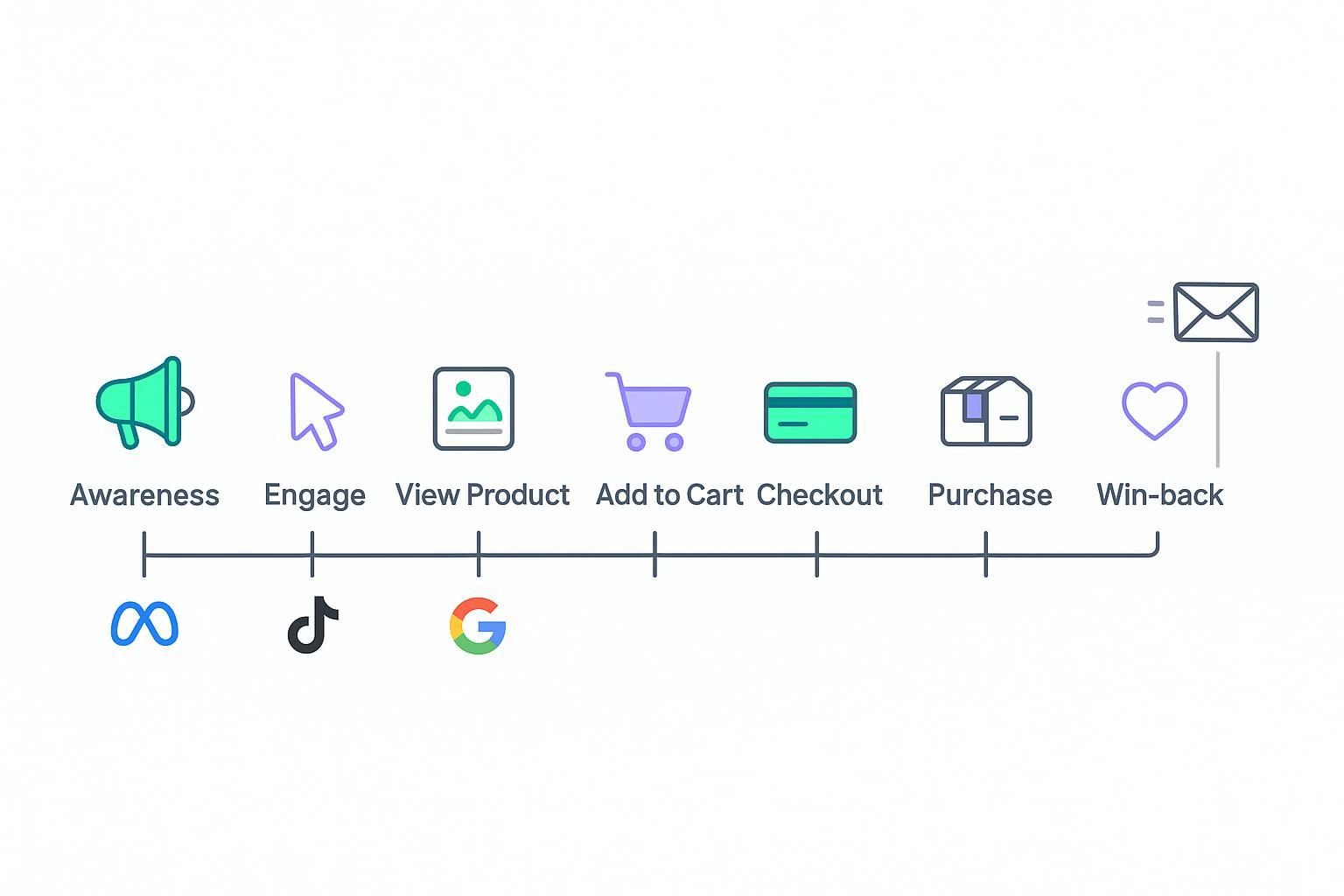
Customer journey retargeting is the coordinated practice of delivering personalized ads and owned-channel messages across the full e-commerce lifecycle—grounded in consented first-party signals—so each touchpoint advances the shopper to the next stage, from awareness and product view to cart recovery, purchase, and loyalty.
Done well, it replaces scattered, channel-only tactics with cross-channel orchestration. It’s built to handle messy, cross-device realities and to measure impact beyond the final click.
Key takeaways
Customer journey retargeting focuses on cross-channel orchestration, not single-channel remarketing.
It’s designed to keep continuity across devices by using first-party identifiers and server-side event forwarding.
Success depends on sequencing, suppression, frequency capping, and multi-touch attribution—without over-relying on cookies.
What is customer journey retargeting?
In plain terms, customer journey retargeting coordinates audiences and messages across paid and owned channels to re-engage shoppers at specific journey stages. The goal is to move someone one step forward—e.g., from product view to add to cart, from checkout start to purchase, and from first-time buyer to repeat buyer.
How is this different from remarketing? Channel-specific remarketing typically runs within a single owned channel (often email/SMS), while customer journey retargeting spans social/display/search and owned channels and uses stage-based logic, unified identity, and cross-channel controls. For a clear discussion of audience intent and terminology, see the Hightouch overview of retargeting vs. remarketing (2024). Industry materials from programmatic providers sometimes blur the distinction, which is why an orchestration-first definition matters; compare with RTB House’s perspective on retargeting and remarketing (2024) and LeadsBridge’s comparison (2025).
The customer journey map we optimize for
Journey-stage retargeting works best when you model the lifecycle clearly. The map below is a simple, e-commerce-specific sequence:
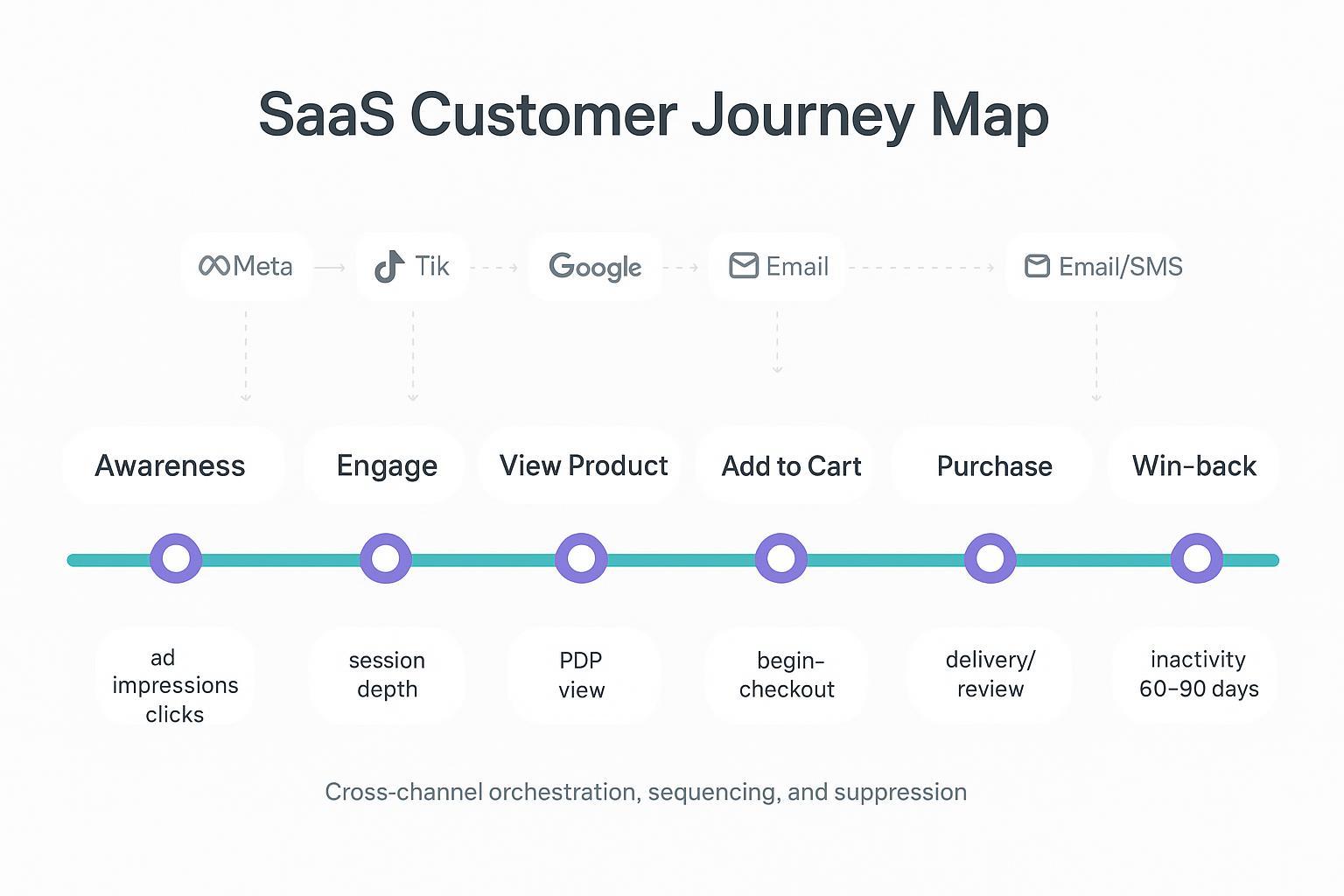
Awareness: discovery via ads or search; signals include impressions and clicks.
Engage: deeper browsing; signals include session depth and PDP visits.
View Product: specific product interest; signals include product detail views.
Add to Cart: strong intent; signals include add_to_cart with item and cart value.
Checkout: initiate payment; signals include begin_checkout and payment information.
Purchase: order completion; signal is purchase.
Post-purchase: delivery, support, reviews; signals include delivery confirmed and review submitted.
Win-back: reactivation of dormant buyers; signals include inactivity over 60–90 days.
Shopify’s journey mapping resources give useful context to stage definitions and mapping practice across retail and e-commerce; see Shopify’s enterprise guide to customer journey maps.
From orchestration to outcomes
Sequencing: decide the order (e.g., social ad touch followed by email for checkout abandoners).
Suppression: remove recent purchasers from retargeting pools to avoid waste.
Frequency capping: control exposure across channels. The IAB Tech Lab’s Identity Solutions Guidance (2024) explains how ID-based approaches enable cross-channel frequency capping; ID-less approaches limit frequency controls to the user-agent and reduce attribution transparency.
How cross-channel orchestration fixes cross-device gaps
Cross-device journeys often break deterministic tracking when identifiers are missing (for example, a user discovers on mobile and buys on desktop). To maintain continuity:
Deterministic identity: collect consented first-party identifiers (hashed email/phone, customer_id). These enable more reliable cross-device matching.
Server-side forwarding: send events from your server to ad platforms alongside browser signals; share event_id between client and server to deduplicate.
Deduplication specifics:
Meta Conversions API: use a shared
event_idbetween Pixel and server events; identifiers inuser_data(e.g., hashed email, external_id) improve matching. See Meta’s original event and deduplication guidance and the omni optimal setup guide.TikTok Events API: combine Pixel + Events API, send hashed match keys, and use shared
event_idto deduplicate client/server events. See TikTok’s Events API overview and matching events guidance.Google Enhanced Conversions: send hashed identifiers to improve conversion measurement in a privacy-safe way; see Google’s Enhanced Conversions documentation.
Consent and compliance: ensure opt-in for expanded marketing/measurement uses and clear notices at collection. The CPRA/CCPA framework emphasizes purpose specificity and user control; consult official guidance such as general notices from the CPPA.
For practical setup tips on identity stitching and deduplication in Shopify, see Shopify cross-device tracking: a beginner’s guide.
Practical example: cart abandonment workflow (neutral)
Disclosure: Attribuly is our product.
Scenario: Add to Cart → Checkout Abandoner
Signals: server-side stream with
event_id,product_id, and cart value; consented email capture.Orchestration: forward deduplicated events to Meta Conversions API and TikTok Events API; sync qualified abandoners to Klaviyo for email/SMS; cap frequency on social retargeting; suppress converters across channels.
Measurement: review assisted conversions across social + email using multi-touch views rather than last-click only.
If you manage Shopify, a practical reference is the Attribuly Shopify integration overview, which explains how product view, add to cart, checkout start, and purchase events can be captured and forwarded for retargeting and measurement.
Multi-touch attribution, briefly
Last-click attribution concentrates 100% of credit on the final interaction, which tends to undervalue journey-stage retargeting that assists earlier in the path. Multi-touch attribution spreads credit across touchpoints, providing a fuller view of impact on ROAS. For definitions from major platforms, see Google’s data-driven attribution glossary and Adobe’s documentation via the Experience League attribution overview.
To validate improvements without overhauling your stack, you can use a short, structured approach like validate multi-touch attribution in 30 days.
Quick setup notes for Shopify/WooCommerce
Event naming: align on common events (page_view, view_item/product, add_to_cart, begin_checkout, purchase). Generate stable
event_idvalues for client and server.Payload consistency: include item IDs, quantities, cart value, and consented identifiers (hashed email/phone) where applicable.
Deduplication checks: verify coverage and dedupe in platform dashboards (Meta Events Manager, TikTok Events Manager). Configure Enhanced Conversions for Google Ads.
Sequencing and suppression: suppress recent purchasers; coordinate owned channels with paid retargeting; apply frequency caps where available.
For consent and first-party data collection specifics, use this practical first-party data checklist for Shopify.
Pitfalls to avoid (and quick checks)
Pixel-only dependence: undercounts conversions and breaks cross-device continuity; add server-side forwarding and hashed identifiers.
Short attribution windows: miss assist value; adopt sensible lookback windows and review assisted conversions.
Model bias and inconsistent credit: compare attribution models; don’t rely on a single view.
Identity fragmentation: prioritize deterministic capture (hashed email/customer_id); implement
event_iddeduplication.Over-frequency and fatigue: cap frequency and suppress converters; monitor relevance and cadence.
Privacy slips: ensure clear consent capture, easy opt-outs, and purpose-specific notices.
Customer journey retargeting helps you move shoppers forward, one stage at a time, across channels and devices. What would change if your retargeting plan guaranteed continuity from product view to purchase—even when the shopper switches devices?
For deeper technical context on cross-device continuity and attribution accuracy on Shopify, review Shopify attribution accuracy and iOS guidance.