
Browse Abandonment vs Cart Abandonment: Different Emails, Different Strategy (2026)
Compare browse abandonment vs cart abandonment emails—triggers, intent, timing, personalization, suppression, and measurement—to pick the right strategy and testing plan.
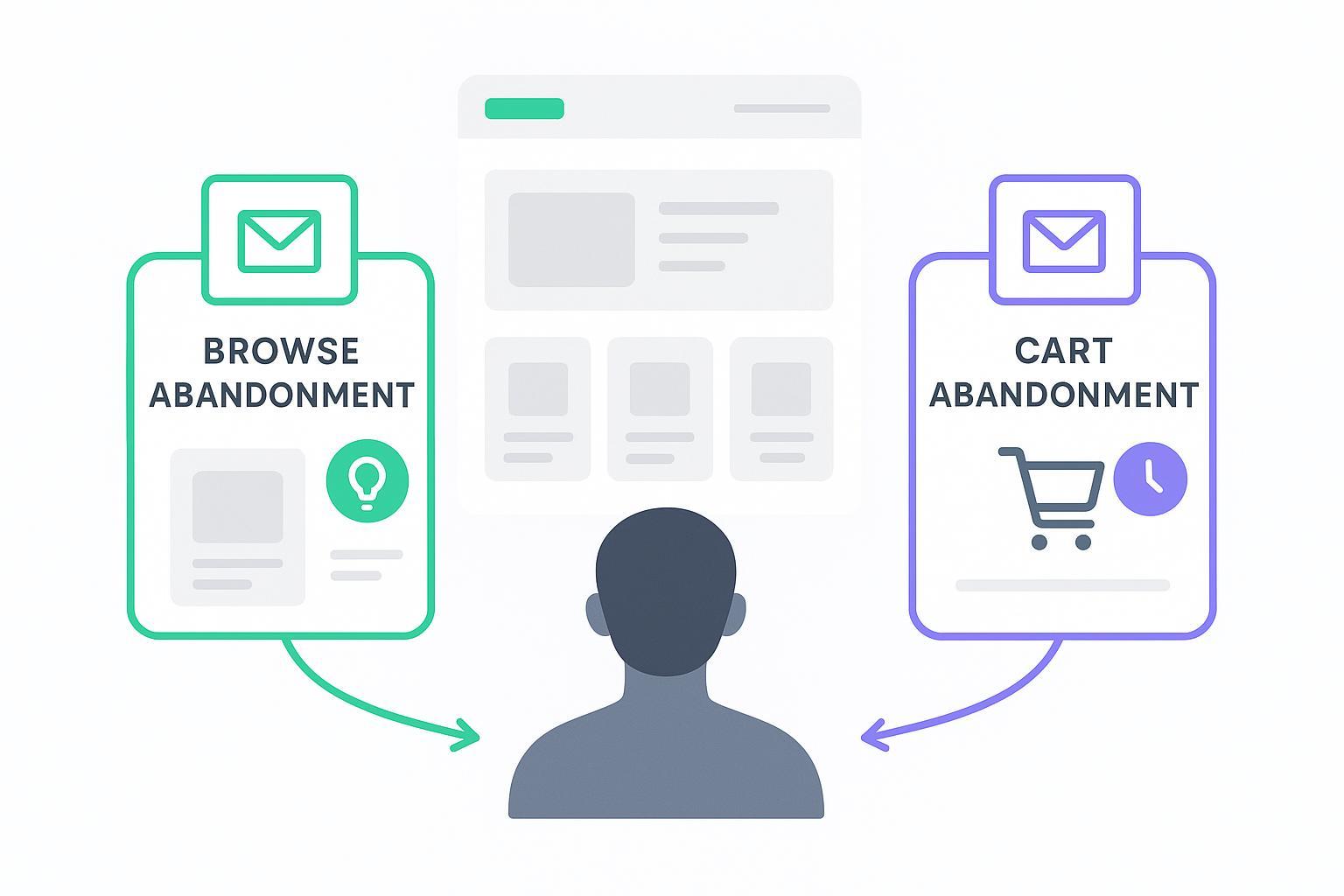
Shoppers leave signals long before and after they click “Add to cart.” Treating those signals the same wastes margin and irritates inboxes. This 2026 guide breaks down browse abandonment vs cart abandonment—two similar‑sounding automations that serve very different jobs—so you can prioritize, design, and measure each with confidence.
Key takeaways
Browse abandonment targets product viewers who didn’t add to cart; tone is educational and light, volume is higher, intent is lower.
Cart abandonment targets shoppers who added to cart or started checkout but didn’t buy; tone is direct, objection‑handling, and sometimes incentive‑backed.
Start timing around 2–4 hours for both, but escalate persuasion more in cart flows; reserve incentives for later touches to protect margins.
Cross‑flow suppression and frequency caps are essential to avoid over‑messaging and attribution confusion.
Identity and event reliability determine whether these flows even fire—server‑side mirroring and clean deduplication materially improve coverage.
Measure success by revenue per recipient and incremental lift, not opens (Apple MPP distorts open rates).
TL;DR verdict with scenario picks
If your average order value is high or the purchase requires more consideration, prioritize cart abandonment first. Its stronger intent signal rewards deeper objection‑handling and, when justified, a late incentive. If your site drives large volumes of casual browsing at low AOV, browse abandonment scales gentle nudges that educate and segment future buyers. In privacy‑constrained environments where client‑side events underfire, stabilize cart first via server‑side event mirroring, then expand browse once match rates improve.
Quick comparison: browse abandonment vs cart abandonment
Two flows, one goal—recovered revenue—with different trigger strength and messaging. Here’s a parity view across the 12 dimensions most teams use to design lifecycle automations.
Dimension | Browse Abandonment Emails | Cart Abandonment Emails |
|---|---|---|
Trigger definition & eligibility | Fires on product views from known subscribers without add_to_cart or checkout. Use “Viewed Product” events; exclude one‑page bounces and non‑consented profiles. | Fires on add_to_cart or started_checkout without purchase. Use “Added to Cart” or “Started Checkout”; ensure checkout events post reliably. |
Intent signal strength | Medium‑low. Many window‑shoppers, early comparison. | High. Clear purchase intent with friction or distraction. |
Cadence & timing windows | Start ~2–4h after view, then +24–48h. Keep a lighter, slower cadence. | Start ~1–4h after abandonment, then +24h, +48–72h with increasing persuasion. See Klaviyo’s 2026 guidance in the abandoned cart best‑practices overview. |
Personalization depth | Last‑viewed product module plus related items; content blocks that educate (fit, sizing, care). | Items left in cart, stock/price reminders, FAQs that remove friction. Dynamic cart blocks recommended. |
Suppression & frequency control | Suppress recent purchasers; pause if a cart email sent within the last 2h; cap daily sends at 1 marketing email. | Suppress once order placed; pause if a browse email just sent; enforce global frequency caps to protect deliverability. |
Incentive governance | Generally avoid incentives early. Use education, social proof, and alternatives. | Consider adding an incentive only on the final touch when margin allows; test holdouts before rolling out. |
Identity resolution & event reliability | Sensitive to anonymous traffic; benefits from server‑side mirroring and identity enrichment to recognize viewers. | Stronger signals but still vulnerable to blocked pixels; server‑side checkout/cart events improve firing reliability. |
KPI framework & measurement | Track revenue per recipient, click‑through, assisted conversions; run periodic holdouts to validate incremental lift. | Track per‑touch revenue per recipient and conversion from clicks; maintain a standing holdout for clean incrementality. |
Attribution & deduplication | Risk of double‑credit with cart/ads. Use shared event stream and dedupe rules. | Same risk; prioritize per‑touch RPR and shared windows to avoid inflation. |
ESP implementation notes | Trigger by “Viewed Product” and segment to consented profiles; test dynamic recommendations. | Trigger by “Started Checkout” or “Added to Cart”; ensure dynamic cart block renders correctly from event payloads. |
Compliance & consent | Treat as direct marketing with opt‑out. For Canada, promotional browse emails require express consent. | Same compliance rules apply; include address and one‑click unsubscribe; honor opt‑outs promptly. |
Best for | Low‑AOV, high‑volume catalogs; content‑led brands; early‑stage segmentation. | High‑AOV or considered purchases; conversion pushes where objection‑handling matters. |
Sources referenced in‑text below: Klaviyo help and benchmark pages (2026), Shopify developer documentation on standard events, Baymard’s multi‑study cart abandonment rate, and deliverability analyses covering Apple Mail Privacy Protection.
Triggers and intent signals
Browse abandonment keys off product views without a subsequent add_to_cart. Cart abandonment keys off add_to_cart or a started_checkout without a purchase. Getting this right sounds trivial; it isn’t. Verify event volumes and definitions in your ESP before launch, and run a full test session to confirm eligibility and exit rules.
Klaviyo documents how flow triggers and filters work and why “Started Checkout” is a common cart trigger; its 2026 best‑practices page positions cart flows among top revenue drivers per recipient. See the guidance in the 2026 update to the abandoned cart overview on Klaviyo’s site.
Shopify’s Web Pixels and standard events let developers subscribe to product_view and add_to_cart and forward them to servers to improve reliability. You don’t need to change your strategy to use these events, but you do need them to fire consistently.
It’s widely observed that cart abandonment audiences convert at higher rates than browse audiences because the intent signal is stronger. Treat that difference as the spine of your messaging: gentle education vs. direct objection‑handling.
For market context, Baymard synthesizes dozens of studies to estimate global cart abandonment around seventy percent. The exact figure isn’t the point—the lesson is that even high‑intent sessions often stall, so small improvements in the highest‑intent cohorts compound quickly.
Cadence, timing, and creative tone
Start both flows around the 2–4 hour mark so the shopping context is still warm. Then diverge:
Browse sequences move slower and stay helpful: fit guides, care tips, price anchors, and related recommendations.
Cart sequences move faster and lean persuasive: social proof near the exact items, answers to shipping/returns questions, and only then—if margins allow—a thoughtful incentive on the final touch.
If you want deeper timing starting points and templates by cohort, see the 2026 timing benchmarks and templates, which expand the 1–4h, +24h, +48–72h pattern with examples.
Personalization and merchandising logic
Personalization amplifies relevance without leaning on discounts. Use dynamic blocks to pull the right items automatically:
In browse flows, display the last viewed product plus a small grid of related items at similar or slightly lower price points. Add copy that reduces uncertainty (fit, materials, how it compares to bestsellers).
In cart flows, render the abandoned items, include a clear CTA back to the cart, and answer the top three objections your support inbox sees. Keep the layout mobile‑first, with large, tappable CTAs and crisp, legible typography.
Klaviyo’s dynamic product blocks pull from event payloads and product feeds; ensure your payloads include the necessary properties for reliable rendering.
Suppression, frequency caps, and compliance
Smart suppression protects deliverability and customer experience. Implement a cross‑flow matrix so the two automations don’t collide.
Example suppression rules in plain language:
Cart flow entry: allow if no purchase since flow start; exclude if received a browse email within the last 2 hours; exit immediately on purchase.
  Browse flow entry: allow for consented profiles with recent product_view; exclude if received a cart email within the last 2 hours or placed an order in the last 7 days; exit on add_to_cart.
  Global caps: target ≤1 marketing email per day per inbox; pause automations for complaint‑risk segments.
Compliance is non‑negotiable. The U.S. CAN‑SPAM law requires truthful headers and subject lines, a physical address, clear unsubscribe, and honoring opt‑outs within 10 business days, per the Federal Trade Commission’s 2026 guidance. Under GDPR/UK GDPR, direct marketing requires a lawful basis (many brands rely on consent) and an easy right to object, as explained by the UK Information Commissioner’s Office. In Canada, the CRTC clarifies that an abandoned cart is not a purchase and does not grant two‑year implied consent; promotional abandonment emails generally require express consent under CASL.
Identity resolution, server‑side events, and reliability
When consent banners, content blockers, or network hiccups hide client‑side signals, flows underfire. Mirroring key events server‑side typically improves firing reliability and makes suppression logic trustworthy.
Shopify’s standard events can be forwarded server‑side so “product_view,” “add_to_cart,” and “started_checkout” reach your ESP even when the browser doesn’t cooperate.
Teams using a unified attribution/identity layer often see better known‑visitor match rates for browse audiences and cleaner deduplication across browse, cart, and paid retargeting. That translates to steadier flow volumes and less over‑messaging.
If you use Attribuly with Shopify and Klaviyo, its integration forwards server‑side product and cart events and syncs identity, which can stabilize abandonment flow triggers and support smarter suppression. Use it as plumbing, not a silver bullet, and validate with your own QA. Learn more in the Attribuly Klaviyo integration overview.
KPIs, attribution, and how to measure incrementality
Open rates are noisy in the Apple Mail era. Focus on outcomes:
Per‑touch revenue per recipient (RPR)
Conversion rate from clicks
Unsubscribe and complaint rates
Incremental lift versus a holdout
Klaviyo supports global holdout groups so you can exclude a stable 5–20% of eligible profiles and measure true incremental revenue from automations, with overrides for essential flows. To go deeper, follow a step‑by‑step method for abandoned cart incrementality that defines windows, budgets, and reporting tables, and that explains how to keep channel deduplication honest.
Attribution discipline matters because both browse and cart flows can claim the same order as paid media. Standardize on shared event streams, consistent post‑click windows, and dedupe rules. Then report RPR by touch alongside incremental RPR from the holdout to avoid mistaking re‑captured demand for net new revenue.
Implementation notes for Shopify and Klaviyo
A quick, practical runbook you can adapt today:
Testing cart flows
Verify “Started Checkout” or “Added to Cart” event volumes in your ESP analytics. Trigger a test session in an incognito window and confirm dynamic cart blocks render correctly from event properties.
Start delays at 1–4h, +24h, +48–72h. Save any incentive for the final touch if margin policy allows.
Testing browse flows
Confirm “Viewed Product” events are captured and associated with consented profiles. Start delays at 2–4h, then +24–48h, and keep the tone helpful.
Add guardrails: pause if a cart email was just sent; exit on add_to_cart or purchase.
Troubleshooting
If flows aren’t firing as expected, audit triggers and recent ESP changes, test event payloads, and confirm frequency caps or segment filters aren’t blocking sends. Server‑side mirroring can reduce silent failures in privacy‑heavy traffic.
Decision tree and a 2‑minute launch checklist
Think of it this way: match effort to signal strength and margin policy. High AOV or complex fit? Prioritize cart with objection‑handling and, when justified, a late incentive. Low AOV with heavy browsing? Use browse to educate and build segments at scale. Privacy‑constrained? Stabilize cart via server‑side event mirroring first, then expand browse once match rates rise.
Two‑minute checklist before you hit “Enable”
Events: product_view, add_to_cart, started_checkout verified in logs; server‑side mirroring on for reliability.
Eligibility: clear trigger filters; exit rules on purchase/add_to_cart set; consented profiles only for browse.
Timing: 2–4h first touch; cart has faster escalation; incentives only on final cart touch if policy allows.
Suppression: cross‑flow mutual exclusions in place; global cap of ≤1 marketing email/day; re‑entry windows defined.
Measurement: per‑touch RPR reporting; standing holdout configured; attribution windows and dedupe rules shared with ads.
FAQ
How soon should I send abandoned cart emails in 2026? Start between 1 and 4 hours after abandonment, then follow at roughly 24 hours and 48–72 hours. This schedule balances recency with attention and aligns with current ESP guidance. Reserve any incentive for the last touch to protect margins.
Which is better for my store: browse abandonment or cart abandonment? Neither universally. Cart tends to win on per‑send ROI because intent is higher; browse wins on volume and upstream segmentation. Use both, but prioritize cart first for fast impact, then add browse to educate and widen the funnel.
Can server‑side tracking improve abandonment flow reliability? Typically yes. When client‑side scripts are blocked, mirroring key events server‑side keeps triggers, exits, and suppressions accurate. Always QA by comparing client versus server event rates over a few weeks.
How do I stop abandonment emails from going to recent buyers? Add exit rules that end the flow on “Placed Order” and global suppressions that exclude recent purchasers (for example, seven days). Cross‑flow mutual exclusions further reduce collisions and complaints.
How do I measure incremental revenue from these flows? Run a persistent holdout (for example, 10%) for eligible profiles and compare revenue per recipient and conversions against the mailed group. Use the same attribution windows across channels and deduplicate to avoid double counting.
Final guidance
Design around intent and identity. Cart abandonment leans persuasive and surgical; browse abandonment builds relevance and future demand. Stabilize your event stream, add cross‑flow suppression, and judge success by per‑touch RPR and incremental lift. Do that consistently and both flows will feel helpful to customers—and profitable to you.
References and further reading cited in this article
Klaviyo’s abandoned cart best‑practices overview (updated 2026) outlines timing patterns and why cart flows drive high RPR: https://www.klaviyo.com/blog/abandoned-cart-email
Klaviyo’s help on dynamic blocks in flow emails (2026) explains rendering cart and browse modules from event payloads: https://help.klaviyo.com/hc/en-us/articles/4408802597659
Shopify developer documentation on building web pixels and standard events (2026) details product_view and add_to_cart capture and server forwarding: https://shopify.dev/docs/apps/build/marketing-analytics/build-web-pixels
Baymard’s cart abandonment rate compilation (2025) provides multi‑study context for abandonment prevalence: https://baymard.com/lists/cart-abandonment-rate
Litmus’s resources on Mail Privacy Protection and email client share (2026) describe why opens aren’t reliable for success metrics: https://www.litmus.com/blog/email-analytics-for-mail-privacy-protection
Related Attribuly resources
Abandoned Cart Timing Benchmarks and Templates (2026): https://attribuly.com/blogs/abandoned-cart-timing-cohort-benchmarks-templates/
How to Measure Abandoned Cart Incrementality Step by Step (2026): https://attribuly.com/blogs/measure-abandoned-cart-incrementality-step-by-step/
Klaviyo Integration Overview for Server‑Side Events and Identity Sync: https://attribuly.com/integrations/klaviyo/