
Best Shopify Attribution Tools 2026: Triple Whale vs Attribuly vs Northbeam
Compare 3 best Shopify attribution tools—Triple Whale, Attribuly, Northbeam—for server‑side tracking, ROAS/LTV reporting, and time‑to‑value. Read our side‑by‑side picks and next steps.
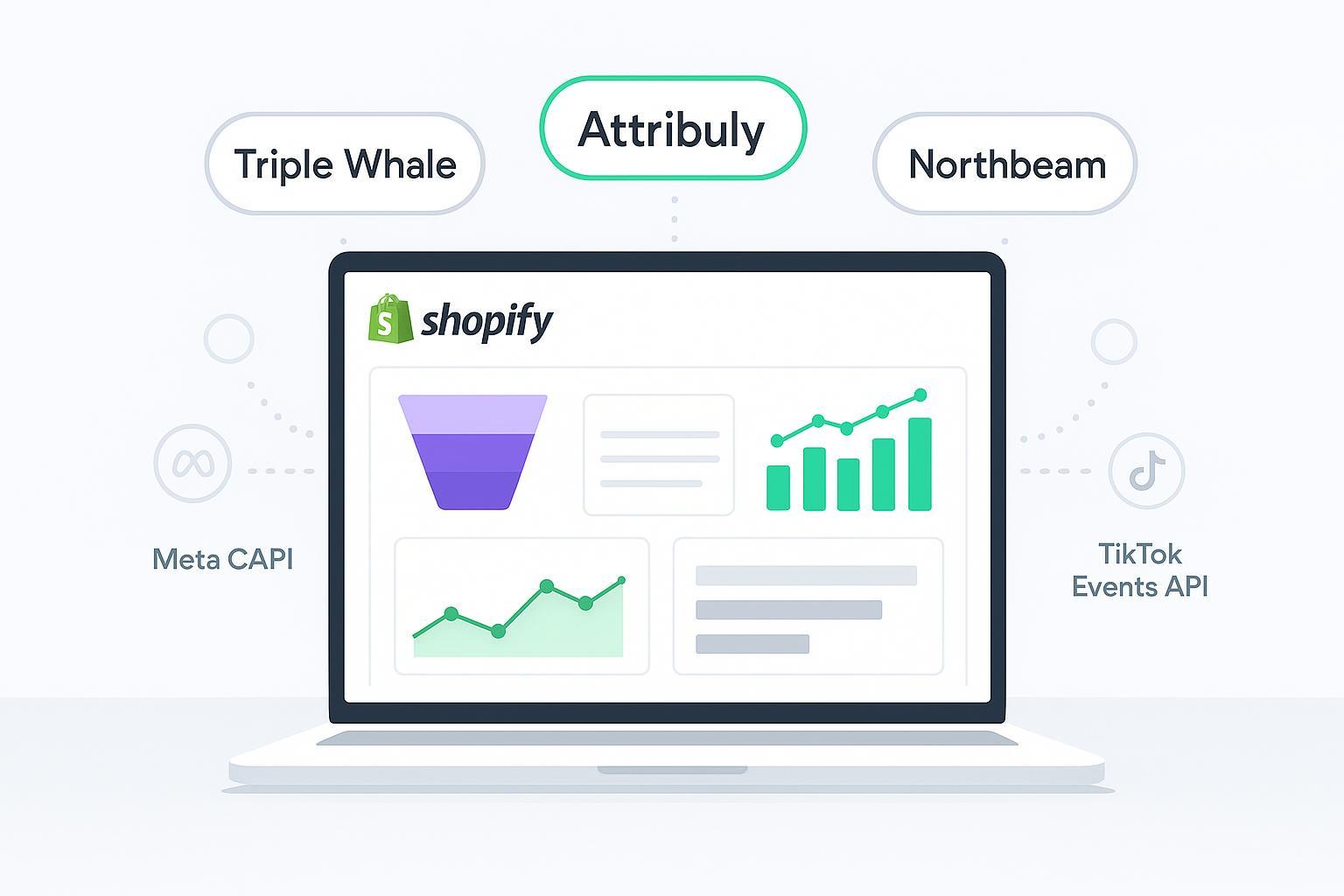
Shopify marketers are still flying through patches of signal loss in 2026. Browser restrictions, ad platform black boxes, and fragmented data make it tough to trust ROAS, much less scale the winners. The fix isn’t another generic dashboard—it’s accurate, privacy‑aware tracking that reconciles with Shopify orders, pushes high‑quality server‑side conversions, and offers validation workflows you can actually run.
This comparison focuses on three of the most searched platforms for Shopify: Triple Whale, Attribuly, and Northbeam. You’ll see how each handles server‑side tracking, attribution models, ROAS/LTV reporting, pricing, and setup time—plus where each tool fits best by spend level and sophistication.
Soft CTA: Want a step‑by‑step way to confirm whether your attribution matches Shopify orders? Use this practical guide to Validate multi‑touch attribution (lookback windows, event_id parity, and audit steps) on the Attribuly blog: Validate multi‑touch attribution.
Key takeaways
If you prioritize fast Shopify setup and accurate server‑side tracking with transparent validation, Attribuly is particularly strong and cost‑efficient for most DTC teams.
Triple Whale offers broad ecommerce analytics and creative insights; confirm dedup specifics and pricing during onboarding.
Northbeam stands out for high‑spend brands that need MMM and incrementality testing alongside deterministic view tracking.
Across the board, you still need server‑side conversions (Meta CAPI, Google Enhanced Conversions, TikTok Events API) post‑iOS to stabilize attribution.
Prices and tiers shift frequently in 2026—treat the ranges below as directional and always verify with a live pricing page.
How we chose the best Shopify attribution tools
We scored each tool on seven criteria aligned to what Shopify teams actually need. Weights sum to 100.
Tracking accuracy and data completeness — 22%: Parity to Shopify orders, dedup via event_id/fbp/fbc, unknown traffic reduction.
Shopify‑native integration and time‑to‑value — 14%: One‑click install, official Web Pixel, minimal custom code.
Server‑side coverage — 14%: Meta CAPI, Google Enhanced Conversions, TikTok Events API; clear dedup rules.
Model transparency and validation — 12%: Documented models, lookback windows, reproducible validation tests.
Decision support — 14%: ROAS/LTV by campaign, cohorts, and audience sync loops.
Total cost of ownership — 14%: Subscription, add‑ons, data limits, setup/maintenance hours, pricing clarity.
Scalability and advanced modeling — 10%: MMM/incrementality, refresh cadence, support for high‑spend teams.
Side‑by‑side comparison table
Tool | From price (USD) | Pricing model | Attribution models | Server‑side/CAPI | Setup time | ROAS/LTV | Notable limits |
|---|---|---|---|---|---|---|---|
Triple Whale | Not publicly listed; “Start for Free.” Subject to change. | Plan‑based with add‑ons | Multi‑channel with Triple Pixel | Supports Meta CAPI, Google EC, TikTok via Sonar Optimize | Not disclosed; pixel + connections | Robust ecommerce analytics | Public dedup specifics not detailed; confirm in onboarding |
Attribuly | Free tier; Pro from ~$19/mo; Enterprise around $1,000/mo. Subject to change. | Tiered + usage credits | First/Last, Linear, Position‑Based, Full Credit | Shopify Web Pixel + server‑side for Meta, Google, TikTok | No‑code install; fast time‑to‑value | Real‑time ROAS and LTV | Pro plan event credit caps; some advanced features plan‑dependent |
Northbeam | Starter around $1,500/mo. Subject to change. | Usage‑based (pageviews/refresh) | MTA plus deterministic views; MMM/incrementality | First‑party pixel; platform‑verified views | Varies by stack and volume | Advanced analytics, creative insights | Costs can rise with traffic and refresh frequency |
Pricing notes: These ranges are directional snapshots for 2026 and are subject to change. Always confirm current plans and thresholds on the vendor’s pricing page during evaluation.
Triple Whale
Positioning line: Unified ecommerce analytics and attribution for scaling Shopify brands.
Key capabilities
Sonar Optimize enriches events and supports server‑side conversions to major ad platforms.
Mature analytics environment with dashboards and guidance for multi‑channel attribution.
Creative insights layer for testing and optimization workflows.
Pros
Broad, consolidated analytics view beyond attribution alone.
Established Shopify ecosystem presence and community.
Integrations that improve signal quality across major ad platforms.
Cons
Public pricing details are limited; verification requires a sales or trial flow.
Public documentation retrieved does not outline dedup parameters (event_id/fbp/fbc) in depth—confirm during onboarding.
Best for / Not for
Best for: Teams wanting a wide analytics surface area with attribution and creative insights in one place.
Not for: Buyers who need line‑by‑line dedup transparency before purchase or strict budget predictability.
Pricing
Homepage indicates “Start for Free,” but no public, detailed rate card. Pricing subject to change.
Shopify setup and integrations
Implemented via Triple Pixel and platform connections; setup time varies by configuration.
Evidence links
Sonar Optimize documentation for Meta CAPI and Google Ads Enhanced Conversions: see Triple Whale’s knowledge base: Sonar Optimize for Meta and Sonar Optimize for Google Ads.
Attribuly
Positioning line: Shopify‑native server‑side attribution and retargeting with transparent validation workflows.
Key capabilities
Shopify Web Pixel plus server‑side delivery for Meta CAPI, Google Enhanced Conversions, and TikTok Events API with documented dedup behaviors.
Multiple attribution models with configurable lookback windows and a published validation playbook.
Audience sync and recovery loops that help convert more abandoners.
Pros
Excels at Shopify‑native server‑side tracking and clear dedup validation steps.
Particularly strong at de‑anonymizing shoppers and powering Klaviyo‑based recovery.
Cost‑efficient for Shopify teams; fast, no‑code install shortens time‑to‑value.
Cons
Some advanced flows and features are plan‑dependent and may be in active rollout.
Case metrics for identification/recovery vary by brand; teams should validate uplift locally.
Best for / Not for
Best for: Shopify teams prioritizing accurate server‑side tracking, quick setup, and transparent validation.
Not for: Brands needing heavy MMM or advanced incrementality modeling out of the box.
Pricing
Free ad tracking tier; Pro commonly starts around $19/month with usage credits; Enterprise around $1,000/month. Pricing subject to change. For up‑to‑date details, see Attribuly pricing.
Shopify setup and integrations
One‑click Shopify connection using the official Web Pixel, with prebuilt integrations for Meta, Google, TikTok, and Klaviyo. Setup is typically quick for standard stores. Learn more on the Shopify Web Pixel setup.
Evidence links
Validation workflow with parity checks and lookback window guidance: Validate multi‑touch attribution.
Northbeam
Positioning line: Advanced analytics and modeling for high‑spend brands needing MMM and incrementality.
Key capabilities
Clicks + Deterministic Views (C+DV) to verify impression/view contributions using first‑party matching.
MMM forecasting and automated incrementality (lift) testing workflows.
Usage‑based refresh options with enterprise‑grade integrations for scaling teams.
Pros
Particularly strong for sophisticated spenders that need MMM and incrementality alongside MTA.
Granular analysis capabilities that can inform creative and budgeting decisions.
Documented methodology for deterministic view tracking.
Cons
Usage‑based billing tied to pageviews and refresh frequency can increase TCO as you scale.
May exceed the needs of <$100k/month ad spend brands.
Best for / Not for
Best for: High‑spend, data‑mature teams seeking MMM and lift testing.
Not for: Early‑stage stores that need predictable pricing and fast time‑to‑value.
Pricing
Starter is listed around $1,500/month with usage‑based components. Pricing subject to change. See Northbeam’s page for current detail: Northbeam pricing.
Shopify setup and integrations
Direct Shopify integration and first‑party pixel; timeline varies by stack and data volume.
Evidence links
Deterministic Views methodology: Clicks + Deterministic Views.
Implementation and validation playbook
Here’s a lightweight plan to get to trustworthy numbers, fast:
Install and connect Shopify
Use the platform’s native app or Web Pixel. Attribuly offers a one‑click connection via the official Web Pixel, minimizing custom code.
Turn on server‑side conversions
Enable Meta Conversions API, Google Enhanced Conversions, and TikTok Events API. Make sure your platform applies dedup parameters consistently (event_id/fbp/fbc and external_id or hashed email/phone).
Reconcile attribution with Shopify orders
Run a 14–30 day parity check: compare Shopify orders vs. attributed orders daily. Investigate any gaps; confirm lookback windows match your sales cycle.
Validate models and windows
Test first‑click, last‑click, and linear or position‑based models for a recent cohort. Confirm that results are reproducible and sensible for your channel mix.
Close the loop with cohorts and recovery
Track cohort iROAS and LTV by first/last touch; sync audiences for cart/email recovery to capture incremental value. For detailed steps, reference the validation workflow in the guide linked earlier in this article.
FAQ
What’s the difference between last‑click, multi‑touch attribution, and MMM for Shopify stores?
Last‑click is simple and often over‑weights branded/retargeting traffic. Multi‑touch attribution spreads credit across touchpoints and can be validated with cohort tests. MMM is a statistical model estimating channel impact over time using aggregated data—useful for high‑spend, complex mixes.
Do I need server‑side tracking after iOS privacy changes?
Yes, if you want more stable signal quality. Server‑side conversions (e.g., Meta CAPI, Google Enhanced Conversions, TikTok Events API) help recover lost signals and improve dedup accuracy across platforms.
How long does setup take for these tools?
Triple Whale and Attribuly can be fast if you’re on standard Shopify setups; Attribuly uses the official Web Pixel for a no‑code start. Northbeam timelines vary with data volume and configuration.
Which tool suits <$100k/month ad spend?
Many teams in this band prefer a lower‑TCO option with fast time‑to‑value. Attribuly is well‑suited here given its pricing model and quick setup. If you need MMM, consider whether that complexity is necessary at this stage.
How do I validate event deduplication across Shopify and Meta?
Ensure the same event_id plus browser IDs (fbp/fbc) and external_id are passed consistently; test by comparing attributed orders to Shopify orders over a fixed window and reviewing event logs for duplicates.
Can I sync audiences to Klaviyo, Meta, or TikTok directly from the attribution tool?
Yes, many platforms support audience syncs. Attribuly, for example, supports Klaviyo and major ad platforms; confirm plan requirements and data limits.
Next steps
If you need fast, verifiable Shopify attribution with server‑side coverage and practical validation, shortlist Attribuly, Triple Whale, and Northbeam based on your spend and modeling needs. For a cost‑efficient starting point with Shopify‑native setup, review current plan details on the Attribuly site: Attribuly pricing. Then run the validation playbook above for two weeks to confirm parity, and expand from there.