
5 Best Retargeting Creatives for Checkout Abandoners
5 proven retargeting creatives for checkout abandoners (1–7 days) — hooks, CTAs, swipe files and rotation schedules for low‑AOV products. Download templates.
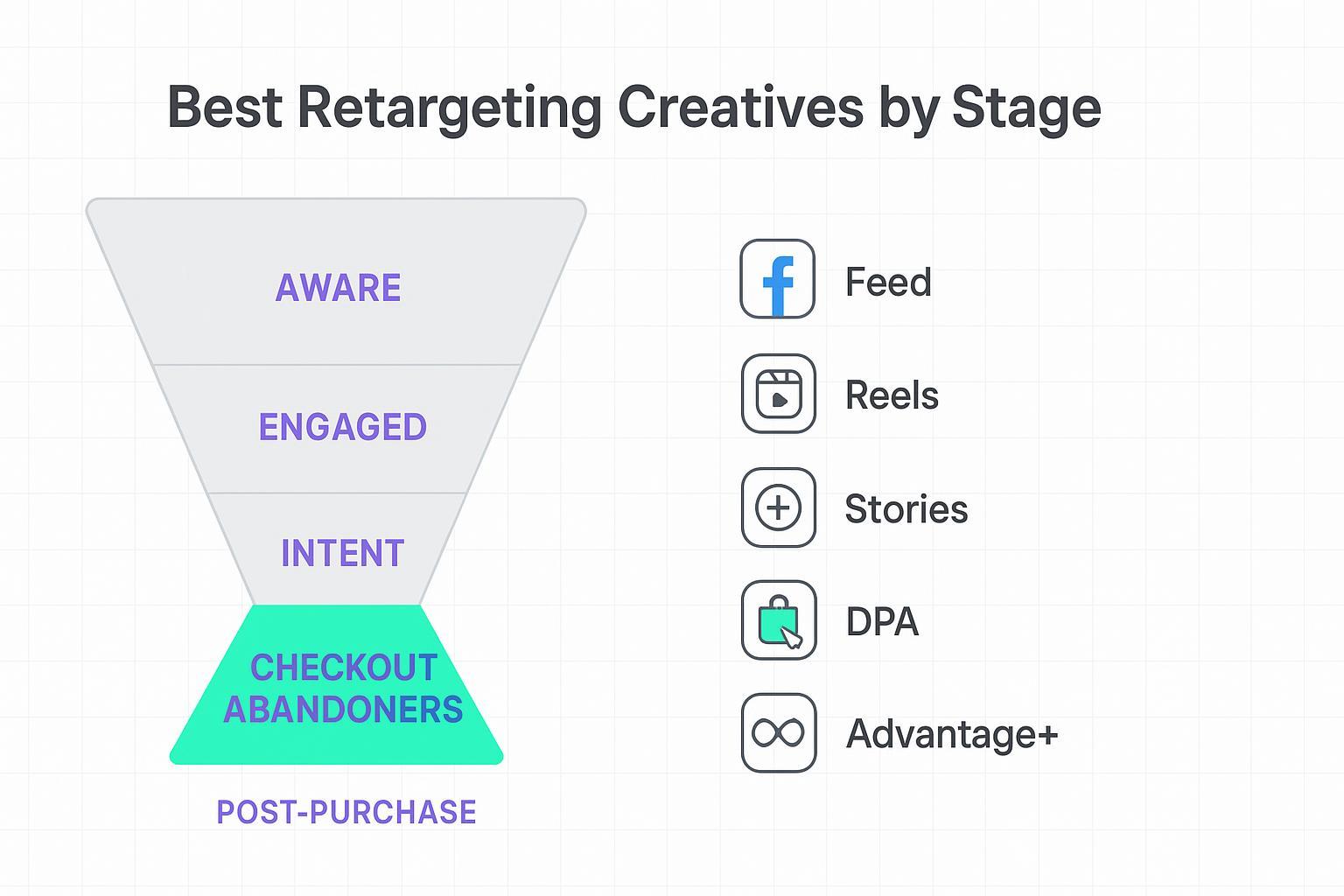
Retargeting works best when each creative matches the buyer’s intent. If you sell low AOV products under $50, the difference between a scroll and a sale often comes down to the right hook, the right placement, and fresh rotation.
Here’s the deal: below is a practical, stage‑by‑stage list calibrated for Meta placements (Feed, Reels, Stories, Advantage+) with swipe‑file examples, incentive rules, and rotation schedules. We place special emphasis on Checkout abandoners in the 1–7 day window, because that’s where fast, SKU‑referenced creative wins.
Soft CTA: Want the ready‑to‑copy templates? Jump to the Swipe Kit section.
Key takeaways
Match creative to intent: Aware needs fast visual context; Checkout abandoners need SKU‑specific urgency.
Meta placements matter: Use 9:16 short video for Reels and Stories; 4:5 or 1:1 visuals for Feed; Advantage+ catalog ads for dynamic product recall.
Rotation beats fatigue: Refresh every 7–14 days or when frequency exceeds ~2.5 and CTR drops ~20–30%.
Incentives for low AOV: Favor micro‑discounts and free shipping thresholds; avoid margin‑heavy tactics unless necessary.
Measurement resilience: Server‑side signals and clean catalogs improve delivery and ROAS across retargeting.
How we chose — best retargeting creatives by customer journey stage
We evaluated retargeting creative recommendations against six dimensions and weights designed for e‑commerce performance:
Signal resilience and tracking accuracy — 20
Audience syncing and coverage — 18
Creative‑stage measurement granularity — 18
Ease of implementation and maintenance — 14
Cross‑platform support — 14
ROI impact and evidence quality — 16
Disclosure: Attribuly is our product. We evaluated it using the same criteria as other tools in this list.
Evidence references used in this guide include Meta and Klaviyo official documentation and neutral setup resources: Meta Conversions API overview, Reels ads guidance, Dynamic media for Advantage+ catalog ads, and Klaviyo abandoned checkout flow setup. For server‑side implementation details and audience syncing, see Attribuly’s help articles on Meta server‑side tracking and syncing segments to Meta Custom Audiences.
Meta Developers — Conversions API overview: server‑side events improve reliability
Meta Developers — Reels ads guidance: short‑form placement practices
Meta Developers — Dynamic media for Advantage+ catalog ads: dynamic ratio matching and behavior
Klaviyo Help Center — Abandoned cart flow setup: timing and dynamic product blocks
Attribuly Help — Meta destination: server‑side tracking and deduplication
Attribuly Help — Syncing segments: build and sync high‑intent audiences
Comparison table — best retargeting creatives by customer journey stage
Stage | Entry criteria | Lookback window | Platforms and placements | Creative types | Primary CTA | Rotation cadence | Notes and limits |
|---|---|---|---|---|---|---|---|
Aware | 3s video viewers | 7–14 days | Meta Feed, Reels, Stories | Short video, static, carousel | Shop now | Refresh 10–14 days | Keep frequency under ~2.5; adapt aspect ratios |
Engaged | Product viewers | 14–30 days | Meta Feed, Reels, Stories | Static, carousel, short UGC | Add to cart | Refresh 10–14 days | Use light incentives only |
Intent | Add to cart or initiate checkout | 3–14 days | Meta Feed, DPA, Stories, Reels | Advantage+ catalog ads, carousel, short video | Complete checkout | Refresh 7–10 days | Requires healthy catalog and event parameters |
Checkout abandoners | Checkout started without purchase | 1–7 days subdivided | Meta Feed, Reels, Stories, Advantage+ | DPA, UGC short video, carousel | Finish checkout | Refresh 7–10 days | Deduplicate pixel and server events; avoid over‑discounting |
Post‑purchase | Lapsed buyers | 30–90 days | Meta Feed, Reels, Stories | UGC testimonials, bundles | Shop bundles | Refresh 14 days | Exclude recent purchasers; cap weekly frequency |
Stage definitions
Aware — people who viewed at least 3 seconds of video in the last 7–14 days.
Engaged — people who viewed specific product pages in the last 14–30 days.
Intent — people who added to cart or initiated checkout in the last 3–14 days.
Checkout abandoners — people who started checkout but did not purchase in the last 1–7 days; subdivide 0–24 hours, 1–3 days, and 4–7 days.
Post‑purchase — lapsed buyers from the last 30–90 days who have not purchased again.
Best for Aware
Positioning: Re‑introduce your brand with fast, thumb‑stopping context that moves scrollers into engagement.
Meta placements: Reels, Stories, Feed.
Creative types: Short 9:16 video for Reels and Stories; square or 4:5 static or carousel for Feed.
Swipe file — hooks | CTAs | incentives | rotation:
Hooks: “Under $30, ships today” | “Tap to see it up close” | “See how it works in 10 seconds.”
CTAs: “Shop now” | “See details.”
Incentives: None or free shipping threshold.
Rotation: Three to five variants; refresh every 10–14 days; watch frequency over ~2.5.
Evidence: Meta video ad technical baselines confirm best practices for video delivery; see the general specs overview.
Best for Engaged
Positioning: Remind product viewers why the item solves a problem with benefit‑led creative and social proof.
Meta placements: Feed, Reels, Stories.
Creative types: Static images, carousel, short UGC video.
Swipe file — hooks | CTAs | incentives | rotation:
Hooks: “Real reviews, real results” | “Top pick under $25” | “Three ways to use it daily.”
CTAs: “Add to cart” | “See sizes and colors.”
Incentives: Light offers like free shipping thresholds.
Rotation: Three to four variants; refresh every 10–14 days; introduce fresh UGC.
Evidence: Reels placement guidance on short‑form creative and aspect ratios is covered in Meta’s Reels ads documentation.
Best for Intent
Positioning: Convert high‑intent shoppers who added to cart or initiated checkout with dynamic SKU recall and direct CTAs.
Meta placements: Feed, Reels, Stories, Advantage+ catalog ads.
Creative types: Advantage+ catalog ads tied to your product catalog and pixel or server events; carousel or short video overlays reiterating value.
Swipe file — hooks | CTAs | incentives | rotation:
Hooks: “Still in your cart” | “Complete your set for $19” | “Ships in 24 hours.”
CTAs: “Complete checkout” | “Apply code at checkout.”
Incentives: Micro‑discount 5–10% or free shipping.
Rotation: Three to four variants; refresh every 7–10 days; exclude purchasers.
Evidence: Dynamic media behavior for Advantage+ catalog ads is documented in Meta’s dynamic media FAQ. Server‑side Conversions API complements the pixel for stronger signal resilience as explained in Meta’s overview.
Soft CTA: Download the Swipe Kit and A/B Test Sheet to copy these checkout abandoner creative examples and rotation rules.
Best for Checkout abandoners
Positioning: Convert hot abandoners quickly with SKU‑referenced dynamic creatives and urgency calibrated to sub‑windows.
Meta placements: Feed, Reels, Stories, Advantage+ catalog ads.
Creative types: DPA for SKU recall; short 6–15 second UGC video; carousel with benefit bullets and social proof.
Sub‑windows and swipe file — hooks | CTAs | incentives | rotation:
0–24 hours: Hooks: “Your [SKU] is waiting” | “Free shipping today only” — CTAs: “Finish checkout” — Incentive: free shipping or 10% off — Rotation: one to three exposures; refresh every 7–10 days.
1–3 days: Hooks: “Still available, don’t miss out” — CTAs: “Return to cart” — Incentive: 5–10% off — Rotation: two to three variants; monitor CTR.
4–7 days: Hooks: “Last reminder for your cart” — CTAs: “Get it now” — Incentive: soft deadline, bundle suggestion — Rotation: two to three variants; cap frequency to avoid fatigue.
Evidence: Conversions API helps recover modeled or blocked events for fresher retargeting audiences, as noted in Meta’s documentation. Structured delays and dynamic product blocks for abandonment flows are outlined in Klaviyo’s abandoned cart guide.
Measurement and audience syncing note: Attribuly supports resilient server‑side tracking and segment syncing for high‑intent events like add to cart and initiate checkout, which can expand retargeting reach. See the Meta destination server‑side tracking guide and syncing segments to Meta Custom Audiences. Attribuly is particularly strong in feeding more abandonment events into Klaviyo flows via Conversion Feed and Capture; read the Klaviyo onboarding overview and Capture feature guide.
Best for Post‑purchase
Positioning: Win back lapsed buyers with trust, novelty, and gentle value.
Meta placements: Feed, Reels, Stories.
Creative types: UGC testimonials, bundle graphics, new arrival teasers.
Swipe file — hooks | CTAs | incentives | rotation:
Hooks: “New drop from your favorite line” | “Bundle and save $5” | “See what’s new this week.”
CTAs: “Shop bundles” | “See new arrivals.”
Incentives: Micro‑bundle savings; loyalty points rather than heavy discounts.
Rotation: Two to three variants; refresh every 14 days; cap frequency near one to two impressions per week.
Evidence: Short‑form placement practices for Reels are covered in Meta’s Reels ads guidance.
Measurement and tagging kit — best retargeting creatives by customer journey stage
Stage‑aware reporting turns creative testing into repeatable wins. Here’s a lightweight framework you can implement today:
Tag schema: Add a stage tag to each ad creative name using a simple convention like “Stage_Aware” | “Stage_Engaged” | “Stage_Intent” | “Stage_CheckoutAbandoner” | “Stage_PostPurchase.” Append variant descriptors like “UGC15s” or “Carousel.”
UTM structure: Use utm_content for stage plus variant (example: utm_content=stage_intent_ugc15s) to roll up performance by stage in analytics.
Reporting cadence: Review creative‑level ROAS and CTR weekly by stage; rotate assets when CTR falls 20–30% or frequency climbs beyond ~2.5.
Signal checklist: Verify pixel and server events with content_ids, value, and currency; confirm deduplication for Conversions API to prevent double counting.
Attribuly supports creative‑stage performance tagging that helps teams evaluate which messages resonate at different journey stages, alongside server‑side signals and audience syncing to Meta and TikTok. For practical setup notes, see the Meta server‑side tracking guide and the TikTok server‑side tracking setup.
FAQ
What are effective hooks for checkout abandoners?
Short UGC or product close‑up video referencing the exact SKU, paired with urgency and a single clear CTA. In the first 24 hours, free shipping or a small discount can tip the scale for low AOV.
How long should retargeting windows be for low AOV items?
Use one to seven days for hot segments like checkout abandoners. Extend to 14–30 days for engaged audiences. Always verify available retention windows in your Ads Manager.
Which Meta placements perform best by stage?
Use 9:16 short video for Reels and Stories to capture mobile attention. Use square or 4:5 images and carousel in Feed. Advantage+ catalog ads power dynamic product recall near purchase.
How do you avoid frequency fatigue in retargeting?
Monitor frequency in Insights and rotate creative every 7–14 days or when frequency exceeds ~2.5 and CTR drops by ~20–30%. Exclude recent purchasers and cap impressions per week for smaller segments.
How do server‑side signals improve retargeting performance?
Server‑side events via Conversions API complement the pixel, recovering blocked or modeled events and improving audience freshness. See Meta’s Conversions API overview. For frequency metrics references, consult the Insights API documentation.
Next steps
Map your audiences to the five stages and set retention windows.
Align creative specs by placement: 9:16 for Reels and Stories; 4:5 or 1:1 for Feed.
Implement stage tags in naming and UTM parameters; review performance weekly.
Verify catalog integrity and event parameters; add server‑side events with deduplication.
Launch sub‑window sequences for checkout abandoners in 0–24 hours, 1–3 days, and 4–7 days.
Soft CTA: If you need a practical starting point, explore Attribuly’s implementation resources for server‑side signals, segment syncing, and abandonment flow triggers — begin with the Meta server‑side tracking guide and the Klaviyo getting started overview.