
Audience Segmentation Checklist for Journey Retargeting
Practical checklist of if/then rules, recency windows, category/SKU depth and exclusions for Meta CAPI + Shopify retargeting to maximize in‑quarter ROAS and control CAC.
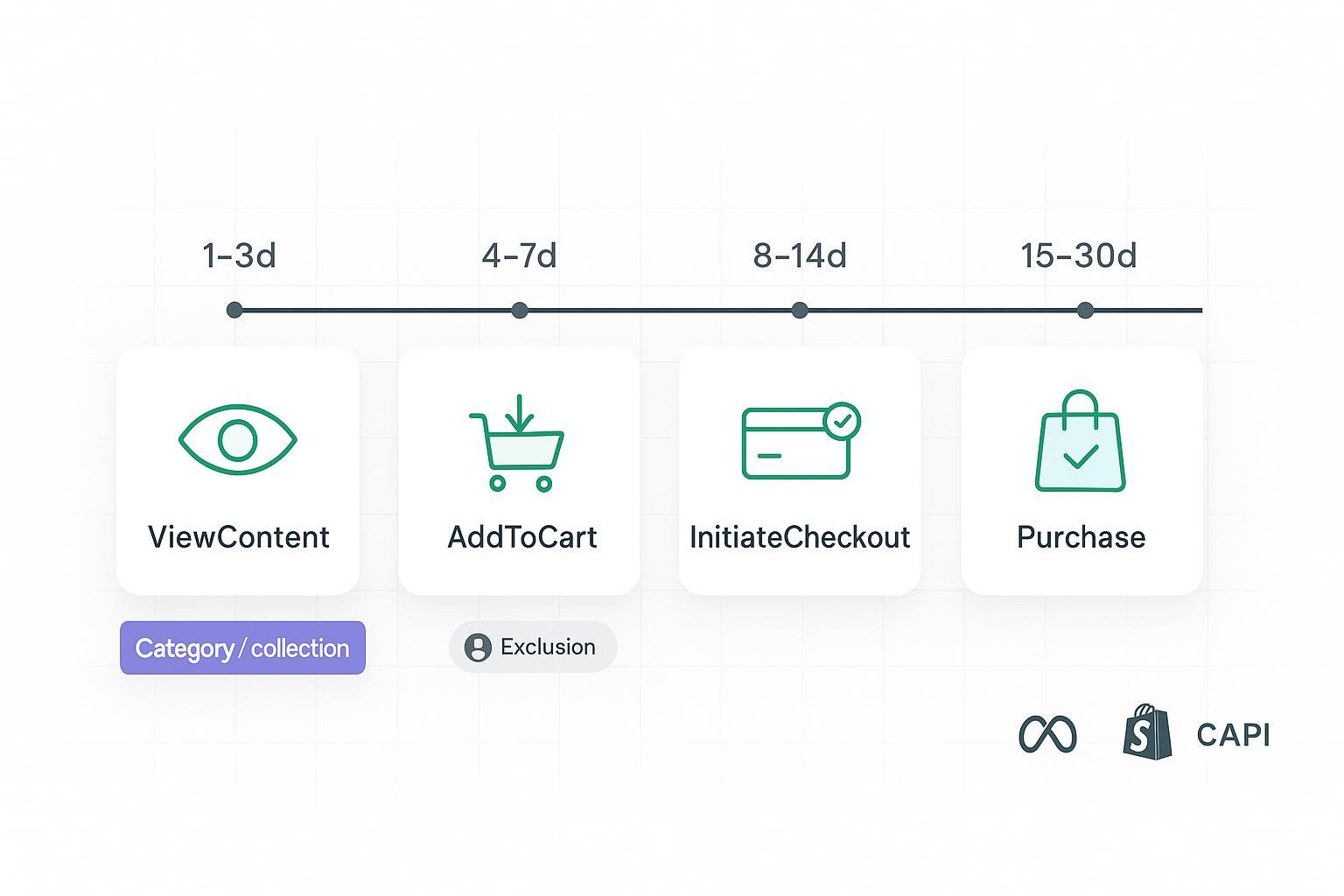
You don’t need more audiences—you need the right audiences. This checklist gives you reproducible, if/then audience segmentation retargeting rules for Meta using Shopify first‑party events via Conversions API (CAPI). It’s tuned for AOV $50–$150 and optimized to maximize in‑quarter ROAS while controlling CAC. Copy the rules, apply the recency windows, and enforce exclusions that keep spend efficient.
Key takeaways
Build audiences from high‑fidelity events (Pixel + CAPI with dedup) and monitor Event Match Quality (EMQ) to keep reach and accuracy high.
Use short recency windows for hot intent (1–3, 3–7 days), mid for warm (8–14), and longer for cool (15–30), matched to a $50–$150 AOV.
Enforce value and depth thresholds (cart value ≥ $50, repeat views, item_count) to filter noise and protect CAC.
Segment by category/SKU and maintain burn windows for purchasers and discount claimants; suppress CX risks.
QA weekly: EMQ, dedup, size/overlap, frequency, CTR/CVR; adjust windows and caps to hold ROAS.
1) Data readiness and fidelity (before you build a single audience)
Strong retargeting starts with reliable signals.
Redundant send + dedup: Send identical website events from both Pixel and CAPI and deduplicate with matching event_name and event_id (preferred). When event_id isn’t present, pair external_id with fbp/fbc values. See Meta’s guidance on Conversions API for sGTM (dedup best practices) and fbp and fbc parameters for formats and matching logic.
Event Match Quality (EMQ): Aim for “Good” or better. Improve user_data completeness (hashed email/phone when consented) and ensure content_ids and value/currency are populated. EMQ diagnostics surface in Events Manager. Reference: Meta’s Omni Optimal Setup Guide (EMQ overview) and CAPI Gateway monitoring.
Ecommerce parameters: For ViewContent, AddToCart, InitiateCheckout, Purchase, pass value, currency, content_ids, content_type, content_category, and num_items where applicable. Keep value numeric and currency ISO 4217. See Meta’s Conversions API parameters overview.
Shopify mapping: Map content_ids to product/variant IDs; derive content_category from product_type or collections; include num_items from line items. See Shopify Web Pixels API: checkout_completed.
Consent gating: Gate both client- and server-side sends based on CMP consent state; don’t transmit identifiers (email/phone/fbp/fbc) without consent. See Meta’s Data Processing Options (Limited Data Use) and Signals Gateway.
Useful reading:
Meta Developers — Conversions API sGTM guide; fbp/fbc parameters; Omni Optimal Setup Guide; CAPI Gateway monitoring; Data Processing Options.
Shopify Dev — Web Pixels API: checkout_completed.
Practitioner context: Littledata’s Shopify→Meta CAPI guidance (heuristics, not standards).
2) Seed audiences by funnel stage (what you’ll build)
Define consistent seeds so campaign structure maps to real intent.
High-intent cart activity: AddToCart (ATC) with value ≥ $50; split 1–3d vs 3–7d.
Checkout starters: InitiateCheckout (IC) 1–3d and 4–7d.
Deep browsers: ViewContent count ≥ 2 in 7d or same content_category viewed ≥ 2 times in 7d.
Category affinity for DPAs: Users who viewed items in the same content_category within 7–30d and didn’t buy that category.
Recent buyers for cross‑sell: Purchasers in last 14–30d with item_count ≥ 2; exclude last purchased category for relevance.
All seeds inherit standard exclusions: recent purchasers, discount claimants, non‑engagers, and CX risk flags (below).
3) Recency windows and thresholds tuned to AOV $50–$150
The timing matters as much as the behavior. Use these as starting points and validate in your data.
Recency tiers (intent-driven)
Intent tier | Window (days) | Primary triggers |
|---|---|---|
Hot | 1–3, 3–7 | AddToCart, InitiateCheckout |
Warm | 8–14 | AddToCart aging, deep ViewContent |
Cool | 15–30 | Category affinity, multi‑view browsers |
Thresholds and depth controls
Signal | Default | Why it helps |
|---|---|---|
Cart value | ≥ $50 | Aligns with AOV floor; filters low‑intent carts |
View depth | ≥ 2 views in 7d | Removes bounces; rewards repeated interest |
Item count | ≥ 2 | Enables cross‑sell and bundles |
Category affinity | Same content_category in 7–30d | Keeps DPAs and creative tightly relevant |
Notes:
For promo-heavy cycles, extend purchaser burn windows to 30d to avoid subsidy stacking.
Tighten ATC windows if CAC creeps (e.g., 1–2d) and raise value thresholds (e.g., ≥ $75) to hold efficiency.
4) Checklist: If/then audience segmentation retargeting rules you can copy
Meta-ready semantics; replace field names with your platform’s equivalents if needed. Parameters: content_ids, content_type, content_category, value, currency, num_items.
High‑Intent ATC 1–3d
If event=AddToCart AND value ≥ 50 AND days_since_event ≤ 3 AND NOT purchased_in_last 14 THEN add to audience “ATC 1–3d (High‑Intent)”.
High‑Intent ATC 3–7d
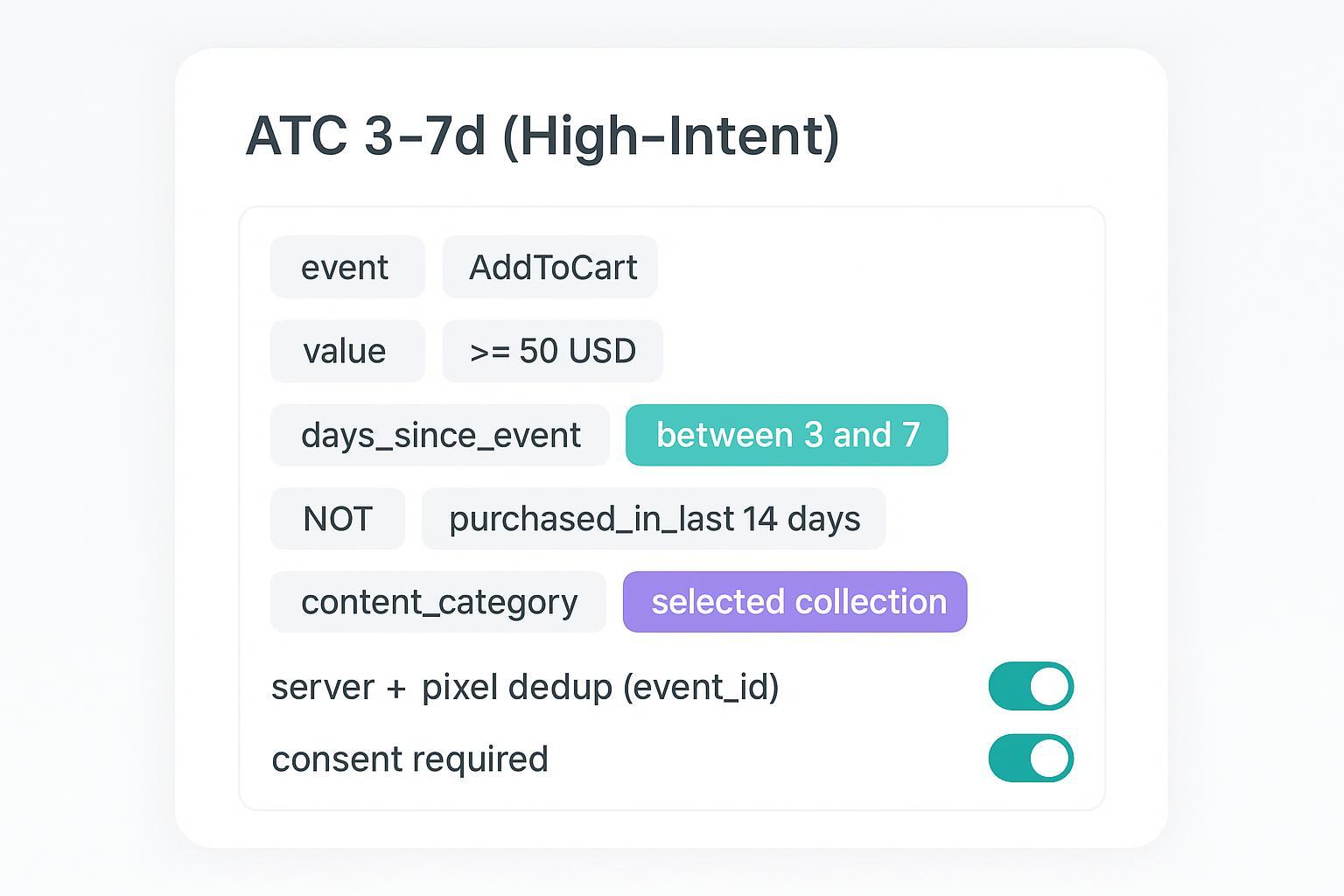
If event=AddToCart AND value ≥ 50 AND 3 < days_since_event ≤ 7 AND NOT purchased_in_last 14 THEN add to audience “ATC 3–7d (High‑Intent)”.
Checkout Starters 1–3d
If event=InitiateCheckout AND days_since_event ≤ 3 AND NOT purchased_in_last 14 THEN add to audience “IC 1–3d”.
Deep Browsers 1–7d
If ViewContent_count ≥ 2 within 7 days OR same content_category viewed ≥ 2 within 7 days AND NOT purchased_in_last 14 THEN add to audience “VC Depth 1–7d”.
Category DPA Seeds 7–30d
If ViewContent in content_category = C AND 7 ≤ days_since_last_view ≤ 30 AND NOT purchased_category = C in last 30 THEN add to audience “Cat‑Affinity 7–30d (C)”.
Multi‑SKU Cross‑sell 14–30d
If purchased_in_last between 14 and 30 AND last_order.item_count ≥ 2 AND current_category ≠ last_purchased_category THEN add to audience “Cross‑sell Recent Buyers 14–30d”.
Operational guardrails
Always include consent_state = true in membership logic for server sends.
Ensure event_id dedup across Pixel and CAPI to avoid double counting and inflated audience math.
5) Exclusions and suppression recipes (protect CAC without starving delivery)
Apply these across all retargeting sets unless testing otherwise.
Purchaser burn window: Exclude Purchase in last 7–14 days; extend to 30 during heavy promos.
SKU/category suppression: Exclude buyers of the promoted SKU or collection in last 30 days.
Discount claimants: Exclude users who claimed ≥ X% discount (e.g., 20%+) in last 14 days to prevent stacking.
Serial non‑engagers: Exclude users with 0 clicks after ≥ 5 impressions in 7–14 days; they’re raising frequency and CAC with little return.
CX risk: Exclude users with refund/chargeback/open support case until resolved to avoid negative experiences and wasted spend.
Consent gating: Exclude or do not send any user lacking consent. Use Data Processing Options where applicable.
When in doubt, prioritize exclusions that directly cut wasted impressions and protect margin.
6) Budget‑aware variants (keep statistical power and control frequency)
Choose the variant that matches your current scale; revisit weekly.
< $1k/day: Consolidate hot intent (ATC + IC 1–7d) into one set to reach n ≥ 1,000. Cap frequency at ~1.5–2.5/day.
$1k–$5k/day: Split 1–3d vs 4–7d for ATC/IC; run Deep Browsers separately to test DPA vs static creative. Watch audience overlap.
$5k/day: Add 8–14d warm and 15–30d cool segments; layer category‑affinity cohorts; consider value tiers (e.g., cart value ≥ $100) if CAC rises.
7) QA and monitoring (weekly cadence)
EMQ: Track per‑event EMQ and investigate drops in hashed email/phone matching or missing content_ids. See Meta’s EMQ overview in the Omni Optimal Setup Guide.
Dedup health: Verify matched event_id or external_id+fbp in Test Events; resolve duplicates before scaling. Reference: Meta CAPI for sGTM (dedup).
Audience size & overlap: Keep n ≥ 1,000 per set; check overlap and use exclusions to avoid cannibalization.
Frequency & CAC: Hold frequency tighter on 3–7d cohorts; loosen slightly on 1–3d if CTR holds; cut spend on 15–30d if CVR or ROAS dips.
Creative fit: Align DPA feeds and static ads to content_category; refresh weekly to avoid fatigue.
8) Example workflow: building and syncing a “High‑Intent ATC 3–7d” audience
Here’s a neutral, illustrative pattern you can reproduce in most audience builders.
Define filters: event=AddToCart; value ≥ 50; days_since_event is between 3 and 7; NOT purchased_in_last 14; content_category equals selected collection. Enable server + pixel dedup (event_id) and require consent=true.
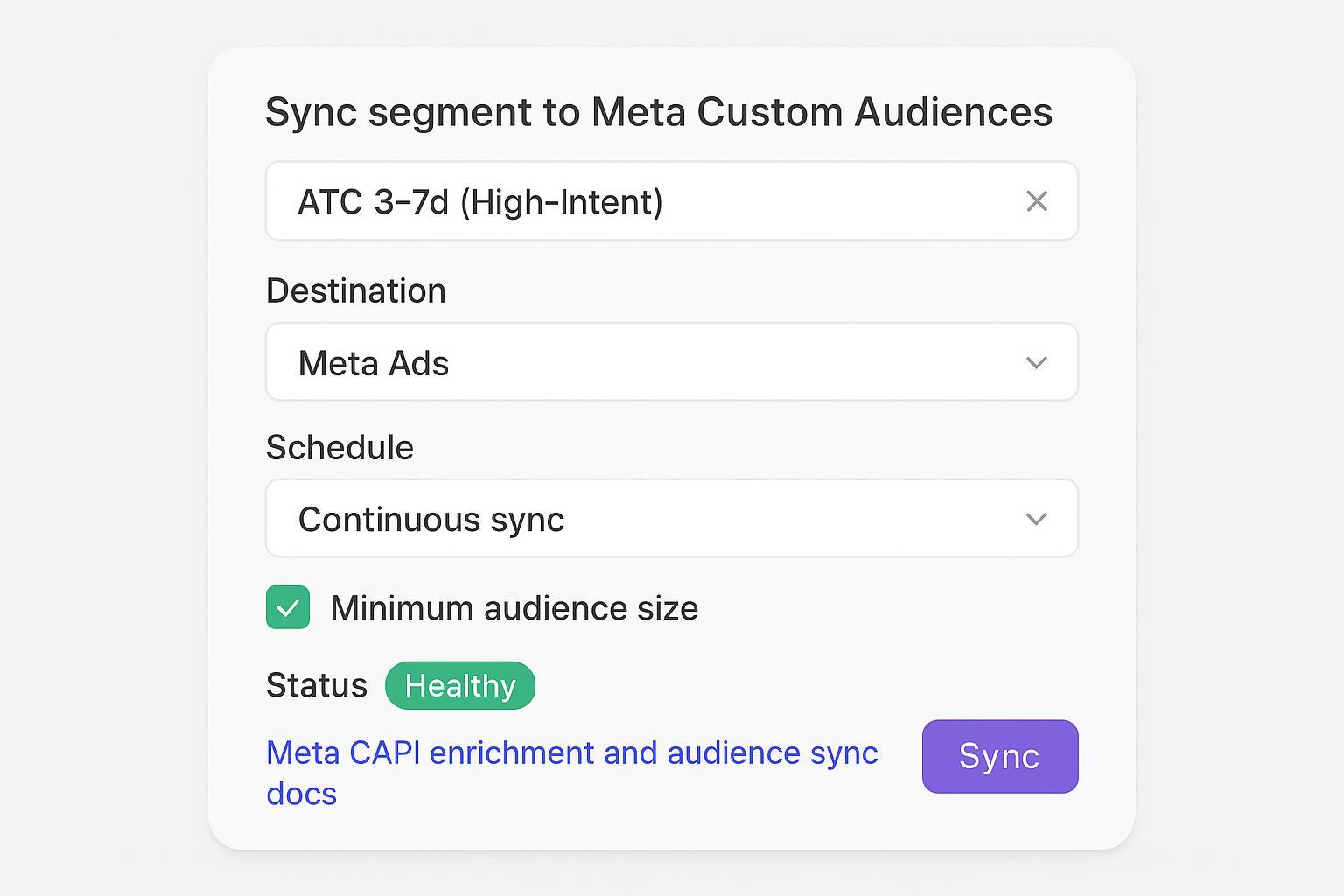
Sync the segment continuously to a Meta Custom Audience. Confirm minimum audience size and monitor status. For documentation, see Meta CAPI enrichment and audience sync.
If you’re using Attribuly, you can follow the same pattern in the audience builder and send it to Meta Custom Audiences; see the overview of Retargeting workflows and signals and, for identity resolution, high‑intent visitor capture/de‑anonymization.
9) Appendix: Shopify → Meta CAPI mapping notes
content_ids: Map to Shopify product or variant IDs from event payloads (arrays for multi‑item). Reference: Shopify Web Pixels API checkout_completed.
content_category: Derive from product_type or primary collection; maintain a mapping table for custom taxonomies. Practitioner mapping; verify in build.
value and currency: Ensure numeric value and ISO 4217 currency per Meta spec.
num_items: Map from line item count; use as item_count for multi‑SKU logic.
event_id: Generate client-side and forward server-side for dedup; validate in Test Events.
Privacy reminder: Gate all identifiers and sends by consent. For policy and controls, see Meta’s Data Processing Options and Signals Gateway documentation.
Related Attribuly resources for context:
Downloadable worksheet (copy/paste audience definitions)
"Audience Name","If/Then Rule","Exclusions","Recency","Thresholds/Notes"
  "ATC 1–3d (High-Intent)","IF event=AddToCart AND value>=50 AND days_since_event<=3 THEN IN","Exclude Purchase last 14d; exclude discount_claim_last_14d; consent=true","1–3d","Start with freq cap ~2/day; raise value to >=75 if CAC creeps"
  "ATC 3–7d (High-Intent)","IF event=AddToCart AND value>=50 AND 3<days_since_event<=7 THEN IN","Exclude Purchase last 14d; SKU/category suppression last 30d; consent=true","3–7d","Use DPA and static; watch overlap with IC 1–3d"
  "IC 1–3d","IF event=InitiateCheckout AND days_since_event<=3 THEN IN","Exclude Purchase last 14d; consent=true","1–3d","Tighten value filters if low AOV add-ons inflate carts"
  "VC Depth 1–7d","IF ViewContent_count>=2 within 7d OR same content_category>=2 within 7d THEN IN","Exclude Purchase last 14d; consent=true","1–7d","Pair with category creative; test low bid floors"
  "Cat-Affinity 7–30d (C)","IF ViewContent content_category=C AND 7<=days_since_last_view<=30 THEN IN","Exclude purchased_category=C last 30d; consent=true","7–30d","Run DPAs; cut if ROAS dips by week 3"
  "Cross-sell Buyers 14–30d","IF purchased_in_last between 14 and 30 AND last_order.item_count>=2 THEN IN","Exclude last_purchased_category; consent=true","14–30d","Keep frequency low; creative = complementary SKUs"
Sources and further reading
According to Meta Developers — Conversions API for sGTM (dedup) and fbp/fbc parameters, using event_id or external_id+fbp enables reliable deduplication (2025–2026 docs).
See Meta’s Omni Optimal Setup Guide and CAPI Gateway monitoring for EMQ diagnostics.
Meta’s Data Processing Options outline processing controls and Limited Data Use.
Shopify Web Pixels API: checkout_completed documents structured payloads you can map to Meta parameters.
Practitioner heuristics: Littledata — How it works: Shopify to Meta CAPI.
Next steps: Replicate the audience segmentation retargeting rules above, validate windows against your payback target, and keep exclusions tight. If you want a faster start, you can implement these retargeting workflows and signals using Attribuly’s neutral building blocks.