
Abandoned Cart vs Browse Abandonment (2026): Triggers & KPIs
Compare abandoned cart vs. browse abandonment: triggers, 24–48h suppression, data requirements, and KPI formulas to measure incremental flow revenue and recovery rate.
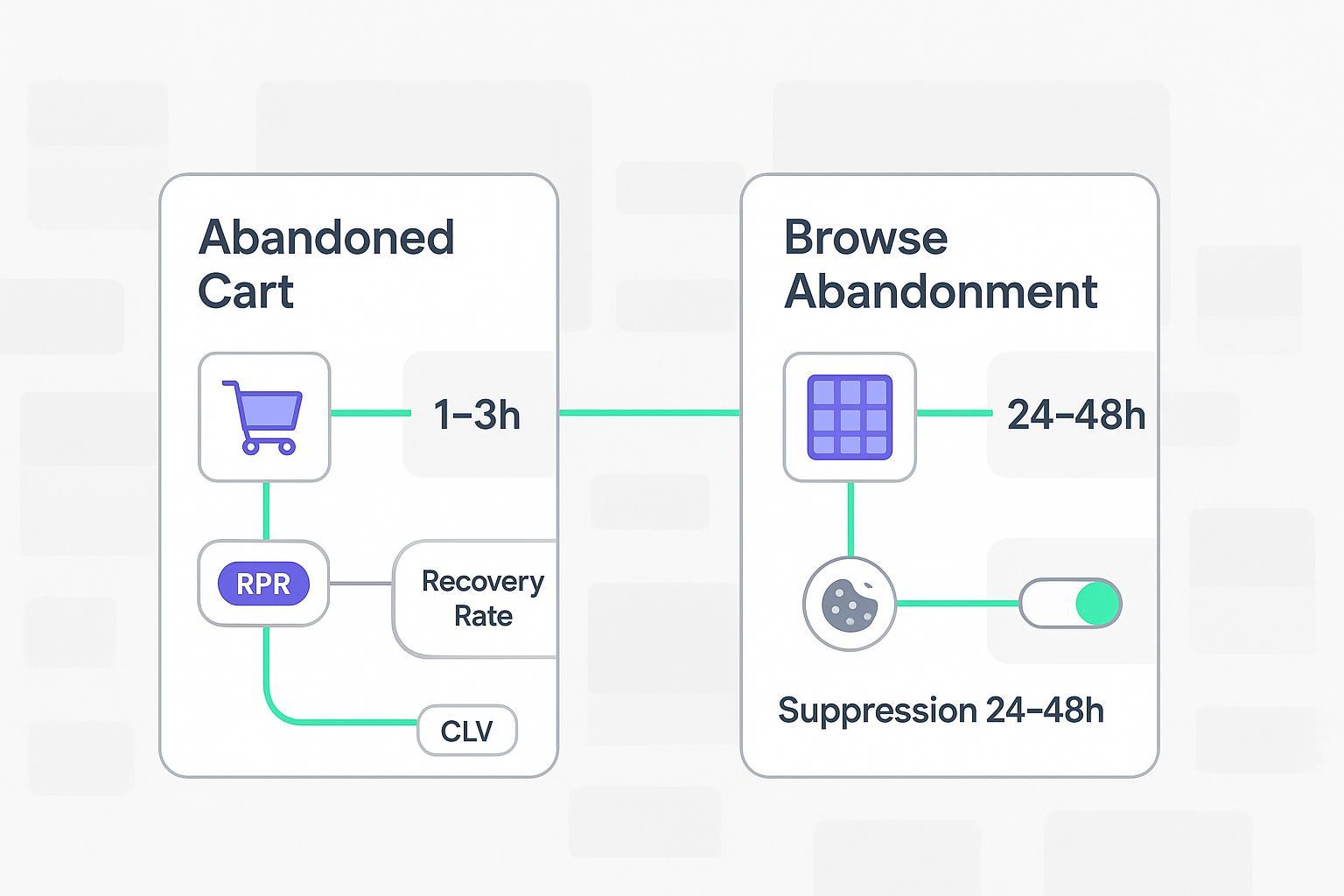
Practices and benchmarks verified as of March 2026. Platform behavior and regulations may change—validate before rollout.
Abandoned cart and browse abandonment both drive meaningful retention revenue—but they’re not interchangeable. This comparison gives you the trigger taxonomy, data requirements, governance rules, and KPI math to choose the right priority for your store and measure true lift.
Key takeaways
North-star KPI: incremental flow revenue measured via randomized holdouts; secondary: recovery rate, time-to-recovery, and 90-day CLV lift.
Prioritize cart/checkout events; suppress browse messages for 24–48 hours after add_to_cart or checkout_started to avoid double messaging and misattribution.
Hybrid data wins: server-side events plus first-party IDs improve eligibility accuracy, attribution, and cross-device stitching.
Abandoned cart typically wins for fastest revenue recovery; browse wins for reach, discovery, and identity capture.
TL;DR decision guide
Your priority | Recommended flow priority | Why |
|---|---|---|
Fastest revenue within 48 hours | Abandoned Cart first | Highest intent, strongest revenue per recipient (RPR) per Klaviyo benchmarks (2026). |
Reach + product discovery | Browse Abandonment first | Larger eligible audience; seeds future add-to-cart events. |
Grow known audience (IDs/emails) | Browse Abandonment + capture | Converts anonymous traffic to known profiles for later cart recovery. |
Compliance-sensitive or limited SMS consent | Keep SMS to Cart only | Late-funnel intent better justifies SMS; keep browse email-first. |
Need clear incrementality | Holdouts on both; optimize Cart first | Lift is easier to observe late-funnel; then scale browse with identity capture. |
Short answer: run both, but let cart win conflicts and enforce a 24–48h browse suppression window after ATC/checkout.
Side-by-side comparison: abandoned cart vs browse abandonment
Dimension | Abandoned Cart | Browse Abandonment |
|---|---|---|
Trigger & eligibility | Trigger: checkout_started (all) or add_to_cart (Shopify). Exclude: placed_order since starting flow. | Trigger: viewed_product. Exclude: placed_order, checkout_started, add_to_cart since starting flow. |
Identity requirement | Known email/phone preferred; can trigger from session → capture step if available. | Known email/phone ideal; can rely on identity capture to grow eligibility. |
Intent vs reach | Highest intent; smaller audience. | Mid intent; broadest audience. |
Timing & cadence | First send ~1–3h; 2–3 touches over 1–3 days; SMS optional with consent. | First send ≥1h; 1–3 touches over a few days; email-first; lighter tone. |
Suppression governance | N/A (priority flow). | Suppress for 24–48h after add_to_cart or checkout_started; reset on purchase. |
Primary KPIs | Recovery rate, RPR, time-to-recovery, incremental revenue, 90-day CLV lift. | Recovery rate, RPR (lower), assisted cart entries, incremental revenue, 90-day CLV lift. |
Data maturity needed | Works client-side; best with hybrid (server-side + first-party IDs). | Works client-side; benefits greatly from identity capture + server-side signals. |
Implementation effort | Medium–High (dynamic cart blocks, offer logic). | Low–Medium (recommendations, recently viewed). |
Best for | Fast revenue recovery; objection handling. | Discovery at scale; list growth; fueling retargeting. |
Definitions and filters reference Klaviyo platform docs for accuracy: see the abandoned cart flow setup in the Klaviyo Help Center and the browse abandonment flow guidance in the Klaviyo Help Center for trigger and filter mechanics.
Trigger taxonomy and data requirements (with example schemas)
Your flows live or die on clean events. In a hybrid setup (client + server-side), you’ll send product_view, add_to_cart, checkout_started, and purchase with durable identifiers and dedup keys.
Minimal event fields (illustrative JSON)
These examples reflect a hybrid “Attribuly-style” payload to clarify the idea (keys and formats vary by stack). Use them to align your engineering brief, then validate in your ESP.
{
    "event_name": "product_view",
    "event_id": "pv_9a12f3c4-2d7b-4d1b-9c12-0f1e2d3c4b5a",
    "timestamp": "2026-03-09T15:21:43Z",
    "user": {
      "email": "jane@example.com",
      "phone": "+13125550123",
      "user_id": "u_78910",
      "first_party_id": "fp_abc123"
    },
    "product": {
      "id": "sku-123",
      "name": "Ribbed Tank",
      "price": 24.00,
      "currency": "USD"
    },
    "source": "server",
    "meta": { "session_id": "s_456", "device": "mobile" }
  }
{
    "event_name": "add_to_cart",
    "event_id": "atc_c15b6e98-fd7e-4a17-8f1e-617ab8a2f0d3",
    "timestamp": "2026-03-09T15:30:05Z",
    "user": { "email": "jane@example.com", "user_id": "u_78910", "first_party_id": "fp_abc123" },
    "cart": {
      "items": [ { "id": "sku-123", "qty": 1, "price": 24.00 } ],
      "value": 24.00,
      "currency": "USD"
    },
    "source": "server"
  }
{
    "event_name": "checkout_started",
    "event_id": "chk_0a9cfe22-4a12-40f1-8439-1cb51af6a2d7",
    "timestamp": "2026-03-09T15:33:47Z",
    "user": { "email": "jane@example.com", "user_id": "u_78910", "first_party_id": "fp_abc123" },
    "checkout": {
      "id": "co_5567",
      "items": [ { "id": "sku-123", "qty": 1, "price": 24.00 } ],
      "value": 24.00,
      "currency": "USD"
    },
    "source": "server"
  }
{
    "event_name": "purchase",
    "event_id": "ord_71d41c77-7c78-4a6c-9d93-0d1ee2fb3a1b",
    "timestamp": "2026-03-09T16:12:10Z",
    "user": { "email": "jane@example.com", "user_id": "u_78910", "first_party_id": "fp_abc123" },
    "order": {
      "id": "#100234",
      "value": 24.00,
      "currency": "USD",
      "items": [ { "id": "sku-123", "qty": 1, "price": 24.00 } ]
    },
    "source": "server"
  }
Notes:
Include a unique event_id to deduplicate cross-channel sends (client + server) and avoid double entries.
Prefer first-party IDs plus email/phone when consented to stitch sessions across devices.
For hybrid S2S patterns and match parameters, see Attribuly’s guidance on server-side tracking for Meta, which outlines durable IDs and deduplication concepts applicable across destinations: Attribuly support on server-side tracking for Meta.
To expand browse eligibility by identifying more visitors, consider privacy-compliant capture: Attribuly Capture for identifying anonymous visitors.
Identity stitching and validation in your ESP
In Klaviyo, validate that product_view → add_to_cart → checkout_started → purchase entries reflect expected funnel ratios. Use profile filters (Placed Order zero times since starting this flow) to prevent post-purchase sends. See the Klaviyo Help Center guidance for abandoned cart flows and for browse abandonment flows for trigger and filter configuration details.
KPI framework, formulas, and realistic benchmarks
Focus optimization on business impact, not vanity metrics.
Formulas
Recovery Rate = recovered orders ÷ eligible abandonments (by flow) in the period.
Revenue per Recipient (RPR) = flow-attributed revenue ÷ total recipients.
Time-to-Recovery = median hours from trigger to purchase.
90-day CLV Lift = CLV of messaged cohort – CLV of holdout cohort over 90 days.
Incrementality method
Use randomized holdouts to quantify lift. Klaviyo documents global holdout groups; exclude a portion of profiles from abandonment messaging and compare RPR, recovery rate, and CLV deltas across 30–90 days. See the description in the Klaviyo Help Center: Klaviyo’s guide to global holdout groups.
Benchmarks (directional, 2026)
Abandoned cart typically leads all automations in RPR on Klaviyo; example ranges often cited in 2024–2026 materials sit around low-to-mid $3 RPR with ~3% placed-order rates (cohort-dependent). For setup specifics, consult: Klaviyo’s abandoned cart flow documentation (updated 2026).
Industry baseline for cart abandonment sits near 70% globally. The Baymard Institute’s 2025/2026 rollup lists around 70.22%: see the analysis at Baymard’s cart abandonment rate list.
Browse abandonment tends to have strong opens and modest direct conversion relative to cart. Omnisend’s 2025 overview remains a helpful directional reference for browse performance patterns: see the analysis in Omnisend’s browse abandonment guide (2025–2026).
Sample calculation
If your cart flow sent 20,000 emails last month, attributed $68,000, and recovered 540 orders in that cohort: RPR = $68,000 ÷ 20,000 = $3.40; Recovery Rate = 540 ÷ eligible cart abandonments (use the same eligibility definition in numerator and denominator). Compare these to a 10% global holdout to estimate incremental RPR and CLV lift.
Suppression and prioritization playbook
Event priority and overlap governance
Rule: Cart/Checkout events take priority. Suppress browse for 24–48 hours after add_to_cart or checkout_started. Re-open browse eligibility when the window expires and no purchase occurred.
Klaviyo implementation patterns (assemble from official filter mechanics)
Browse flow entry: Trigger Viewed Product AND Placed Order zero times since starting this flow AND Started Checkout zero times since starting this flow AND Added to Cart zero times since starting this flow; limit re-entry (e.g., hasn’t been in this flow in 30 days). Configuration details follow the filter capabilities described in the Klaviyo Help Center article for browse abandonment: Klaviyo’s browse abandonment setup.
Cart flow entry: Trigger Started Checkout (or Added to Cart on Shopify) AND Placed Order zero times since starting this flow; re-entry controls as appropriate. For trigger and filter specifics, see: Klaviyo’s abandoned cart flow documentation (updated 2026).
Testing windows
Branch-test first-send timing (e.g., 1h vs 3h) and suppression windows (24h vs 48h). Track not only conversion but also negative signals (unsubscribes, spam complaints) and time-to-recovery.
Messaging tone and cadence that match intent
Abandoned cart
Focus on objection handling and clarity: show the exact items, shipping/returns, social proof, and—if justified—an incentive in a later touch. Consider a timely SMS to fully consented profiles within 48 hours.
Browse abandonment
Keep the tone helpful and discovery-led: recently viewed, similar items, and lightweight education. Start with email; reserve SMS for strong consent and clear justification.
Compliance note (U.S. SMS)
Follow TCPA/CTIA guidance (written consent, quiet hours, opt-out keywords). Use built-in consent and Smart Sending features in your ESP to stay within safe defaults. For industry principles, see the CTIA’s overview: CTIA Messaging Principles and Best Practices.
Implementation quick-start
Client-side only (Shopify + Klaviyo web events)
Use conservative suppression (48h) to account for noisy identity and cookie limits; keep browse email-first. Validate entries by simulating events in a staging profile and comparing funnel ratios.
Hybrid (server-side + first-party IDs)
Send server-side versions of product_view, add_to_cart, checkout_started, purchase with event_id for dedup and first_party_id for stitching. This helps mitigate browser tracking gaps and improves eligibility accuracy across devices. For a neutral overview of sending durable signals and deduplication ideas, review: Attribuly’s Shopify integration overview.
Cross-channel orchestration (optional)
Sync high-intent audiences to your ESP and paid platforms to accelerate follow-up; keep channel caps and quiet hours consistent. If you need to expand known-audience reach for browse flows, the earlier Capture link is a pragmatic place to start.
FAQs
Q: Which is better for fastest revenue recovery: abandoned cart or browse abandonment? A: Abandoned cart. Late-funnel intent and higher RPR make it the practical first priority in most stores, as reflected in Klaviyo’s flow performance patterns cited above.
Q: How long should I suppress browse abandonment after add_to_cart? A: Start with 24–48 hours. Keep cart/checkout as the priority event and test 24h vs 48h windows to balance conversion with fatigue.
Q: What event fields are required to trigger these flows reliably? A: A unique event name, a dedup-ready event_id, a precise timestamp, durable identifiers (email/phone/first-party ID), and normalized product/cart fields. Hybrid server-side sends improve reliability.
Q: How do you measure incremental revenue from abandonment flows? A: Use randomized holdouts (e.g., via Klaviyo’s global holdout groups) and compare RPR, recovery rate, and CLV over 30–90 days between messaged and holdout cohorts.
Q: Should I use SMS for browse abandonment? A: Generally keep browse email-first. Use SMS primarily for cart flows with explicit, documented consent and within quiet-hour rules.
Also consider (data and identity enablement)
If you’re moving from client-only tracking to a hybrid setup, tools like Attribuly can help with server-side event delivery and identity capture in ways that support the governance and KPI accuracy discussed here. For neutral reference material: Attribuly support on server-side tracking for Meta and Attribuly Capture for identifying anonymous visitors.
References (selected)
Abandoned cart setup and best-practice filters: Klaviyo’s abandoned cart flow documentation (updated 2026)
Browse abandonment definitions and filters: Klaviyo’s browse abandonment setup
Global holdout methodology: Klaviyo’s guide to global holdout groups
Industry baseline: Baymard’s cart abandonment rate list
Browse engagement patterns: Omnisend’s browse abandonment guide (2025–2026)
U.S. SMS compliance context: CTIA Messaging Principles and Best Practices