
Abandoned Cart Email Timing: The 1h / 24h / 72h Framework That Recovers Most Revenue
Proven 1h/24h/72h abandoned cart email timing for e-commerce pros. Evidence-backed cadence, Klaviyo implementation notes, subject lines, and testing templates to recover revenue.
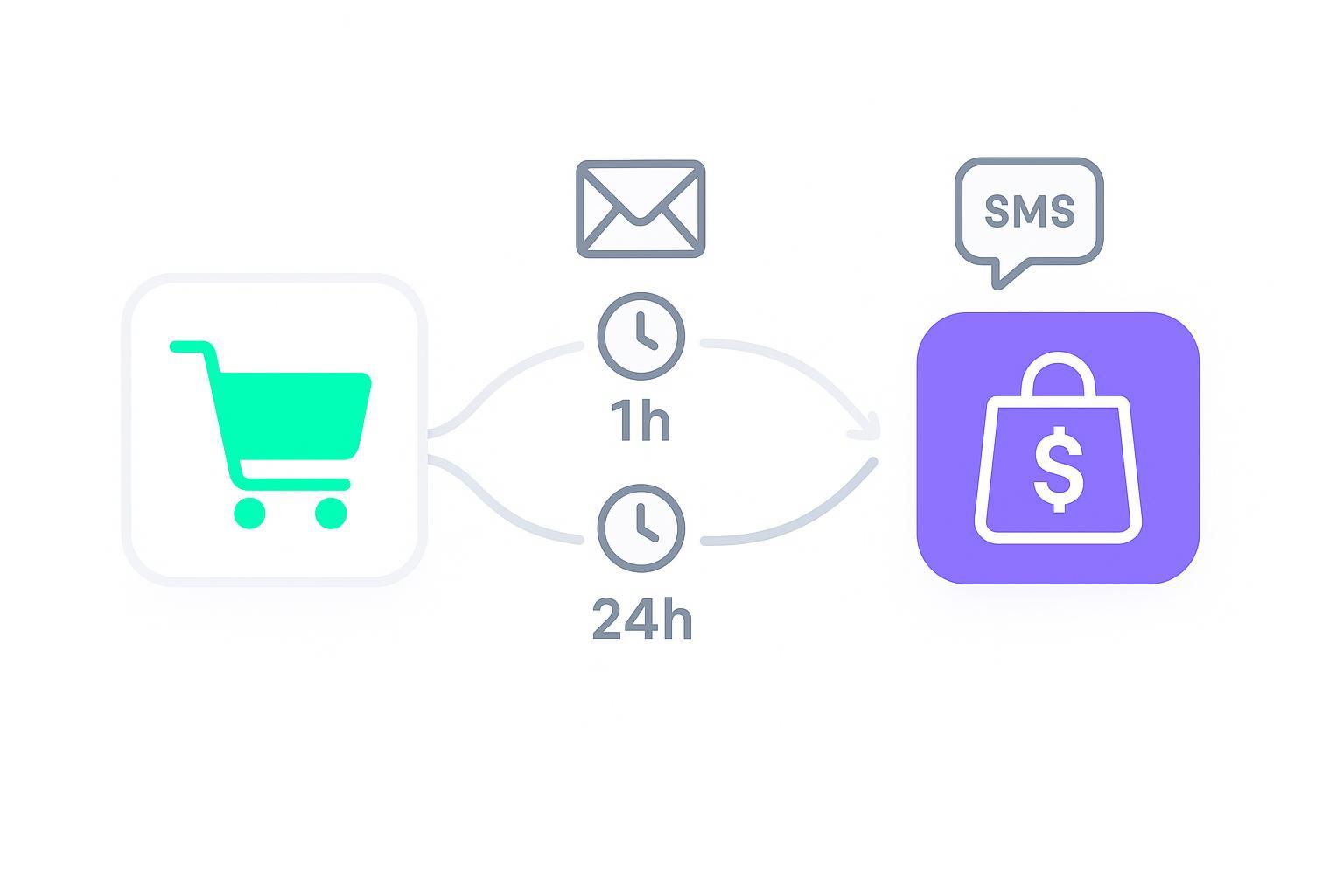
If you recover even a fraction of abandoned checkouts, the revenue adds up fast. Industry research shows cart abandonment hovers around seven in ten sessions, a reminder that timing your follow‑ups matters as much as the creative. This guide distills the most reliable cadence—1 hour, 24 hours, and 72 hours—into a practical playbook you can deploy in Klaviyo (or any ESP) and adapt by cohort without guesswork.
Key takeaways
A simple 3‑touch cadence—1h, 24h, 72h—balances speed with respect for inbox fatigue; it’s the best starting point for most stores.
Evidence from platform benchmarks and official guides shows abandoned cart flows deliver standout revenue per recipient; treat timing as a high‑leverage variable.
Personalize the first touch and add light incentive only on the second or third message; throttle discounts for high‑AOV cohorts.
Measure revenue per recipient (RPR) and conversion rate with a holdout; test 1h vs 3–4h for the first send before tweaking everything else.
Respect Gmail/Yahoo 2024 sender rules and regional consent requirements to protect deliverability and revenue.
Evidence and benchmarks for abandoned cart email timing
A few authoritative data points anchor this framework.
Scope of the opportunity: The Baymard Institute’s multi‑study analysis reports an average cart abandonment rate around 70% globally, underscoring how much revenue is recoverable with better UX and timely reminders. See the synthesis in the Baymard cart‑abandonment overview: Baymard’s 2026 aggregate of 50 studies (2026).
Cadence endorsement: Shopify’s current playbooks recommend a three‑email sequence at approximately 1 hour, 24 hours, and 72 hours to act while intent remains high without spamming customers; see Shopify’s abandoned cart email best practices (2026).
Performance potential: According to Klaviyo’s 2024 abandoned cart benchmarks (reporting 2023 data), abandoned cart flows deliver industry‑leading revenue per recipient alongside high open and conversion rates. Treat these as directional ranges rather than promises; your mileage will vary by AOV and offer.
Benchmark or guidance | Key takeaway | Source & year |
|---|---|---|
Global cart abandonment rate | ~70% of carts are abandoned; recovery is a major growth lever | Baymard Institute, 2026 |
Recommended timing | 1h → 24h → 72h as a default three‑touch cadence | Shopify, 2026 |
Abandoned cart flow performance | Among the highest RPR of all automations; strong open/convert rates | Klaviyo, 2024 (2023 data) |
The 1h / 24h / 72h sequence (and when to adjust it)
Start with the default, then adapt by cohort.
Email 1 (1 hour): A friendly reminder while intent is fresh. Keep it short: product thumbnails, a single “Restore your cart” CTA, and quick reassurance (shipping, returns, payment security). No discount yet for most brands. This first touch defines your abandoned cart email timing baseline.
Email 2 (24 hours): For non‑purchasers, add value: social proof, a brief FAQ, or a low‑friction incentive like free shipping. If your margins are tight, gate incentives by AOV or customer status.
Email 3 (72 hours): Final nudge with clear urgency and, if viable, a stronger incentive. Remind shoppers of your guarantee and easy returns. Suppress immediately on purchase.
Cohort adjustments
Low AOV or impulse‑friendly items: Consider moving the first send slightly earlier (30–60 minutes) and the second at 20–24 hours. The third can land between 48 and 72 hours. The aim is to compress time‑to‑purchase without over‑messaging.
High AOV or research‑heavy purchases: Nudge the first send to 2–4 hours (sometimes up to 4–8 hours) to allow deliberation, then 24–48 hours, then 72–96 hours. Prioritize richer content (comparisons, reviews) over discounts.
Pro tip: If your ESP’s default template uses a 2–4h first delay, test it head‑to‑head against the 1h standard before changing anything else.
Subject lines and concise templates you can ship today
To keep scannability high and avoid long lists, use the following swipe file as copy‑and‑paste blocks.
Subject lines — Touch 1 (reminder, no incentive)
Your cart is ready when you are
  Still thinking it over, {{ first_name }}?
  Left something behind — checkout is 2 clicks
  Quick reminder: your items are in stock
  A gentle nudge to finish your order
  We saved your cart for later (no rush)
Subject lines — Touch 2 (value or light incentive)
Need a hand? Here are reviews + free returns
  A little help: free shipping still applies
  Your picks + 1 tip before you buy
  Popular choice — here’s why shoppers love it
  {{ first_name }}, got questions? We answered the top 3
  Complete your order and keep your discount
Subject lines — Touch 3 (final nudge, urgency)
Last reminder: your cart expires soon
  Final hours to claim your offer
  Clock’s ticking — complete your order today
  Last chance: we’re holding your items
  Before it sells out, finish checkout
  Ends tonight: finish your order in minutes
Three concise email body templates
Email 1 (1 hour)
Headline: Still interested?
  Body: We saved your cart so you don’t have to start over. Your items are in stock.
  Bullets: Free returns | Secure checkout | Fast shipping
  CTA: Restore your cart → {{ cart_url }}
  Footer: Questions? Reply to this email.
Email 2 (24 hours)
Headline: A quick favor before you decide
  Body: Customers love {{ product_name }} for {{ benefit }}. If it helps, shipping is on us today.
  Social proof: ★★★★☆ (2,143 reviews)
  CTA: Complete your order → {{ cart_url }}
  Fine print: Free shipping auto‑applies at checkout for 24 hours.
Email 3 (72 hours)
Headline: Final reminder (your cart is expiring)
  Body: We’re wrapping this up. Finish your order now to secure your items and today’s offer.
  Reassurance: 30‑day returns | 24/7 support | Secure payments
  CTA: Finish checkout → {{ cart_url }}
  Fine print: Offer ends at 11:59 pm tonight.
Optional SMS snippets (for opted‑in profiles)
SMS A (30–60 min): We saved your cart. Finish here: {{ short_cart_url }} — Reply STOP to opt out.
  SMS B (24–48 h): Last reminder: your items are waiting. {{ short_cart_url }} — STOP to end.
Implementation notes for Klaviyo (with a tested flow blueprint)
Trigger the flow on checkout intent, not just product views.
Trigger: “Checkout Started” (or your server‑side equivalent). Add a filter like “Placed Order zero times since starting this flow” to prevent post‑purchase sends.
Structure: Delay → conditional split (purchased?) → Email 1 → delay → split → Email 2 → delay → split → Email 3. Suppress immediately upon purchase or unsubscribe.
Cart‑restore links: Use the platform’s cart token so the CTA opens a preloaded checkout. After long delays, make sure the link still reconstructs the cart; otherwise fall back to product‑level links.
SMS orchestration: Add a parallel SMS branch for opted‑in subscribers with quiet hours. Keep it to one SMS within 48 hours for this use case.
Sample Klaviyo‑style pseudo‑JSON
{
    "trigger": "Checkout Started",
    "filters": ["Placed Order = 0 since flow start"],
    "sequence": [
      {"delay": "1h"}, {"email": "Touch 1"},
      {"delay": "23h"}, {"email": "Touch 2"},
      {"delay": "48h"}, {"email": "Touch 3"}
    ],
    "suppress_on": ["Placed Order", "Unsubscribed"],
    "sms_branch": {"enabled": true, "max_messages": 1, "quiet_hours": true}
  }
Attribuly micro‑example (server‑side events powering triggers) For stores enriching Klaviyo with server‑side signals, Attribuly can sync metrics such as “Product viewed - Attribuly SS,” “Added to Cart - Attribuly SS,” “Checkout Started - Attribuly SS,” and “Checkout Completed - Attribuly SS.” In practice, you can clone your abandoned‑checkout flow and switch the trigger to the server‑side “Checkout Started - Attribuly SS,” then add profile filters to avoid duplicates with native events. This is especially helpful for previously anonymous shoppers who resurface before purchase. Learn more in the Attribuly → Klaviyo integration overview.
Testing and measurement you can trust
Primary metrics Use revenue per recipient (RPR) as your north star, with placed‑order rate as a close second. Track open, click, unsubscribe, and complaint rate for context.
Timing test (first‑touch A/B)
Goal: Compare 1h vs 3–4h first send while holding 24h and 72h constant.
Design: Randomly split eligible recipients; run until each arm reaches enough volume to detect a ~10–15% RPR lift (heuristic: ~5,000 recipients/arm for mid‑variance stores; adjust for your baseline).
Guardrails: Freeze discounting policy and list‑hygiene changes during the test window. Suppress anyone who purchases from further touches.
Incentive test (later‑touch value proposition)
Goal: Quantify the impact of adding free shipping in Email 2 and a percent‑off incentive in Email 3.
Design: Keep the first email incentive‑free. In variants, toggle free shipping in Email 2 and a modest percent‑off in Email 3. Segment by AOV to protect margin.
Analysis: Evaluate RPR, AOV, and unsubscribe/complaint deltas; confirm lift isn’t purely cannibalizing full‑price orders.
Incrementality Create a persistent holdout (e.g., 10–15%) or a geo‑split if volume allows. Attribute revenue with a consistent window and account for multi‑touch effects when you interpret results.
Deliverability and privacy (keep your gains sustainable)
Bulk‑sender rules
Gmail and Yahoo enforce updated bulk‑sender standards introduced in 2024. Authenticate with SPF/DKIM, publish DMARC, keep spam complaints <0.3%, and implement one‑click list‑unsubscribe that’s honored quickly. See Google’s bulk sender requirements (2024) for specifics.
Regional compliance
United States: The CAN‑SPAM Act requires accurate headers, clear identification and physical address, and an easy opt‑out processed promptly. Consult the FTC’s CAN‑SPAM compliance guide.
EU/UK: Marketing emails to individuals typically require prior consent (with limited soft‑opt‑in exceptions for similar products). Provide clear identity and easy opt‑out. See the UK regulator’s guidance in the ICO’s PECR resource.
Real‑world result (first‑party case, for context)
A home‑and‑living brand reported meaningful lifts in recovered revenue after improving cart identification and abandonment triggers; the figures are first‑party and attributed by Attribuly. For details, see the Attribuly FunnyFuzzy case study (first‑party report).
Next steps
If you’re ready to implement the 1h / 24h / 72h flow, start with the pseudo‑JSON above and your Klaviyo trigger. For server‑side signals and cohort measurement, review the Attribuly → Klaviyo integration and iterate with a 30‑day timing test.