
Best Practices for Abandoned Cart Email Sequences (2026)
Practitioner guide to abandoned cart email sequences—optimal cadence, subject lines, copy, segmentation, incentives, and server‑side triggers for measurable recovery.
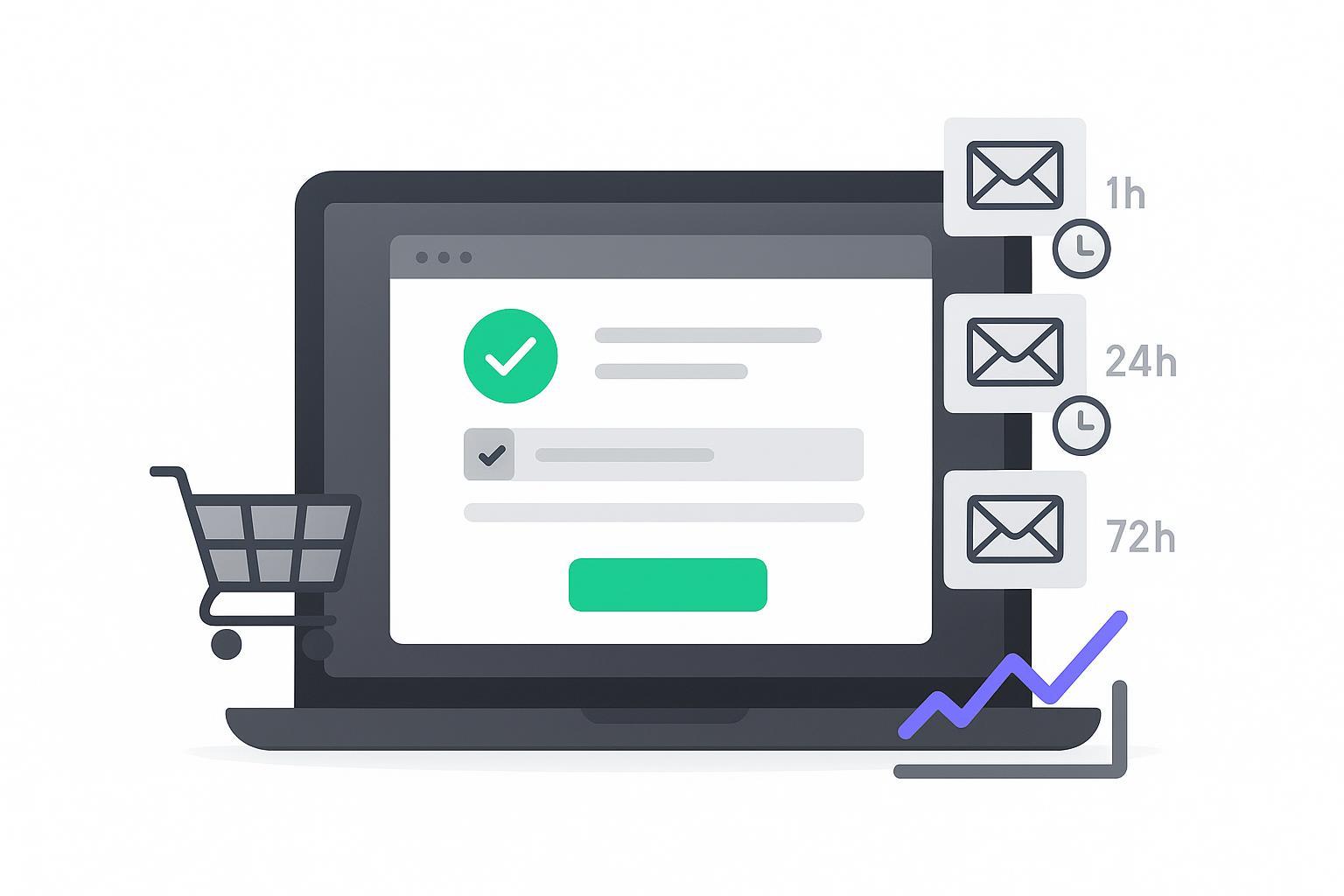
Roughly seven in ten carts never convert. The Baymard Institute’s rolling analysis cites a global average around 70%, which is why abandoned cart programs remain among the highest‑ROI automations. Winning in 2026 hinges on two levers you fully control: trigger reliability (prefer server‑side) and persuasive, margin‑aware messaging that resolves real objections.
Key takeaways
Use a three‑touch cadence: first email within 2–4 hours, second at 24–36 hours, third at ~72 hours; adjust by AOV and daypart.
Start with clarity in subject lines, then layer personalization and honest urgency; let preview text tackle the top objection.
Lead with no incentive, test modest perks later for price‑sensitive cohorts; protect margin with expiries and purchase suppression.
Segment by intent, AOV band, and traffic source; always suppress on purchase and respect quiet hours for SMS.
Prefer server‑side triggers and exits to reduce missed events and false positives across devices.
Measure recovery and revenue per recipient; run focused A/B tests with proper sample sizes and power.
Why abandoned cart email sequences work (and how to pace them)
Most stores win with a front‑loaded, three‑email flow. As a baseline: send Email 1 at 2–4 hours post‑abandonment, Email 2 at 24–36 hours, and Email 3 around 72 hours. This aligns with timing windows highlighted in Klaviyo’s abandoned cart guidance (2025) and with the broader performance pattern for flows in Klaviyo’s Email Marketing Benchmarks (2026).
Tune cadence by AOV and daypart. For low AOV (<$50), try 1–2h, 24h, and 48h; for mid AOV ($50–$200), 2–4h, 24–36h, and 72h; and for high AOV (>$200), 4–8h, 24–48h, and 72–96h while emphasizing assurance over urgency. Nudge with SMS only if you have explicit consent and a reason to believe it will add value. Avoid landing the first email at 2 a.m. local time—defer to the next business morning for mobile‑heavy, late‑night sessions.
Here’s the idea: the first touch jogs memory, the second resolves objections, and the third adds a gentle, truthful nudge. Think of it less like three reminders and more like removing three layers of friction.
Subject lines, preview text, and copy that move carts
Clarity beats cleverness. Begin with straightforward reminders before testing personalization (product name, variant) and, only when warranted, urgency. Preview text should complement the subject line and address the most likely blocker: shipping, fit, delivery time, or returns.
Subject and preview pairings you can use immediately:
“You left something behind.” — “We saved your picks—shipping estimates inside.”
“A quick reminder about your cart” — “Questions? Our team’s here to help.”
“Still eyeing this?” — “See sizing, delivery times, and reviews.”
“Is shipping the holdup?” — “Fair rates, fast delivery—details inside.”
“Your cart is saved for 24 hours” — “Stock moves quickly—support links included.”
“We set these aside for you” — “Sizes, colors, and delivery windows at a glance.”
“Need a second opinion?” — “See real customer photos and reviews.”
“One click from done” — “Pick up where you left off—items pre‑filled.”
“Ready when you are” — “Free exchanges and easy returns explained.”
“Last reminder from us” — “Not interested? Help us improve in 5 seconds.”
Write for each touch with a clear objective. Email 1 should be short, visual, and singular in its call to action—return to cart—plus one‑line reassurance on returns or shipping. Email 2 should tackle the top objection you’ve observed (for many, it’s delivery cost or timing), offer a concise review or UGC tile, and link to the relevant FAQ. Email 3 brings an honest urgency note (save‑window or stock), and if you’re introducing an incentive, keep the terms narrow and time‑boxed; include alternatives below in case the original item isn’t the right fit. For engagement context, see Klaviyo’s click‑rate explainer (2024).
Incentives and margin protection
Discounts can push wavering shoppers over the line—but they also risk training people to wait. A resilient approach is to lead with reassurance and value, then test perks surgically where they matter.
Start without a discount in Email 1. For price‑sensitive cohorts, test free shipping or a small percentage in Email 2. Reserve stronger offers for high‑AOV or loyal customers who’ve shown price resistance. Add clear expiries and purchase suppression so redeemers don’t receive later incentive emails. Emarsys warns against over‑discounting and recommends segmented incentives with suppression; see Emarsys’ best‑practice post (2025).
Shopify advocates tiered incentives tied to margin protection and AOV thresholds; see Shopify’s shopping cart abandonment guidance and their abandoned cart primer for practical framing.
Timing wise, Barilliance’s analysis reflects solid conversion at 1h, 24h, and 72h touches (methodology caveats apply). See Barilliance’s 2023 analysis.
Bottom line: incentives are tools, not defaults. Use minimum spends, clear exclusions, and narrow windows to protect margin and brand.
Segmentation, suppression, and personalization—made simple
Not all abandoners are the same, so don’t treat them that way. Use intent signals like size selector activity, visits to shipping/returns, or live chat to identify higher‑intent shoppers. Split by AOV band: low, mid, and high, each with its own cadence and incentive thresholds. Watch traffic source and device too—a paid social mobile click at midnight behaves differently from a branded search desktop session at lunch. New customers need education and social proof; returning customers may respond better to loyalty framing or replenishment cues.
Suppression is non‑negotiable. Always exit the flow on a confirmed purchase within minutes, adding a short grace window (think 5–15 minutes) for fast checkouts. Respect quiet hours and regional rules for SMS, and filter strictly on explicit consent. Keep cross‑channel frequency caps so email and SMS don’t collide or double‑nudge. Exclude profiles with recent refunds or chargebacks from incentive‑heavy branches. For personalization, pull abandoned SKUs with images, sizes, and colors, and show shipping estimates by location where permissible—helpful, not creepy.
Technical micro‑example: switching Klaviyo to a server‑side abandon trigger
Client‑side triggers can miss events due to blockers, privacy settings, and multi‑device behavior. Server‑side events improve both entry (abandon) and exit (purchase) conditions for your abandoned cart email sequences.
Objective
Trigger the flow from a server‑side Checkout Started event and exit it on a server‑side Checkout Completed/Placed Order event. Branch delays and incentives by AOV band.
Event sketch (pseudo‑JSON)
{
    "event": "checkout_started",
    "timestamp": "2026-05-02T14:12:00Z",
    "profile": {
      "email": "alex@example.com",
      "phone": "+13125550000",
      "aov_band": "mid"
    },
    "properties": {
      "cart_items": [
        {"sku": "RUNNER-NAVY-9", "name": "Navy Runner", "qty": 1, "price": 98.00, "image": "https://cdn.example.com/runner.jpg"}
      ],
      "total_value": 98.00,
      "currency": "USD",
      "source": "shopify",
      "session_id": "abc123"
    }
  }
Klaviyo flow wiring
Trigger: “checkout_started” (server‑side). Flow filter: not purchased in the last 1 day; has email consent.
Exit: receive “checkout_completed” or “order_placed” (server‑side). Add a 5–15 minute exit grace period.
Branching: if profile.aov_band = high, delay Email 1 to 4–8h and skip early incentives; if low, consider 1–2h first send and test free shipping at Email 2.
SMS: send only when has_sms_consent = true; respect quiet hours.
Troubleshooting
Confirm both start and completion events arrive within minutes and stitch across devices via server‑side identifiers.
Ensure purchase suppression hits before the next email delay.
Monitor for sample ratio mismatch (unexpected branch splits) in flow analytics.
Implementation note (first‑party reference): If you’re exploring server‑side capture with real‑time sync to Klaviyo, see Attribuly + Klaviyo for high‑level integration context. Treat it as first‑party documentation and follow in‑app guidance for exact schemas.
KPIs, benchmarks, and what “good” looks like in 2026
Benchmarks vary by platform dataset and industry, but they set direction. Omnisend reports open rates around 35.75%, click‑to‑sent ~3.84%, conversion ~1.51%, and revenue per email near $2.54 across its customer base; see Omnisend’s 2026 update. Klaviyo’s benchmark reports emphasize that automated flows outperform campaigns on engagement and revenue; see Klaviyo’s Benchmarks (2026). For global context, Baymard’s compilation places average cart abandonment at 70.22%; see Baymard Institute’s statistics (2025 update).
Score your program by recovery rate (orders attributed to the flow ÷ abandon events), revenue per recipient, and time‑to‑recovery. Segment reporting by AOV band and traffic source, and compare against your own baselines rather than chasing a universal “good.” Watch complaint and unsubscribe rates—if they spike after incentive emails, revise your policy and cadence.
Your A/B testing roadmap—with sample‑size guardrails
Prioritize experiments with meaningful potential effects: first‑touch delay (1–2h vs. 2–4h vs. 4–6h, split by AOV), subject line clarity vs. urgency vs. humor, incentive timing (introduce free shipping at Email 2 vs. Email 3 vs. none), creative format (multi‑item grid vs. single hero; UGC vs. studio), and preview text content (objection vs. benefit).
Method notes: Calculate sample size using your baseline conversion and minimum detectable effect (MDE) at 95% confidence and 80% power; avoid early stopping and check for sample ratio mismatch (SRM). If volume is low, run fewer, bolder tests sequentially rather than splitting traffic into many branches. Useful primers include Convert.com on MDE, Convert.com’s SRM guide, and Optimizely’s low‑traffic tips.
Three ready‑to‑use sequences you can launch today
Standard (mid‑AOV, $50–$200): Email 1 at 2–4h with item grid and a single CTA plus one‑line reassurance; Email 2 at 24–36h addressing the top objection and, if warranted, testing free shipping for price‑sensitive cohorts; Email 3 at ~72h with an honest urgency note and, if still unconverted, a modest time‑boxed incentive and alternatives.
High‑AOV (>$200): Email 1 at 4–8h with longer copy emphasizing warranty/sizing and concierge support (no early incentive); Email 2 at 24–48h with a comparison or buying guide and high‑trust social proof; Email 3 at 72–96h with a carefully considered perk only if margins allow, plus clear terms and curated alternatives.
Aggressive 24‑hour (low‑AOV, <$50): Email 1 at 1–2h—short, visual, one CTA; optional SMS at 3–6h for non‑openers (consent required); Email 2 at 24h—if still unconverted, test a small perk with a narrow expiry; Email 3 at 48h—final reminder with alternatives or a feedback link.
Reusable snippets: “Free 30‑day returns. Prepaid label included.” “Delivered in 3–5 business days from our U.S. warehouse.” “Questions? Reply to this email—our team answers fast.” “Valid on items in your saved cart; expires in 24 hours.”
Deliverability and compliance in 2026—keep the lights green
Mailbox providers tightened sender requirements in 2024. Authenticate SPF and DKIM and publish DMARC (start p=none) aligned to your From domain; add List‑Unsubscribe and One‑Click headers and honor opt‑outs within 2 days; keep Gmail/Yahoo spam complaints below 0.3% (aim ≤0.1%); consider a dedicated sending subdomain as you scale and pursue BIMI once DMARC enforcement is in place; send SMS only with explicit consent, include STOP language, and respect quiet hours. Helpful primers: Google’s sender requirements, Yahoo best practices, and Litmus’ explainer.
Soft next step (first‑party link): If you’re evaluating server‑side capture and real‑time Klaviyo sync for your abandoned cart email sequences, review Attribuly’s Klaviyo integration overview for implementation context.