
Abandoned Cart Email Benchmarks 2026: Open Rate, CTR, CTOR & Recovery by Industry
Compare 8 industry benchmarks for abandoned cart email benchmarks—open rates, CTR/CTOR, recovery rates and revenue per email (2026). Read actionable tips & sources.
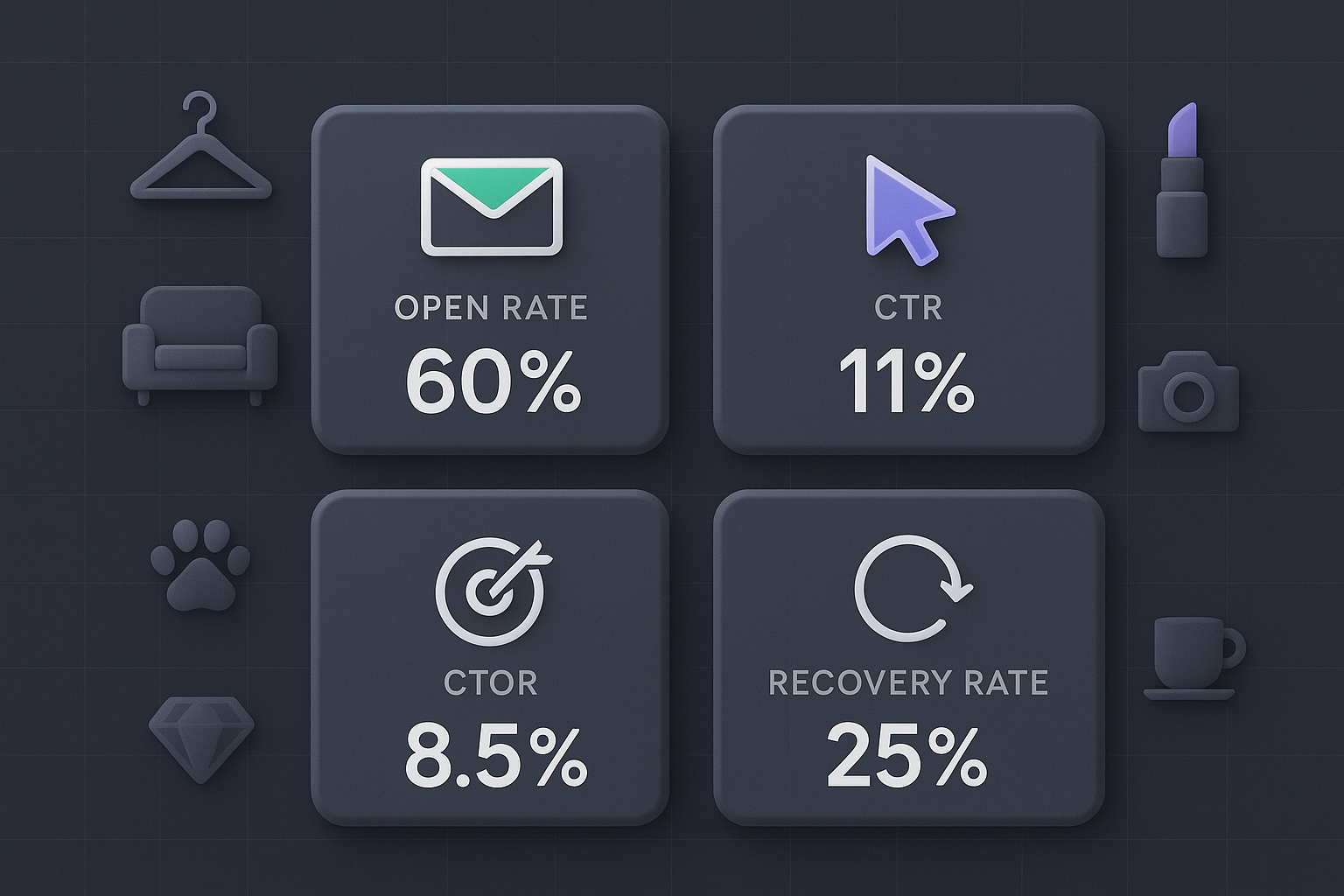
Abandoned cart emails remain one of the highest‑earning automations in ecommerce, but 2026 measurement looks different. Apple Mail Privacy Protection (MPP) continues to inflate opens, definitions vary across vendors, and not every provider publishes cart‑specific numbers by industry. That makes it easy to misread your results—or celebrate a win that isn’t really there.
This guide compiles the latest 2025–2026 evidence into one view so you can compare your performance against realistic ranges. We share a transparent methodology, a scannable industry matrix, and pragmatic actions to lift recovery without guesswork.
Key takeaways
Treat “open rate” as directional in 2026; prioritize CTR and placed‑order (recovery) rates for decision‑making.
Typical abandoned cart opens cluster around low‑40s to mid‑50s, but inflation from MPP means clicks and orders are the truer signal.
Recovery (placed‑order) rates commonly land in the low single digits; standout programs push higher with better triggers, timing, and offers.
Revenue per email (RPR) varies widely; average benchmarks hover around $3–$4, while top decile programs can be an order of magnitude higher.
If your stack lacks reliable server‑side tracking and deduplication, your recovery metrics may be under‑ or over‑counted across channels.
Methodology: How we compiled the 2026 abandoned cart email benchmarks
To keep these abandoned cart email benchmarks credible and comparable, we used a strict evidence and labeling protocol:
Time window and sources: We prioritized documents updated in 2025–2026 and cite dates inline. Core references include Omnisend’s 2026 statistics hub, Triple Whale’s ecommerce benchmarks (updated April 2026), Klaviyo’s 2026 benchmarks pages, Revenue Memo’s 2026 automation ROI analysis, Clean Email’s 2026 industry report, Baymard’s abandonment rate context (2025), and Litmus’ 2025 trends piece.
Metrics standardized and labeled:
Open rate (inflated by MPP; use directionally)
CTR (clicks ÷ sent)
CTOR (clicks ÷ opens; also MPP‑sensitive; use with caution)
Recovery / placed‑order rate (orders attributed to cart emails)
Revenue per email (RPR; also called revenue per recipient)
When per‑industry, cart‑specific splits were not publicly available, we used clearly labeled proxies (e.g., automation‑overall click rates) and conservative ranges.
Definitions and caveats: Vendors differ on “conversion” vs. “placed order” and whether metrics are per‑email or per‑workflow. Footnotes clarify each case below.
Measurement example (internal link): For teams formalizing attribution and deduplication, see how a standardized approach works in practice in Attribuly’s page on Full Impact Attribution (neutral reference for methodology context).
2026 Industry Benchmark Matrix — Abandoned Cart Email Benchmarks
Notes on reading the table:
“Open rate” is indicative due to MPP. Focus decisions on CTR and placed‑order rates.
“Recovery” uses placed‑order or conversion definitions as specified by the source; see footnotes.
“Revenue/email” (RPR) varies by AOV and industry economics; use ranges as starting points, not targets.
Industry | Open rate | CTR | Recovery/Placed order rate | Revenue/email | Source | Time window |
|---|---|---|---|---|---|---|
Apparel & Fashion | 42–55% (directional) | 2–5% (automation proxy) | 1.5–2.7% (cart avg) | $2.54–$3.65 (overall/cart mix) | Omnisend (2026); Klaviyo (2026) | 2025–2026 |
Beauty & Personal Care | 42–55% (directional) | 2–6% (automation proxy) | 1.5–2.7% (cart avg) | $2.54–$3.65 | Omnisend (2026); Klaviyo (2026) | 2025–2026 |
Home & Garden | 42–55% (directional) | 2–5% (automation proxy) | 1.5–2.7% | $2.54–$3.65 | Omnisend (2026); Klaviyo (2026) | 2025–2026 |
Consumer Electronics | 42–55% (directional) | 2–4% (automation proxy) | 1.5–2.7% | $2.54–$3.65 | Omnisend (2026); Klaviyo (2026) | 2025–2026 |
Pet Supplies | 42–55% (directional) | 2–5% (automation proxy) | 1.5–2.7% | $2.54–$3.65 | Omnisend (2026); Klaviyo (2026) | 2025–2026 |
Luxury & Jewelry | 42–55% (directional) | 2–4% (automation proxy) | 1.5–2.7% | $2.54–$3.65 | Omnisend (2026); Klaviyo (2026) | 2025–2026 |
Subscription/Box (DTC) | 42–55% (directional) | 3–6% (automation proxy) | 1.5–2.7% | $2.54–$3.65 | Omnisend (2026); Revenue Memo (2026) | 2025–2026 |
Food & Beverage | 42–55% (directional) | 2–5% (automation proxy) | 1.5–2.7% | $2.54–$3.65 | Omnisend (2026); Klaviyo (2026) | 2025–2026 |
Footnotes and citations (selected):
Directional open range based on Clean Email’s 2026 industry report (Mar 27, 2026). See: Email Industry Report 2026. Triple Whale cites 41.8% opens for cart emails overall in their Ecommerce Benchmarks (updated Apr 10, 2026).
CTR values use automation‑overall proxies from Omnisend’s hub (updated through Apr 18, 2026): Digital Marketing Statistics 2026; cart‑specific CTR by industry isn’t publicly available.
Recovery/placed‑order rates generalize cart averages from Klaviyo and Omnisend and include Triple Whale’s broader “conversion” construct: Klaviyo Email Marketing Benchmarks 2026 (Mar 29, 2026); Omnisend 2026 statistics; Triple Whale benchmarks. Interpret conservatively due to definition drift.
Revenue/email ranges reflect Omnisend’s abandoned cart example (RPR ≈ $2.54), combined with the 2026 automation ROI analysis from Revenue Memo (avg ≈ $3.65; top decile $28.89): Marketing Automation ROI Statistics (Feb 16, 2026).
For abandonment context (rate ≈ 70.22%), see Baymard’s longitudinal analysis: Cart Abandonment Rate List (Sept 22, 2025, 50 studies).
What the numbers mean—and how to improve recovery in 2026
If your open rates sit above 40% but orders aren’t moving, you’re seeing 2026’s reality: opens are noisy. Here’s how to act on the metrics that matter.
Aim decisions at CTR and placed orders. Treat CTOR as secondary since MPP distorts opens. When CTR rises without a matching recovery lift, look for landing‑page friction (shipping fees, returns clarity, payment options).
Tighten triggers and timing. A simple, proven pattern is a 2–3 step series (≈1 hour, 24 hours, 72 hours post‑abandon). Test timing against your AOV and buying cycle; replenishment categories can support shorter cadences than luxury.
Enrich with high‑intent events. Add triggers like Checkout Started, Add to Cart, and Product Viewed (with recency windows) to catch more real abandoners across devices.
Segment incentives by economics. Replenishment and subscription categories often respond to modest incentives or first‑order bonuses; high‑AOV luxury may convert better with assurance (authenticity, warranty, returns) than discounts.
Measure with deduplication and server‑side tracking. Without it, paid and email channels will double‑claim orders and mask true lift. Think of it this way: you can’t improve what you can’t trust.
Toolbox (neutral example): If you use Klaviyo, an event‑reliable setup helps a ton. Solutions like Attribuly’s Klaviyo integration send server‑side, first‑party events that can trigger flows more consistently and help teams reconcile recovery across channels.
Action checklist you can run this month
Ship a lean 3‑step cart series and A/B test subject lines on email 1 only (don’t over‑optimize opens).
Test one incentive lever (free shipping vs small % off) and a no‑discount assurance variant for high‑AOV categories.
Add a product‑image module with 1–3 recently viewed items and a single clear CTA.
Validate tracking: confirm events fire server‑side, deduplicate across ad platforms, and align attribution windows.
Report weekly on CTR and placed orders; hold opens and CTOR as directional.
FAQ: Your 2026 questions answered
What is a good abandoned cart email open rate in 2026?
Directionally, low‑40s to mid‑50s is common, but it’s inflated by Apple MPP. Use opens to spot outliers, then judge success by CTR and placed‑order rate. Evidence: Clean Email’s 2026 industry report and Triple Whale’s 41.8% cart‑email opens (2026).
How many abandoned cart emails should I send?
Most merchants do best with 2–3 messages spaced around 1 hour, 24 hours, and 72 hours after the abandon event. Categories with longer consideration cycles (e.g., Home, Luxury) can extend timing and emphasize assurance over discounts. Benchmarks and examples appear throughout Omnisend’s 2026 statistics hub.
What affects recovery rates by industry?
AOV and purchase risk, discount elasticity, replenishment cadence, shipping/returns friction, and social proof all play roles. Electronics and Luxury often need warranties and trust cues; Beauty and Pet frequently benefit from replenishment nudges and bundles. Treat the table as a starting range and test into your own economics.
Should I track CTOR instead of CTR due to Apple MPP?
Prefer CTR and placed‑order/revenue as primary KPIs. CTOR relies on opens, which MPP distorts, so use it directionally only. For broader context on 2026 tracking shifts, see Litmus’ trends overview (Dec 17, 2025).
How does SMS compare to email for cart recovery?
Results vary by audience and consent coverage. Many programs see incremental recovery from adding one SMS touch, but costs and frequency caps matter. Use your margins and AOV to decide where SMS belongs in the sequence. Omnisend’s hub aggregates cross‑channel outcomes in their 2026 stats.
Source notes, dates, and caveats
Omnisend, Digital Marketing Statistics 2026 (updated through Apr 18, 2026): automated flows vs campaigns; cart examples including opens ≈35.75%, CTR ≈3.84%, conversion ≈1.51%; RPR ≈$2.54. See Omnisend’s 2026 statistics hub.
Triple Whale, Ecommerce Benchmarks (updated Apr 10, 2026): cart‑email opens ≈41.8%, “conversion” ≈10.7% (definition broader than placed‑order). See Triple Whale’s benchmarks.
Klaviyo, Email Marketing Benchmarks 2026 (Mar 29, 2026) and UK explainer (Apr 16, 2026): industry pages and methodology notes; cart flows among top‑earning automations. See Klaviyo’s 2026 benchmarks page and UK benchmarks explainer.
Revenue Memo, Marketing Automation ROI Statistics (Feb 16, 2026): RPR averages ≈$3.65; top decile ≈$28.89 per recipient. See Revenue Memo’s 2026 analysis.
Clean Email, Email Industry Report 2026 (Mar 27, 2026): directional open range 42–55%. See Clean Email’s 2026 report.
Baymard Institute, Cart Abandonment Rate List (Sept 22, 2025): overall abandonment ≈70.22% (50 studies). See Baymard’s master list.
Caveats: Apple MPP affects opens (and CTOR by inheritance). Definitions for “conversion” and attribution windows differ across vendors. Some RPR values reference automation‑overall, not cart‑only; these are labeled accordingly.
Next steps (single soft CTA)
Want to benchmark, test, and measure cart recovery with confidence? Consider pairing your flows with standardized, server‑side events and clear attribution. As a neutral example, merchants using Shopify + Klaviyo often start with Attribuly Capture to identify more abandoners and feed high‑intent events into flows while keeping recovery measurement consistent.